Best Club Car Tie Rods (2026): Based on Specs and Reviews
The best Club Car tie rod replacement kit is usually the OEM-style kit matched to the chassis: DS, Precedent, Onward, Tempo, and Carryall are commonly reported to use different lengths and ends, so model fit matters more than brand. A wrong kit can cause bump steer, loose steering, or extra labor from returns and rework. Below, you’ll find the best replacement picks by Club Car model, sorted by fit certainty, durability, and install ease.
Quick comparison
| Product | Badge | Best for | Price | ||
|---|---|---|---|---|---|
 |
10L0L Club Car Front Tie Rod for Club Car DS (2009-up) –10L0L | Our pick | 20.67 inch · Heavy duty · Club Car DS | $28.99
Price as of 20 Oct 2026
|
View |
 |
10L0L 2 Pack Ball Joint Tie Rod End Kit 102022601 10228830110L0L | Budget pick | 2-pack · M12x1.25 RH · Precedent & Tempo | $19.94
Price as of 20 Oct 2026
|
View |
Club Car fitment starts with the model name, then the year range, then the thread style on each end. Golf Cart Tire Supply separates Club Car, EZGO, and Yamaha tie rods, and it also sorts Club Car parts by model, while Global Parts groups tie rods under steering and suspension with steering gears and housings nearby.
The fitment issue is simple: the right bar length and the right handed threads matter more than marketing language. Lifted carts add another layer because the angle changes and the front end may need an alignment check after the install.
How we chose
These picks are ranked for fitment certainty first, then wear coverage, then install simplicity. We weighed model-specific compatibility, whether a full assembly or ends-only repair makes more sense, and how much return risk an owner takes by ordering a broader or more generic part.
We also favored parts with clear thread and application details. That matters because tie rod ends are threaded steering joints, and left/right compatibility has to match the cart’s steering linkage layout.
Finally, we looked at ownership tradeoffs. OEM-style fit usually reduces guesswork, while aftermarket parts can save money if the listing is specific enough and the return policy is acceptable.
10L0L Club Car Front Tie Rod for DS: best for older carts
This is the strongest fit for a Club Car DS owner who wants a complete front tie rod assembly and clear model matching. Based on the published product details, it replaces OEM 103354701 and 1033547-01, uses a 20.67 inch metal replacement part, and is aimed at Club Car DS 2009-up carts.
It is a good choice when the bar itself is worn, bent, or corroded, not just the joints. The OEM-compatible sizing and heavy-duty construction matter most on older DS carts, where accumulated steering play often turns into noticeable wander and toe change.
The drawback is fitment scope. It is DS-specific, so it is not the right answer for a Precedent, Onward, Tempo, or Carryall owner trying to guess across platforms.
10L0L 2 pack Ball Joint tie rod end kit: best for Precedent and Tempo
This is the better buy when the steering bar is still straight and the wear is concentrated in the joints. The listing says it is a 2-pack with M12x1.25 RH threads, replaces OEM parts 102022601 and 102288301, and fits Club Car Precedent 2004-up and Tempo 2018-up carts.
That makes it the practical end-only option for owners who want to fix slop without replacing the full assembly. It also fits the common repair pattern where the tie rod ends show the wear first, but the linkage tube remains serviceable.
The drawback is obvious: this kit is only for the listed Precedent and Tempo applications, and the right-hand thread detail means you still need to confirm the opposite end and the cart’s steering layout before ordering.
Club Car tie rod fitment matrix
| Model | Best kit type | Compatibility checks | Wear-symptom decision path | Lifted-cart note |
|---|---|---|---|---|
| DS | Complete front tie rod assembly | Confirm DS chassis, 2009-up application, and matching overall length; verify the replacement matches the factory-style bar layout | Choose a full kit if the bar is bent, rusted, or both ends are loose; choose ends only if the bar is straight and the joints are the only worn points | Lift kits can change angle and toe; check clearance after install and re-check alignment |
| Precedent | End-only kit or full assembly, depending on wear | Confirm 2004-up fitment, thread direction, and whether the part is meant for the Precedent steering linkage | Choose ends if steering is tight at the bar but loose at the ball joints; choose a full assembly if there is clunking plus visible bar damage | Lifted Precedent carts often need a toe check after replacement because the steering angle changes |
| Onward | Model-specific OEM-style replacement | Confirm Onward year range and compare the listing against the cart’s exact steering linkage layout before buying | Choose the most exact match when fit certainty matters more than price; choose only ends if the bar is straight and the symptoms are localized | Lifted Onward carts can alter tie rod angle and create alignment drift if the front end is not reset |
| Carryall | Model-specific steering linkage part | Confirm Carryall application, utility-cart linkage layout, and the correct end style before ordering | Choose a full kit when loading has caused broad steering play or uneven toe; choose ends only for isolated joint wear | Utility use can accelerate wear, so inspect after heavy hauling and after any lift change |
| Tempo | End-only or full assembly based on wear | Confirm Tempo 2018-up fitment, thread hand, and whether the part is listed for the front steering linkage | Choose ends when the joints are loose but the rod is straight; choose a full assembly when play is wide or hardware is corroded | Lifted Tempo carts need a post-install toe check because suspension angle changes can move the wheels out of spec |
Club Car DS: best for older carts
A DS owner should start with a complete front tie rod assembly when steering play is obvious, the hardware is rusty, or the cart has already needed repeated front-end work. Older platforms often need more than a single end because wear tends to spread across the linkage.
What to verify before ordering a DS replacement
Check the cart brand, then the exact model, then the year range. For the DS, that means confirming the listing says DS 2009-up if you are buying the 10L0L assembly, then checking bar length, thread direction, and whether the replacement matches the steering linkage layout on your cart.
A common first-timer mistake is to assume every Club Car tie rod is the same. If a DS has noticeable wander after a front-end refresh, a wrong-length bar can leave the toe off even if the cart rolls straight in the shop.
When a complete kit makes sense
Choose the full assembly if the tube is bent, the ends are both sloppy, or the threads are damaged. That is the safer call when you want one shipment, one fitment decision, and less risk of mixing left and right end styles.
Club Car Precedent: best for common fitment
Precedent owners have the widest chance of finding a straightforward repair, but they still need year-specific confirmation. The platform is common, yet tie rod ends and bar length can still differ across the steering linkage, so the label must say Precedent before you buy.
Why year-specific compatibility matters
Precedent fitment is a place where generic listings cause the most returns. The better approach is to match the year range, then compare the part’s thread hand and overall application against the front steering layout on the cart.
That matters because the tie rod does more than hold the wheels in place. Worn ball joints create steering play, uneven toe, and a cart that wanders instead of tracking cleanly.
When tie rod ends are enough and when they are not
If the rod is straight and the issue is limited to joint looseness, an end-only kit makes sense. If the bar is bent, seized, or the hardware is badly corroded, a full replacement reduces the chance of fixing one problem and leaving another behind.
On a Precedent, the 10L0L 2 Pack is the cleaner choice when the symptom set is narrow. It is also the lower-cost path, but only if the listing matches the exact cart year and the thread direction matches the side it will sit on.
Club Car Onward: best for newer carts
Onward owners should buy the most exact replacement they can confirm, because newer platforms are where a close-but-not-right part can waste time fast. The model is newer, so the smartest move is to verify the application against the year and the steering linkage layout before ordering anything.
Newer-platform fitment checks that prevent wrong orders
Start with model name and year, then inspect whether the listing identifies the Onward specifically. If it does not, keep searching. A generic Club Car steering part may look close, but the wrong thread direction or tube length can create alignment issues after install.
That warning matters more on newer carts because owners often expect a quick swap and a clean steering feel. A mismatch can leave you with more labor than the original repair.
Full assembly or end-only replacement for mild wear
Use a full assembly when both ends show wear or the linkage has visible damage. Use end-only replacement when the bar remains straight and the joints are the only loose parts.
For an Onward, the buying priority should be fit certainty. Price matters, but wrong fitment is more expensive than a slightly pricier part that matches the chassis on the first try.
Club Car Carryall: best for utility use
Carryall carts see work duty, so steering parts often wear faster under load. That makes the compatibility check more important, not less, because a utility cart can show play, toe drift, and joint wear sooner than a light-use cart.
Why utility-cart loading changes wear priorities
Load weight changes how the front end works. When a Carryall carries tools or cargo, the steering linkage sees more stress, and tie rod ends can loosen before the tube itself looks damaged.
Global Parts lists tie rods as part of steering and suspension inventory, and steering gears and housings sit in the same related category. That is a clue to inspect the whole front linkage, not only the part that looks worst.
Compatibility checks for work-cart steering linkage parts
Confirm Carryall application first. Then verify the end style, thread direction, and any notes about front-end steering geometry. If the cart has had a lift or cargo-related front-end changes, plan on a post-install toe check.
A lifted Carryall can pull the tie rod into a different angle, and the result may be steering that feels normal at low speed but drifts under load. That is a fitment problem, not a mystery symptom.
Club Car Tempo: best for later-model owners
Tempo owners should use the most model-specific part available, because later-generation carts are less forgiving of mixed-fit hardware. The clearest published option here is the 10L0L 2 Pack, which lists Tempo 2018-up fitment and the matching replacement OEM numbers.
Model-specific fitment checks for Tempo front steering parts
Confirm Tempo 2018-up before ordering. Then check whether the listing is for the front steering linkage, not a different suspension or steering component that only looks similar in a catalog photo.
That step matters because Tempo owners often want the faster fix. Fast is fine, but only when the thread direction and end style are correct.
Signs the cart needs more than a single worn end
If the steering wheel has noticeable free play, the front tires point unevenly, and there is clunking over bumps, the problem may be broader than one end. In that case, the full assembly is safer than replacing one joint and hoping the rest holds up.
If a Tempo starts wandering after a curb strike, the bar is straight and one joint is loose, ends-only repair is reasonable. If the rod is bent, the full assembly is the better move.
Which one should you buy?
Buy the full DS assembly if you want the safest fit on an older cart and the linkage shows broad wear. Buy the Precedent/Tempo 2-pack if the bar is straight and only the ball joints are loose. Buy the most model-specific option when fit certainty matters more than price, especially for Onward and Carryall owners.
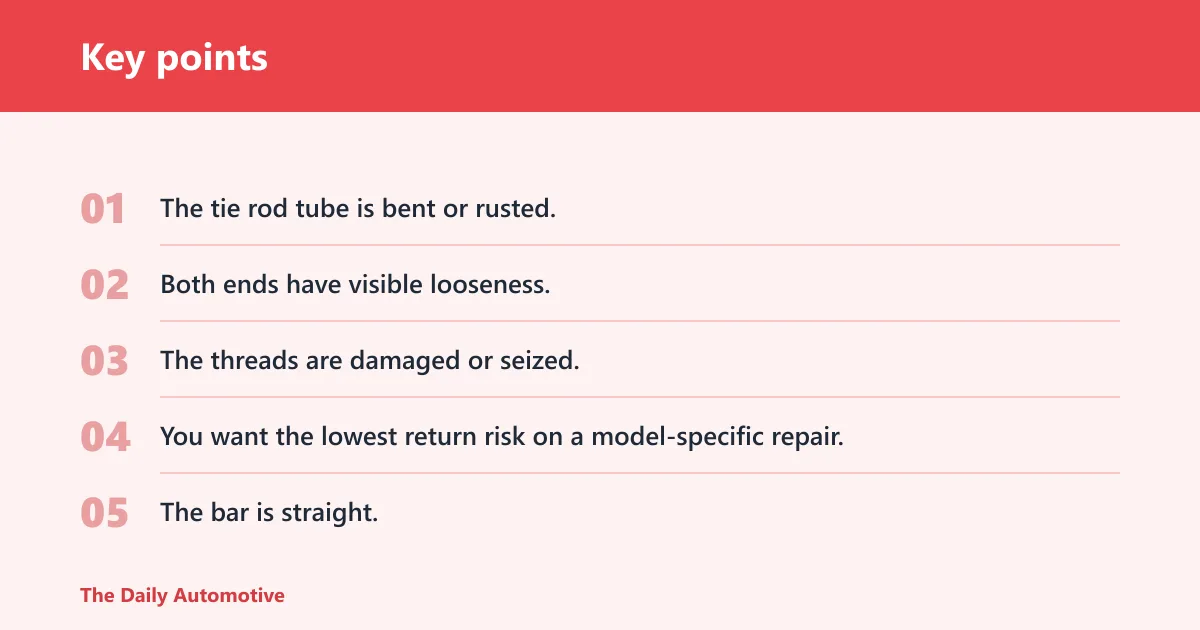
Choose a full kit when any of these are true
- The tie rod tube is bent or rusted.
- Both ends have visible looseness.
- The threads are damaged or seized.
- You want the lowest return risk on a model-specific repair.
Choose ends only when any of these are true
- The bar is straight.
- Only the joints are loose.
- The cart steers normally apart from play at the wheel.
- The listing clearly matches your model and year range.
Use model certainty to break ties
If two parts look close, choose the one with the better model match. That is especially true on Club Car, where DS, Precedent, Onward, Carryall, and Tempo do not all use the same steering linkage parts.
OEM-style listings reduce return risk, while aftermarket parts can be a solid value if the fit data is specific. The same source says it has sold more than 5 million parts and has more than 150,000 parts available, and the European site advertises a 90-day warranty on selected parts. Those details do not replace fitment checks, but they do matter when comparing ownership risk.
How to measure and verify a Club Car tie rod
Measure before you buy. The right order is brand, model, year range, thread direction, and overall length. If any one of those is uncertain, stop and confirm the listing before checkout.
- Confirm the cart brand is Club Car.
- Identify the exact model: DS, Precedent, Onward, Carryall, or Tempo.
- Check the year range on the cart serial or parts reference.
- Inspect the existing tie rod for left-hand or right-hand thread ends.
- Measure the overall length from end center to end center or by the method used on the replacement listing.
- Compare the listing’s end style, thread hand, and application against the cart.
- After installation, verify toe and steering wheel center position.
What is the main point of the measurement step? It is to stop wrong orders before they turn into downtime. A correct length with the wrong thread hand is still the wrong part.
What tools do you need to replace a golf cart tie rod?
You need basic hand tools, safe support, and a way to verify the alignment afterward. At minimum, plan on jack stands, a jack, wrenches or sockets that fit the tie rod hardware, and replacement hardware such as cotter pins if the design uses them.
Keep the front end supported before loosening anything. Then remove the old part, install the replacement with the correct thread orientation, snug the hardware, and finish with a torque check against the manufacturer’s specification for your cart and fasteners.
Do not skip the post-install check. If the toe is visibly off, the cart may steer poorly even though the new tie rod is physically in place.
How do I know if my Club Car tie rod is bad?
A bad tie rod usually shows up as steering play, clunking from the front end, uneven toe, or visible looseness at the joints. If the wheel turns more than it should before the tires respond, the steering linkage deserves a close inspection.
Look at the ends first. Worn tie rod ends often show joint movement at the threaded connection, torn boots if equipped, or uneven wheel angle from side to side. If the cart wanders or needs constant correction, the front linkage may be the cause.
One more clue is excessive toe change after a bump or curb strike. When the linkage moves too easily, the cart may track straight for a few feet and then drift again.
Are Club Car tie rods different for lifted carts?
Yes. Lift kits can change tie rod angle, clearance, and alignment needs, so a lifted cart may not behave like a stock-height cart even when the steering parts are still Club Car-specific. That is why a model match alone is not enough on a modified cart.
Lifted carts often need a stronger post-install alignment check. The front wheels can point slightly differently after the suspension geometry changes, and that can lead to bump steer or uneven tire wear if you ignore the toe setting.
Check the lift status before ordering. A stock-length tie rod on a lifted cart may fit physically but still leave the steering off enough to matter.
Can I use an aftermarket tie rod on a Club Car?
Yes, if the part is clearly listed for your exact Club Car model and year range. Aftermarket can be a smart value choice, but the tradeoff is higher return risk if the listing is vague or the hardware does not match the steering linkage layout.
Use aftermarket only when the specs are concrete. That means matching the model, year, thread direction, and overall length, and then accepting that warranty and return terms may differ from an OEM-style part.
If the cart is used hard, or if you want the cleanest fit decision, OEM-style compatibility is usually the safer path. If budget matters most, aftermarket can work well, but only with careful verification before purchase.
Frequently asked questions
What are the best tie rod replacement kits for a Club Car?
The best kit depends on the model and wear level. For DS, the 10L0L front tie rod assembly is the better fit when you need a full replacement. For Precedent and Tempo, the 10L0L 2-pack end kit is the better choice when the bar is straight and only the joints are worn.
Which club car tie rod fits my DS, Precedent, or Onward?
Match the cart model first, then the year range, then the thread direction and length. DS, Precedent, and Onward do not use one universal steering linkage part, so you should buy only a listing that names your exact platform and application.
Do I need a full tie rod kit or just ends?
Use a full kit if the bar is bent, heavily corroded, or both ends are loose. Use ends only if the rod is straight and the looseness is isolated to the joints. That choice keeps cost down without leaving damaged hardware in place.
How do I measure a Club Car tie rod?
Measure the overall length the same way the replacement listing defines it, then compare the thread hand and end style against the old part. If the cart is still assembled, note the model and year before removal so you can verify fitment before ordering.
Products related to this article
Sponsored / affiliate links. As an Amazon Associate I earn from qualifying purchases. I may earn additional commission from eligible campaigns.