4WD Service Cost: What You’ll Actually Pay for Repairs
A basic 4WD fluid service often costs around $150-$300; a diagnostic visit runs around $100-$200; transfer-case repair or replacement can rise to roughly $1,500-$4,000 or more. Ignore a Service 4WD warning or low fluid, and a small fix can become a damaged transfer case, front differential, or driveshaft repair. This guide breaks down 4WD service cost by maintenance, diagnosis, and major failure mode.
What 4WD service costs
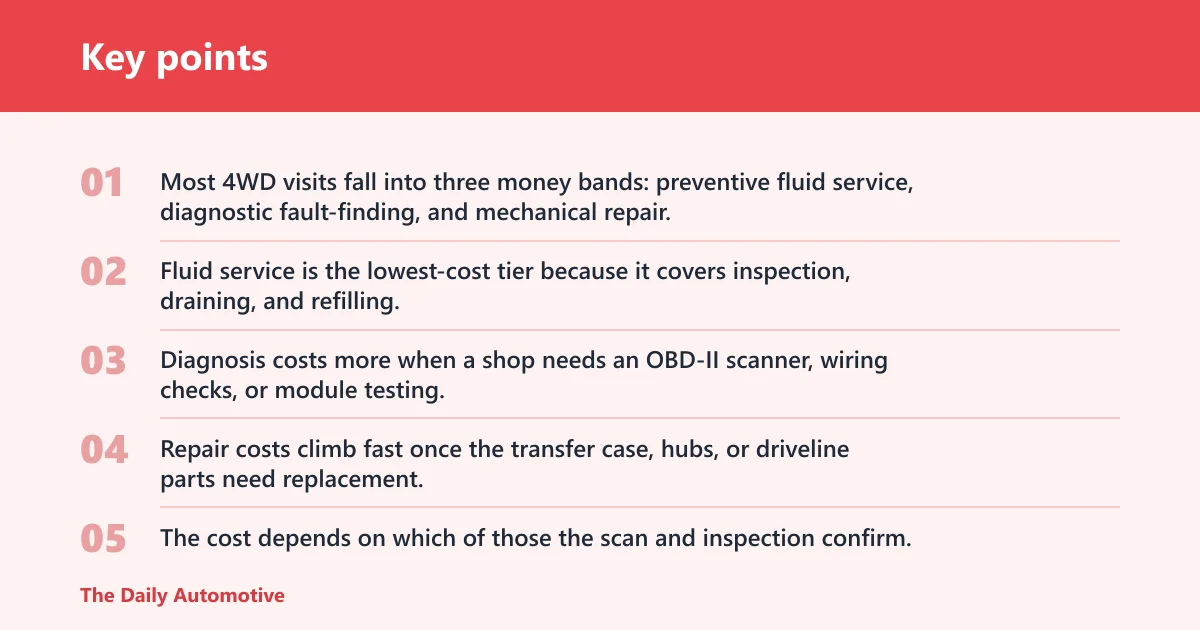


Most 4WD visits fall into three money bands: preventive fluid service, diagnostic fault-finding, and mechanical repair. Fluid service is the lowest-cost tier because it covers inspection, draining, and refilling. Diagnosis costs more when a shop needs an OBD-II scanner, wiring checks, or module testing. Repair costs climb fast once the transfer case, hubs, or driveline parts need replacement.
That spread matters because the Service 4WD light does not always mean the transfer case itself is failing. It can point to a sensor fault, communication error, low fluid, or mechanical binding in the 4×4 subsystem. The cost depends on which of those the scan and inspection confirm.
4WD cost matrix
| Service line item | Typical low | Typical high | Warning signs that justify it |
|---|---|---|---|
| Diagnostic scan and fault-finding | $100 | $200 | Service 4WD light on, 4WD stuck in one mode, hard shifting, ABS-linked warning, intermittent message |
| Transfer case fluid service | $150 | $300 | Routine maintenance due, dark or contaminated fluid, minor seepage, no major noise or binding |
| Front differential service | $100 | $200 | Fluid level low, seal seep, towing use, off-road use, gear whine under load |
| Rear differential service | $100 | $200 | Low fluid, burnt smell, contamination, towing, highway whine, leak at axle seal |
| Hub service | $150 | $400 | 4WD engagement issue, clicking, rough hub operation, wheel-end wear, service warning after hub inspection |
| Transfer case repair or rebuild | $1,500 | $4,000+ | Persistent warning, grinding, fluid contamination, stuck in 4WD, heavy leakage, internal damage |
| Driveshaft or U-joint repair | $250 | $900+ | Clunking, vibration, high-pitched whistle near axle, visible play, torn seals, grease loss |
| Actuator or module-related repair | $200 | $1,200+ | Communication fault, electronic shift failure, intermittent 4WD function, sensor-related codes |
Price also varies by vehicle size and layout. A midsize SUV with electronic shift-on-the-fly 4WD often lands near the lower end for service, while a full-size truck or a Jeep with more labor-intensive driveline access can move up. Ram 1500, full-size pickups, and body-on-frame SUVs usually cost more when corrosion, larger fluid volumes, or additional components add labor.
Why diagnosis and repair cost more than fluid service
A fluid change is mostly preventive. Diagnosis requires confirming whether the fault lives in the transfer case, the wheel speed sensors, the transfer case control module (TCCM), wiring, or the ABS/4WD communication path. Repair adds parts, labor, and sometimes teardown. Once a transfer case needs internal parts, costs rise because the unit may need a rebuild, replacement, or both fresh fluid and hardware.
What does a 4WD service include?
A 4WD service usually includes a transfer case check, fluid inspection, differential fluid checks, and a look at hubs, drivelines, and U-joints. A full inspection should also check for leaks, contaminated fluid, loose wiring, and wear marks on moving parts. The exact package changes by shop, but the core work should focus on the parts that keep the 4×4 system moving power from the transmission to both axle ends.
Transfer case fluid check and refill
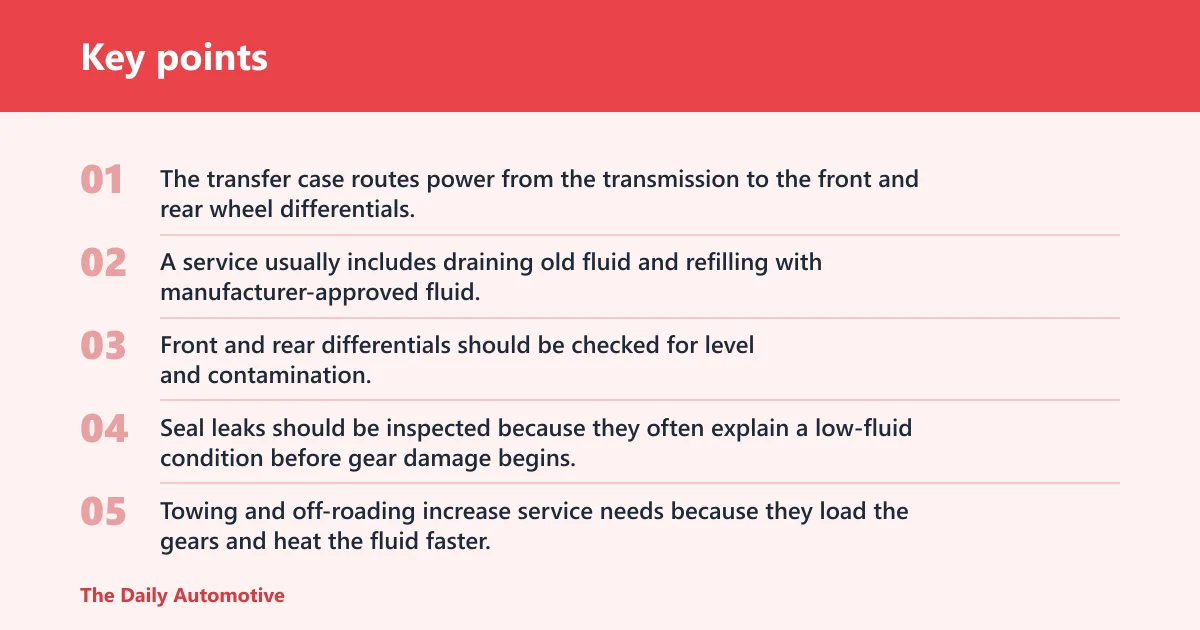
The transfer case routes power from the transmission to the front and rear wheel differentials. It can be mechanical or electronic, and both types depend on proper fluid condition. A service usually includes draining old fluid and refilling with manufacturer-approved fluid. Low fluid can cause serious damage in 4WD applications, so a leak or burnt fluid can move this job from maintenance to repair.
Differential fluid inspection and replacement
Front and rear differentials should be checked for level and contamination. Seal leaks should be inspected because they often explain a low-fluid condition before gear damage begins. Towing and off-roading increase service needs because they load the gears and heat the fluid faster.
Hubs, driveshafts, and U-joints
Locking hubs should be inspected and serviced regularly. They connect the wheels to the drive shafts in many 4WD setups, and wear can leave the system slow to engage or noisy under load. Driveshafts and U-joints deserve a close look for wear, damage, and lubrication loss. Clunking or a high-pitched whistle near the axle can point to trouble there.
Suppose a half-ton truck comes in with a faint whine only in 4WD High, plus a damp rear differential seal. That visit may stay in the $100-$300 service range if the issue is fluid level and seal seepage. If the scan finds metal in the transfer case fluid and the truck is stuck in four-wheel drive, the bill can move into repair territory quickly.
Why is the Service 4WD light on?
The Service 4WD warning means the 4×4 subsystem has a detectable fault. Common triggers include sensor faults, communication errors, low fluid, and mechanical binding. It does not automatically mean the transfer case is ruined, but it does mean the system needs a scan and a physical check before the fault spreads.
Wheel speed sensor and ABS faults
Wheel speed sensors feed data to the 4WD control module and ABS system. If a sensor signal drops out, the dash may show a 4WD warning even when the transfer case is mechanically fine. That is why an OBD-II scanner matters. It can pull fault codes that point the technician toward the sensor, the wiring, or the ABS side of the fault.
Transfer case control module communication issues
The transfer case control module, or TCCM, helps coordinate 4WD operation and dashboard warnings. A communication error can come from the module itself, a connector problem, or a wiring fault between the TCCM and related components. Troubleshooting sometimes includes disconnecting the module during diagnosis so the circuit can be checked cleanly.
Low fluid, leaks, and mechanical wear
Fluid condition matters because low or contaminated fluid can drive wear in the transfer case and differentials. A leak at the transfer case or axle seal may start as a cheap service item and end as internal damage if ignored. Mechanical binding, worn hubs, or U-joint wear can also trigger the warning and add repair cost.
How much is a 4×4 diagnostic visit?
A 4×4 diagnostic visit usually costs around $100-$200, which is often a reasonable budget for the first visit after a warning light appears. The scan can confirm whether the fault is stored in the 4WD module, ABS system, or a related sensor circuit. If the light is intermittent, diagnosis may need extra labor for wiring inspection or live data testing.
-
Scan the fault codes. A shop uses an OBD-II scanner to read stored codes from the 4WD and ABS systems. This is the fastest way to separate a sensor or communication issue from a mechanical problem.
-
Inspect the obvious wear points. The technician checks fluid level, leaks, hubs, driveline joints, and visible wiring. That matters because a low-fluid condition or damaged connector can explain the warning without opening the transfer case.
-
Test the circuit path. If the code points to the TCCM, wheel speed sensors, or shifting hardware, the next step is wiring and module diagnosis. Extra labor here raises the bill, but it is cheaper than guessing at a major repair.
-
Turn findings into an estimate. A scan that points to contaminated fluid may stay near maintenance pricing. A scan that shows a failed actuator, stuck 4WD mode, or internal transfer case damage usually turns into a repair estimate instead.
When does a 4WD service become a repair?
It becomes a repair when the system has internal damage, persistent leakage, or a part that no longer functions as designed. Transfer case rebuilds or replacements sit at the top of the price range. Hub, actuator, and U-joint failures can also turn a routine service into a larger ticket, especially if the vehicle is stuck in four-wheel drive or shifting becomes difficult.
Transfer case rebuild or replacement
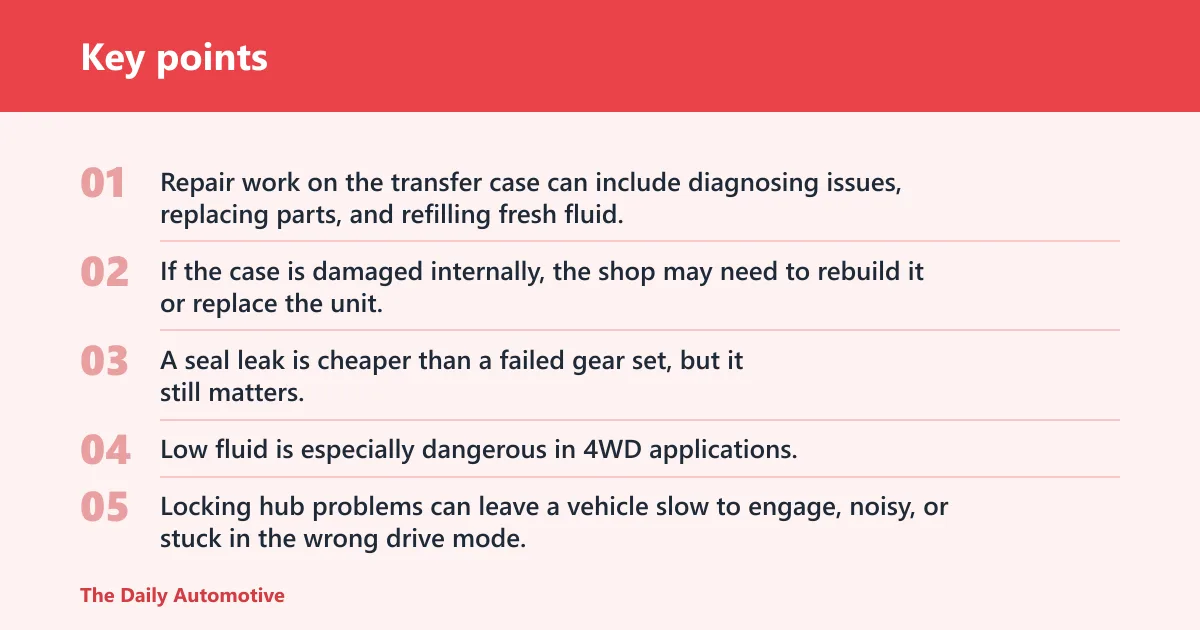
Repair work on the transfer case can include diagnosing issues, replacing parts, and refilling fresh fluid. If the case is damaged internally, the shop may need to rebuild it or replace the unit. That is where the cost can reach $1,500-$4,000+ because the labor and parts burden rises sharply.
Seal leaks and contaminated fluid
A seal leak is cheaper than a failed gear set, but it still matters. If the fluid is contaminated with metal or burnt enough to lose lubrication, the repair bill can climb because the damage may have spread beyond the first leak. Low fluid is especially dangerous in 4WD applications.
Hub, actuator, or U-joint failure
Locking hub problems can leave a vehicle slow to engage, noisy, or stuck in the wrong drive mode. Actuator failures and worn U-joints can produce clunking, vibration, or a whistle near the axle. Those symptoms justify a repair estimate, not just a fluid change.
Is 4WD service different from AWD service?
Yes. 4WD service usually focuses on the transfer case, front and rear differentials, hubs, and shift hardware. AWD systems often use a different coupling or transfer unit, and some brands package the service differently. The fluid type and interval can also change by manufacturer, so the correct service depends on the exact drivetrain design.
Those systems are not identical, so the service approach should match the transfer case and axle hardware on the vehicle, not the badge on the tailgate.
Most manufacturers also list different fluid requirements for 4WD and AWD components. That is why the shop should use the specified fluid, not a universal fill, when the transfer case or differential requires a particular formula.
Frequently asked questions
How much does 4wd service cost?
A diagnostic visit often runs $100-$200. If the fault is inside the transfer case or driveline, the repair can move to $1,500-$4,000+ depending on parts and labor. The final total depends on whether the job is maintenance, diagnosis, or internal repair.
How much is a 4×4 service?
A 4×4 service is usually a maintenance job unless the warning light or symptoms point to failure. Expect $150-$300 for fluid service, more if the shop adds a scan, hub inspection, or driveline checks. The price rises when the vehicle needs sensor testing, module diagnosis, or replacement parts.
What causes a Service 4WD warning light?
Common causes include sensor faults, communication errors, low fluid, and mechanical binding. Wheel speed sensors can trigger the light because they feed data to the 4WD control module and ABS system. A transfer case problem is common, but wiring, the TCCM, or a leak can set it off too.
Should I keep driving with a Service 4WD message?
If the light is brief and the vehicle still shifts normally, you may be able to drive to a shop without delay. A persistent warning, stuck 4WD mode, difficult shifting, clunking, or fluid leakage needs prompt diagnosis. Ignoring it can turn a small service job into a damaged transfer case or differential.
Which fluids are checked in a 4WD service?
The main fluids are the transfer case fluid and the front and rear differential fluids. The shop should check for level, contamination, and leaks, then refill with manufacturer-approved fluid if needed. Low or dirty fluid matters because it can damage 4WD parts quickly.
What parts of a 4WD system wear out first?
Common wear points include locking hubs, U-joints, driveshafts, seals, and sensors. The transfer case can also wear if fluid is low or contaminated. If the system starts clunking, vibrating, or sticking in 4WD, those parts should be checked before the problem reaches the gears.
How often should transfer case fluid be changed?
Most manufacturers call for regular transfer case service, but the interval varies by model and use. Towing, off-roading, and frequent 4WD operation justify shorter intervals. The safest rule is to follow the owner’s manual and shorten the interval if the fluid runs hot, leaks, or turns dirty.
What symptoms mean my 4WD needs repair?
Repair is more likely if the vehicle is stuck in four-wheel drive, has difficulty shifting gears, makes clunking or whistle noises near the axle, or shows a persistent Service 4WD warning. Leaking fluid, burnt fluid, vibration, or repeated warning lights also point beyond routine service.
Products related to this article
Sponsored / affiliate links. As an Amazon Associate I earn from qualifying purchases. I may earn additional commission from eligible campaigns.