Can You Sue an Auto Repair Shop for Negligence?
Yes, if the shop’s bad repair was careless enough to break the duty of reasonable care and cause damage or injury, you can sue for negligence; if it is only a billing or workmanship dispute, the claim is usually smaller and contractual. Bad repairs can leave you paying for repeat fixes, towing, a totaled engine, or medical bills. This guide explains the line between a repair dispute and a negligence claim, and what facts matter before you call a lawyer.
Why your claims hinge on repair records and documentation
When bad work becomes a legal claim
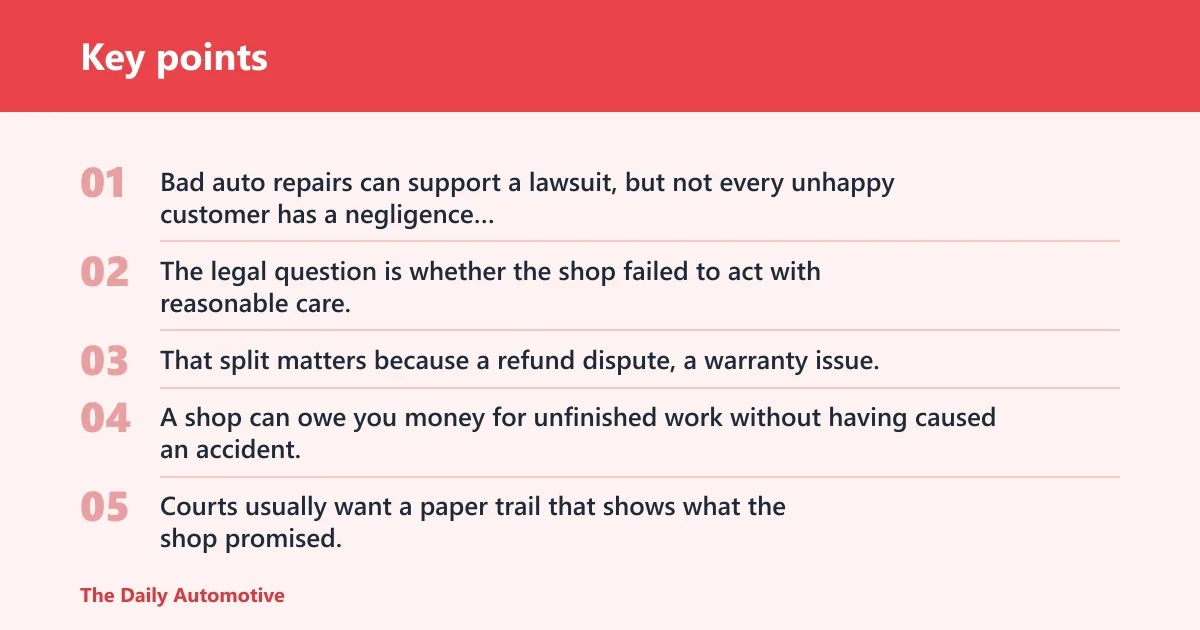
Bad auto repairs can support a lawsuit, but not every unhappy customer has a negligence case. The legal question is whether the shop failed to act with reasonable care, then caused a real loss that can be proved.
That split matters because a refund dispute, a warranty issue, and an injury claim do not use the same proof. A shop can owe you money for unfinished work without having caused an accident, and an accident can create a personal injury claim even if the repair invoice was already paid.
Why the answer depends on harm, proof, and the repair record
Courts usually want a paper trail that shows what the shop promised, what it actually did, and how the vehicle failed afterward. Repair orders, written authorizations, invoices, photos, tow records, and second-opinion diagnostics matter because they help connect the work to the breakdown.
Modern repair software can speed the shop side of that record. AutoLeap serves thousands of shop owners across North America, claims builds estimates 60% faster, claims reduce no-shows by 50%, and says it is used by mechanic shops, tire shops, independent garages, and multi-location franchises. None of that proves negligence, but it shows how much of a repair dispute turns on documentation.
Shop liability versus mechanic liability
A repair shop may be liable for unsafe repairs, missed inspections, or a job that was not completed. A mechanic may also face individual liability if that technician personally performed negligent work, though the scope of the work matters. A mistake is not always negligence.
In many cases, the shop is the better defendant because it set the repair process, kept the records, and took payment. In others, the technician’s conduct is central, especially if the injury claim turns on one person’s failed installation or inspection.
Sue auto repair shop checklist
Use this checklist to sort a refund dispute from a possible negligence claim. It also helps you see where causation is weak, which is often the hardest part when a car fails days or weeks after service.
| Symptom | Evidence to gather | Likely claim type | Red flags for causation |
|---|---|---|---|
| Brakes failed after pad or caliper work | Repair order, brake invoice, photos of worn or missing parts, tow bill, post-failure inspection | Negligence, breach of contract, warranty | Prior brake wear, low fluid from a separate leak, later damage from another mechanic |
| Tire separated or blew out after tire service | Tire receipt, alignment report, tire photos, DOT code, tow record, road-shoulder photos | Negligence, consumer-protection, warranty | Road hazard, old tire age, curb strike, underinflation before service |
| Steering pulled hard or locked after steering or suspension repair | Alignment sheet, repair authorization, before-and-after photos, second-opinion diagnosis | Negligence, breach of contract | Prior collision damage, worn suspension parts, later modification by another shop |
| Lights, wipers, or signals still did not work after repair | Invoice showing promised repair, video or photos, diagnostic scan, parts list | Breach of contract, consumer-protection, negligence in some cases | Electrical corrosion, blown fuse from unrelated fault, later battery failure |
| Failure happened days or weeks after service | Timeline notes, mileage since service, towing records, post-repair inspection | Depends on harm and proof | Missed maintenance, owner misuse, third-party tampering, prior warning lights ignored |
What to collect right away
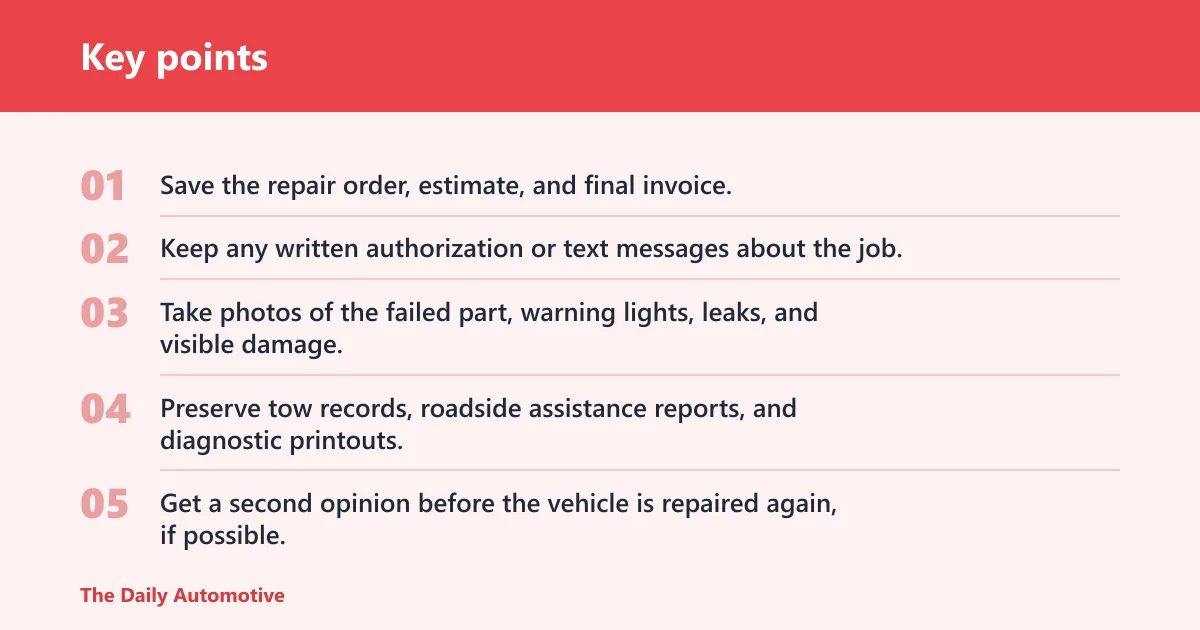
- Save the repair order, estimate, and final invoice.
- Keep any written authorization or text messages about the job.
- Take photos of the failed part, warning lights, leaks, and visible damage.
- Preserve tow records, roadside assistance reports, and diagnostic printouts.
- Get a second opinion before the vehicle is repaired again, if possible.
- Write down the timeline: service date, mileage, symptom, and failure date.
Real-world examples of weak and stronger proof
Suppose your brakes were serviced on Monday, but the pedal went soft on Wednesday and a new shop found a loose caliper bolt still attached to the original repair. That is closer to a negligence claim because the parts, timing, and diagnosis point to the first shop’s work.
Picture a tire rotation followed by a blowout six weeks later, after a curb strike and several low-pressure warnings. That may still be a repair dispute, but causation is weaker because outside damage and owner maintenance issues can break the chain.
What counts as negligence?
Negligence requires duty of care, breach of duty, causation, and damages. In auto repair, that means the shop or mechanic had a duty to inspect, maintain, or fix the vehicle with reasonable care, then did work below industry standard, and that failure caused measurable harm.
Duty of care and the repair order
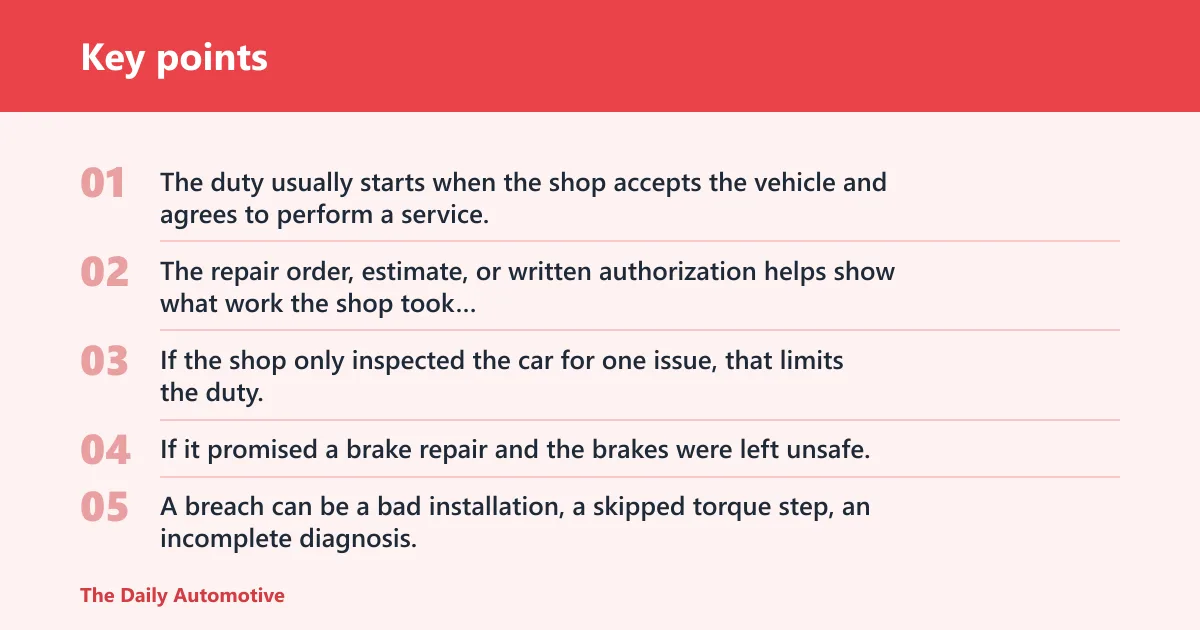
The duty usually starts when the shop accepts the vehicle and agrees to perform a service. The repair order, estimate, or written authorization helps show what work the shop took responsibility for and what problem it was supposed to address.
If the shop only inspected the car for one issue, that limits the duty. If it promised a brake repair and the brakes were left unsafe, the scope is broader and the case is stronger.
Breach of duty and care below industry standard
A breach can be a bad installation, a skipped torque step, an incomplete diagnosis, or a repair that no reasonable shop should have released as safe. Unsafe repairs often involve brakes, tires, steering, suspension, lighting, and wipers because those systems affect control and visibility.
Failure to inspect can matter too. So can failure to diagnose the actual problem, or failure to perform the promised repair at all.
Causation and damages in vehicle repair cases
Causation is the hard part. You have to show the repair failure caused the loss, not just that the car later broke down. If the vehicle had existing wear, missed maintenance, or later damage from a third party, the shop will likely argue that the repair was not the true cause.
Damages can include towing, repeat repairs, rental costs, property damage, and medical bills if the failure is linked to a crash. Expert mechanic testimony may help compare the work to industry standards and explain why the failure happened.
Can I sue a mechanic for negligence?
Yes, if the individual technician personally performed careless work that caused harm, you can sue that mechanic for negligence. But many claims are stronger against the shop itself, because the shop hired the mechanic, controlled the job, and issued the invoice.
Individual technician liability
A mechanic can be named when the claim turns on a specific act, such as a loose wheel, a missed brake line connection, or an improper steering component installation. The question is whether that person’s conduct fell below reasonable professional care.
Mistakes versus negligent workmanship
Not every mistake is negligent workmanship. A diagnostic miss, by itself, may be a claim problem rather than a negligence case unless it was unreasonable under the circumstances. The stronger the proof of ignored warnings, skipped steps, or unsafe release of the vehicle, the better the claim.
When the shop, not just the mechanic, may be named
The shop may face liability for contract breaches, consumer-protection claims, or negligent supervision. If the business mispriced the work, billed for parts not installed, or told you the car was fixed when it was not, the shop’s own conduct may matter as much as the technician’s.
Some shops also make the legal paper trail easier to trace than others. AutoLeap claims grow revenue by 30%, claims 50% faster communication, claims 10% higher profit margins, and claims up to 1300% ROI. Those are business claims, not evidence of fault, but they show how much repair disputes depend on records and communication logs.
What if the repair caused a crash?
If an unsafe repair caused a collision, you may have a personal injury claim, not just a repair dispute. That changes the stakes because the case can include medical bills, lost wages, pain and suffering, and vehicle damage tied to the accident.
Personal injury claims after unsafe repairs
A personal injury claim requires harm caused by the repair failure. If a brake job failed and the car struck another vehicle, or a steering failure caused a run-off-road crash, the damage is no longer limited to the invoice.
Proving the failure caused the accident
You need evidence that links the repair defect to the crash sequence. That often means photos, crash reports, tow records, black-box data if available, and a mechanic or accident-reconstruction opinion showing the vehicle failed because of the repair work.
Timing matters. A failure minutes after service is easier to trace than a failure weeks later, especially if the car kept being driven, serviced elsewhere, or ignored warning signs in between.
When to contact a lawyer right away
If anyone was injured, the vehicle was totaled, or a highway crash followed a brake, tire, or steering repair, talk to a lawyer quickly. Evidence can disappear, and insurance carriers often move fast on liability disputes.
What other claims may fit better?
Sometimes the best case is not negligence. A repair order, warranty promise, refund dispute, or misrepresentation may point more cleanly to breach of contract, warranty, or consumer-protection theories.
Breach of contract for promised but unfinished work
If the shop promised one repair and did not do it, breach of contract may be the cleaner claim. The key proof is the service agreement, estimate, or repair order showing what was supposed to happen and what was actually billed.
Consumer protection or fraud when repairs were misrepresented
Consumer protection laws may apply when the shop misrepresents repairs, bills for unnecessary work, or falsely says the vehicle was fixed. Those claims can overlap with negligence or fraud, and they may fit better when the real issue is deception rather than an unsafe technical mistake.
Warranty and refund disputes for defective service
If the service failed but did not cause an injury or crash, warranty or refund claims may be the better route. Those cases often focus on whether the shop honored its written promise and whether the customer can recover the cost of a redo.
A common first-timer mistake is treating every broken part as proof of negligence. If the loss is only money and the dispute is over workmanship, small claims court may be enough; if the repair caused injury or a major crash, a lawyer is usually the better choice.
Frequently asked questions
Can you sue an auto repair shop for negligence?
Yes, if the shop owed a duty of reasonable care, breached that duty, and caused actual damage or injury. If the dispute is only about a bad invoice, unfinished work, or a refund, breach of contract or consumer-protection claims may be a better fit than negligence.
What do I need to prove if a repair shop caused my accident?
You need proof that the repair was unsafe, that the unsafe repair caused the crash, and that the crash caused your losses. Tow records, photos, repair orders, crash reports, and expert mechanic testimony can help connect those dots, especially when the failure happened later.
What counts as negligent auto repair?
Negligent auto repair is work that falls below reasonable industry standards and creates foreseeable harm. Common examples include unsafe brakes, incorrect tire service, loose steering components, skipped inspections, and a vehicle being released as fixed when the known problem was not addressed.
Should I use small claims court or hire a lawyer for a repair dispute?
Small claims court can fit a low-dollar refund dispute or a clearly documented unfinished repair. If the case involves injuries, a totaled vehicle, disputed causation, or expert testimony, hiring a lawyer is usually the better move because the stakes and proof burden are higher.
What evidence do I need before suing an auto repair shop?
Start with the repair order, authorization, invoice, photos, tow records, and any diagnostic reports. Add a second opinion if the vehicle was inspected again. Those records help show what was promised, what failed, and whether the failure points to the shop or to some other cause.
Can you sue if the shop said the car was fixed but it wasn’t?
Yes. That may support breach of contract, consumer-protection, fraud, or negligence depending on what was said and what was done. The strongest proof is a written repair order, the shop’s statement that the vehicle was repaired, and a later inspection showing the original problem remained.
What damages can I recover from a negligent mechanic?
Possible damages include repeat repair costs, towing, rental expenses, property damage, and medical bills if the failure caused a crash. Punitive damages may be available in some states only for reckless or malicious conduct, not ordinary mistakes, so that claim generally needs more than a bad repair alone.
Products related to this article
Sponsored / affiliate links. As an Amazon Associate I earn from qualifying purchases. I may earn additional commission from eligible campaigns.