5 Best Radar Detectors for Cars (2026): We Compared
The best radar detector for your car depends on where you drive. Highway commuters should prioritize long-range K and Ka filtering; city drivers need stronger false-alert rejection; stealth-sensitive buyers should choose GPS lockouts and directional awareness. A poor match brings missed threats, constant alerts, or money spent on a detector that gets in your way more than it helps. This guide breaks down the right features for highway, city, stealth-sensitive, and budget buyers so you can pick the best fit.
Quick comparison
| Product | Badge | Best for | Price | ||
|---|---|---|---|---|---|
 |
Escort Redline 360c Plug and Play Radar Detector, ExtremeEscort | Our pick | Extreme range · Plug-and-play · 360° awareness · Built-in WiFi | $799.95
Price as of 24 Oct 2026
|
View |
 |
Uniden DFR7 Laser/Radar Detector, Super Long-Range, GPSUniden | Budget pick | Super long-range · GPS mute memory · OLED display · Voice alerts | $224.99
Price as of 24 Oct 2026
|
View |
 |
Beltronics RX65 Professional Series Radar DetectorBeltronics | Also great | Full X/K/SuperWide Ka · DSP processing · VG-2 immune · Customizable | $349.99
Price as of 24 Oct 2026
|
View |
 |
Escort MAX 360c MKII Laser Radar Detector, 360° DirectionalEscort | Upgrade pick | 50% improved range · 360° arrows · Dual-band WiFi/Bluetooth · Shared alerts | $594.49
Price as of 24 Oct 2026
|
View |
 |
Valentine One V1 Gen 2 Radar DetectorValentine One | Also great | X/K/Ka/SuperWide Ka · 360° laser · Ku band · Directional indicator · Rear antenna | $798.98
Price as of 24 Oct 2026
|
View |
No single detector fits every route. A unit that works well on open interstate miles can feel noisy and tiring in a dense downtown area.
📊 Car and Driver tested the group over nearly 40 hours and 1,250 miles. Source: Best Radar Detectors for 2026, Tested.
How we chose
The comparison below weighs range, false-alert control, stealth risk, and daily usability. It also factors in update support, GPS tools, and whether the unit fits a highway commute, urban driving, or a stealth-sensitive region.
That matters because a detector can look strong on paper and still frustrate you in real traffic. Instant-on radar, laser targeting, and poor mounting can all limit real-world usefulness.
One common tradeoff: a simpler budget unit may alert later and chatter more in town, while a premium unit may cost more to buy and keep current with updates and accessories.
| Driving type | Enforcement risk | Must-have features | Features to skip | Likely tradeoffs |
|---|---|---|---|---|
| Highway commuter | High Ka-band and instant-on exposure | Long range, directional arrows, strong K/Ka filtering | Basic units with weak filtering | More upfront cost, more to learn |
| Urban driver | High false-alert density from stores and traffic systems | GPS lockouts, auto mute, tight false-alert suppression | Overly sensitive units without lockouts | May miss less if you maintain databases well |
| Stealth-sensitive driver | RDD-sensitive regions and active detector searches | Stealth positioning, GPS, careful placement | Visible, easy-to-detect models | Higher price and more setup care |
| Budget buyer | Moderate exposure, lower mileage | Basic K/Ka coverage, app support, simple alerts | Premium RDD stealth extras | Shorter range and more nuisance alerts |
| App-first driver | Mixed urban and highway routes | Bluetooth, crowdsourced alerts, firmware updates | Models with no phone integration | Depends on phone connection and data quality |
| Dash-cam buyer | Mixed exposure with documentation needs | Integrated camera, GPS warnings, clean install | Separate camera plus detector if you want fewer devices | Higher price and more compactness tradeoffs |
Uniden R8w: best overall
The Uniden R8w is the top overall pick for most drivers because it combines long range, directional arrows, and strong false-alert control. It fits drivers who split time between highway and suburban roads and want one unit to handle most jobs well.
Its front and rear antennas help it sort out where a threat is coming from, and its auto and manual GPS lockouts help cut down repeat false alerts in city zones. The R8w also supports Bluetooth and Wi-Fi, which matters if you want wireless updates and app-linked features rather than a more basic standalone setup.
The drawback is cost and complexity. It is not the simplest or cheapest choice, and a detector this capable still cannot defeat instant-on radar or a laser hit aimed directly at your car.
Escort Redline 360c: best for stealth and range
The Escort Redline 360c is the premium pick for drivers who want long range and a stronger stealth posture. It is built for people who care about RDD-sensitive areas, strong filtering, and a wireless feature set that fits a serious daily driver.
Its triple antenna design and GPS filtering are the main reasons it belongs in the premium tier. RadarBusters says the Redline 360c is completely undetectable by radar detector detectors, but that kind of claim should still be read as model-specific and environment-specific rather than a universal shield.
The tradeoff is price. You are paying for range, stealth positioning, and connectivity, and it is more detector than many casual drivers need.
RDD-sensitive regions and Spectre Elite risk
Radar Detector Detectors, or RDDs, are used in some enforcement environments to spot active detectors. Spectre Elite is the named detector to know, and compatibility varies by model and region, so stealth is never absolute. (Wikipedia)
If your area has active detector screening, a less visible unit matters more than raw range alone. Placement also matters, because a poor windshield mount or an interior obstruction can reduce detection and make the unit easier to notice.
Valentine One Gen2: best for signal clarity
The Valentine One Gen2 is the choice for drivers who want signal clarity and directional arrows in a high-end package. It fits buyers who want to know not only that a signal exists, but also whether it is ahead, behind, or nearby.
That clarity helps when traffic is dense and multiple alerts overlap. The detector’s strong-end performance appeal is aimed at users who can tolerate a more expensive unit in exchange for detailed situational awareness.
The obvious drawback is price. It is a premium purchase, and it makes the most sense for drivers who value signal interpretation enough to pay for it.
Who should skip it?
Drivers who mainly want a simple city commuter detector may not need this much information. If your route is short, your speed is steady, and your tolerance for setup is low, a less expensive model may be a better fit.
Escort MAXcam 360c: best all-in-one
The Escort MAXcam 360c is the best all-in-one option for drivers who want a detector and dash cam in the same package. That integrated setup reduces clutter and gives you radar alerts plus recording in one mounted unit.
Its GPS and database-style warnings fit buyers who want camera alerts and a more complete commuting setup. For some drivers, the real value is the cleaner installation and fewer devices on the windshield.
The drawback is cost and compromise. Integrated gear usually costs more, and if one function needs service, you are dealing with a more complex unit than a standalone detector.
Who needs a combined setup
This is the right direction if you already want a dash cam and do not want a separate radar unit plus a separate camera. It is also a practical choice if you prefer GPS-based warnings and a single mounted device with fewer cables.
Cobra RAD 480i, 490i, and 700i: best budget picks
Budget Cobras are for buyers who want basic protection without jumping to premium pricing. The same source lists the Cobra RAD 700i as the best radar detector for the money, under $250, which makes it the standout value play in this group.
The appeal is app support and, where applicable, Apple CarPlay and Android Auto compatibility. That kind of connectivity can help with alerts and updates, but these units usually give up range and polish compared with premium detectors.
The drawback is the usual budget package: shorter range, more false alerts, and less confidence in dense traffic. also matters here, because budget detectors under $100 missed instant-on radar in tests.
App support and connectivity
Phone-linked alerts can help, especially for drivers who like crowdsourced data and firmware updates through an app. Bluetooth and wireless updating can be useful, but they should not replace the detector’s own radar performance.
If you drive in mixed traffic, app support helps only when the unit itself is already alerting well. A weak detector with a strong app is still a weak detector.
Which one should you buy?
The right choice depends on where you drive most and how much annoyance you will tolerate. A detector that is too chatty in town becomes easy to ignore, which defeats the point.
Pick by budget
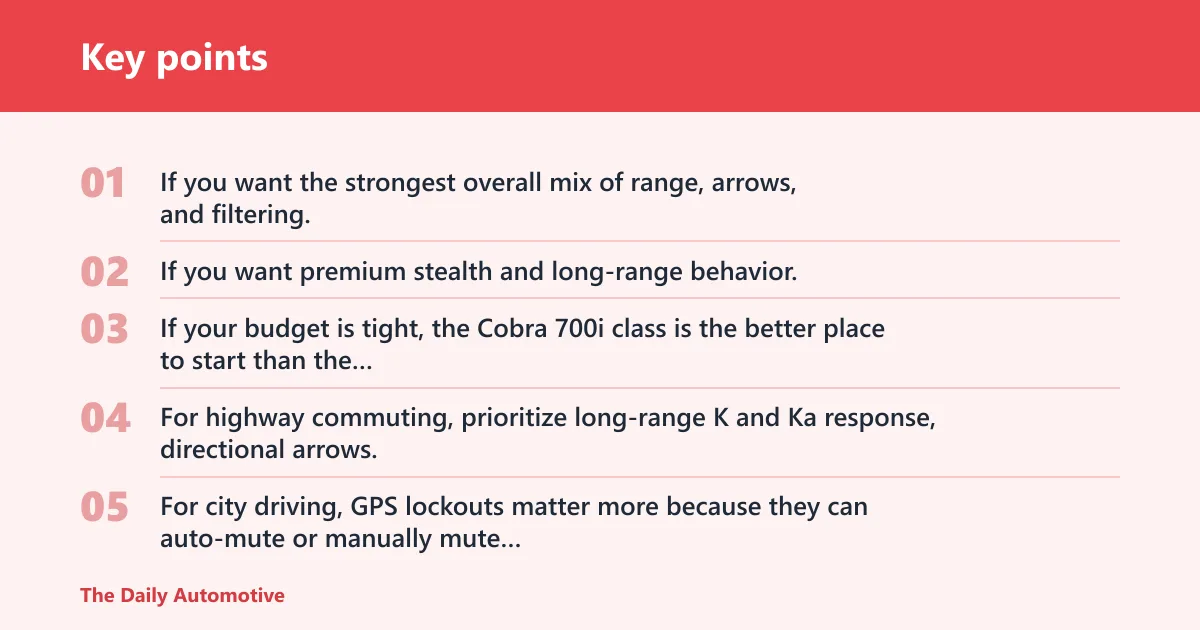
If you want the strongest overall mix of range, arrows, and filtering, start with the Uniden R8w. If you want premium stealth and long-range behavior, the Escort Redline 360c is the more specialized buy. If your budget is tight, the Cobra 700i class is the better place to start than the no-name bargain shelf.
Pick by commute type
For highway commuting, prioritize long-range K and Ka response, directional arrows, and fast signal sorting. For city driving, GPS lockouts matter more because they can auto-mute or manually mute repeat false sources such as store doors and traffic sensors.
Suppose your weekday route is 12 miles through a metro area with frequent supermarket doors and transit signals. A detector without reliable GPS lockouts may alert so often that you start tuning it out, while a better-filtered unit stays useful.
Pick by stealth risk
If you drive in a region where detector screening matters, choose a model with stronger stealth positioning and be careful about placement. Do not assume any unit is invisible to every enforcement tool, because RDD risk varies by model, region, and how the detector is installed.
What each model does best
The Uniden R8w is the broadest recommendation for most drivers. The Escort Redline 360c is the stronger premium stealth and range play. The Valentine One Gen2 is for signal clarity and directional awareness. The Escort MAXcam 360c suits buyers who want camera integration. Cobra models fit the budget lane, with obvious tradeoffs.
What features should you look for in a radar detector?
Start with range on K and Ka band, because those are the bands most drivers worry about. Then look at GPS lockouts, directional arrows, laser awareness, and how often the detector gets firmware or database updates.
For city use, auto and manual lockouts matter because they cut down repeat false alerts. For highway use, long-range reception and quick response matter more. For stealth-sensitive buyers, RDD behavior and model compatibility matter too.
A common first-timer mistake is choosing a radar detector solely for long-range alerts without considering false alarms, GPS filtering, or how it fits your daily commute. More sensitivity can mean more noise, especially in a dense urban area where false alerts are already common.
How we read the bands and coverage claims
Radar detectors mainly watch for K band, Ka band, X band, and laser, often labeled LIDAR. K and Ka are the core concern for most drivers, while X band is less common in many places but still worth understanding.
Laser is different. It is often targeted at one vehicle, which means a detector may warn after the officer already has a reading. That is why long-range radar performance is useful, but not enough by itself.
Windshield mounting and cabin layout matter too. A detector hidden behind tint bands, mirrors, or trim can miss part of the scene, and that can reduce both alert timing and directional usefulness.
- Choose the driving environment first: highway, city, mixed use, or stealth-sensitive territory.
- Decide whether false-alert control matters more than maximum range.
- Check for GPS lockouts, especially if you drive near store fronts and traffic sensors.
- Verify update support: Bluetooth, Wi-Fi, app access, or database refreshes.
- Compare mounting and install costs, including a hardwire kit if you want a cleaner cabin.
- Remember that no detector stops every ticket, especially with instant-on radar or laser.
Say your commute is mostly suburban, with one long freeway stretch and a few school zones. A detector with strong K and Ka filtering plus GPS lockouts can be useful on both ends of that drive, while a noisy budget unit may feel annoying by the third week.
What is the best radar detector for a car?
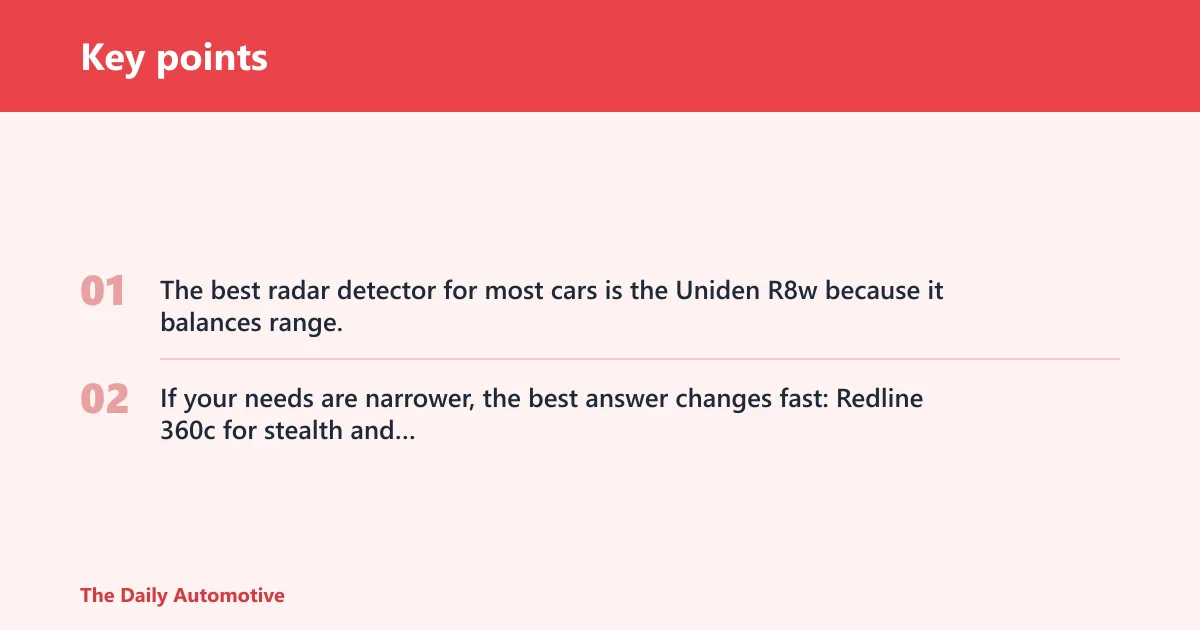
The best radar detector for most cars is the Uniden R8w because it balances range, directional arrows, and false-alert control well enough for mixed driving. If your needs are narrower, the best answer changes fast: Redline 360c for stealth and range, MAXcam 360c for all-in-one use, and Cobra for budget shoppers.
Which radar detector has the longest range?
Among the models covered here, premium long-range units lead the field, and the Escort Redline 360c belongs in that tier. Why range matters, since premium models in that test reached 98%+ accuracy, while cheaper units struggled with instant-on radar. Range still helps most on open roads.
Are radar detectors legal in my state?
Radar detectors are legal in 49 U.S. states for passenger vehicles. Virginia and Washington D.C. prohibit radar detectors, so you need to check local rules before you buy or mount one. Also watch for windshield-mount restrictions and any commercial-vehicle limits that may apply.
What radar detector has the fewest false alerts?
Premium detectors with GPS and Bluetooth filtering tend to do best in city use, and those features reduced false alerts by over 80% in city zones. The practical winner is usually a premium model with auto lockouts, not a basic detector that you have to mute constantly.
Do I need GPS in a radar detector?
Yes, if you drive in town or pass the same false sources every day. GPS lockouts, both auto and manual, are one of the most useful tools for reducing repeat nuisance alerts, and they also help with red-light and speed-camera warnings when the database is current.
Is a radar detector worth it for avoiding speeding tickets?
It can be worth it if you understand the limits. A detector can warn you about radar-based enforcement and camera zones, but it cannot guarantee ticket avoidance, and instant-on radar or laser can still beat a late warning. The value comes from better awareness, not certainty.
Can police detect my radar detector?
Yes, some can. RDDs are the issue, and Spectre Elite is the best-known example to think about. Detection risk depends on the detector model, the region, and how the unit is installed, so stealth-sensitive buyers should not assume every premium detector is invisible.
What is the best budget radar detector?
The best budget radar detector is usually the Cobra RAD 700i class if you want a lower-cost entry point with app support and decent convenience. The tradeoff is shorter range and more false alerts than premium models, which matters a lot if your route is crowded or enforcement is aggressive.
Which radar detector is best for city driving?
For city driving, choose the detector with the best false-alert filtering and GPS lockouts, not the one with the loudest range claims. A detector that learns repeat sources and can mute them automatically will stay useful far longer than a sensitive unit that screams at every door opener.
Products related to this article
Sponsored / affiliate links. As an Amazon Associate I earn from qualifying purchases. I may earn additional commission from eligible campaigns.