Best Motion Sensor for Car: 2 Picks Compared
For the best motion sensor for car use, match the alarm to the parking spot: use a low-false-alarm unit for garages, and a louder, more sensitive alarm for street parking. Those are the two setups most buyers need. Choose poorly, and you either miss real tampering or get so many false alerts that you start ignoring the alarm. This guide compares two motion-sensor car picks by parking scenario, installation ease, and false-alarm risk.
Motion sensor decision matrix
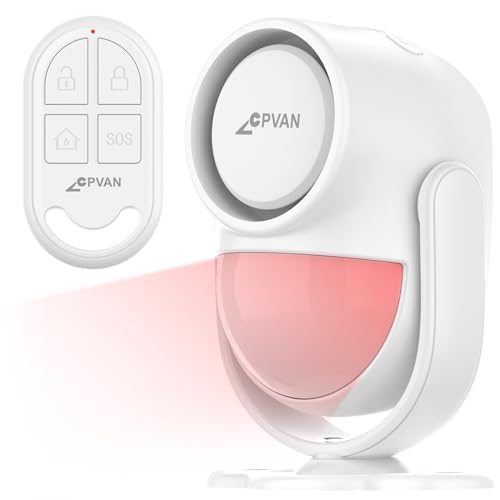

| Decision factor | Low-false-alarm pick: CPVAN CP2 Pro | High-deterrence pick: Electop car alarm |
|---|---|---|
| Parking scenario | Garage, apartment carport, or a calm driveway where passing traffic is limited. | Street parking, curbside parking, or any spot where you want the alarm to be heard fast. |
| Sensor type | PIR motion detector with a 40-foot PIR detector. | Motion/vibration alarm with stronger audible and visual deterrence. |
| Alert style | Quieter, cleaner alert profile with less nuisance firing; works best when you want a warning, not a neighborhood event. | 120dB siren plus a 360° red strobe for immediate attention. |
| Installation effort | Simple standalone setup with remote arming and disarming; good for drivers who want less wiring. | Also straightforward as a standalone unit, but the louder alert makes placement and sensitivity setup more important. |
| False-alarm risk | Lower, especially in a garage or sheltered space. | Higher if mounted where trucks, wind, or foot traffic constantly shake the vehicle. |
| Best use case | Drivers who want a motion sensor light for a car alarm without constant nuisance triggers. | Drivers who want the strongest deterrent signal and can tolerate more alert noise. |
| Choose this if… | You park indoors, want fewer false alarms, and care more about reliable alerting than maximum volume. | You park outside, need the alarm to carry farther, and want the most obvious warning signal. |
What is the best motion sensor for car theft deterrence?
The best motion sensor for car theft deterrence depends on where the vehicle sits overnight. A PIR-based alarm is usually the calmer choice for garages and sheltered parking, while a louder vibration or motion alarm fits curbside parking where you need fast attention. If the spot is open to the street, deterrence matters more.
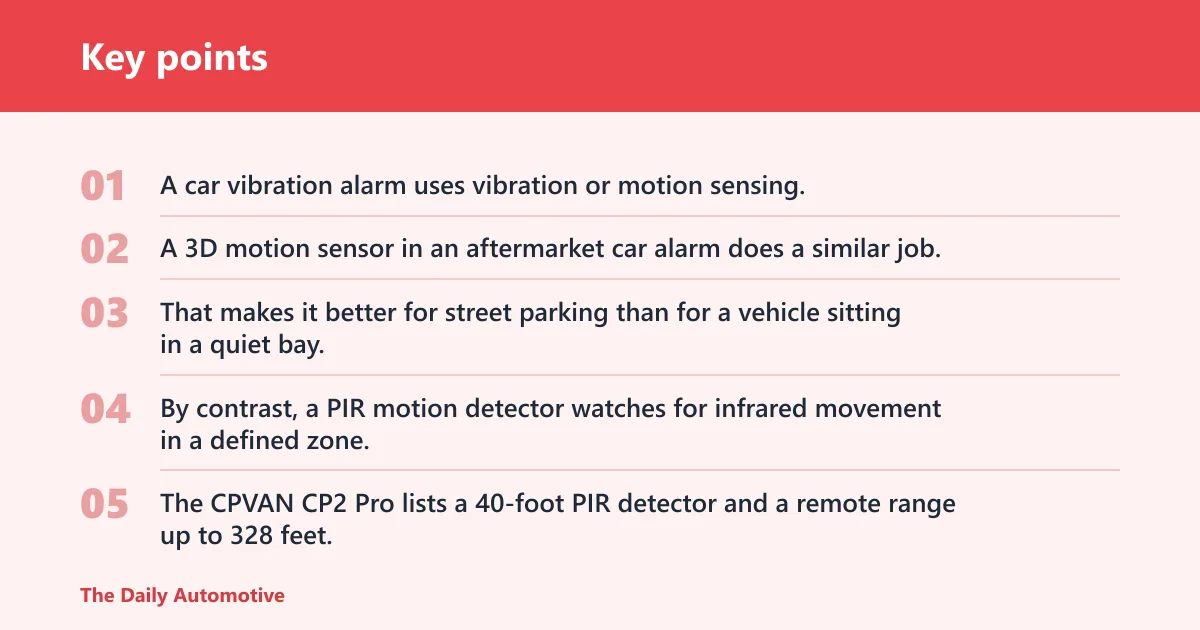
A car vibration alarm uses vibration or motion sensing, often with adjustable sensitivity, and may trigger a siren, a light, or both. A 3D motion sensor in an aftermarket car alarm does a similar job, but with filtering meant to cut false alarms from minor movement. That makes it better for street parking than for a vehicle sitting in a quiet bay.
By contrast, a PIR motion detector watches for infrared movement in a defined zone. The CPVAN CP2 Pro lists a 40-foot PIR detector and a remote range up to 328 feet, which makes it fit well for a garage or indoor-adjacent driveway where you want cleaner detection and less noise.
How the two sensor types behave in real parking spots
Suppose your sedan sits in a covered apartment garage where people walk by but do not touch the car. A PIR setup can warn you about close approach without reacting to every small vibration from nearby traffic. That is where lower false-alarm risk matters more than raw volume.
Now picture a pickup parked on a city street under a lamp post. A vibration or 3D motion alarm gives you more deterrence because the siren and strobe do the work fast. In that setting, a quieter sensor can be too easy to ignore.
Which car motion sensor alarm has the least false alarms?
The least false alarms usually come from the more selective setup: a PIR detector in a sheltered parking spot or a 3D motion sensor with filtering and adjustable sensitivity. For exposed street parking, vibration-based units tend to fire more often because passing trucks, slamming doors, and wind can shake the vehicle.
That trade-off is the core decision. A 3D motion sensor is better when you want broader motion detection around the vehicle, but a PIR motion detector is better when the car sits in a garage or a protected carport. The wrong match can turn a useful alarm into background noise.
Why sensitivity settings matter
Adjustable sensitivity is not a bonus feature; it is the setting that stops nuisance triggers. Start at the middle setting, then walk past the vehicle, close the door, and tap the body lightly to see what sets it off. Increase sensitivity only until normal nearby activity no longer trips it.
A common first-timer mistake is setting the alarm to maximum sensitivity and leaving it there. That usually works for one night, then the owner turns it off because every delivery truck becomes an event. Lower sensitivity plus better placement usually beats maximum gain.
How loud should the siren be?
A good car motion sensor alarm should be loud enough to catch attention quickly without becoming hard to live with. Many aftermarket models list siren output in decibels, and louder alarms matter most for open parking, street parking, and motorcycle use where theft deterrence depends on immediate notice.
The Electop car alarm uses a 120dB siren and a 360° red strobe. The LNKERCO upgrade model offers three volume levels: 100dB, 110dB, and 120dB. Those figures show the practical spread: some owners want one loud blast, while others want a lower setting for garages or shared parking.
Single loudness versus multiple levels
Multiple loudness levels are useful because the best volume depends on the parking site. A covered garage, a townhouse driveway, and a curbside spot do not need the same output. If the alarm offers 100dB, 110dB, and 120dB options, you can reduce nuisance inside a building and turn it up outside.
Visual deterrent light matters here too. A red flashing light or strobe helps in low light, draws attention before anyone reaches the car, and supports the siren instead of replacing it. The best units use both at once, because sound alone does not always catch a passerby’s eye.
Can you install a car motion sensor alarm without wiring?
Yes. Many standalone motion sensor car alarms arm and disarm by wireless remote control, which avoids hardwiring and keeps setup simple. Remote range is often listed in feet, and some models support multiple remotes so more than one driver can arm or disarm the same unit.
The CPVAN CP2 Pro has a remote range up to 328 feet. That is enough for practical daily use in a lot of parking situations, especially if you want to arm the system from a distance or check status before walking away.
Where no-wire setups fit best
No-wire alarms fit best when you want a quick install on a car, truck, SUV, or motorcycle without pulling trim or tapping the electrical system. They also suit leased vehicles, because the alarm can usually be removed later without evidence of a permanent install.
Battery burden is the trade-off. If the unit runs on its own cells, you need to replace or recharge them on schedule. For perimeter systems, that burden can be more obvious: the Dakota Alert PR-4000 receiver lasts 6-7 days between USB Micro charges, which is fine for a receiver but not a direct substitute for a vehicle alarm.
Motion sensor light and alarm features
Look for four features together: a visible red strobe or flashing light, adjustable sensitivity, an IP weather rating, and a usable remote range. Those are the pieces that affect whether the alarm works in daily parking, not just in the product listing.
Visual deterrent light
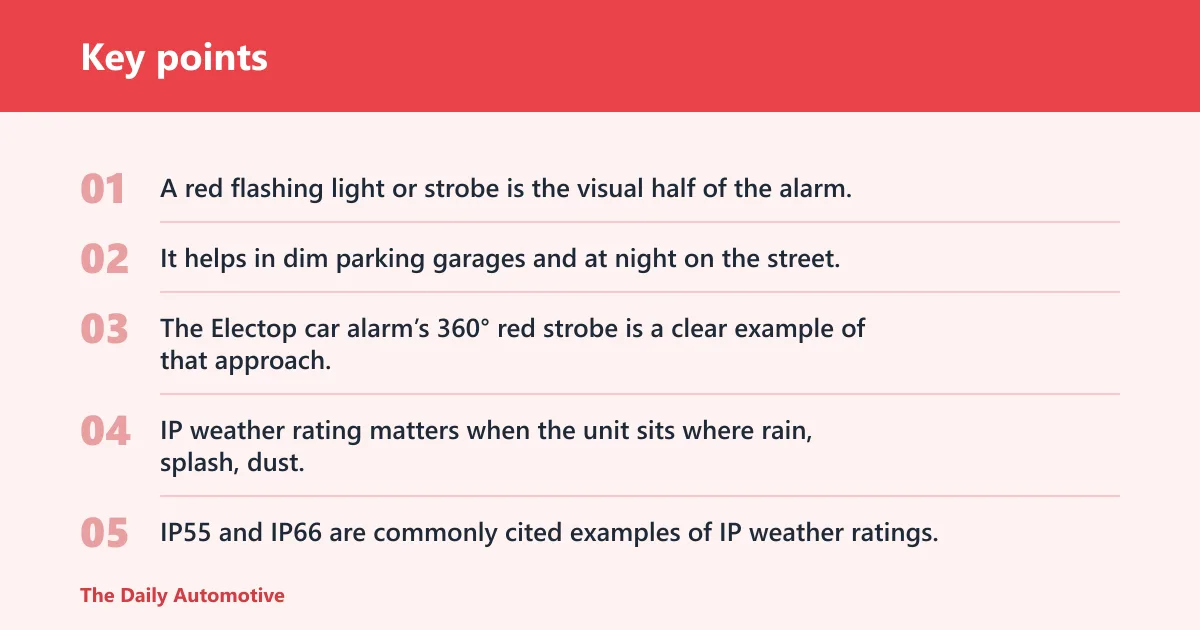
A red flashing light or strobe is the visual half of the alarm. It helps in dim parking garages and at night on the street, and it can discourage casual interference before the siren reaches full attention. The Electop car alarm’s 360° red strobe is a clear example of that approach.
IP weather rating
IP weather rating matters when the unit sits where rain, splash, dust, or road grime can reach it. IP55 and IP66 are commonly cited examples of IP weather ratings. The KCMYTONER alarm has an IP66-rated housing, which is the sort of spec you want for exposed mounting and year-round outdoor use.
Remote arm and disarm range
Wireless remote control should be easy to read on the box. Range is usually listed in feet, and multiple remotes can be a useful convenience if two drivers share the vehicle. Longer range matters most in a large lot, on a driveway, or when you want to check the alarm without standing next to the car.
Driveway alarm receiver versus vehicle alarm
Do not mix up a vehicle motion alarm with a driveway alarm receiver. A driveway system uses outdoor sensors and a receiver to extend alerts beyond the vehicle, which is useful for perimeter monitoring, not direct car security. The Dakota Alert MTPR-4000 claims a one-mile wireless range, which makes sense for perimeter coverage rather than a trunk-mounted theft alarm.
Choose CPVAN CP2 Pro if… / Choose Electop if…
Choose the CPVAN CP2 Pro if you park in a garage, carport, or quiet lot and want fewer false alarms. It fits drivers who prefer a PIR detector, a cleaner alert profile, and a remote range up to 328 feet. It also makes sense if you want a lower-noise setup for daily use.
Choose the Electop car alarm if you park on the street, want a louder deterrent, and care more about the alarm being noticed immediately. Its 120dB siren and 360° red strobe make sense for exposed curb parking, motorcycle use, or any spot where a visible warning is worth the extra nuisance risk.
For ownership cost, look beyond the sticker price. Battery replacement burden matters on standalone units, and any accessory receiver or monitor can add charging upkeep. CherryPicks evaluated 28 car motion sensors, analyzed 92,097 items across its list, and reported reviewed prices from $5.59 to $92.99, which shows how wide the market really is.
How do I test a motion sensor on a car alarm?
Testing a car alarm motion sensor means checking trigger distance, sensitivity, and reset behavior without setting it so high that normal activity causes constant alerts. The goal is a reliable warning pattern, not the loudest possible reaction. Test in the same parking environment where the vehicle will actually sit.
- Arm the alarm with the remote and wait for it to settle.
- Walk past the vehicle at different speeds and distances.
- Close a nearby door or simulate a light vibration to see what it triggers.
- Adjust sensitivity one step at a time, then repeat the same motion.
- Confirm the siren, strobe, and remote disarm all work correctly afterward.
If the alarm fires from traffic vibration alone, lower the sensitivity or move the sensor away from the body panel that is vibrating most. If it misses a clear approach, raise sensitivity in small increments. Test again after wind, rain, or a parking location change because conditions can shift the trigger point.
Do I need a motion sensor alarm for a car, truck, or motorcycle?
Yes, but the best setup changes by vehicle type. Cars and trucks can usually carry a slightly larger standalone alarm with a louder siren, while motorcycles often benefit from compact, wireless units that are easy to mount and easy to remove. The key is matching the sensor type to the parking environment, not the badge on the tailgate.
For a motorcycle parked outdoors, a louder vibration alarm can make sense because it needs to be noticed quickly. For a garage-kept car, a quieter PIR setup is usually less annoying and more practical. The same alarm can work on multiple vehicle types, but the false-alarm risk is not the same.
Frequently asked questions
How do I choose motion sensor light for a car alarm?
Choose a unit with a visible red flashing light or strobe, then match brightness and placement to your parking spot. In low light, the light should help someone spot the vehicle before the siren peaks. Adjustable sensitivity and a usable remote range matter just as much.
What dB level is good for a car motion sensor alarm?
Lower settings can make sense in garages or shared buildings. If the alarm offers multiple volume levels, that is usually more useful than a single fixed output.
Products related to this article
Sponsored / affiliate links. As an Amazon Associate I earn from qualifying purchases. I may earn additional commission from eligible campaigns.