Best Wax & Grease Cleaners for Prep (2025): We Compared
Choose the safest wax and grease remover by contamination: solvent-based for heavy wax or road film, silicone-specific for fisheyes and polish residue, and a milder body-shop cleaner for fresh primer, plastics, or trim-adjacent panels. Use the wrong cleaner and you can trap contamination, soften edges, or trigger paint defects that force a respray. This guide ranks top picks by contamination type, wipe method, and surface risk so you can match the remover to the job.
Quick comparison
| Product | Badge | Best for | Price | ||
|---|---|---|---|---|---|
 |
LiME LiNE Wax and Grease Remover – Multi-Surface Paint PrepLiME LiNE | Our pick | 1 Gallon · Multi-Surface · Fast-Drying | $44.87
Price as of 24 Oct 2026
|
View |
 |
Surface Prep Spray Automotive Wax and Grease Remover, PaintBUFFZIT | Budget pick | 5 fl oz · Spray · Multi-Surface | $14.99
Price as of 24 Oct 2026
|
View |
 |
Dupli-Color Grease & Wax Remover, 1 QuartDupli-Color | Pair with it | 1 Quart · Grease & Wax · Paint Adhesion | $13.99
Price as of 24 Oct 2026
|
View |
Start with the contamination, then pick the format. A fast-flash, no-residue cleaner fits most pre-paint work, but the safest choice shifts when the panel includes plastic, fiberglass, or soft trim.
The table below sorts products by job type only. Use the product sections for the details that matter before primer, sanding, or final paint.
How we chose
We compared these removers on four specific checks that matter during paint prep: contamination type, drying behavior, residue control, and surface compatibility. We also weighed package size and application format, because an aerosol for a door handle opening is a poor fit for a full hood.
That matters most when the failure mode is hidden. Fisheyes often point to silicone left behind, while soft trim can smear if the cleaner is too aggressive or the wipe is too wet.
We also separated panel wipe use before sanding, after sanding, and before primer. Those steps are not interchangeable, and the right cleaner changes with the stage.
Wax remover decision table
| Scenario | Contamination | Best format | What to avoid | Wipe sequence | When to spot-test |
|---|---|---|---|---|---|
| Waxed hood | Wax, road film, old polish | Liquid jug or aerosol with fast flash-off | Dry wiping only; one-cloth pass | Wet one cloth, lift contamination, follow with a dry cloth before the solvent flashes back | Test the edge if the hood has repainted areas or fresh clear |
| Silicone-contaminated panel | Polish residue, fisheye risk | No-residue cleaner with a clean second wipe | Rubbing residue around with the same rag | Apply lightly, wipe once, then switch to a fresh dry cloth for the final pass | Always test if the panel has detailing history or unknown dressings |
| Plastic bumper | Road grime, light wax, trim dressing | Trim-safe cleaner in controlled spray or damp cloth form | Heavy soak, hot solvent, aggressive scrubbing | Spray the cloth, not the bumper, then wipe and dry immediately | Test near a hidden edge or underside before full use |
| Fiberglass repair | Release agents, dust, sanding residue | Compatibility-labeled remover that flashes clean | Products with unknown plasticizer effects or oily residue | Clean once before sanding, then again after sanding and before primer | Spot-test every repair panel, especially if the gel coat is unknown |
| Small touch-up | Finger oils, masking residue, light wax | Aerosol or small spray bottle | Flooding the panel or using a large jug for a tiny area | Two-cloth method with a light spray on the first cloth | Test if the touch-up sits beside OEM clear or edge-sealed trim |
| Full respray | Mixed contamination across larger panels | Gallon jug for economy and repeat wipes | Running out mid-job and switching chemistry halfway through | Work panel by panel, then repeat with a fresh dry cloth | Spot-test on every new substrate type in the vehicle |
Dupli-Color Grease & Wax Remover: best aerosol
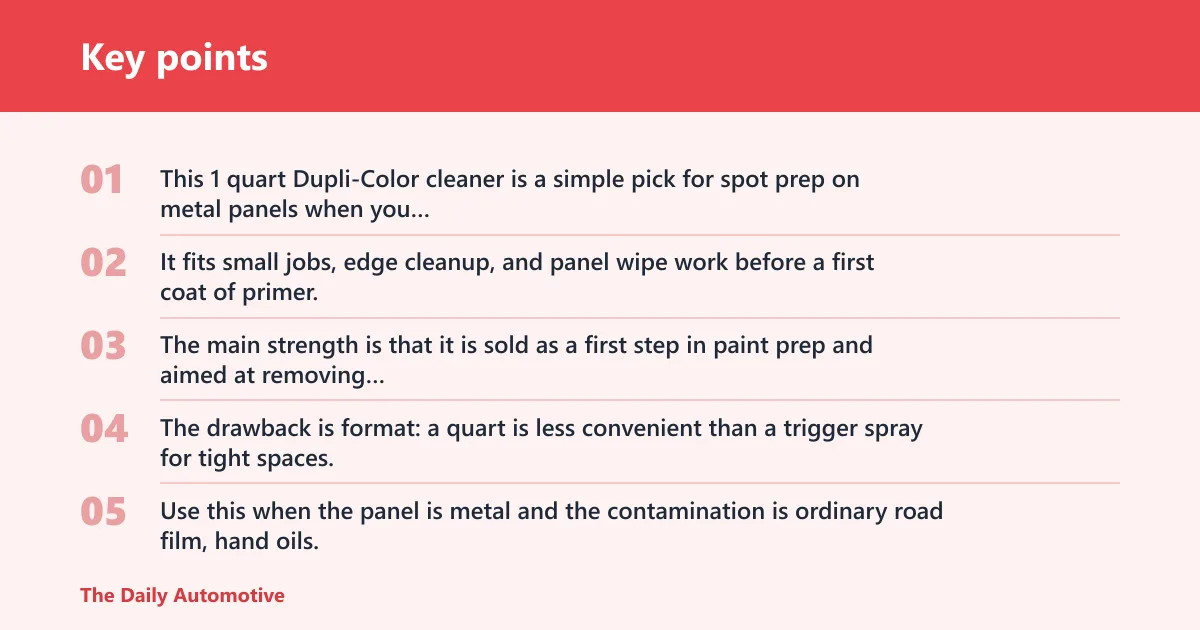
This 1 quart Dupli-Color cleaner is a simple pick for spot prep on metal panels when you want a compact bottle tied to paint adhesion. It fits small jobs, edge cleanup, and panel wipe work before a first coat of primer.
The main strength is that it is sold as a first step in paint prep and aimed at removing grease and wax before painting. The drawback is format: a quart is less convenient than a trigger spray for tight spaces, and it is not the most efficient choice for a full-body job if you need repeated wipe-downs.
Use this when the panel is metal and the contamination is ordinary road film, hand oils, or old wax. If the surface includes soft trim or a bumper cover, spray the cloth first and keep the application light.
Dupli-Color VHT CM541 Grease/Wax Remover: best first-step prep
This cleaner suits prep work where the main goal is a clean first pass before sanding or primer, especially when you want a fast-flashing product that leaves no residue. That makes it useful for panels that need a clean surface fast and for shops that do not want solvent lingering under tape or fresh primer.
The no-residue claim matters because leftover film can create fisheyes or weak adhesion if you move straight into paint. The drawback is that it is best treated as a prep-stage product, not a cure for heavy tar or badly neglected paint.
Use it early in the process, then switch to the sanding step if the panel still needs refinement. For final wipe-downs, keep the second cloth clean and dry so contamination does not get spread back across the panel.
Dupli-Color Soy Based Wax Remover: best low-impact option
This 32 oz soy-based formula is the better fit when you want a smaller bottle and a lower-impact label without moving away from wax-removal prep. It is the one to consider for hobby work where solvent smell, disposal concerns, or light-duty use matter more than bulk economy.
The trade-off is that soy-based does not mean universal. Surface compatibility still needs checking, and you should treat it as a prep cleaner, not a blanket answer for silicone-heavy contamination or tar.
Use a test spot before wider use on fresh paint, plastics, or fiberglass. If the panel has unknown dressings or a repainted edge, wipe a hidden area first and watch for softening, haze, or smear.
Rust-Oleum Wax and Tar Remover: best for tar
This 32 oz cleaner is the better fit when the contamination is not just wax but also tar or heavy road film. That changes the choice because tar removal usually needs a cleaner aimed at sticky, stubborn residue rather than a mild wipe for a clean panel.
The drawback is that tar-focused cleaners can be too much for delicate trim if you use them like an all-purpose detail spray. That is where a hidden test patch matters, especially on plastic bumper covers or repaired edges.
Use it on automotive surfaces that need tar and wax removal before paint or recoat work. For a full respray, pair it with a fresh cloth for the final pass so dissolved residue does not dry back onto the panel.
KLEAN-STRIP Prep-All Wax and Grease Remover: best for multi-surface prep
KLEAN-STRIP Prep-All is the broadest fit when you need a remover that is described as compatible with metal, plastic, and fiberglass. It is offered in a one-gallon size for larger prep jobs, and it is also listed in aerosol form at 13.5 oz, which gives you a size choice based on project scale.
That flexibility is the main strength. A gallon makes sense for repeated wipe-downs on a full respray, while the aerosol format is easier for spot cleaning and tight areas. The drawback is that the bigger jug is not ideal for tiny work, and the aerosol still needs careful cloth control so you do not flood trim or leave streaks.
Because it is described as fast-acting and no-residue, it fits prep where you need quick flash-off and low downtime. Still, compatibility rules do not disappear on plastic or fiberglass; a hidden test spot is still the right move before full use.
Picture a quarter panel that was recently polished and then masked for paint. A fast-acting cleaner clears the wax film, but only if you use the two-cloth method and stop before the first cloth loads up with residue.
Which one should you buy?
If you are doing a small, targeted repair, start with the Dupli-Color 1 quart bottle. It is the most straightforward choice for spot prep, and it keeps the workflow simple when the contamination is limited to one panel.
If you are cleaning multiple panels, KLEAN-STRIP Prep-All is the more practical pick because the one-gallon size is built for larger prep jobs. The aerosol format also makes sense when you need controlled application on tight areas or trim-adjacent seams.
If tar is part of the mess, choose Rust-Oleum Wax and Tar Remover instead of a general cleaner. If the goal is fast first-step prep before sanding or primer, Dupli-Color VHT CM541 is the cleaner to look at first.
Aerosols help when the job is small or awkward. Gallons make more sense when you are repeating the same panel wipe across a whole vehicle and do not want to stop mid-job.
How to use the two-cloth wipe method
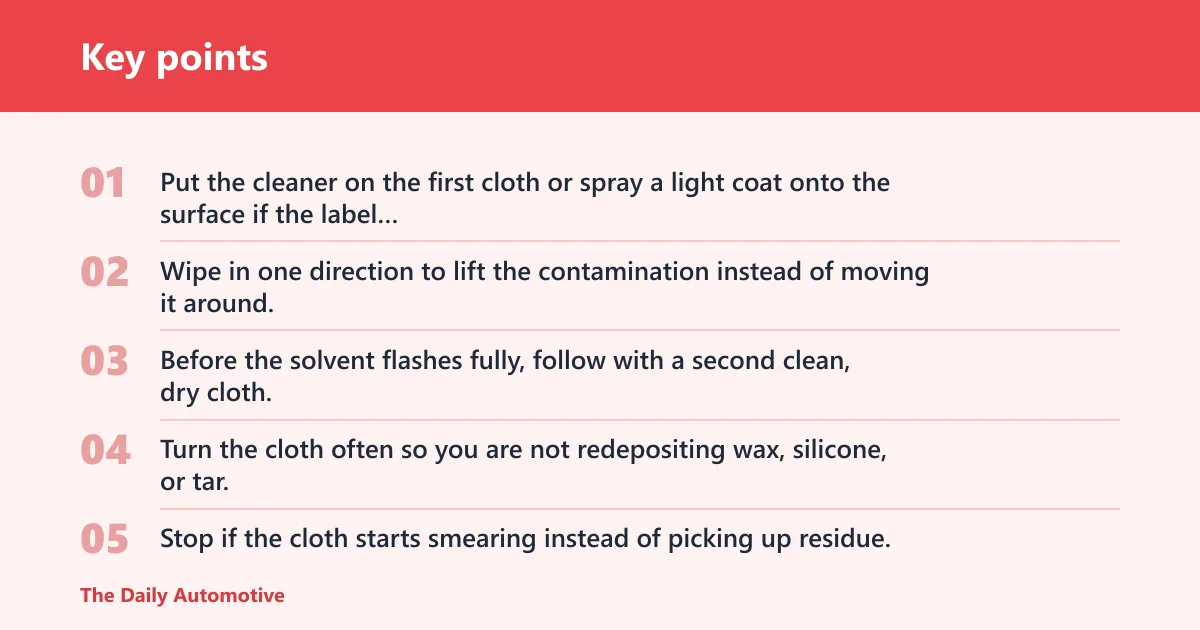
- Put the cleaner on the first cloth or spray a light coat onto the surface if the label allows it.
- Wipe in one direction to lift the contamination instead of moving it around.
- Before the solvent flashes fully, follow with a second clean, dry cloth.
- Turn the cloth often so you are not redepositing wax, silicone, or tar.
- Stop if the cloth starts smearing instead of picking up residue.
A common first-timer mistake is wiping an entire fender with the same cloth, which just spreads oil and dirt back onto the surface. That can push the contamination back into the finish and leave the kind of residue that later shows up as fisheyes or poor primer grip.
What to avoid by contamination type
Wax-heavy panels need a cleaner that flashes off fast and a cloth change before the solvent dries back. Silicone-heavy contamination is different: a cleaner can look fine on the surface and still leave enough residue to crater the next coat.
Soft trim is the most forgiving-looking surface and the easiest to damage. If the cleaner is too aggressive, the trim can smear, dull, or soak up too much solvent.
Should you choose aerosol or liquid?
Choose aerosol for spot cleaning, tight edges, and small repairs where control matters more than economy. Choose a liquid jug when you are doing a hood, roof, or full respray and want fewer interruptions, lower downtime, and less package waste.
Aerosols are also useful when the contamination is localized, such as a fingerprint near a mask line or polish residue around a repair area. Gallons make more sense when you need repeated panel wipes before primer on multiple surfaces.
Say your project is a single door mirror cap with detailing residue around the edges. An aerosol can be the safer choice because you can spray the cloth, not the trim, and reduce the chance of over-wetting the part.
Can you use wax remover on plastic bumper covers?
Yes, but only with a product that is labeled for plastic or used very cautiously after a hidden test spot. Plastic bumper covers can react badly to heavy soak, and the wrong cleaner can dull the surface or soften the edge of nearby tape lines.
Use a cloth-first wipe, not a flooded spray, and keep the pass short. If the bumper has old dressing, repeat with a fresh cloth instead of scrubbing harder.
Fiberglass repair panels deserve the same caution. A remover that is compatible with fiberglass can still behave differently on fresh gel coat, filler edges, or repaired areas, so spot-testing is the right rule before primer.
How do you know it is compatible? Check the label first, then test a hidden corner. If the surface stays unchanged after drying and no haze, swelling, or softening appears, you have a safer path for the larger area.
Frequently asked questions
What is the best wax and grease remover for painting cars?
The best choice depends on the contamination and the substrate. For mixed prep work on metal, plastic, and fiberglass, KLEAN-STRIP Prep-All is the strongest all-around fit in this group because it is described as fast-acting, no-residue, and multi-surface, with both gallon and aerosol formats available.
Is wax and grease remover better than rubbing alcohol for car paint prep?
For true pre-paint cleaning, yes in most cases. Wax and grease remover is made for road film, wax, silicone, and adhesive residue, while rubbing alcohol is better suited to light wipe-downs and does not address the same contamination range. It is not the safer all-purpose substitute.
Can I use wax and grease remover on plastic bumper covers?
Yes, if the product label allows plastic and you use a light, cloth-first method. Plastic bumper covers are more sensitive than metal, so avoid soaking the part. A hidden spot test is the safer move before using any cleaner over the full bumper face.
Should I choose an aerosol or a gallon wax and grease remover?
Choose aerosol for small repairs, edge work, and tight spaces where controlled application matters more than volume. Choose a gallon for larger jobs, repeated panel wipes, or a full respray. The gallon is usually the better fit when the same cleaner will be used across multiple panels.
Does wax and grease remover leave residue before painting?
It should not, if the product is formulated and used correctly. Dupli-Color VHT CM541 is described as drying quickly with no residue, and similar no-residue formulas are preferred because leftover film can cause adhesion trouble, fisheyes, or smearing under primer and paint.
Is soy-based wax and grease remover safe for auto paint prep?
It can be a sensible option, especially when lower-impact positioning matters and the job is moderate rather than heavy-duty. The safer approach is still to check compatibility, use a small test spot, and avoid assuming soy-based means universal on every plastic or repaired surface.
How do I know if a wax and grease remover is compatible with fiberglass?
Look for fiberglass compatibility on the label first. KLEAN-STRIP Prep-All is described as compatible with fiberglass, which is the kind of clear labeling you want. Even then, use a hidden spot test, because repaired fiberglass, gel coat, and filler edges can react differently.
Products related to this article
Sponsored / affiliate links. As an Amazon Associate I earn from qualifying purchases. I may earn additional commission from eligible campaigns.