Best Car Storage Solutions for Messy Cars: We Compared
The best way to organize a messy car is by access frequency and crash-safe storage: keep daily-use items within arm’s reach, put loose heavy items in locked or strapped compartments, and use one bin per category. Poor layout turns clutter into distractions, wasted time, and dangerous projectiles in a sudden stop. This guide covers the top storage solutions and where each one belongs in a daily-use car.
Quick comparison
| Product | Badge | Best for | Price | ||
|---|---|---|---|---|---|
 |
LumiRakuen Heavy Duty Trunk Organizer with Lid for SUV &LumiRakuen | Our pick | XL · Green · 1680D Fabric | $59.99
Price as of 17 Oct 2026
|
View |
 |
XJVSS Car Seat Organizer, Collapsible Auto Console StorageXJVSS | Budget pick | Standard · Black · Oxford Fabric | $9.99
Price as of 17 Oct 2026
|
View |
The strongest setup uses three zones: glove compartment for low-frequency items, center console for daily grab items, and trunk storage for bulk backup gear. That split keeps the cabin usable, helps in hard braking, and makes cleanup faster because every item has one home.
How we chose
The right organizer should match access frequency, fit the available space, and stay put during sudden stops. It also needs a shape that suits the vehicle, because a good bin in the wrong compartment becomes dead space fast.
We compared options on four points: where they belong, how quickly you can reset them, whether they help contain loose items, and whether the design supports safer storage of hard or heavy objects. Capacity matters too. A tiny bin can help a sedan console, while a larger trunk setup makes more sense in an SUV or work truck.
Zipper pouches: best for loose items
Zipper pouches are the easiest way to stop small items from floating around the cabin. Use them for paperwork, cords, extra masks, small tools, and other pieces that would otherwise spill across the console or glove box. They also make a fast reset possible, because one pouch goes back in one place.
In a glove box, zipper pouches work well for car documents, a mini first-aid kit, and a mini sewing kit. In the center console, they can separate chargers from pens or wipes without turning the compartment into a pile of mixed items. The goal is simple: group matching items together, not everything at once.
Labeling helps. A label maker keeps categories consistent, and a marker is a fine fallback if you need a quick system now. Clear labels reduce mix-ups when more than one driver uses the car.
Photo boxes: best for small grouped items
Photo boxes are compact modular bins that fit well inside a console-style space. They work because they impose order without taking over the whole compartment. They are a strong fit when you want small groups of items to stay separated but still easy to reach.
Use them for phone chargers, gum, pens, disinfecting wipes, spare batteries, or similar small items that get grabbed often. Because they are box-shaped, they stack neatly and create cleaner divisions than loose pouches in some consoles.
Choose a larger bin instead when the items are bulky, awkward, or likely to be pulled out together. Photo boxes are not for heavy backup gear. They are for compact categories that need quick access and clean separation.
LumiRakuen trunk organizer: best for bulk cargo
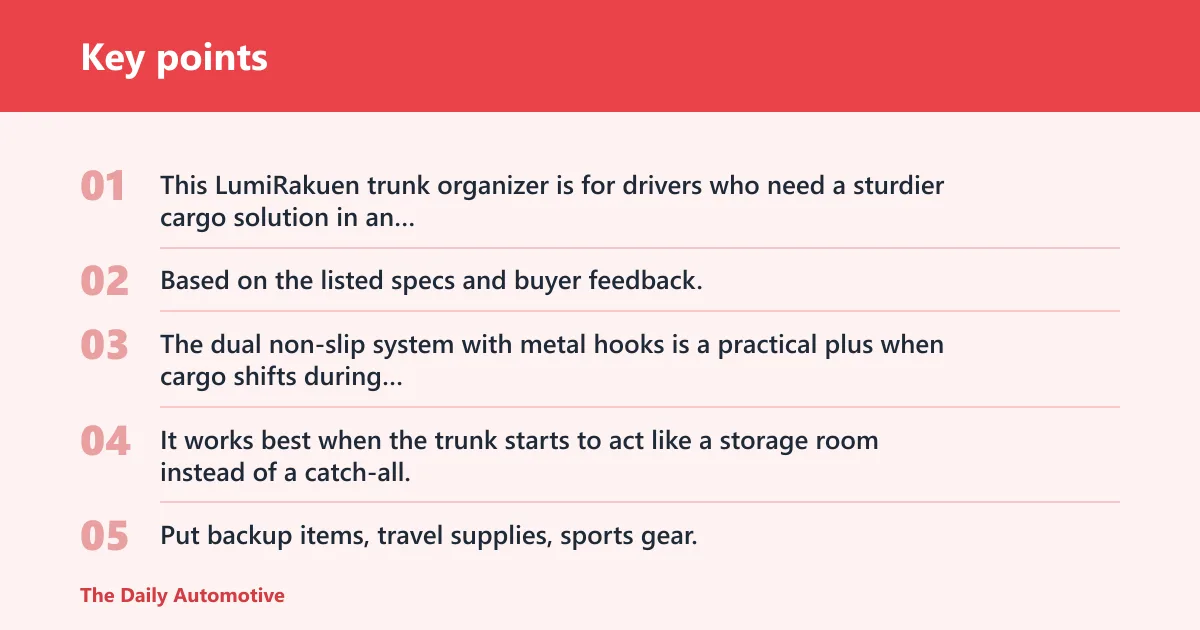
This LumiRakuen trunk organizer is for drivers who need a sturdier cargo solution in an SUV or truck. Based on the listed specs and buyer feedback, the 1680D water-resistant fabric and 3.5mm PP skeleton should suit groceries, gear, and supplies that need shape and containment. The dual non-slip system with metal hooks is a practical plus when cargo shifts during stops.
It works best when the trunk starts to act like a storage room instead of a catch-all. Put backup items, travel supplies, sports gear, and shopping bags inside it so they do not slide around. That matters in minivans and work trucks too, where a loose tote can become a nuisance fast.
The drawback is size. An XL organizer can be more than a small sedan trunk needs, and a larger footprint can crowd other cargo if the trunk is already tight. It is a better pick for drivers with real cargo volume than for minimalists.
XJVSS car seat organizer: best for front-seat storage
This XJVSS seat organizer suits drivers who need quick access to daily items without filling the center console. Based on the manufacturer’s details, the two oversized main compartments and four mesh pockets make it useful for commutes, errands, and rideshare use where passengers leave clutter behind. The carry handles also make it easy to move between vehicles.
It fits best as a secondary storage point for wipes, papers, cords, and small supplies that you want near the front row but not loose on the seat. For parents and rideshare drivers, that separation can keep the cabin from turning chaotic between trips.
The drawback is that it is not a replacement for a true trunk organizer or a well-planned console. It stores front-row items well, but it can become another overfilled catchall if you do not assign categories first.
Trunk organizer setup
A trunk organizer should hold bulkier backup items, groceries, gear, and supplies so they do not slide across the cargo area. The point is containment, not cramming every spare thing into the back. A trunk full of loose items is still a messy car.
Use the trunk for items you do not need every trip: extra cleaning supplies, emergency extras, folded reusable bags, sports equipment, or work gear. Keep the heaviest objects low and against the seatback or side wall when possible, and avoid stacking hard items where they can move in a sudden stop.
Vehicle type changes the layout. Sedans usually need a narrower organizer that leaves room for luggage. SUVs and minivans often benefit from a wider, divided setup. Work trucks need something that can stay anchored, especially if the bed or rear area sees heavy movement. Rideshare vehicles need trunk storage that clears fast and does not invite passenger clutter into the cabin.
What belongs in the trunk
Grocery bags, folding crates, pet supplies, backup cleaning products, jumper cables, sports gear, and other bulky items belong in the trunk organizer. If you need it often during the drive, move it forward. If it is backup gear, it stays in back.
How to stop shifting
Choose an organizer with a stable base and a shape that fits the trunk wall or floor. Straps, hooks, or a non-slip bottom help. The goal is to keep the load from sliding into the cargo opening or tipping into another bag.
Best layouts for groceries and gear
Keep soft grocery bags upright in one section, then reserve another section for sports items or work supplies. That split makes unloading faster and cuts the odds of a spilled bag knocking into something fragile.
Car clutter triage table
This table gives a decision framework you can use before you buy anything else. Start by deciding whether an item should stay in the car at all, then place it in the safest zone that matches how often you reach for it.
| Common item | Best storage zone | Access frequency | Keep, relocate, or remove |
|---|---|---|---|
| Car documents | Glove compartment in a zipper pouch | Low | Keep |
| Mini first-aid kit | Glove compartment | Low | Keep |
| Mini sewing kit | Glove compartment in a zipper pouch | Low | Keep |
| Phone chargers | Center console in a labeled photo box or pouch | High | Keep |
| Disinfecting wipes | Center console | High | Keep |
| Gum | Center console | High | Keep |
| Pens | Center console | High | Keep |
| Hand sanitizer | Driver’s door pocket | High | Keep |
| Trash bags | Driver’s door pocket or center console | High | Keep |
| Microfiber cloth | Driver’s door pocket | High | Keep |
| Lint roller | Driver’s door pocket | High | Keep |
| Loose coins | Center console in a pouch | High | Relocate |
| Old receipts | Outside the car | Low | Remove |
| Heavy tools not needed for daily driving | Home garage or work box | Low | Relocate |
| Loose bottles or hard objects | Strapped trunk organizer only | Low | Relocate |
Way organize messy car checklist
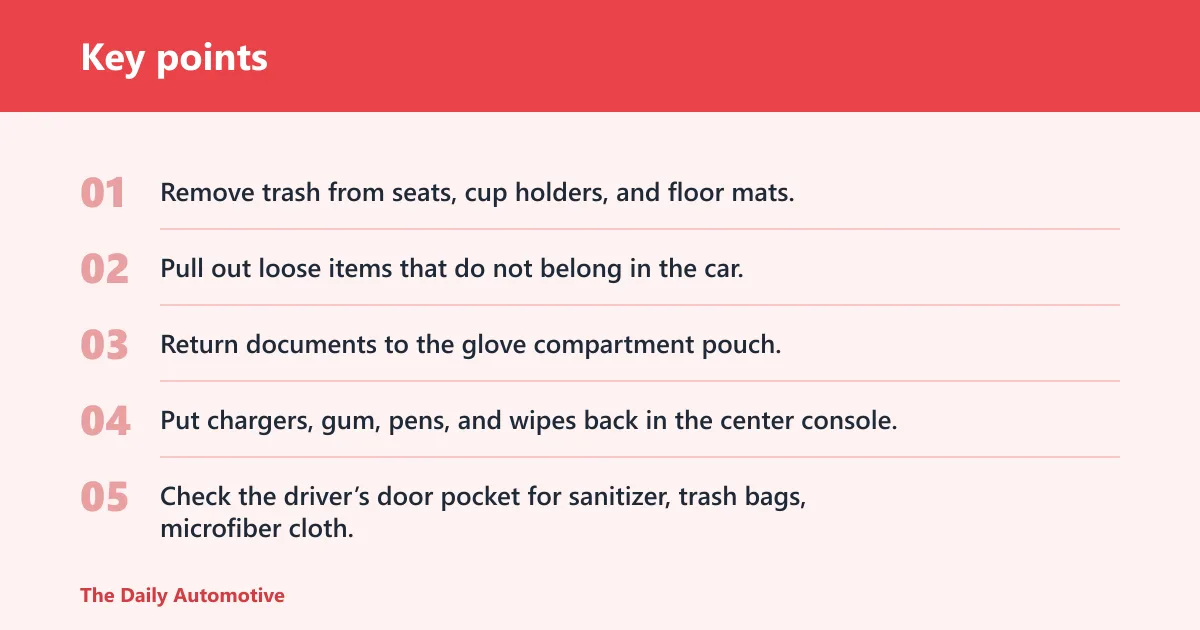
- Remove trash from seats, cup holders, and floor mats.
- Pull out loose items that do not belong in the car.
- Return documents to the glove compartment pouch.
- Put chargers, gum, pens, and wipes back in the center console.
- Check the driver’s door pocket for sanitizer, trash bags, microfiber cloth, and lint roller.
- Restock the trunk organizer and secure any shifting cargo.
- Wipe dust from high-touch surfaces with a microfiber cloth.
- Use a handheld vacuum on crumbs, pet hair, and floor debris.
What should go in the glove compartment?
The glove compartment should hold low-frequency items only: car documents, a mini first-aid kit, a mini sewing kit, and a small zipper pouch for loose pieces. Keep it organized and do not stuff it with random extras, because that makes it harder to find anything fast and can block the latch or create clutter spillover.
A zipper pouch is especially useful here for insurance papers, registration, manuals, and tiny necessities that would otherwise slide to the bottom. The rule is simple: if you do not need it often, it can go in the glove box. If you do, it belongs closer to the driver.
Pouches for paperwork and small parts
Use one pouch for documents and one for small car-related items. That split makes the glove compartment easier to search and easier to reset. A clear label helps if more than one person drives the car.
How do I organize a car with kids?
For cars with kids, keep the front row calm and the rear row prepared. Put daily-access items like wipes, snacks, and small toys in reachable bins, then move backup supplies to the trunk. That way the cabin handles the next mess without turning every drive into a search.
Use one pouch or box per category. Snacks do not belong with crayons. Wipes do not belong under a seat. The more obvious the system, the easier it is to reset after school pickup or a long errand run.
Daily-access bins for snacks, wipes, and toys
A compact bin in the center console or seat organizer can hold the items children need during the drive: wipes, tissues, a few snacks, and a small toy set. Keep the count limited so the bin stays usable instead of becoming a stash pile.
Backup storage for extras
Backup diapers, extra clothes, spare wipes, and bulk snacks belong in the trunk organizer. That keeps the cabin from filling with overflow while still leaving you prepared for delays, spills, and unexpected messes.
Say your SUV carries two children, a stroller, and a diaper bag. The stroller stays in the trunk organizer area, wipes sit in the front-access bin, and extra diapers stay in the trunk. That split keeps the most-used items reachable without turning the whole car into storage.
How do I keep my car organized every day?
Daily upkeep works best when every item has a fixed zone. Put things back immediately, remove trash at the end of the trip, and do not let the front row become a temporary holding area. Small habits matter more than occasional deep cleaning.
A weekly reset should clear out stray receipts, wrappers, and anything that drifted into the wrong compartment. A monthly reset should empty each organizer, check whether the categories still make sense, and move items that have not been used. That cadence keeps the system from decaying.
One-minute habits
Take a quick look at the center console and driver’s door pocket before you exit. If something is loose, put it back where it belongs. If trash appears, remove it now instead of waiting until the next trip.
Weekly and monthly reset schedule
Once a week, empty the cup holders, toss trash, and wipe the dash or console. Once a month, open the glove compartment and trunk organizer, check labels, and remove items that no longer belong in the car. If the system keeps breaking, the categories are too vague or the organizers are the wrong size.
Suppose a commuter car picks up coffee cups, charging cables, and two pairs of sunglasses in one week. A five-minute weekly reset moves the sunglasses to one pouch, coils the cables into another, and sends the cups out with the trash. The car stays organized because each item returns to a named zone.
What should go in the driver’s door pocket?
The driver’s door pocket should hold daily-use items only: hand sanitizer, trash bags, microfiber cloth, and a lint roller. Those items can handle movement and are easy to grab quickly. Avoid valuables or anything that could fall out when the door opens.
This is also a good place for a compact cleanup kit. A microfiber cloth pairs well with a small spray bottle for dust, and a lint roller helps with pet hair on seats or clothing. The pocket should stay light enough that it does not become a dumping ground.
What to keep out of the door pocket
Do not store hard tools, loose coins, paperwork, or anything valuable in the door pocket. If the pocket is crowded, items can shift, rattle, or spill onto the floor. Use it for quick-grab items only.
Which one should you buy?
If budget is tight, start with zipper pouches and a few labeled photo boxes before buying a larger organizer. If the car is a heavy mess, add a sturdy trunk organizer first, then sort the console and glove compartment. If the vehicle sees family duty, prioritize a console caddy and a trunk system together. For commuting, focus on the front row: console, door pocket, and a simple glove box setup.
Do not buy a large organizer just because it looks useful. The right choice depends on cargo shape, how often you reach for the items, and how much room the compartment actually has. A compact sedan and a minivan need different solutions.
Best for tight budgets
Start with zipper pouches and labels. That gives you the fastest improvement for the lowest cost because it separates categories before you add a bigger bin.
Best for heavy messes
Choose the trunk organizer first, then the glove compartment pouch system. That combination stops the biggest sources of clutter and keeps backup items from sliding around.
Best for frequent family use
Use a center console system with photo boxes plus a trunk organizer. Families need fast access to wipes, chargers, and snacks up front, with backup supplies stored out back.
Best for commuting
A compact console setup and a tidy driver’s door pocket are usually enough. Keep the front row simple so you can find what you need without digging while parked or at a drive-through.
Frequently asked questions
What is the best way to organize a messy car?
The best way is to sort the car by access frequency and then assign each category to a zone. Keep daily items in the center console or driver’s door pocket, low-use items in the glove compartment, and bulk backup gear in the trunk. That structure reduces clutter and helps with crash safety too.
What should I keep in the glove compartment?
Keep low-frequency items there: car documents, a mini first-aid kit, a mini sewing kit, and a zipper pouch for small loose items. Do not stuff it with random extras. The glove compartment should stay easy to open, easy to search, and free of clutter that spills out.
How do I organize my center console?
Split the console into simple categories and keep only high-frequency items there. Chargers, gum, pens, and disinfecting wipes belong in labeled photo boxes or pouches. If the console gets crowded, move backup items out and keep only what you reach for every day.
What is the best car trunk organizer?
The best trunk organizer is the one that fits the cargo area, stays anchored, and can hold the items you actually carry. For bigger loads, a sturdy organizer with a stable base works well. It should contain groceries, gear, and supplies without letting them slide around.
How do I stop my car from becoming messy again?
Use the same zone system every day and reset it on a schedule. Empty trash after each drive, return items to their assigned compartment, and do a weekly check for drift. A monthly reset keeps labels, categories, and organizer size aligned with what you now carry.
Products related to this article
Sponsored / affiliate links. As an Amazon Associate I earn from qualifying purchases. I may earn additional commission from eligible campaigns.