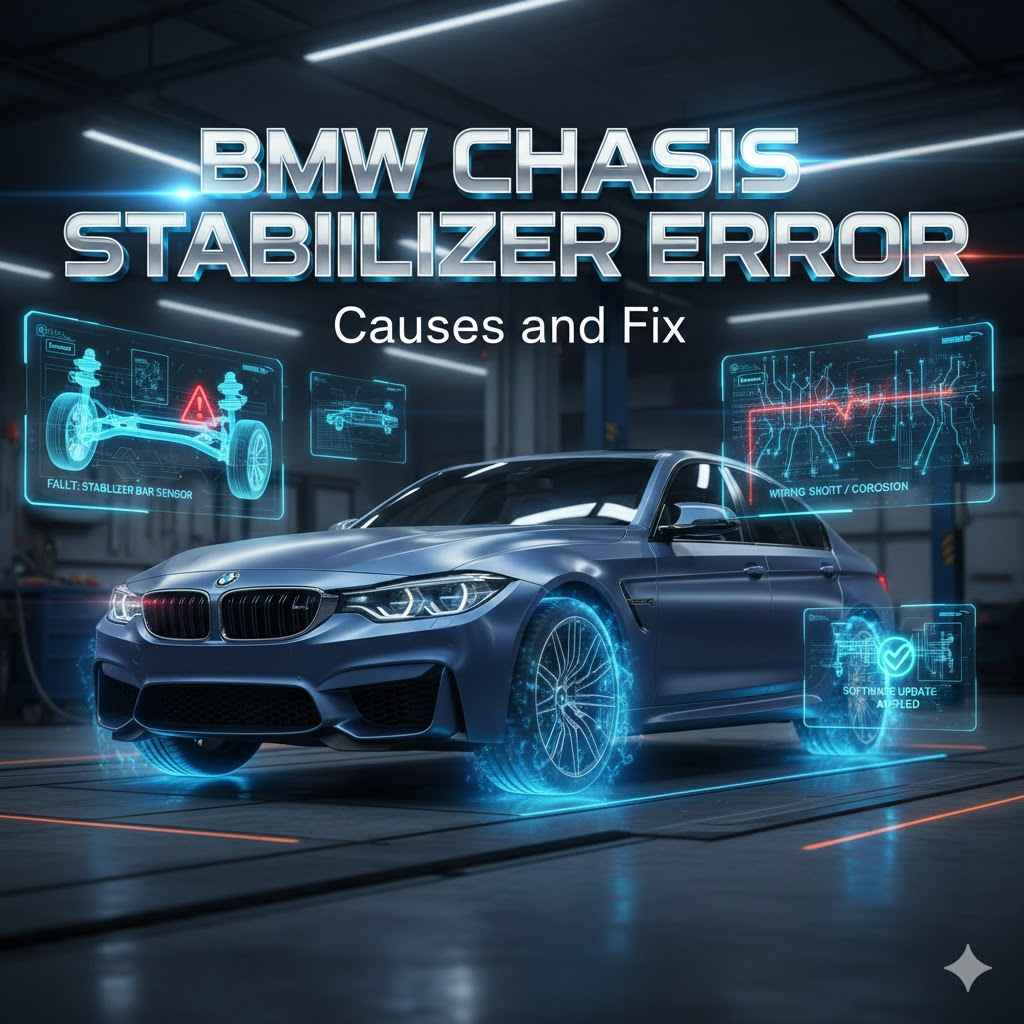
BMW Chassis Stabilizer Error: Causes and Fix
It can be frustrating when your BMW shows a warning light related to the chassis stabilizer. Many drivers find this issue a bit tricky because it involves several parts of the car that work together. When this BMW Chassis Stabilizer Error: Causes and Fix appears, it might seem like a big problem.
But don’t worry, we are here to help! This guide will walk you through what might be causing it and how you can sort it out, step by step. We’ll make it easy to understand.
Understanding BMW Chassis Stabilizer Errors
A BMW chassis stabilizer error, often displayed as a warning light on your dashboard, signals a problem within the vehicle’s stability control system. This system is vital for keeping your car steady, especially during turns or when braking suddenly. When it malfunctions, your driving experience can feel less secure.
This section will explore what the chassis stabilizer system is and why its errors are common.
What is the Chassis Stabilizer System
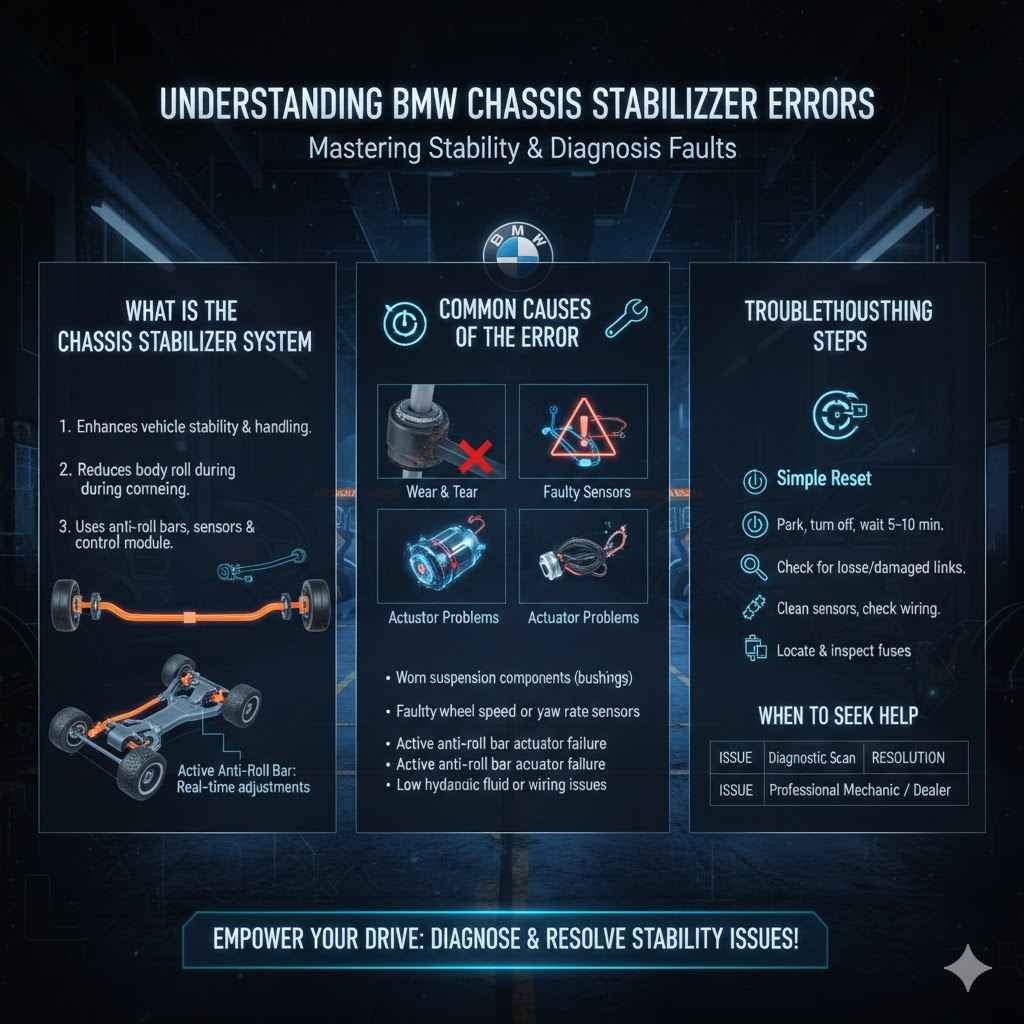
The chassis stabilizer system in a BMW is a sophisticated network designed to enhance vehicle stability and handling. It includes various components that work in unison to detect and correct unwanted body roll during cornering or evasive maneuvers. The primary goal is to keep the vehicle’s chassis as level as possible.
This leads to a more comfortable ride and improved safety.
Key parts of this system include the anti-roll bars (also known as sway bars), which are T-shaped metal bars that connect the left and right sides of the suspension. These bars resist twisting forces. When the car corners, one side of the suspension compresses more than the other, causing the anti-roll bar to twist.
This twisting action pushes the raised side down and lifts the compressed side, counteracting body roll.
The system also relies on sensors, such as wheel speed sensors and yaw rate sensors, to measure the vehicle’s motion and the forces acting upon it. A central control module then processes this data. If it detects excessive or abnormal body roll, it can command actuators to adjust the suspension.
This might involve tightening or loosening the anti-roll bars.
The active anti-roll bar system is a more advanced version. It uses electric motors or hydraulic systems to actively adjust the stiffness of the anti-roll bars in real-time. This allows for much finer control over body roll.
It can even make the suspension stiffer during spirited driving or softer for a more comfortable ride.
When any part of this complex system experiences an issue, a warning light can appear on the dashboard. This light tells the driver that the system’s ability to keep the car stable might be compromised. Ignoring such warnings can lead to reduced handling performance and increased risk, especially in challenging driving conditions.
Common Causes of the BMW Chassis Stabilizer Error
Several issues can trigger a BMW chassis stabilizer error. These range from simple wear and tear to more complex electronic problems. Understanding these common causes is the first step in diagnosing and fixing the problem.
One frequent cause is wear in the suspension components. This includes bushings, links, and mounts that connect the anti-roll bar to the chassis and suspension. Over time, these rubber or polyurethane parts can degrade, crack, or loosen.
This leads to increased play and noise. When the system detects this looseness, it flags an error.
Faulty sensors are another significant contributor. Wheel speed sensors, for instance, provide data about each wheel’s rotation. If a sensor is dirty, damaged, or its wiring is frayed, it can send incorrect information to the stability control module.
This false data can lead the system to believe there is a stability issue when there isn’t one. Similarly, a faulty yaw rate sensor can misinterpret the car’s rotational movement.
Problems with the active anti-roll bar actuators are also common, especially in newer BMW models with advanced systems. These actuators are electric motors or hydraulic pumps responsible for adjusting bar stiffness. If an actuator fails, or if its control module malfunctions, the system will report an error.
This could be due to mechanical failure, electrical shorts, or software glitches.
Low hydraulic fluid levels can affect hydraulic active anti-roll bar systems. If the fluid is low or contaminated, the system may not be able to adjust the bars correctly. This can trigger a warning.
Also, issues with the power supply to these components, like blown fuses or faulty wiring harnesses, can prevent them from operating.
Sometimes, a BMW chassis stabilizer error can be a temporary glitch. This might happen after hitting a large pothole or during extreme weather conditions. In such cases, the error might clear itself after the car is turned off and on again.
However, persistent errors indicate a more serious underlying problem that needs attention.
Troubleshooting Steps for the Error
When you encounter a BMW chassis stabilizer error, it’s wise to start with simple troubleshooting steps. These can sometimes resolve the issue or at least help narrow down the problem before you seek professional help.
First, try a simple reset. Park your BMW on a level surface. Turn off the engine completely.
Then, remove the key and wait for at least 5-10 minutes. This allows the car’s electronic modules to reset. After the waiting period, restart the engine and see if the warning light has disappeared.
If it has, the issue might have been a temporary glitch.
Next, check for any obvious physical damage. Inspect the suspension components you can see from the outside. Look for any loose or damaged anti-roll bar links, bushings, or arms.
Pay attention to any unusual noises coming from the suspension, especially when driving over bumps or turning. These sounds can be indicators of worn parts.
Examine the wheel speed sensors. These are typically located near the wheel hub. Check if they are clean and free from debris.
Ensure their wiring harnesses are securely connected and show no signs of damage. Dirt or road salt can easily accumulate on these sensors, affecting their readings.
If your BMW has an active anti-roll bar system, consider checking the related fuses. Consult your owner’s manual to locate the fuse box and identify the fuse for the active stabilizer system. If a fuse is blown,
If these basic steps don’t resolve the BMW chassis stabilizer error, it’s likely time to consult a qualified mechanic. They have the specialized tools and knowledge to perform a thorough diagnosis. This includes using diagnostic scanners to read specific error codes from the car’s computer.
Diagnosing the BMW Chassis Stabilizer Error
Accurate diagnosis is key to resolving a BMW chassis stabilizer error. This involves more than just looking at the warning light. It requires a systematic approach to identify the root cause.
Professional mechanics use specialized equipment to get to the bottom of the problem.
Using Diagnostic Scanners
Modern vehicles like BMWs rely heavily on sophisticated electronic control units (ECUs) that manage various functions, including the chassis stabilization system. When an error occurs, the ECU stores a diagnostic trouble code (DTC). A diagnostic scanner is a device that plugs into the car’s onboard diagnostics (OBD-II) port, usually located under the dashboard.
The scanner communicates with the ECUs and retrieves these stored DTCs. Each code corresponds to a specific problem detected by the car’s computer. For a BMW chassis stabilizer error, the scanner might display codes related to sensor failures, actuator malfunctions, communication issues between modules, or signal implausibility.
Examples of common codes might include ‘Active Roll Stabilization System Malfunction’ or specific sensor circuit errors.
Reading these codes is just the first step. Technicians then interpret the codes in the context of the vehicle’s symptoms and other data. For instance, a code for a faulty wheel speed sensor needs to be investigated further.
Is the sensor itself bad, or is there a problem with the wiring or the tone ring it reads? The scanner can often provide live data from the sensors, allowing the technician to see if the readings are plausible or erratic.
Beyond just reading codes, advanced scanners can also perform system tests. They can command specific components, like an active anti-roll bar actuator, to operate. This helps determine if the component is functioning correctly or if it’s stuck, weak, or unresponsive.
The scanner is an indispensable tool for pinpointing the exact faulty part or system.
The use of diagnostic scanners ensures that repairs are targeted and efficient. Instead of replacing parts randomly, technicians can focus on the components that the scanner indicates are problematic. This saves the owner time and money.
It also ensures that the correct fix is applied, preventing recurring issues.
Inspecting Suspension Components
The physical integrity of the chassis stabilizer system’s components is critical. Even with perfect electronics, worn or damaged mechanical parts will cause errors. A thorough visual and physical inspection of the suspension is a crucial part of the diagnostic process.
Technicians will carefully examine the anti-roll bar itself. They will look for any signs of bending, cracking, or corrosion. A bent anti-roll bar won’t function as intended, leading to imbalances in the chassis.
They also inspect the bar’s mounting points to the chassis. These points typically involve rubber or polyurethane bushings.
The bushings are designed to cushion the anti-roll bar and absorb vibrations. Over time, these bushings can deteriorate. They might crack, tear, or become loose.
This wear allows the anti-roll bar to move excessively, creating noise and reducing its effectiveness. A worn bushing can cause a noticeable clunking sound over bumps.
Next, the inspection focuses on the links that connect the anti-roll bar to the suspension arms. These links often have ball joints or bushings at each end. These can wear out, becoming loose and causing play in the system.
A faulty link can lead to a loss of control during cornering and will often trigger a chassis stabilizer error.
The technician will also check the connection points for any signs of damage or corrosion. Loose bolts or fasteners can compromise the entire assembly. In some cases, rust can weaken the metal components.
Ensuring all parts are securely fastened and free from damage is essential for the system’s proper operation.
This hands-on inspection complements the electronic diagnostics. A code might point to a specific sensor, but if the physical links are clearly worn and loose, that worn link could be the actual cause of the sensor error. It’s a comprehensive approach that addresses both electronic and mechanical aspects of the system.
Checking Sensors and Actuators
Sensors and actuators are the electronic brains and muscles of the chassis stabilizer system. Problems here are a very common reason for the BMW chassis stabilizer error. Diagnosing them requires a combination of scanner data and direct testing.
Wheel speed sensors are paramount. They monitor the rotation of each wheel. If one sensor is faulty, dirty, or its wiring is damaged, the stability control system will receive inaccurate data.
This can lead to phantom warnings. Technicians use scanners to check the live feed from each wheel speed sensor. They look for consistent, plausible readings for all wheels, even during turns.
The yaw rate sensor measures the vehicle’s rotation around its vertical axis. This helps the system understand how the car is turning. A malfunctioning yaw rate sensor can lead to incorrect stability adjustments.
Its readings are also checked via the diagnostic scanner for accuracy.
For cars with active anti-roll bars, the actuators are a key point of failure. These are typically electric motors integrated into the anti-roll bar assembly. They actively adjust the bar’s stiffness.
Diagnostic scanners can often command these actuators to move. This allows technicians to determine if they are responding, if they are moving smoothly, or if they are making unusual noises.
The control module for the active anti-roll bar system can also fail. This module receives data from sensors and sends commands to the actuators. If the module has internal faults or communication issues, it will trigger errors.
This might require specialized testing or even replacement of the module itself.
Wiring harnesses that connect these sensors and actuators are also checked. Corrosion, chafing, or breaks in the wires can disrupt signals. A technician will trace the wiring from the sensor or actuator back to the control module to ensure continuity and proper insulation.
Any signs of damage will need to be repaired.
A comparison of sensor outputs is often made. For example, if one wheel speed sensor is significantly different from the others, it points to a potential problem with that sensor or its related components. This detailed examination is vital for accurately diagnosing the BMW chassis stabilizer error.
Fixing the BMW Chassis Stabilizer Error
Once the cause of the BMW chassis stabilizer error is identified, the next step is to implement the correct fix. The repair will depend entirely on the specific component that has failed or is malfunctioning.
Replacing Worn Suspension Parts
If the diagnostic process reveals that worn suspension parts are the culprit, replacing them is straightforward. This is a common repair that many workshops can handle efficiently.
This often involves replacing the rubber bushings that hold the anti-roll bar in place. These are typically pressed into brackets attached to the vehicle’s frame. New bushings are installed, ensuring a snug fit that eliminates excess play.
The anti-roll bar links, which connect the bar to the suspension, may also need replacement. These links can wear out at their ball joints or bushings. New links are installed, ensuring proper alignment and articulation.
In some cases, the anti-roll bar itself might be damaged, bent, or excessively corroded. If this is the case, the entire bar will be
After replacing any worn parts, the suspension geometry may need to be checked and adjusted, especially if significant work was done. This ensures that the wheels are properly aligned and the car handles as it should.
The cost of these repairs can vary. Replacing bushings is generally less expensive than replacing the entire anti-roll bar. However, addressing worn suspension parts promptly is important for maintaining vehicle safety and handling.
Repairing or Replacing Sensors
When sensors are identified as the source of the BMW chassis stabilizer error, the fix usually involves replacement. Sensors are often sealed units, and internal failures typically mean they need to be swapped out.
Wheel speed sensors are relatively easy to replace for experienced mechanics. They are usually held in place by a single bolt and can be disconnected and reconnected quickly. The wiring harness leading to the sensor is also inspected for damage.
If the wiring is frayed or corroded, it will be repaired or replaced as well.
Yaw rate sensors, which are more complex, are usually located in a specific position within the vehicle. Their replacement might be slightly more involved, but the process is still well-defined for professional technicians.
After a sensor is replaced, the diagnostic system will need to be reset. The new sensor’s data is then verified to ensure it is functioning correctly. In some cases, the car’s computer may need to relearn the sensor’s characteristics.
The cost of sensor replacement can range from moderate to high, depending on the specific sensor and vehicle model. However, a functioning sensor system is crucial for the proper operation of many safety features.
Servicing Active Anti-Roll Bar Systems
Active anti-roll bar systems are more intricate. Their fixes can be more complex and potentially more expensive. These systems use actuators and control modules that can fail.
If an actuator for the active anti-roll bar is faulty, it will need to be replaced. This often involves removing the anti-roll bar to access the actuator, which is integrated into the bar itself or its mounts. The new actuator is then installed, and the system is reconnected and calibrated.
The control module for the active system may also require attention. If it’s malfunctioning, it will be diagnosed and possibly repaired or replaced. Software updates might also be available for these modules to address known issues.
For hydraulic active anti-roll bar systems, checking and refilling hydraulic fluid is part of the service. If leaks are found, the affected lines or seals will be repaired. Contaminated fluid will be flushed and replaced.
Calibration is a critical step after servicing active anti-roll bar systems. The system needs to be properly configured to work with the new components or repaired modules. This ensures that the stiffness adjustments are made accurately.
These types of repairs often require specialized diagnostic tools and expertise, so it’s best to take your BMW to a dealer or a specialist mechanic experienced with these advanced suspension systems.
Resetting the System After Repair
After any repair is completed on the chassis stabilizer system, it is essential to reset the fault codes and recalibrate the system. This tells the car’s computer that the problem has been addressed.
A diagnostic scanner is used to clear the stored DTCs. Simply clearing the codes without performing the repair would be ineffective. Once the codes are cleared, the system is tested to ensure the warning light remains off.
For systems with active components, a recalibration process is often necessary. This process allows the system’s control module to learn the parameters of the new or repaired parts. It ensures that the system operates within its designed specifications.
For example, active anti-roll bars need to be calibrated to ensure they apply the correct amount of stiffness.
The recalibration process can vary between BMW models. Some systems may require a simple drive cycle to re-learn. Others may need to be put into a special service mode using a diagnostic tool.
The technician will follow the specific procedures for your vehicle.
Once the system has been reset and recalibrated, a test drive is performed. This confirms that the warning light stays off and that the chassis stabilizer system is functioning normally. This final step provides confidence that the BMW chassis stabilizer error has been successfully resolved.
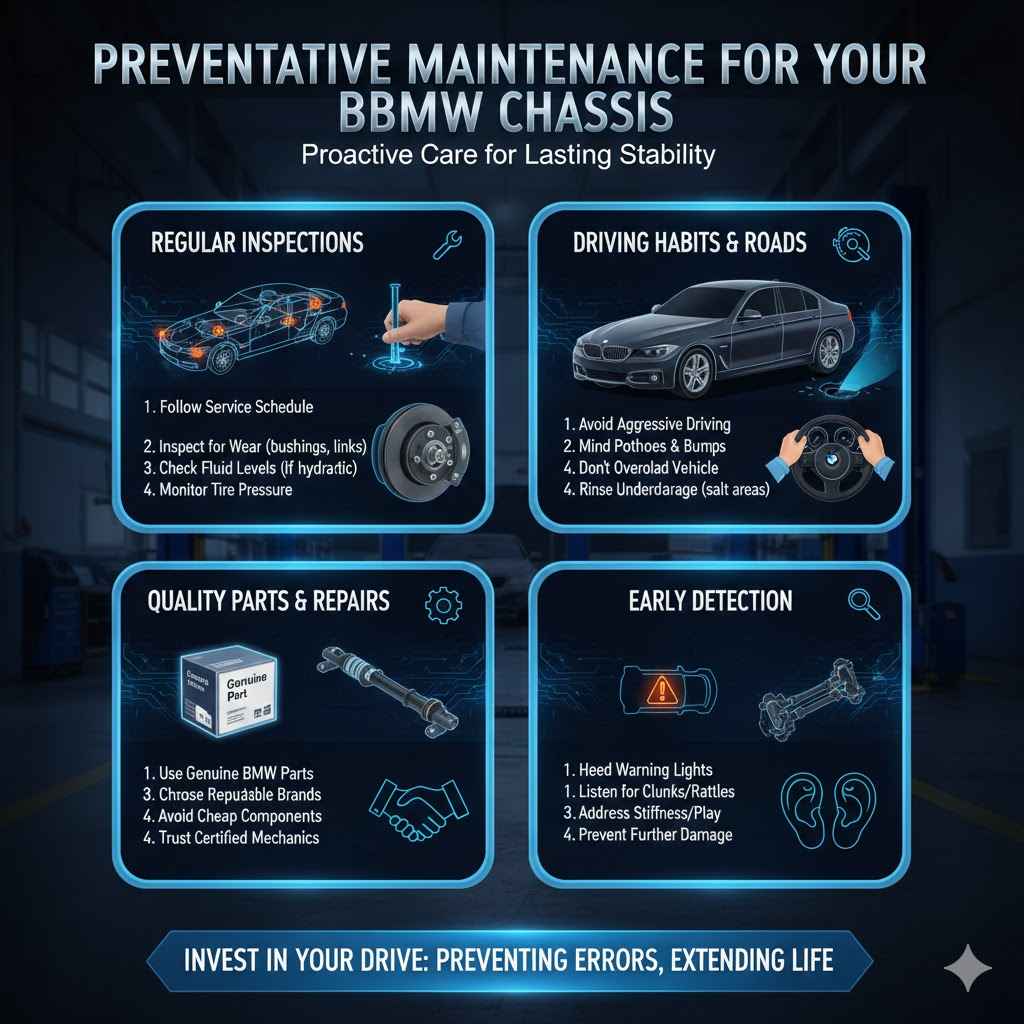
Preventative Maintenance for Your BMW Chassis
Taking good care of your BMW can help prevent the BMW chassis stabilizer error from occurring in the first place. Regular maintenance is key to keeping your car’s complex systems in good working order.
Regular Inspections and Servicing
Following your BMW’s recommended service schedule is crucial. This includes periodic inspections of the suspension and steering components. Mechanics can spot early signs of wear in bushings, links, or seals during these routine check-ups.
Pay attention to any unusual noises coming from your car, such as clunks, rattles, or squeaks. These sounds can indicate that a suspension part is starting to fail. Addressing them early can prevent more significant issues and costly repairs down the line.
Ensure that all fluid levels are checked regularly, especially if your BMW has a hydraulic active anti-roll bar system. Low or contaminated fluid can lead to system malfunction.
Regularly check your tire pressure. Properly inflated tires contribute to overall vehicle stability and can reduce stress on the suspension system.
A well-maintained BMW is a safer and more enjoyable BMW to drive. Proactive care can save you from unexpected repairs and warning lights.
Driving Habits and Road Conditions
How you drive and the roads you drive on can significantly impact the lifespan of your suspension components. Avoiding aggressive driving, such as sharp turns at high speeds or sudden braking, can reduce wear and tear.
Be mindful of road conditions. Potholes, speed bumps, and uneven surfaces can be hard on your suspension. Try to drive around them when possible or slow down to minimize impact.
Avoid carrying excessive weight in your vehicle. Overloading your BMW can put undue stress on the chassis and suspension.
If you live in an area with harsh weather conditions, such as heavy snow or ice, be aware that road salt and debris can accelerate corrosion and wear on suspension parts. Rinsing your car regularly, especially the undercarriage, can help.
Mindful driving and awareness of your surroundings can go a long way in preserving your BMW’s chassis integrity.
Choosing Quality Parts for Repairs
When it comes time to replace any parts related to the chassis stabilizer system, always opt for high-quality components. Using genuine BMW parts or reputable aftermarket brands ensures that the replacement parts meet the original specifications.
Cheap, low-quality parts may not fit correctly, may wear out faster, or may not perform to the same standards as original equipment. This can lead to premature failure and potentially cause other systems to malfunction.
Always work with a trusted mechanic who sources quality parts. They can advise you on the best options for your specific BMW model.
Investing in quality parts is an investment in the longevity and safety of your vehicle. It helps maintain the integrity of the chassis and its complex stabilization systems.
Frequently Asked Questions
Question: What does the chassis stabilizer warning light mean on my BMW
Answer: This warning light indicates an issue with your car’s system that helps keep it stable during turns and braking. It means the system might not be working correctly, affecting how stable your car feels.
Question: Can I still drive my BMW if the chassis stabilizer light is on
Answer: You can usually still drive your car, but it’s not recommended for long distances or aggressive driving. The car’s stability control may be reduced, making it less safe, especially in bad weather or during sudden maneuvers.
Question: How much does it typically cost to fix a BMW chassis stabilizer error
Answer: The cost can vary greatly, from a few hundred dollars for simple repairs like replacing bushings to over a thousand dollars for more complex issues involving active anti-roll bars or electronic control modules.
Question: How long does it take to fix a BMW chassis stabilizer error
Answer: A simple fix, like replacing bushings or sensors, might take a few hours. More complex repairs, such as dealing with active anti-roll bar systems, could take a full day or longer, depending on the diagnosis and parts availability.
Question: Should I take my BMW to a dealer or an independent mechanic for this issue
Answer: For complex or newer models with advanced active suspension, a BMW dealer or a specialized independent shop with BMW expertise is often recommended. They have the right tools and training.
Summary
Addressing a BMW chassis stabilizer error requires understanding its causes, from worn parts to sensor failures. Diagnosing the issue accurately with scanners and inspections is the first step. Repairing or replacing faulty components, then resetting the system, ensures your BMW’s stability is restored.
Regular maintenance and careful driving habits can help prevent these issues.