
Can I Lose House? Legal Guide to Home Loss Risks
Yes. You can lose a house if a lender forecloses, a tax authority sells it, or a court orders a sale after certain debts. Missed mortgage, tax, and HOA deadlines can turn arrears into a forced sale, added fees, and lost equity. This guide ranks the risks, explains how fast each one can move, and outlines options that may still stop or reverse the process.
Can you lose your house for missed mortgage payments?
Yes. Missed mortgage payments can lead to default, late fees, acceleration of the loan balance, and possibly foreclosure if the borrower does not cure the default. The lender usually must send notices before a sale, and the process can move through judicial or nonjudicial foreclosure, depending on state law and the loan documents.
What starts default and acceleration
Default usually begins after the first missed payment, though many loans allow a short grace period before late charges apply. If the default continues, the lender may accelerate the debt, which means the full balance becomes due, not just the overdue installments. That step often leads to foreclosure.
How foreclosure notices and sale dates usually unfold
Most lenders send a delinquency notice, then a notice of default or notice of intent to accelerate, and later a notice of sale or auction date. The exact sequence and timing vary by state and by whether the loan is federally backed. The practical question is simple: what deadline is left to reinstate, modify, or redeem?
Judicial vs nonjudicial foreclosure
In judicial foreclosure states, the lender generally must file a lawsuit and obtain a court judgment before the property can be sold. In nonjudicial states, the lender may be able to use a power-of-sale clause in the mortgage or deed of trust, which may move faster. Either way, the result can be a sale or auction if the default is not cured.
Which debts can put your house at risk first?

Mortgage default is common, but it is not the only fast-moving threat. Property tax delinquency can outrank a mortgage in some states, HOA arrears can lead to lien foreclosure under state law, and judgment liens can attach to equity. The legal path, priority, and speed are different for each debt.
Property tax liens and tax-sale risk
Property taxes often have priority over a mortgage, so unpaid taxes can create a serious risk even when the mortgage is current. Local governments may sell tax certificates, conduct a tax sale, or pursue deed enforcement. Many states also give a redemption period after a tax sale, but the deadline is short and state-specific.
HOA liens and state-law limits
Unpaid HOA assessments can lead to a recorded lien and, in some states, foreclosure. Associations usually must follow notice requirements and may face limits on when and how they can proceed. Some states restrict foreclosure for small balances, while others allow it after a defined delinquency period or after the lien reaches a certain age.
Judgment liens and homestead protection
A lawsuit creditor may record a judgment lien against real property if state law allows it. A lien does not always mean an immediate sale, but it can make refinancing, selling, or tapping equity harder. Homestead exemption rules may protect a portion of equity, and some states limit whether a judgment lien can attach at all.
House-loss risk matrix: what is most urgent?
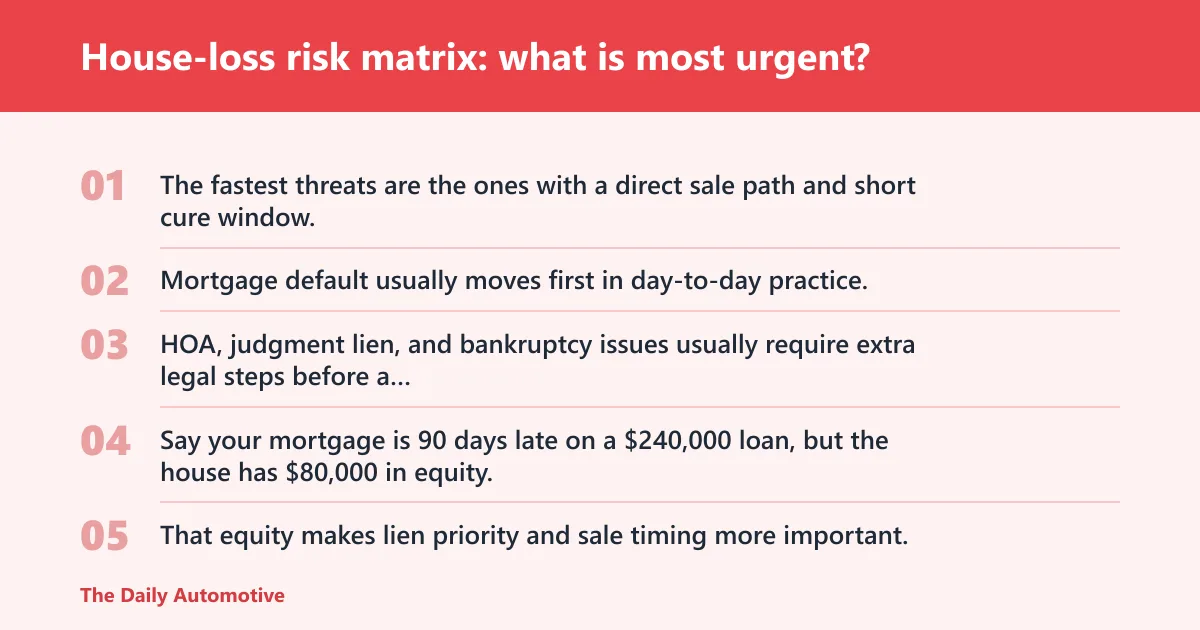
The fastest threats are the ones with a direct sale path and short cure window. Mortgage default usually moves first in day-to-day practice, but unpaid property taxes can become more urgent if the government has superior priority. HOA, judgment lien, and bankruptcy issues usually require extra legal steps before a forced sale.
| Risk type | Typical urgency | Usual path to sale | Can you still cure before sale? |
|---|---|---|---|
| Mortgage default | High | Missed payments, default notice, acceleration, foreclosure, auction | Often yes, through reinstatement, repayment plan, modification, or bankruptcy stay |
| Property tax delinquency | Very high in many states | Tax lien, tax sale or certificate sale, redemption period, deed enforcement | Often yes before sale or during redemption, but deadlines are strict |
| HOA arrears | Medium to high | Assessment default, lien filing, demand notice, possible foreclosure under state law | Often yes before foreclosure, sometimes after notice and fees are paid |
| Judgment lien | Lower for immediate sale, higher for equity risk | Court judgment, lien recording, later sale or refinance pressure | Often yes if the lien can be satisfied, negotiated, or avoided by exemption law |
| Bankruptcy option | Depends on timing | Automatic stay, repayment plan, discharge, reaffirmation, or asset sale issues | Yes for many borrowers if filed before sale; not a cure by itself |
Say your mortgage is 90 days late on a $240,000 loan, but the house has $80,000 in equity. That equity makes lien priority and sale timing more important, because a creditor may have more reason to pursue value in the property. A different response is needed if the loan is underwater.
Suppose the mortgage is current, but $6,000 in property taxes and $1,800 in HOA dues are unpaid. The tax bill may move faster than the mortgage problem would, and the HOA may still need to satisfy state-law notice rules before foreclosure. The deadlines matter more than the label on the debt.
Can bankruptcy stop foreclosure and help you keep the house?

Bankruptcy can stop or slow foreclosure through the automatic stay, but it does not erase every house risk. Chapter 13 is often the more useful tool for keeping a home because it can cure arrears over time, while Chapter 7 is more limited and may only buy time or help with unsecured debts. Timing before sale matters.
Chapter 7 versus Chapter 13
Chapter 7 can discharge many unsecured debts, yet it does not usually create a repayment plan for mortgage arrears. If the borrower cannot resume payments, the lender may still seek relief from the stay and continue foreclosure. Chapter 13 can spread missed payments over a court-approved plan, which may help a borrower keep the home if ongoing payments are also made.
Automatic stay and what it can stop
The automatic stay generally pauses collection, foreclosure, garnishment, and many lawsuits when the case is filed. It can stop a pending sale if the filing happens before the auction and if the creditor is bound by the stay. It will not permanently fix a missed-payment problem without plan compliance.
Reaffirmation, repayment, and limits on keeping equity
Reaffirmation can keep a secured debt active in Chapter 7, but it also keeps the borrower liable. Chapter 13 can help with arrears, tax debts in some situations, and certain lien issues, yet it does not guarantee retention if payments fail or if the plan is not feasible. Equity can also affect whether a trustee may treat the house as an asset.
What should you do first after a foreclosure notice?
Read the notice immediately, identify the deadline, and separate cure rights from sale rights. Then ask the lender about reinstatement, repayment plans, or loss mitigation, and check whether tax liens, HOA claims, or junior liens are also attached. The sooner the paperwork is mapped, the better the chance of stopping a sale.
- Identify the notice type: delinquency, default, acceleration, notice of sale, or lawsuit papers.
- Write down every deadline and compare it with the auction date, cure period, or redemption window.
- Ask the lender whether reinstatement, forbearance, modification, or short sale review is available.
- Check county records for tax liens, HOA liens, judgment liens, and any recorded foreclosure filings.
- Call a housing counselor or foreclosure attorney if the timeline is short or the paperwork is unclear.
Can the bank take your house without going to court?
Sometimes yes. In nonjudicial foreclosure states, the lender can foreclose under a power-of-sale process without filing a lawsuit first, provided the loan documents and state notice rules are followed. In judicial states, the lender must sue, prove the default, and obtain a court order before sale.
How nonjudicial foreclosure works
Nonjudicial foreclosure relies on the deed of trust or mortgage terms and state statutes. The lender sends required notices, waits through any cure period, and then schedules a trustee sale or auction. Borrowers can still challenge defects in notice, payment accounting, or statutory compliance, but the sale date can arrive quickly.
What changes in judicial foreclosure states
Judicial foreclosure usually gives the homeowner more formal process, because the lender must file in court and serve the borrower. That does not mean extra safety if deadlines are missed. It simply means the sale path is slower and more document-heavy, which can create room for settlement, reinstatement, or a bankruptcy filing.
When a sale can still be challenged
A sale may be challengeable if notice was defective, the wrong amount was claimed, a required mediation step was skipped, or the lender violated state foreclosure rules. The challenge must usually be raised fast, often before the sale or soon after it, and state law controls the remedy.
How do homestead exemptions and redemption rights change the outcome?
Homestead exemptions can protect some equity in a primary residence, but the amount and filing rules vary by state. Redemption rights may let an owner reclaim the house after a foreclosure or tax sale by paying arrears, costs, and fees within a deadline. Those rights are powerful, but they are not universal.
Primary residence rules and state caps
Homestead protection usually applies only to a primary residence, not to a second home or investment property. Some states require a recorded declaration; others apply the exemption automatically. Dollar caps vary widely, so a homeowner with substantial equity should check whether the protected amount is enough to block a creditor sale or reduce recovery.
Post-sale redemption windows
Redemption periods differ by state and by type of sale. Some states allow redemption after tax sales, some after mortgage foreclosure, and some do not allow redemption at all once the auction is complete. To redeem, the homeowner usually must pay the overdue amount, interest, penalties, and sale-related costs within the deadline.
Why these protections vary by state
State law controls foreclosure process, lien priority, exemption amounts, and redemption rights. That means the same missed payment can lead to very different outcomes depending on where the home is located. The legal path is not generic, and the deadline clock is usually unforgiving.
Frequently asked questions
Can I lose my house if I stop paying the mortgage?
Yes. Stopping mortgage payments can trigger default, late fees, acceleration, and foreclosure if the arrears are not cured. Lenders usually send notices first, but once the sale date is set, the borrower may need reinstatement, modification, or bankruptcy protection to stop the process.
Can I lose my house because of debt or a lawsuit?
Yes, but usually not as fast as a missed mortgage or tax debt. A lawsuit creditor often needs a judgment, then a recorded lien, before property exposure becomes serious. Homestead exemptions and state exemption rules may protect some equity, though they do not solve every lien problem.
How long does it take to lose a house after missed payments?
There is no single timeline. Some nonjudicial foreclosures can move from default notice to sale in a few months, while judicial cases often take longer. Property tax and HOA enforcement can also vary sharply by state, so the real deadline is the one in the notice you received.
Can bankruptcy stop foreclosure and keep my house?
Often, yes, if the case is filed before the sale and the borrower can follow the court-approved plan. Chapter 13 is usually better for curing mortgage arrears over time, while Chapter 7 is more limited. Bankruptcy is a tool, not a guarantee of retention.
Can the bank take my house without going to court?
In many states, yes. Nonjudicial foreclosure lets the lender sell under a power-of-sale clause if statutory notice rules are followed. In judicial states, the lender must sue first. Either way, a defective notice or wrong payoff figure may create a legal challenge.
Can I lose my house for unpaid taxes or HOA fees?
Yes. Unpaid property taxes can create a tax lien and tax-sale risk, often with priority over a mortgage. HOA arrears can also lead to a lien and, under some state laws, foreclosure. Both issues need fast review because cure windows can be short.
Can Definition & Meaning | YourDictionary — Can definition: Used to request or grant permission.
That phrase is not a housing rule and does not affect foreclosure, liens, or redemption rights. In this context, the important word is not “can” as permission, but “can” as legal risk: whether a lender, tax authority, or court has authority to force a sale under state law.
Products related to this article
Sponsored / affiliate links. As an Amazon Associate I earn from qualifying purchases. I may earn additional commission from eligible campaigns.