Progressive Auto Insurance Review: Coverage and Cost
Progressive is worth quoting if you want strong telematics and app-based servicing, but compare renewal pricing and add-on limits against State Farm, GEICO, and Allstate before you buy. Skip that comparison and you can miss a low first-term rate that rises at renewal or a policy that leaves out coverage you need. This review checks Progressive’s coverage choices, Snapshot telematics, mobile service tools, and how its value holds up after the first term.
This guide is part of our Car insurance coverage guide series.
Verdict: is Progressive a good auto insurer?
Progressive fits drivers who want coverage choice, app-based policy handling, and a quote you can adjust with add-ons. It is less appealing if you only care about the lowest first-term price, because telematics, location, vehicle type, and coverage limits can change the bill at renewal.
Where Progressive is strongest
Progressive says it serves 43+ million customers nationwide and has been trusted since 1937. It offers online quotes by ZIP code, policy management in the app and on the web, and 24/7/365 support for customer questions and concerns. U.S. News also gave it a 4.6 rating and labeled it “Most Likely to be Renewed.”
Where it can disappoint
The main weakness is that a quote can look attractive before underwriting, then change once driving history, location, vehicle, and coverage choices are fully priced in. Snapshot can also shift the math. Safe drivers may see savings, while higher-risk drivers can end up with a worse result than a standard rating alone.
Bottom line for quote shoppers
Quote Progressive if you want a national carrier with broad coverage options and strong digital convenience. Treat the first quote as a starting point, not the finish line. If you drive for rideshare, want gap-style protection, or have aftermarket parts, its add-ons can create real value.
📊 Progressive says it serves 43+ million customers nationwide. Source: Progressive.
Pros and cons
Progressive’s appeal is straightforward: it gives you many ways to build a policy, and its app can cut friction for routine tasks. The trade-off is that those options do not always lead to the cheapest long-term cost, especially if Snapshot or your renewal pricing works against you.
Pros
- Available in many states and Washington, DC.
- Online quote flow and app-based policy management.
- Broad menu of add-ons, including loan/lease payoff and rideshare coverage.
- Strong digital servicing for billing, ID cards, claims, and roadside help.
- Large national insurer with long operating history.
Cons
- Low introductory pricing may not hold after renewal.
- Snapshot can raise costs for some drivers.
- Not every add-on is useful for every driver.
- Customer sentiment is mixed, even with positive renewal signals.
What does Progressive auto insurance cover?
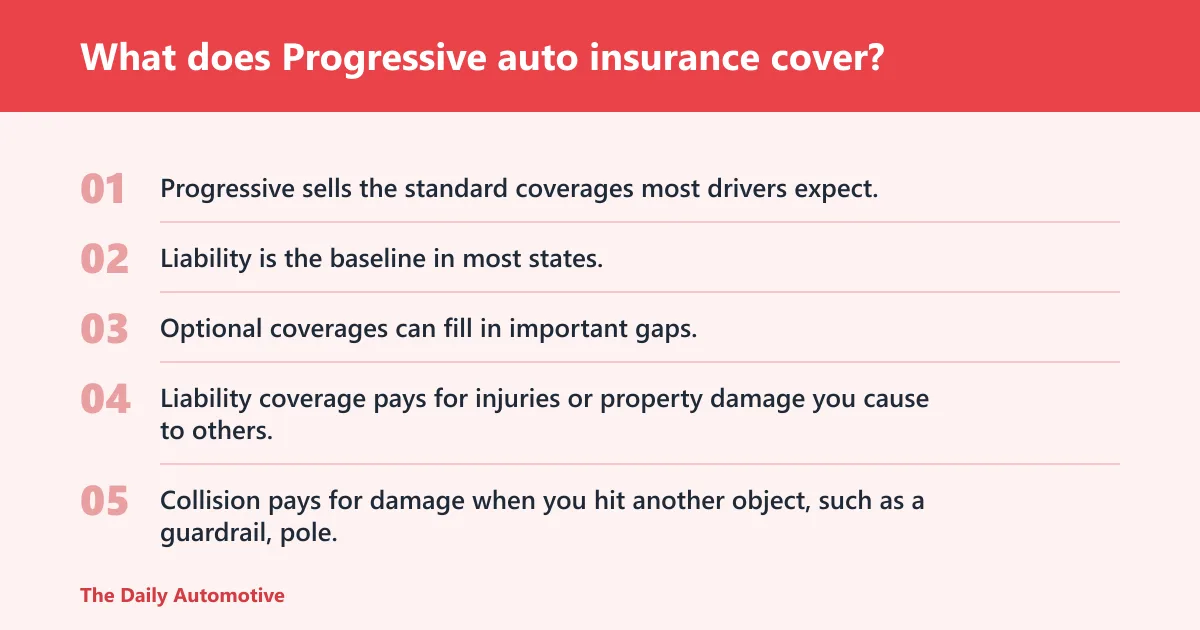
Progressive sells the standard coverages most drivers expect, plus a long list of add-ons that can matter a lot in day-to-day ownership. Liability is the baseline in most states, while collision and comprehensive address damage to your own car under different circumstances. Optional coverages can fill in important gaps.
Liability, collision, and comprehensive coverage
Liability coverage pays for injuries or property damage you cause to others, and it can include legal fees tied to those claims. Collision pays for damage when you hit another object, such as a guardrail, pole, or another vehicle. Comprehensive covers theft, vandalism, fire, animals, and acts of nature.
Collision and comprehensive are often paired because they protect your own car in different ways. They also matter for rental reimbursement eligibility in many review frameworks, since that benefit is usually tied to having those physical damage coverages in force.
Loan/lease payoff and other add-ons
Loan/lease payoff is Progressive’s gap-style protection. Experian says it covers the difference between the settlement and the loan balance, up to 25% of the car’s cash value. That can matter if you owe more than the car is worth after a total loss.
Roadside assistance can cover roadside repairs, assistance, or towing, and Progressive also supports self-service requests through the app. Rideshare coverage matters if you drive for a platform and want protection that better matches time spent logged in. Pet injury coverage can also come into play for drivers who transport animals.
Custom parts and equipment coverage
Custom parts and equipment coverage is for aftermarket upgrades and accessories that standard coverage may not fully protect. That can include a high-end stereo, navigation equipment, wheels, and paint work. If your car has any meaningful customization, this add-on deserves a close look before you accept a quote.
How does Progressive price policies and discounts?
Progressive’s pricing varies by driver profile, ZIP code, vehicle, claims history, coverage limits, and optional features. That is why two shoppers can see very different quotes for the same company. Discounts and bundling can lower the bill, but they do not erase the effect of risk factors or weak renewal pricing.
Why rates vary by driver and ZIP code
Progressive uses the information in your ZIP code and application to estimate how likely a claim is and how expensive that claim might be. That means urban density, theft risk, parking conditions, and local repair costs can all move the price. A low quote in one neighborhood may not travel to another.
Bundling and common discounts
Progressive offers discounts when you bundle policies, and that can materially change the final price. Common savings categories in the insurance market include multi-policy, safe driving, paperless billing, pay-in-full, and automatic payment discounts. The exact mix available to you depends on your state and your policy setup.
Why the cheapest quote may not stay cheapest
The first-term quote is only part of the story. U.S. News reported Progressive’s average annual rate as $1,911 and listed that as -$597 versus the national average. That does not mean it will stay the least expensive option for your next term, especially if your driving record changes or Snapshot adjusts your pricing.
- Compare the first-term premium, not just the teaser quote.
- Check the renewal terms and expected discount conditions.
- Price the same liability, collision, comprehensive, and deductible choices at competing carriers.
- Test the cost of add-ons separately, especially loan/lease payoff and rideshare coverage.
- Look at the total yearly cost, not only the monthly payment.
Should you use Snapshot?
Snapshot is Progressive’s usage-based telematics program. It tracks driving behavior and can affect rates, which means it can help careful drivers save money or work against drivers whose habits suggest higher risk. It is worth considering only if you are comfortable being rated on behavior, not just history.
How the telematics program works
Snapshot monitors signals tied to driving behavior. Progressive uses that data to adjust pricing for some customers. The appeal is clear: if you brake smoothly, avoid late-night driving patterns that suggest higher risk, and keep mileage manageable, the program can work in your favor.
When it can help safe drivers
Drivers with steady habits, low annual mileage, and a clean record may benefit from Snapshot if the program rewards that profile. A common first-timer mistake is assuming a standard quote already reflects those traits. Snapshot can sometimes make the difference between average pricing and meaningful savings.
When it can work against you
If your schedule forces hard braking, rush-hour driving, or frequent weekend trips, telematics can produce a worse outcome than a non-usage-based policy. Picture a commuter who drives 40 miles a day through dense city traffic. Even with no tickets, the data may not look as favorable as the driver expects.
Who is Progressive best for?
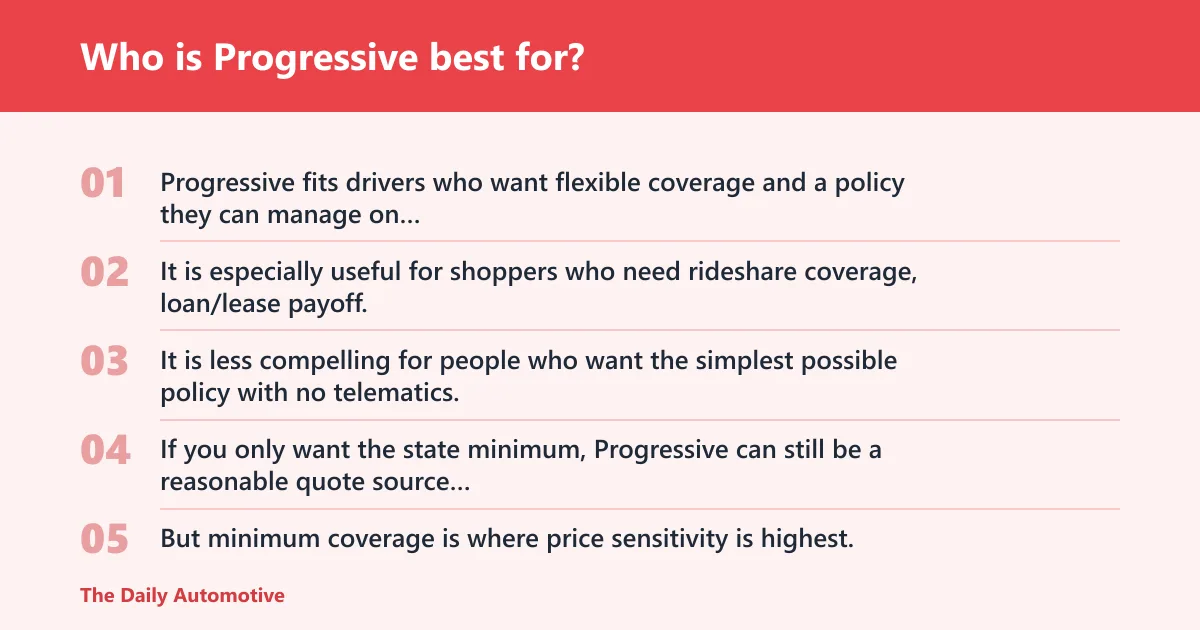
Progressive fits drivers who want flexible coverage and a policy they can manage on their phone or laptop. It is especially useful for shoppers who need rideshare coverage, loan/lease payoff, or custom-parts protection. It is less compelling for people who want the simplest possible policy with no telematics.
Minimum-coverage shoppers
If you only want the state minimum, Progressive can still be a reasonable quote source because it is a major national insurer with broad availability. But minimum coverage is where price sensitivity is highest, so you should compare several carriers before deciding. The cheapest quote today may not be the cheapest renewal next term.
Drivers who want app-based servicing
Progressive’s app supports common tasks like bill payment, claims reporting, ID cards, proof of insurance, and roadside assistance requests. That makes it a practical fit for drivers who prefer to handle policy tasks without calling in. If you want self-service and quick document access, that can be worth real money.
Drivers who need rideshare or gap-style protection
Drivers who use their car for gig work or who still owe money on a financed vehicle should pay close attention to these add-ons. Loan/lease payoff can cover the gap up to 25% of the car’s cash value, and rideshare coverage can fill an exposure that basic personal auto policies often leave open.
Drivers with aftermarket parts or accessories
If your vehicle has wheels, paint work, audio upgrades, or navigation equipment that standard coverage would not fully replace, custom parts and equipment coverage is one of Progressive’s more practical add-ons. That is where a low base quote can become a smarter ownership value story, because replacement costs can be higher than they look.
How good is Progressive for claims and policy management?
Progressive is strong on policy servicing. The app and website make it easy to pay bills, report claims, pull ID cards, and request roadside help. Claims service can still vary by adjuster and claim type, but the digital workflow is more mature than what many smaller carriers offer.
Claims filing and status tracking
You can file claims and check status online or in the app, which matters after a loss when you need a paper trail and quick updates. That cuts friction, especially if you are waiting for a tow, repair estimate, or rental-car decision. It does not guarantee a fast payout, but it helps you follow the process.
ID cards, proof of insurance, and billing in the app
The app handles billing, proof of insurance, and access to ID cards. That is useful in routine situations and during traffic stops, fender-benders, or repair-shop visits. Being able to pull those documents instantly is a real advantage if you do not want to search through email attachments.
Roadside assistance and self-service tools
Progressive’s roadside assistance is built for towing and other on-the-spot problems. The app-supported self-service option means you can ask for help without starting from scratch on the phone. For drivers who keep long hours or travel outside familiar routes, that convenience matters.
How does Progressive compare with other major insurers?
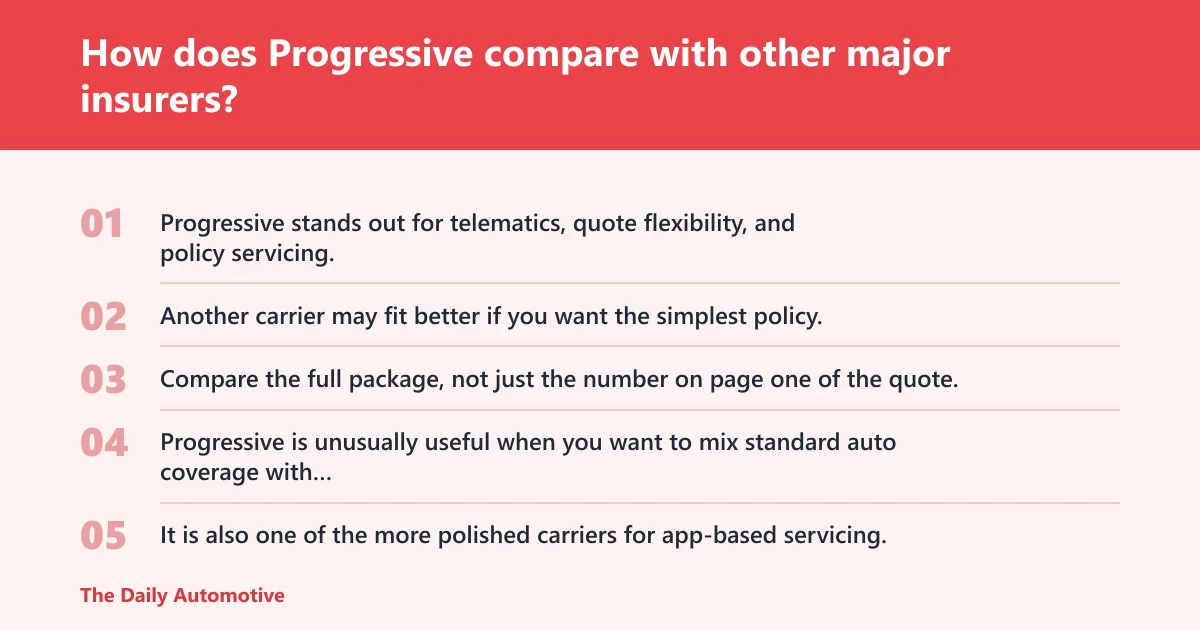
Progressive stands out for telematics, quote flexibility, and policy servicing. Another carrier may fit better if you want the simplest policy, a different claims reputation, or a stronger fit for your specific driving profile. Compare the full package, not just the number on page one of the quote.
| Driver profile | What matters most | Progressive features that matter | Watch for |
|---|---|---|---|
| Safe commuter with low mileage | Lower premium, easy renewal, basic coverage | Snapshot, bundling, app-based billing | Telematics can help, but renewal pricing still matters |
| Rideshare driver | Coverage during app-based driving | Rideshare coverage, roadside help, digital claims | Confirm when coverage applies and what gaps remain |
| Financed car owner | Protection if the loan balance exceeds the payout | Loan/lease payoff | Check the 25% cap against your loan balance |
| Car with upgrades | Protection for added value | Custom parts and equipment coverage | Standard coverage may not protect aftermarket work |
| Price-only shopper | Lowest total cost over time | Quote comparison tools | Do not stop at the first quote or assume renewal will match it |
Where Progressive stands out
Progressive is unusually useful when you want to mix standard auto coverage with targeted add-ons. It is also one of the more polished carriers for app-based servicing. Progressive reportedly launched its website in the mid-1990s and later enabled consumers to buy policies online.
Where another carrier may be a better fit
If you want the fewest moving parts possible, another insurer may be easier to live with. That is also true if Snapshot does not fit your driving pattern or if a competing carrier gives you a better renewal quote after the first term. The right choice depends on the profile, not the brand name.
What to compare before you buy
Use the same limits, deductibles, and add-ons across quotes. Compare liability, collision, comprehensive, loan/lease payoff, roadside assistance, and any custom-parts protection. Then look at renewal behavior, app convenience, and whether you are comfortable with telematics data collection.
Who it’s for
Progressive is a strong match for drivers who want a national carrier with flexible add-ons, telematics options, and solid self-service tools. It is a weaker fit for drivers who dislike usage tracking, want the simplest policy possible, or care only about the cheapest possible first quote with no concern for renewal.
Say your car is financed, you drive 12,000 miles a year, and you also do weekend rideshare. Progressive can make sense because loan/lease payoff and rideshare coverage address two real exposures at once. Suppose your sedan has $2,000 in wheels and audio upgrades. Custom parts coverage becomes much more relevant than a slightly lower base premium.
Which car insurance company has best reviews?
There is no single carrier with the best reviews for every driver. Review quality depends on claims handling, pricing, service, and fit. Progressive has mixed-to-positive sentiment overall, with U.S. News reporting 87% of surveyed policyholders were likely or very likely to renew and 77% likely or very likely to recommend it.
Frequently asked questions
Does Progressive have good auto insurance?
Yes, for the right driver. Progressive is good if you want broad coverage choices, app-based servicing, and the option to use telematics for possible savings. It is less attractive if you want the least complicated policy or if renewal pricing is likely to rise after a low first-term quote.
Is Progressive auto insurance cheap?
It can be, but “cheap” depends on your profile and location. U.S. News reported an average annual rate of $1,911, but that figure will not match every quote. Drivers with favorable risk profiles may see strong pricing, while others may find competing carriers cheaper at renewal.
Is Progressive insurance reliable?
Progressive looks reliable in the sense that it is a major national insurer, serves 43+ million customers nationwide, and offers 24/7/365 support. Financial strength also matters here: Experian said its ratings included A+ by AM Best. Reliability still depends on claims experience and fit for your policy needs.
What does Progressive auto insurance cover?
Progressive covers the basics and a long list of add-ons. Liability pays for injuries or property damage to others, collision pays when you hit another object, and comprehensive covers theft, vandalism, fire, animals, and acts of nature. Add-ons include loan/lease payoff, roadside help, and custom parts coverage.
How does Progressive handle claims and policy management?
Progressive lets you file claims, check status, pay bills, access ID cards, show proof of insurance, and request roadside assistance through its app and website. That makes day-to-day servicing easier than many people expect. Claims outcomes still depend on the specific loss and claim process.
Why is Progressive auto insurance so cheap?
Progressive can look cheap because it prices risk aggressively and gives shoppers many ways to tune the quote with discounts, telematics, and coverage choices. That same structure can also make it less cheap later if your profile changes or if Snapshot and renewal pricing work against you.
Products related to this article
Sponsored / affiliate links. As an Amazon Associate I earn from qualifying purchases. I may earn additional commission from eligible campaigns.