State Farm Auto Insurance Review: who it fits best
State Farm is a strong auto insurer if you want local-agent help, claims support, and bundling, but it is a weaker choice than digital-first rivals when you need instant quotes, policy edits, and self-service. Picking the wrong model can mean slower changes, more phone calls, and quotes that take longer to compare. This review covers coverage, pricing, claims, discounts, and where State Farm beats or trails online-first competitors.
This guide is part of our Car insurance coverage guide series.
State Farm auto insurance review: verdict first
State Farm makes the most sense for buyers who want an agent to help shape coverage, explain tradeoffs, and handle follow-up after a claim. It is less attractive if you want a fast, app-first purchase flow or a fully digital claims path. That split matters more than brand recognition.
Bottom line for bundle-first households, young drivers, and self-service shoppers
Bundle-first households may be a good fit, since State Farm says customers can bundle auto and renters insurance, and may have other bundling options with auto. Young drivers can also do well if they qualify for Steer Clear. Self-service shoppers are the weakest match because the agent model adds steps.
Where the agent model helps and where it can slow you down
An agent can help when you need to compare liability limits, deductibles, and state-specific medical coverage choices. It can slow things down when you want to edit a policy at night, compare quotes in minutes, or move a claim through a purely app-based workflow. That tradeoff is the core State Farm question.
📊 State Farm says Drive Safe & Save can deliver savings up to 30%. Source: Statefarm.
Pros and cons of State Farm auto insurance
Pros
- Strong fit for bundled accounts, especially when you already want auto plus renters, homeowners, condo, or life coverage.
- Large agent footprint, with State Farm saying it provides service through 19,000 agents.
- Useful discounts for safe drivers and younger drivers, including Drive Safe & Save and Steer Clear.
- App tools cover claims, bills, payment scheduling, and insurance cards.
Cons
- Less convenient than digital-first competitors for instant policy edits and round-the-clock self-service.
- Telematics and agent workflows can add friction if you want minimal interaction.
- Discount claims depend on eligibility, state rules, driving behavior, and selected coverages.
- Claims may still require documentation, repair questions, or agent follow-up that slows the process.

What does State Farm auto insurance cover?
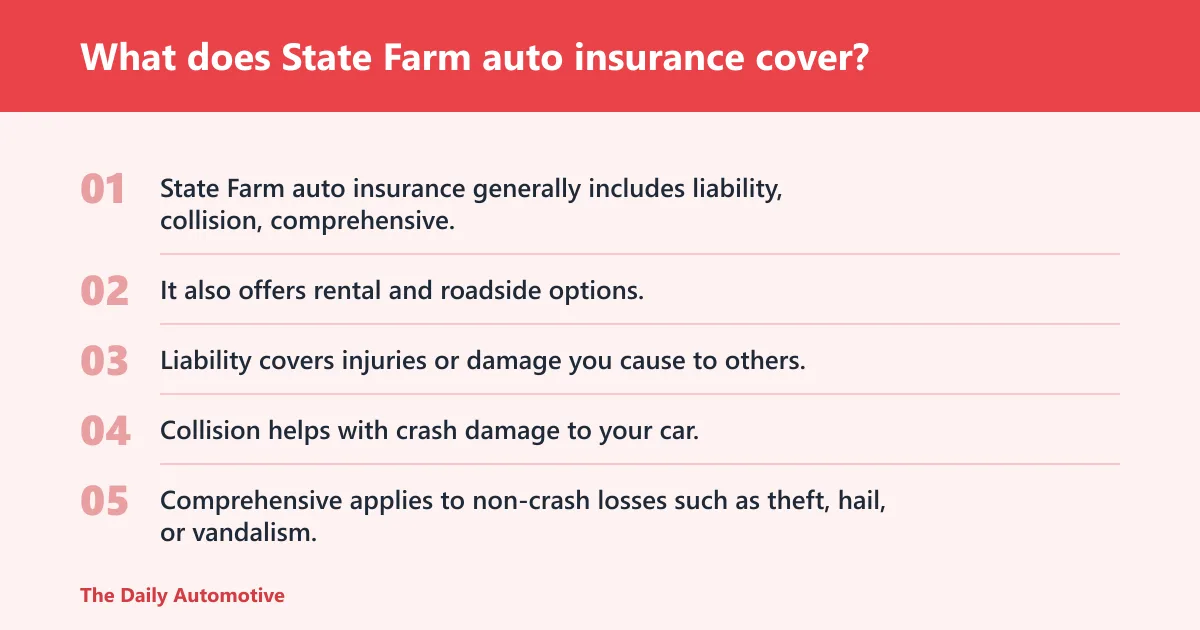
State Farm auto insurance generally includes liability, collision, comprehensive, uninsured and underinsured motorist coverage, and medical payments or personal injury protection where available. It also offers rental and roadside options, which matter if you want broader day-to-day protection.
Core coverages and common add-ons
Liability covers injuries or damage you cause to others. Collision helps with crash damage to your car. Comprehensive applies to non-crash losses such as theft, hail, or vandalism. Uninsured and underinsured motorist coverage can matter if the other driver carries too little insurance. Rental and roadside options are common add-ons.
How coverage choices affect pricing and claims
Price rises as limits rise, deductibles fall, and add-ons stack up. Claims also get more complex as coverage layers increase. A driver with full coverage and rental reimbursement will usually have a more useful policy after a crash than someone who bought only minimum liability, but the premium will reflect that.
Say your sedan is parked outside in a hail-prone suburb and a storm dents the hood and roof. Comprehensive coverage is the part that matters. If you skipped it to save money, the repair bill becomes your problem unless another policy term applies.
is state farm good car insurance for your profile?
State Farm is good car insurance for the buyer who wants guided setup, bundled policies, and a large agent network. It is a less convenient choice for the shopper who wants to buy, edit, and claim entirely online with minimal human contact. The fit depends on your preferred service model.
Best fit: bundle-first households
State Farm says customers can bundle auto and renters insurance, and that the average household savings can be up to $900 when bundling auto and renters. It also says customers can combine homeowners, condo, or life insurance with auto. That makes it especially relevant if you are already insuring more than one asset.
Best fit: young drivers
Steer Clear is the most obvious young-driver angle. State Farm says it can save safe-driving young adults up to 20%. That discount only helps if the driver qualifies and completes the required safe-driving focus or training. For a teen or young adult on a family policy, that can be meaningful.
Poor fit: self-service shoppers
If you want to compare deductibles, coverage changes, and claim status mostly in-app, State Farm may feel slower than rivals built around self-service. The app is useful, but the model still leans on an agent relationship. That can mean more calls, more follow-up, and more waiting for answers.
How much can you save with State Farm discounts?
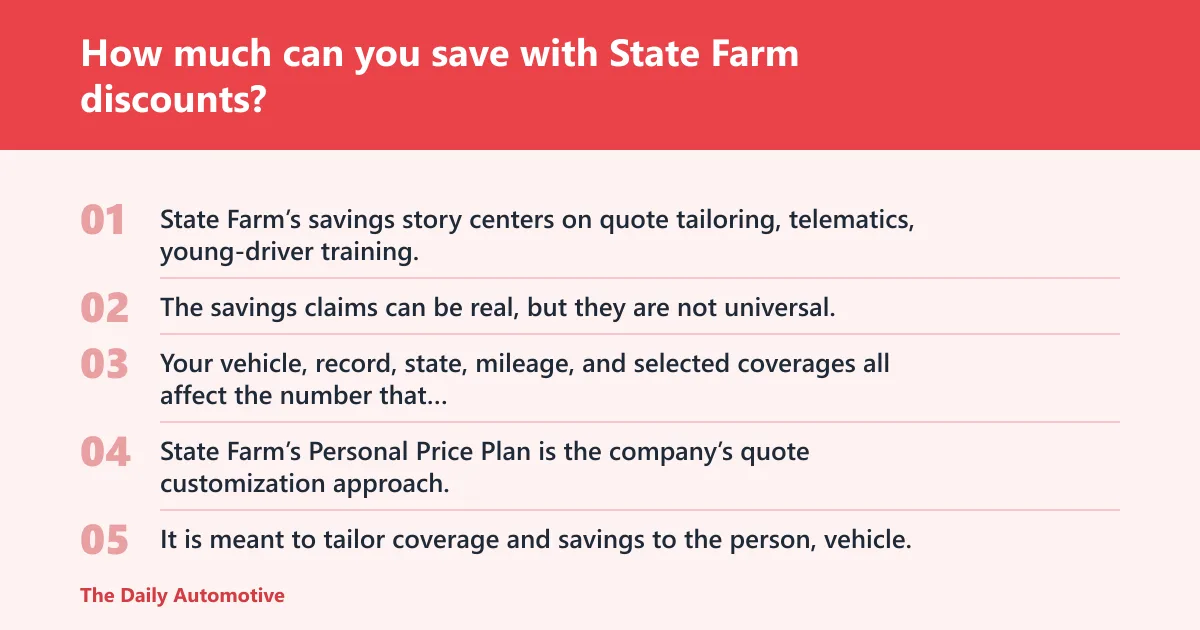
State Farm’s savings story centers on quote tailoring, telematics, young-driver training, and bundling. The savings claims can be real, but they are not universal. Your vehicle, record, state, mileage, and selected coverages all affect the number that appears on your quote.
Personal Price Plan and quote customization
State Farm’s Personal Price Plan is the company’s quote customization approach. It is meant to tailor coverage and savings to the person, vehicle, and bundle setup in front of the agent or online form. The key limitation is simple: a personalized quote can look very different from a neighbor’s.
Drive Safe & Save, including the up to 30% claim
State Farm says Drive Safe & Save can deliver savings up to 30%. That is a usage-based discount tied to driving behavior, so the upside depends on how the car is driven and, in many cases, how often it is driven. The tradeoff is telematics tracking.
Steer Clear, including the up to 20% claim
State Farm says Steer Clear can save safe-driving young adults up to 20%. That makes it more targeted than a broad discount. It helps when a household has a young driver with a clean record and the willingness to complete the program requirements, but it is not a blanket youth discount.
Bundling: auto, renters, homeowners, condo, and life
Bundling is where State Farm is most straightforward. State Farm says customers can bundle auto and renters insurance, and can pair auto with homeowners, condo, or life policies. The company also says the average household savings for auto and renters can be up to $900. That is a household-level claim, not a promise for every quote.
| Discount or pricing path | What State Farm says | Who it tends to help | Where it can fall short |
|---|---|---|---|
| Personal Price Plan | Tailored quote based on profile, vehicle, and coverages | Shoppers comparing multiple coverage setups | Does not guarantee the lowest market price |
| Drive Safe & Save | Up to 30% savings | Low-risk drivers open to telematics | Tracking and driving-pattern sensitivity |
| Steer Clear | Up to 20% savings | Safe young adults and family policies | Only useful for eligible younger drivers |
| Bundling | Auto with renters, homeowners, condo, or life; auto and renters up to $900 average household savings | Multi-policy households | Less useful if you only need standalone auto |
How the agent model changes the customer experience
State Farm says it serves more than 96 million policies and accounts through 19,000 agents. It also says customers get a dedicated agent for each account, with virtual contact available. That structure can lower friction when you want guidance, but it adds steps if you want fast, app-first service.
About 19,000 agents and dedicated support
A large agent network helps when you need to sort out coverage choices, household bundling, or a claim question that does not fit neatly into a menu. The downside is that the service experience can vary by office and by how quickly the assigned agent responds.
When virtual contact helps and when it adds steps
Virtual contact helps if you want a human answer without visiting an office. It adds steps if your goal is a same-minute change to a policy or a simple document upload. Suppose a two-car household needs to add a teen driver before school starts next week. An agent can help. A self-service carrier may be faster.
State Farm app, claims, and account access
State Farm’s app is solid for routine account tasks, but it is not the same as a fully app-run insurance experience. State Farm says its app has a 4.8/5 rating with 1M+ reviews. It also says customers can manage claims in the app, pay bills or schedule payments online, and find and save insurance cards.
App features: claims, ID cards, and policy access
For many buyers, those basics are enough. The app can help with ID cards, billing, and claim follow-up. That said, app access does not erase the agent layer. If your issue needs paperwork, repair approval questions, or coverage clarification, you may still end up speaking with someone.
What digital-first shoppers should check before buying
- Confirm how much you can actually edit in-app without calling an agent.
- Ask how claims documentation is handled after a loss.
- Check whether telematics enrollment changes your rate or data-sharing expectations.
- Compare how quickly a quote can be updated across drivers, vehicles, and addresses.
State Farm vs. Progressive, GEICO, and Allstate
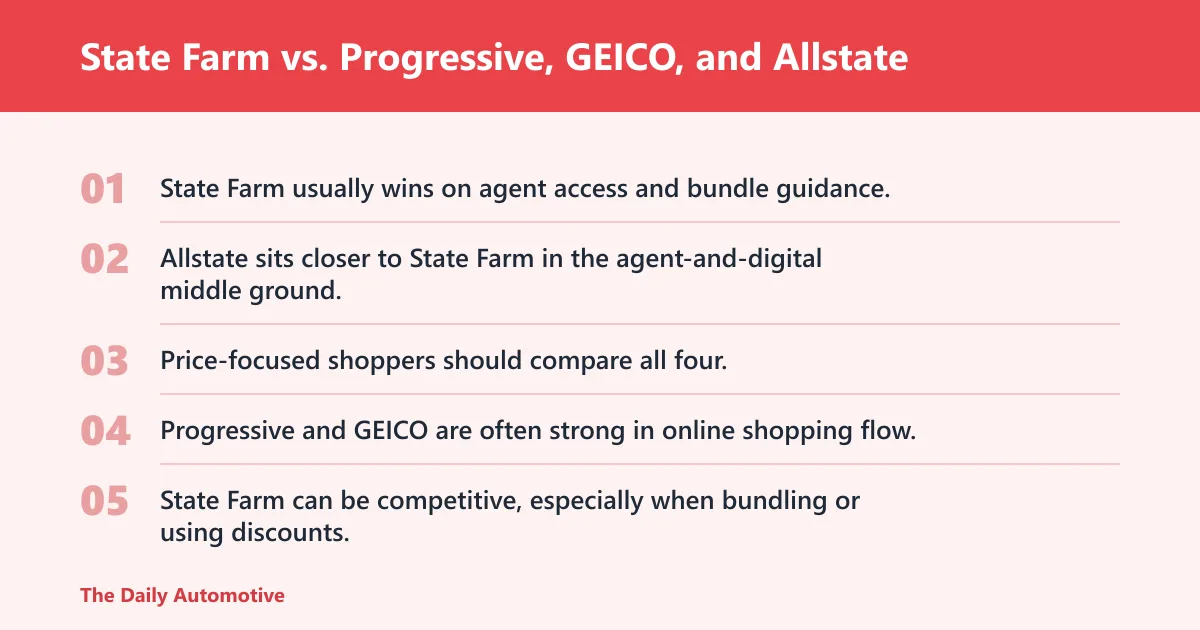
State Farm usually wins on agent access and bundle guidance, while Progressive and GEICO tend to appeal more to self-service shoppers. Allstate sits closer to State Farm in the agent-and-digital middle ground, though the best pick still depends on the exact quote and how much help you want.
Who wins for price-focused shoppers
Price-focused shoppers should compare all four. Progressive and GEICO are often strong in online shopping flow, but the quote that matters is the one tied to your driving record, vehicle, and location. State Farm can be competitive, especially when bundling or using discounts, but it is not automatically the cheapest.
Who wins for self-service
GEICO and Progressive usually fit better for shoppers who want fast quote changes and limited human contact. State Farm’s app is useful, yet the service model still leans on agents. That can be fine for many buyers, but it is not the simplest setup for pure self-service.
Who wins for bundled households
State Farm is often the better starting point if your goal is to combine auto with renters, homeowners, condo, or life insurance. The bundle math can matter more than a small rate gap on auto alone. Allstate can compete here too, but State Farm’s household-savings messaging is more central to its pitch.
| Buyer profile | State Farm | Progressive | GEICO | Allstate |
|---|---|---|---|---|
| Bundle-first household | Strong | Good if price wins | Mixed | Strong |
| Young driver | Strong if Steer Clear fits | Good for comparison shopping | Good for online shopping | Mixed |
| Self-service shopper | Weaker | Strong | Strong | Moderate |
Driver-fit decision matrix
State Farm scores highest for households that want bundled coverage and an agent to help manage the account. It scores lower for buyers who want the fewest touchpoints possible. The matrix below is meant to reflect fit, not universal price or claim quality.
| Buyer type | Fit score out of 10 | Why the score looks that way |
|---|---|---|
| Bundle-first households | 9 | Auto plus renters, homeowners, condo, or life can reduce friction and may lower household cost; agent help is useful when multiple policies are involved. |
| Young drivers | 7 | Steer Clear is a real fit for eligible safe drivers, but the value depends on program participation and the family’s policy setup. |
| Self-service shoppers | 4 | The app covers key tasks, yet the agent-first structure can slow quote shopping, policy changes, and claim follow-up compared with digital-first rivals. |
Picture a household with two adults, one renter’s policy, and a college student on the family car. State Farm can be efficient there because one agent can coordinate multiple policies and the student may qualify for Steer Clear. The same setup may frustrate a driver who wants every change handled from a phone screen in under five minutes.
Frequently asked questions
is state farm good car insurance
Yes, for the right buyer. State Farm is good car insurance if you want agent help, bundling, and a broad coverage menu. It is less appealing if you want fast self-service and the most digital claims workflow. Fit matters more than brand familiarity.
does state farm have good auto insurance
State Farm has solid auto insurance options, especially for shoppers who want liability, collision, comprehensive, uninsured motorist protection, and optional add-ons like rental or roadside coverage. The policy can be good, but the best result depends on your state, record, and whether the quote is competitive.
what is state farm auto insurance rating
State Farm says its app has a 4.8/5 rating with 1M+ reviews, but that is not the same as a full insurer rating. For the insurance itself, the better question is how the quote, coverage, claims handling, and service model fit your needs versus other carriers.
progressive vs state farm auto insurance reviews
Progressive usually gets the edge for self-service shoppers who want quick online quotes and easier app-led account management. State Farm often fits better when you want agent guidance and bundling. The better review is the one tied to your profile, not the one with the louder brand.
why is state farm the worst insurance company
It is not accurate to call State Farm the worst insurance company overall. Some shoppers dislike the agent-first model because it adds calls and slows changes. Others value that same model because it gives them a person to call. The right label depends on what you expect from an insurer.
what discounts does state farm offer for auto insurance?
State Farm highlights Drive Safe & Save, which it says can save up to 30%, and Steer Clear, which it says can save safe-driving young adults up to 20%. It also promotes bundling, including auto with renters, homeowners, condo, or life coverage. Eligibility and savings vary by profile.
how many agents does state farm have?
State Farm says it provides service through 19,000 agents. It also says each account gets a dedicated agent, with virtual contact available. That is a major part of the company’s service model and the main reason it can feel more hands-on than app-first competitors.
can i manage a state farm policy online or in the app?
Yes. State Farm says customers can manage claims in its app, pay bills or schedule payments online, and find and save insurance cards. Those are useful basics. Still, some policy changes and claim questions may move faster with an agent than through the app alone.
Products related to this article
Sponsored / affiliate links. As an Amazon Associate I earn from qualifying purchases. I may earn additional commission from eligible campaigns.
 FLORICH Leather Seat Cover, Car Seat Covers Front Set, Waterproof Car Seat Protectors, Front Seat Covers 2 Pack, Breathable Automotive Seat Covers Protector Fit for Most Cars Trucks SUV
 XICHG Universal Auto Body Alignment Bar Pulling Stick Tool, Dent Puller Tool 30 Inch Frame Puller, 3.9 inch Heavy Chain, High-Strength Rubber Pad for Auto Body Repair, Car Dent Removal (30 Inch)