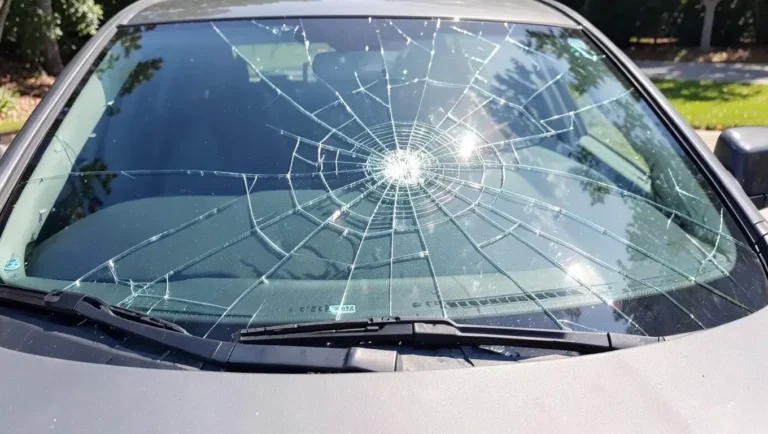
GEICO Auto Insurance Review: Coverage, Costs, and Fit
GEICO is often a solid low-price option for drivers with clean records, but only if its limits, deductibles, and claims handling line up with competing quotes. A cheap premium can leave a driver underinsured or stuck with extra hassle after a crash. This review checks GEICO’s coverage, claims friction, pricing traps, and where it fits best against other insurers.
GEICO auto insurance review: verdict and bottom line
GEICO is a strong shortlist candidate for price-first shoppers who want standard auto coverage, broad availability, and decent digital tools. It is a weaker pick when the driver needs gap coverage, tighter claims support, or a policy built around more than the state minimum.
GEICO says it has been protecting drivers for nine decades, and it sells auto insurance in all 50 states plus Washington, D.C. That matters. Availability alone does not make the policy the right fit, though. The real question is whether the quote leaves the driver exposed to lender rules, deductibles they cannot afford, or coverage holes after a loss.
Pros and cons
- Pros: Standard coverages are easy to assemble, the mobile app handles core policy tasks, and discounts can help lower the bill for some drivers.
- Pros: Nationwide availability makes it easy to quote across states and compare against local insurers.
- Cons: GEICO does not offer gap insurance, which is a real issue for financed or leased cars with negative equity.
- Cons: Service quality can vary, and complaint or satisfaction data does not guarantee a smooth claim in every state or city.
Who it’s for
GEICO fits drivers who want a mainstream policy with standard coverages, especially if they are comparing multiple quotes and can verify that the deductible, rental limit, and lender requirements line up. It is less appealing for shoppers who need gap coverage, high-touch claims help, or a policy tailored to unusual risk.
📊 NerdWallet says GEICO has available coverage in 48 states plus D.C. shown in its list. Source: Geico Auto Insurance Review 2026: Rates and Discounts….
What GEICO auto insurance covers
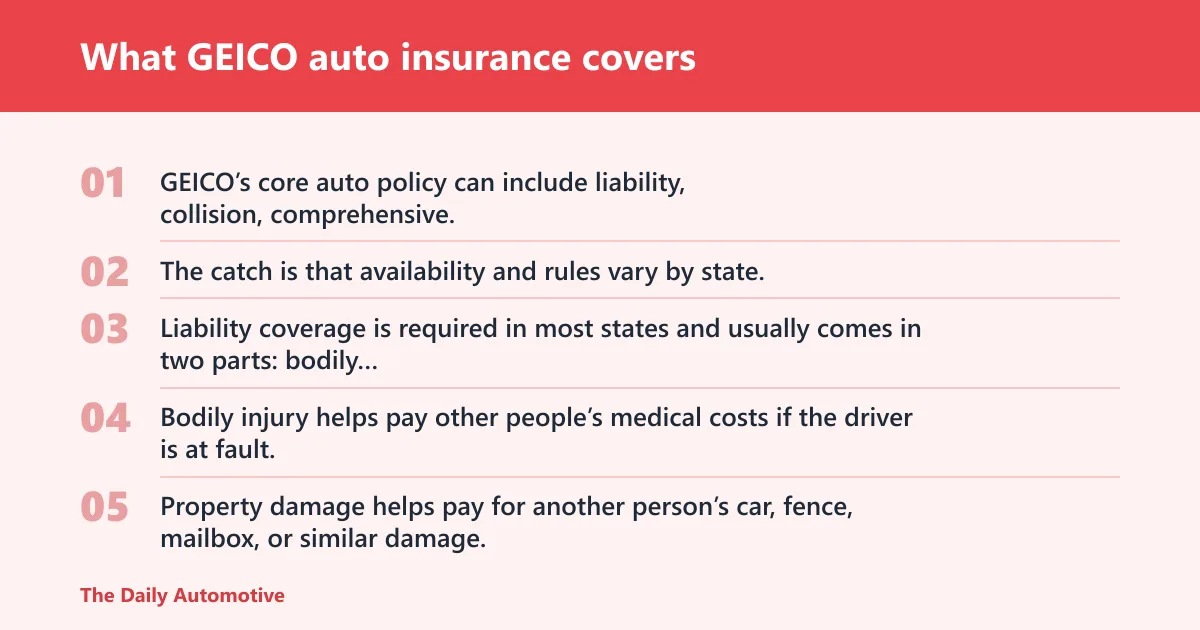
GEICO’s core auto policy can include liability, collision, comprehensive, uninsured or underinsured motorist protection, medical payments or PIP, rental reimbursement, and roadside service. The catch is that availability and rules vary by state, and some coverages are optional rather than automatic.
Liability coverage, bodily injury, and property damage
Liability coverage is required in most states and usually comes in two parts: bodily injury and property damage. Bodily injury helps pay other people’s medical costs if the driver is at fault. Property damage helps pay for another person’s car, fence, mailbox, or similar damage.
Drivers shopping only for the minimum should be careful here. State minimum requirements are often low, and a serious crash can run past them quickly. The quote may look lean, but the out-of-pocket exposure can be much larger than the premium savings.
Collision and comprehensive coverage
Collision coverage pays for damage to the insured car after a crash, no matter who caused it. It is usually optional unless a lender or lease contract requires it. Comprehensive coverage pays for theft, vandalism, flood, fire, hail, and similar non-crash losses. It is also optional unless the financing contract says otherwise.
Both coverages use deductibles. That means the driver pays the first part of the repair bill before insurance pays the rest. A lower deductible raises the premium. A higher deductible lowers the premium, but it also raises the amount due at claim time.
Uninsured and underinsured motorist coverage
Uninsured motorist coverage helps if the other driver has no insurance. Underinsured motorist coverage helps if the at-fault driver’s policy is too small to cover the loss. Some states also allow property damage protection under this section. In injury-heavy crashes, this coverage can matter more than many shoppers expect.
Medical payments coverage and PIP
Medical payments coverage and personal injury protection, or PIP, are state-dependent. They can help with medical bills, and PIP can also cover lost wages and related costs. Fault rules differ by state, so the same accident can trigger different outcomes depending on where the policy is written.
Rental reimbursement and roadside service
Rental reimbursement helps pay for a temporary rental while the car is being repaired. Policies usually carry daily and total claim limits, so the benefit can run out before the repair is done. Emergency roadside service can help with towing, jumpstarts, flat tires, and locked-car calls.
Those add-ons are useful, but they are not full repair coverage. A tow on a bad night is helpful. It is not a substitute for a policy that properly covers the car’s actual exposure.

Does GEICO have the add-ons and limits your car needs?
GEICO covers many drivers well on the basics, but some shoppers run into a hard stop on features that matter after a loss. The biggest example is gap insurance. Another is the way deductibles and claim limits shape the real value of the policy once a claim begins.
Mechanical Breakdown Insurance
GEICO offers Mechanical Breakdown Insurance on certain newer cars. Experian says it applies to vehicles under 15 months old and under 15,000 miles, and it can last up to seven years or 100,000 miles. That is not the same as a factory warranty. It is an insurance product with its own terms, exclusions, and claim process.
For a buyer of a lightly used car, this can be useful if the vehicle fits the mileage and age rules. For everyone else, it may simply not apply.
Gap insurance and what GEICO does not offer
NerdWallet says GEICO does not offer gap insurance. That matters most for leased vehicles, financed vehicles with little equity, and cars that are worth less than the loan balance. If the car is totaled, the insurer may pay the actual cash value, not the remaining loan payoff.
Without gap coverage, the driver can still owe money after the vehicle is gone. That is the hidden cost many quote pages skip. If the loan is long, the down payment was small, or the car depreciates fast, this absence can matter more than a small premium difference.
Deductibles, claim limits, and lender rules
Deductibles are where cheap quotes can turn expensive. Collision and comprehensive claims both use them, and rental reimbursement also has caps that may leave a driver paying for extra days out of pocket. A low quote with a high deductible may be fine for a paid-off commuter, but it can be poor value for a financed car owner who needs predictable claim costs.
- Check the lender or lease contract first.
- Match liability, collision, and comprehensive limits to the required terms.
- Compare the deductible against cash on hand, not just the monthly premium.
- Confirm rental reimbursement days and dollar limits before buying.
- Ask how roadside service and mechanical breakdown coverage apply in the car’s state.
GEICO costs: what changes your quote
GEICO’s price can be attractive, but no average quote tells the whole story. NerdWallet lists GEICO minimum coverage at $41 per month and full coverage at $168 per month. U.S. News gives GEICO an average annual rate of $1,925. Those figures can help with comparison shopping, but they are not a promise for any one driver.
Why price varies by driver and state
Premiums shift with age, driving record, vehicle value, location, annual mileage, and coverage choices. State rules also matter. A policy written in one state may differ from the same company’s policy in another because PIP, uninsured motorist rules, and required liability levels are not identical everywhere.
How coverage choices move the premium
Liability-only coverage usually costs less than a policy with collision and comprehensive. Lower deductibles usually raise the quote. Higher limits can also raise it, but they can protect the driver when the loss is bigger than the minimum. The cheapest policy is often the one with the largest blind spots.
How to compare a cheap quote against a stronger policy
Compare the same items line by line: liability limits, uninsured motorist limits, deductible levels, rental reimbursement caps, and roadside add-ons. A policy that is $20 or $30 lower per month can still be worse if it leaves a financed car underprotected or makes a repair claim harder to absorb.
What discounts does GEICO offer?
GEICO promotes multi-policy bundling, and it also advertises a mix of safe-driving, affiliation-based, and quote-based savings. That can help, but discounts do not guarantee the lowest total cost once limits, deductibles, and add-ons are matched to the vehicle.
Multi-policy and affiliation-based discounts
GEICO promotes multi-policy bundling for auto and property insurance. It may also offer savings tied to employer, organization, or membership relationships. These discounts can be useful for homeowners and renters who want one insurer for more than one policy, though not every shopper will qualify.
Safe driving and usage-based savings
Safe driving discounts reward clean records, and some drivers may qualify for usage-based savings if their mileage and habits are favorable. These programs can lower the bill for low-risk motorists, but the tradeoff is that the savings depend on the insurer’s rules and the driver’s profile.
Why a discount is not the same as low total cost
A discount only matters after the policy is built correctly. If a driver has to add collision, raise liability limits, or increase rental reimbursement to meet real needs, the final price may still be a better buy at another carrier. Always compare the final policy, not the headline savings.
GEICO claims and customer service: is it reliable?
GEICO’s claims support is generally solid enough for mainstream shoppers, but the service record is mixed rather than perfect. U.S. News says 80% of surveyed customers were satisfied contacting service, and 85% were satisfied with claims resolution. That is helpful context, not a guarantee of speed or fairness on a specific claim.
What complaint data can and cannot tell you
NAIC complaint patterns and consumer survey feedback can hint at trouble spots such as billing friction, claim delays, or problems reaching support. J.D. Power claims satisfaction studies can add another layer. Even so, these signals measure trends, not the outcome of any one repair estimate or total-loss file.
How claims handling affects repair delays and payout speed
For a driver, the big risk is not the slogan on the website. It is the time between filing the claim and getting the car repaired or the settlement paid. Delays can come from claim review, supplement disputes, repair shop coordination, or missing documents. Faster service matters more when the car is the daily driver.
What the mobile app does well
GEICO Mobile lets users access digital ID cards, file claims, make payments, request roadside service, and handle account tasks 24/7. That is useful for paperwork and first notice of loss. It does not, by itself, prove a smooth claim outcome, but it does reduce friction for routine policy management.
GEICO fit-check: who should buy, and who should keep shopping?
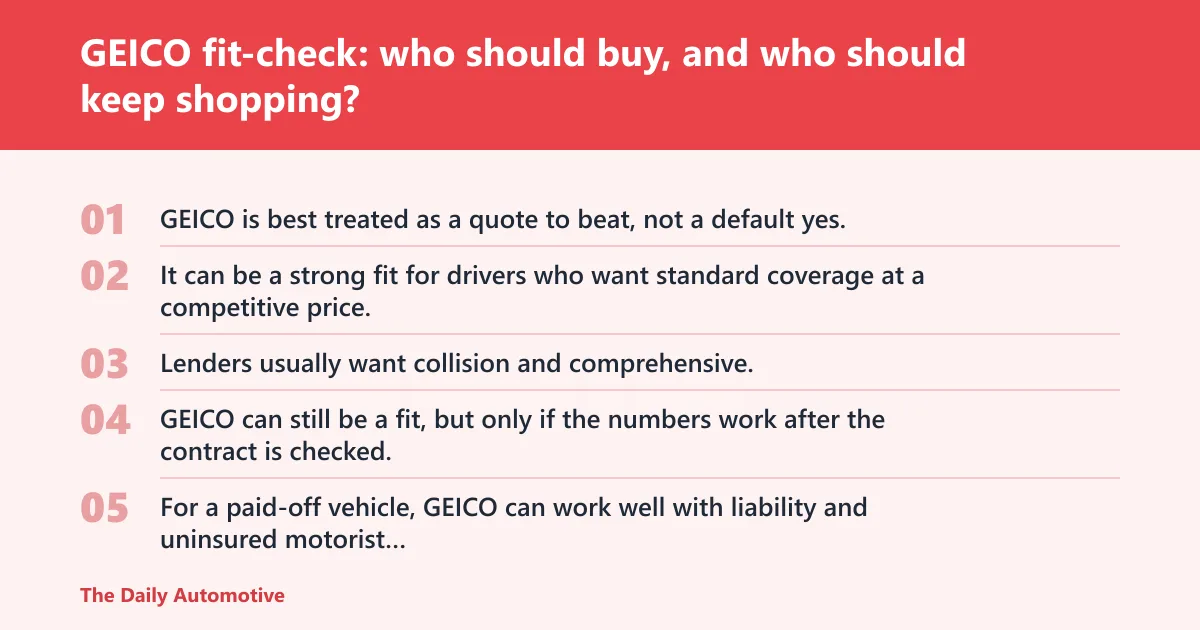
GEICO is best treated as a quote to beat, not a default yes. It can be a strong fit for drivers who want standard coverage at a competitive price, but it is a weak fit when the policy must solve for loan payoff risk, higher repair exposure, or unusually specific coverage needs.
| Driver profile | Must-have coverages | Likely GEICO gap | Recommended action |
|---|---|---|---|
| Financed car | Collision, comprehensive, rental reimbursement, strong liability | No gap insurance | Compare GEICO only if the loan balance stays below the car’s value or if another carrier can add gap coverage |
| Leased car | Collision, comprehensive, lender-required limits, low enough deductible | Gap coverage absence can be a problem | Check lease terms first and shop carriers that can cover payoff risk more fully |
| Older paid-off car | Liability, uninsured motorist, roadside service | Full coverage may not be worth the cost | Price liability-only versus a modest full-coverage package with a deductible you can absorb |
| Low-mileage driver | State-required liability, possibly roadside and usage-based savings | Benefits depend on state and discount eligibility | Ask about mileage-based pricing and compare the final quote after discounts |
| Minimum-coverage shopper | State minimum liability, uninsured motorist where required | Low limits can leave major exposure | Only choose minimums if the driver can accept the risk and has no lender requirements |
Financed cars and leased cars
These drivers need the closest review. Lenders usually want collision and comprehensive, and the missing gap coverage is a real concern if the payoff balance is high. GEICO can still be a fit, but only if the numbers work after the contract is checked.
Older paid-off cars
For a paid-off vehicle, GEICO can work well with liability and uninsured motorist coverage, plus roadside service if needed. Full coverage may still be worth it on a clean, valuable older car, but the deductible should be compared to the car’s real cash value.
Low-mileage drivers
Low-mileage drivers may find GEICO attractive if safe-driving or quote-based savings apply. The bigger question is whether the policy still covers the right risks, especially if the vehicle is parked outside, driven in hail-prone areas, or used occasionally for long trips.
Minimum-coverage shoppers
Minimum coverage can satisfy state law, but it does not protect the policyholder from all financial pain. GEICO may fit this buyer on price, yet the safer buy is often the one with slightly stronger liability and uninsured motorist limits if the budget allows it.
is geico a good insurance company
GEICO is a good insurance company for many mainstream drivers, especially those who want standard auto coverage and can verify that the limits fit the car and the lender. It is not automatically the right choice for everyone, because the best insurer is the one whose policy matches the real risk.
does geico have good insurance
GEICO has good insurance for drivers who need common coverages, want a quote from a national carrier, and can live with its terms on deductibles, claim limits, and add-ons. It is less compelling when a shopper needs gap insurance, broader service support, or very specific coverage tailoring.
how reliable is geico auto insurance
GEICO looks reasonably reliable on paper, with strong availability and acceptable satisfaction signals, but reliability in insurance also means claim handling under pressure. Survey results can be encouraging, yet they do not prevent delays, disagreements over repairs, or local service bottlenecks in a real claim.
is geico the best insurance company
GEICO is not the best insurance company for every driver. It can be among the better options for price-focused shoppers with straightforward needs, but a better choice may exist if the driver needs gap coverage, stronger bundled protection, or more confidence in claims handling.
what does geico auto insurance cover
GEICO auto insurance can cover liability, collision, comprehensive, uninsured and underinsured motorist protection, medical payments or PIP, rental reimbursement, roadside service, and in some cases Mechanical Breakdown Insurance. Exact availability and rules depend on the state, the vehicle, and the policy design.
how much does geico car insurance cost
Reported snapshots can help with comparison shopping, but they do not predict any single quote. NerdWallet lists GEICO minimum coverage at $41 per month and full coverage at $168 per month, while U.S. News gives an average annual rate of $1,925. The right test is the actual quote for the driver’s profile.
does geico offer gap insurance
No. NerdWallet says GEICO does not offer gap insurance. That is a serious issue for leased vehicles, financed vehicles with small equity cushions, and drivers whose cars depreciate faster than the loan balance falls. Without gap coverage, a totaled car can still leave a loan balance behind.
how do geico claims and customer service compare
GEICO’s claims and customer service are decent for many shoppers, but not flawless. U.S. News reports 80% satisfaction with service contact and 85% with claims resolution, which suggests workable support. Even so, complaint patterns and local repair coordination still matter when the claim becomes real.
is geico a good insurance company for home and auto
GEICO can be a practical choice for shoppers who want to bundle auto and property insurance, since GEICO promotes multi-policy bundling. The bundle only makes sense if both policies are strong enough on their own. A discount is not worth much if the auto policy misses key protection or the home coverage is thin.
is geico a good insurance co
GEICO can be a good insurance company for a clean-profile driver who wants broad availability, common coverages, and a competitive quote. It is a weaker choice for anyone who needs gap coverage, higher-touch claims support, or a policy that is designed around financing rules rather than just price.
Frequently asked questions
Products related to this article
Sponsored / affiliate links. As an Amazon Associate I earn from qualifying purchases. I may earn additional commission from eligible campaigns.