Can You Check Car Service History Online? What It Shows First
Yes, you can check some car service history online, but it is rarely complete; use it as proof of recorded maintenance, not proof of every oil change or repair. Missing records can hide skipped servicing, odometer gaps, and expensive surprises. This guide shows which online sources are credible, what they can confirm, and when you still need paper invoices or dealer records.
What Online Checks Actually Reveal About a Vehicle
Yes, but only partly. Online checks can reveal maintenance entries, repair notes, accident reports, ownership changes, theft flags, title problems, and recall alerts. They do not create a full service log on their own, and they often miss work done outside participating dealers or shops.
What online checks can actually show
A VIN-based search can surface maintenance records and accident reports, and some vehicle history reports also include sales history, theft records, warranty information, impounding events, and towing events. A few platforms also show service alerts or recall notices tied to the vehicle.
What online checks cannot prove
They cannot prove every routine service happened on schedule. They also cannot prove a dealer or garage submitted every invoice, and they cannot confirm undocumented work done by a private seller. A clean report is not the same thing as a full service history.
Why records are often partial
Many cars have gaps because older paper records were never digitized, independent garages may not share data, and owners may use shops that do not feed into large databases. A vehicle can be well maintained and still have thin online records.
What you need before you start
Most online lookups start with the Vehicle Identification Number, or VIN. It is a unique code consisting of 17 characters, and it is the main key used by online lookup tools to decode vehicle details and match records across databases.
Find the VIN and confirm it matches the car
Check the VIN on the dashboard, driver’s door area, registration paperwork, and insurance documents where allowed. Every label should match. If the numbers differ, stop and ask why before relying on any history report.
Gather the registration or plate number where allowed
Some checks work from a registration number or plate, including in the UK. Others require the VIN. Use both when the site permits it, because a second identifier can help catch mismatches or cloned plates.
Know when seller permission is needed
Some owner-facing tools require an account linked to the vehicle, so the seller may need to share access or produce records directly. Do not assume a third-party report gives permission to view private shop invoices or account data.

Which online sources are worth checking?
The strongest online approach uses multiple sources rather than one report. VIN-lookup and vehicle-history services can pull maintenance, repair, accident, theft, ownership, title, and recall data, but reliability varies by source, so one clean report should never be treated as complete proof.
VIN-lookup and vehicle-history services
These are the broad reports most buyers think of first. They may show maintenance entries, accident reports, title problems, and other events tied to the VIN. Some platforms offer free VIN checks for vehicle history details, while paid reports may add more breadth.
CARFAX Car Care
CARFAX offers a free Car Care account. It can show vehicle service history and alerts, find trusted service shops, and alert owners about open recalls. That makes it useful for ongoing tracking, but it still depends on what participating sources submitted.
NICB VINCheck
NICB offers a free VIN check for stolen or salvage-status vehicles. That is useful screening, but it is not a full service-history tool. It helps answer whether a car carries theft or salvage signals, not whether every oil change was logged.
Dealer portals and brand sites
Some brands and dealer networks store service entries tied to the VIN. These records can be more useful than generic history reports when the work was done inside the manufacturer’s network. The limit is obvious: they miss outside repairs and independent garages.
Verification matrix: source, proof, and trust level
Use the matrix below to separate evidence from noise. The trust level is about buying confidence, not legal certainty. A high-trust source can still be incomplete, and a low-trust source can still point you toward a real issue worth checking.
| Source | What it can prove | What it cannot prove | Trust level before buying |
|---|---|---|---|
| Dealer-reported service records | Work done by that dealer or its network, often with dates and mileage | Independent-garage work, private repairs, and any missed uploads | High for that dealer’s own entries |
| VIN-lookup service | Maintenance records, accident reports, ownership history, title events | Full servicing, all invoices, and non-participating shop work | Medium |
| Vehicle history report | Sales history, theft records, warranty information, impounding and towing events, sometimes service entries | Complete maintenance chronology | Medium |
| CARFAX Car Care | Service history and alerts, trusted service shop search, open recalls | Every repair performed outside participating data sources | Medium to high for tracked entries |
| NICB VINCheck | Stolen-vehicle status and salvage-title signals | Service history, routine maintenance, and repair details | High for theft/salvage screening only |
| VINCheck.info | Free VIN search service data summaries | Full maintenance proof and dealership invoice trail | Low to medium |
How much weight to give each result
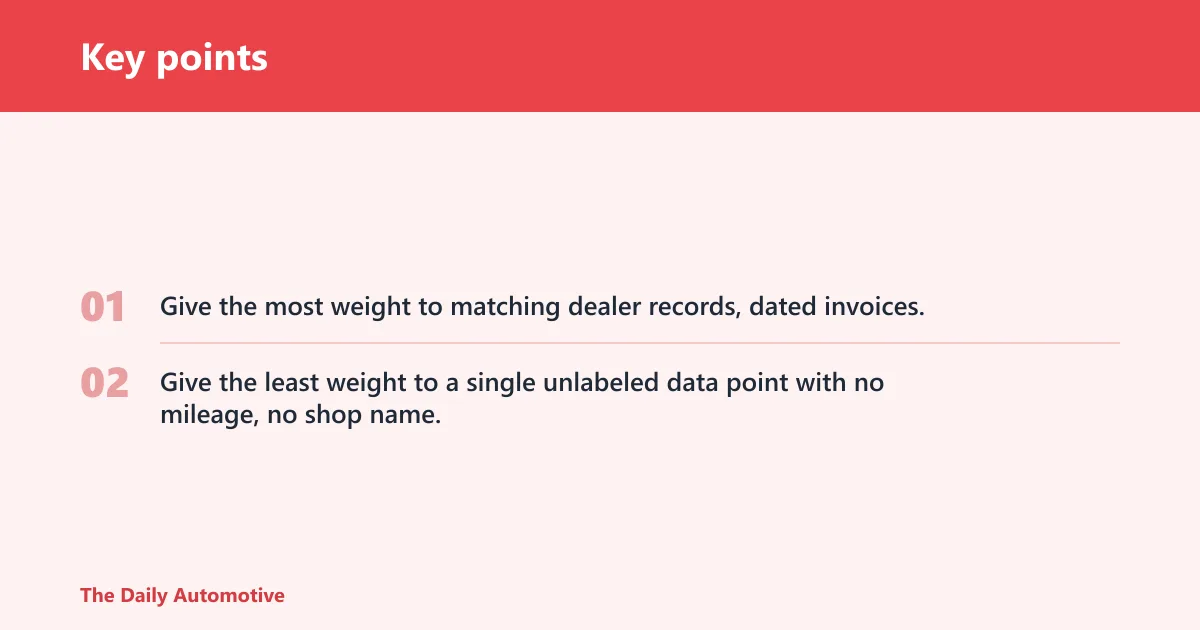
Give the most weight to matching dealer records, dated invoices, and entries that repeat across multiple sources. Give the least weight to a single unlabeled data point with no mileage, no shop name, and no supporting paperwork. Consistency matters more than volume.
How do you check a car’s service history online?
Start with a VIN-based history report, then compare it with any owner account or dealer portal tied to the car. Check the mileage sequence, service dates, and shop names. If the record trail stops early, ask for invoices, repair orders, or OEM service printouts.
Run a VIN-based history report
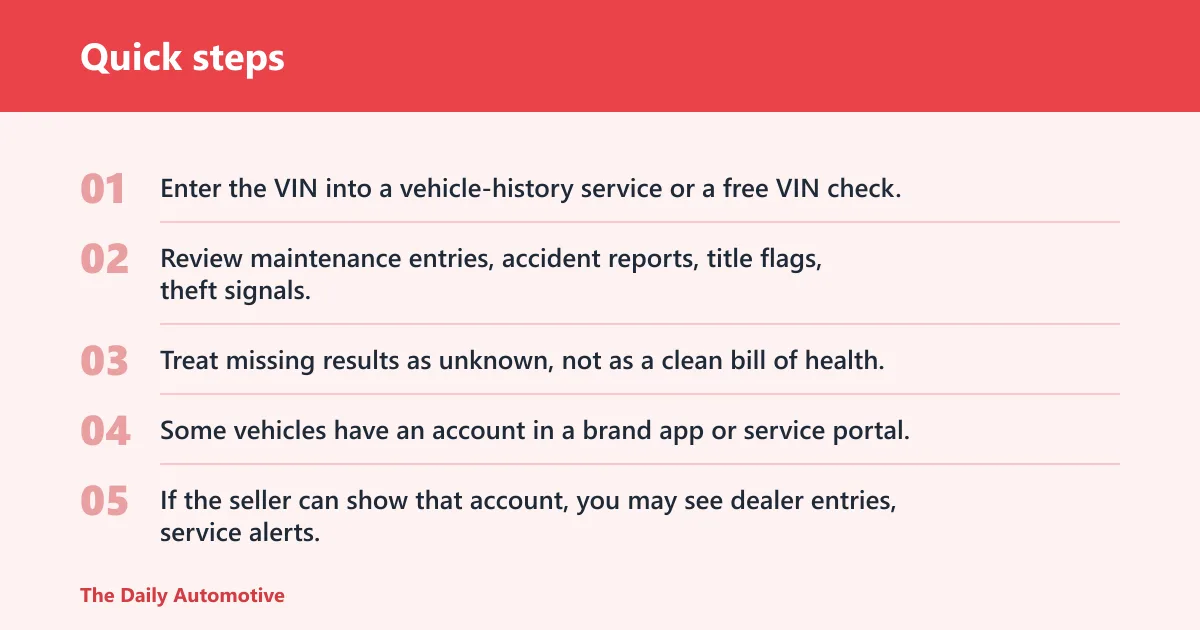
Enter the VIN into a vehicle-history service or a free VIN check. Review maintenance entries, accident reports, title flags, theft signals, and ownership changes. Treat missing results as unknown, not as a clean bill of health.
Open any owner account tied to the car
Some vehicles have an account in a brand app or service portal. If the seller can show that account, you may see dealer entries, service alerts, or recall notices. This is stronger than a generic report because it is tied to the vehicle’s own record set.
Cross-check mileage, dates, and shop names
Look for a sensible progression. A service entry at a lower mileage would usually not come after one at a higher mileage dated earlier. A common first-timer mistake is trusting a report with neat formatting while ignoring impossible mileage jumps.
Ask the seller for invoices when records stop
Suppose a 2018 hatchback shows service entries only through a later year. That may mean the car was maintained privately after that point. Ask for paper invoices, emailed repair orders, or dealer statements before deciding the history is incomplete.
Free checks vs paid reports: what is worth paying for?
Free checks are good screening tools. Paid reports may add more source coverage, more event types, or better continuity. Neither one proves a full maintenance log on its own, so the real question is whether the report is good enough to change your buying decision.
What free checks are good for
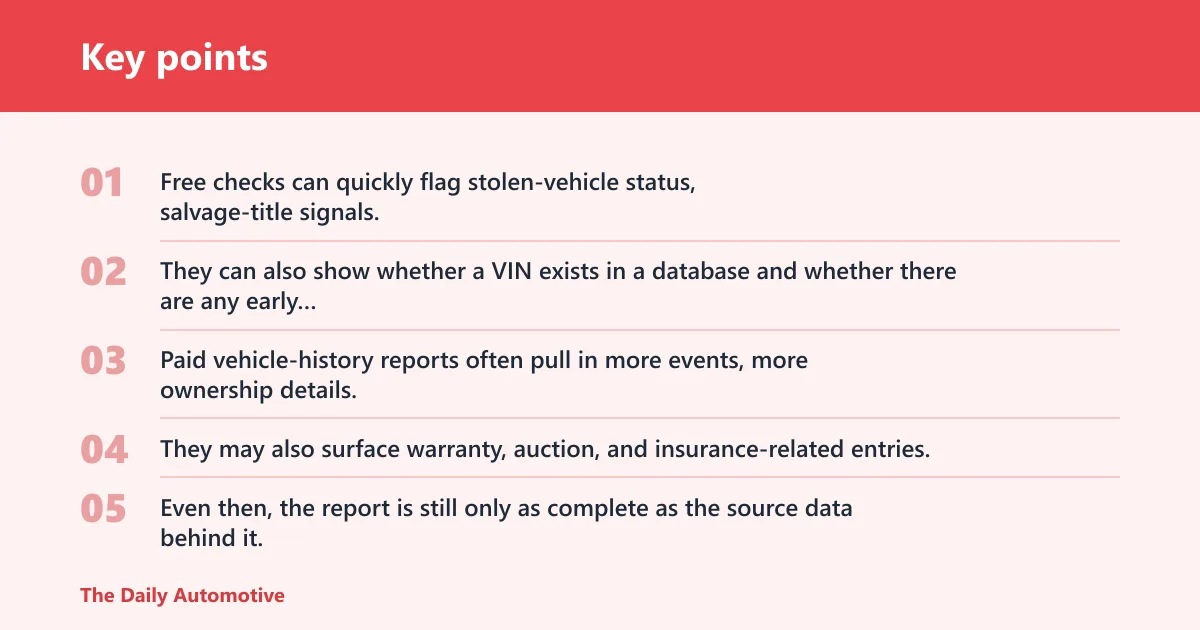
Free checks can quickly flag stolen-vehicle status, salvage-title signals, and obvious red flags. They can also show whether a VIN exists in a database and whether there are any early maintenance or recall clues worth chasing.
What paid reports may add
Paid vehicle-history reports often pull in more events, more ownership details, and more record types than free tools. They may also surface warranty, auction, and insurance-related entries. Even then, the report is still only as complete as the source data behind it.
When to stop relying on online data
Stop when the report becomes too thin to support the asking price. If the car is older, heavily modified, or serviced across several independent garages, online data may only give partial comfort. At that point, paper invoices matter more than another report, and you should inspect the car in person instead of relying only on records.
Can you check car service history online free in the UK?
Yes, but free UK checks often cover registration status, MOT history, tax, and basic vehicle data more often than a full service log. UK service history is commonly split between franchised dealers and independent garages, so no single free site usually proves everything.
UK-free checks and what they usually cover
Free UK checks are useful for confirming registration details, roadworthiness records, and whether the car has obvious administrative issues. They may not reveal the full maintenance trail, especially if servicing happened outside a dealer network or before records were digitized.
Why UK service history is often split across dealers and independent garages
Franchised dealers may store one set of records, while independent garages keep another. A car can therefore have a valid service history that is fragmented across several systems. That is why a buyer should ask for invoices, stamped booklets, and digital printouts together.
What to request from the seller before paying
Ask for the service book, invoices, MOT-related paperwork where relevant, and any screenshots or PDFs from dealer systems. If the seller cannot produce anything but claims a “full history,” treat that as unverified until the paperwork appears.
Can you check car service history online free?
Yes, you can check some car service history online free, but free tools usually screen for problems rather than prove full maintenance. They are best for checking theft, salvage, recall, and partial service entries before you spend money on deeper reports or inspections.
Are free VIN checks enough to prove service history?
No. Free VIN checks can confirm stolen-vehicle status, salvage flags, or a few database entries, but they do not prove a full service log. They are useful as the first filter, not the final answer on whether the car was maintained properly.
Can you get car service records online?
Sometimes. Dealer portals, brand apps, and owner-linked accounts can show service records online, and CARFAX Car Care can also show service history and alerts. The limitation is coverage: many repairs never reach those systems, especially if done outside the network.
How reliable is an online service history check before buying a used car?
It is reliable for screening, not for certainty. Online checks are good at spotting red flags that deserve follow-up. They are weak at proving a car had every scheduled service, because online sources vary in reliability and can miss non-digitized work.
Can you check if a car has full service history online?
You can sometimes get enough online evidence to suggest a car has a strong service record, but full service history is hard to prove online alone. A complete picture usually needs dealer data, printed invoices, and mileage consistency across several sources.
What full service history usually means in practice
In practice, it means service entries or invoices covering the expected maintenance schedule with no obvious gaps. That is stronger than a database summary. If the timeline has missing years, missing mileage, or anonymous shop entries, the history is partial.
What to do when the report looks incomplete
Ask the seller to fill the gaps with invoices, stamped service books, or dealer confirmations. If that evidence never appears, assume the maintenance trail is incomplete and price the car accordingly.
Can you check car service history online free uk gov
UK government-style checks can help confirm registration and test history, but they usually do not provide a complete service log. For service evidence, you still need dealer records, invoices, or owner-supplied paperwork. Use government data for screening, not for total maintenance proof.
What do you need to look up a car’s service history online?
You usually need the 17-character VIN, and sometimes the registration or plate number too. Some tools also ask for seller access, an owner account, or confirmation details to open service records tied to the car.
Privacy, data-sharing, and VIN misuse risks
Share the VIN only with reputable services and the seller when needed for verification. A VIN can be used to pull vehicle data, so avoid posting it publicly if you do not need to. Watch for cloned listings, where the same VIN appears on different cars.
How to handle incomplete or inconsistent records
If mileage jumps backward, shop names look generic, or dates do not line up, treat the report as a warning. A partial record is better than no record, but it should not be used as proof of careful maintenance.
Products related to this article
Sponsored / affiliate links. As an Amazon Associate I earn from qualifying purchases. I may earn additional commission from eligible campaigns.