Can You Negotiate Car Service Charges? A Line-Item Guide
Yes, many car service charges can be negotiated, but usually only labor hours, diagnostic fees, shop supplies, and parts markup; safety-critical repairs, taxes, and manufacturer-priced warranty work usually are not. Push the wrong line items and you can waste time, lose goodwill, or delay a repair you actually need. This guide maps each estimate line by line and gives you the exact wording to ask for a lower price without compromising the fix.
Ask for a Written Estimate and Target Specific Line Items



Yes, but the realistic target is the total bill, not every line item. The most movable pieces are diagnostics, parts markup, and package pricing, while labor rates are usually harder to change. Ask for a written estimate first, then ask for specific line items to be reviewed instead of asking for “a discount” in general.
What usually moves on a service bill
Service coupons can bring dealer maintenance close to independent-shop rates, so check those before you ask for a manual price cut. Larger repair orders, especially over $500-1,000, tend to have more flexibility. Service managers may have more pricing flexibility than service advisors, and a competitor quote is a legitimate negotiating tool for bigger jobs.
Dealers often have more room on package pricing than on posted labor. Independent shops may be more willing to adjust the total when the job is already in the bay. Mobile mechanics and quick-lube chains usually work from tighter menus, which means fewer moving parts and less room to bargain line by line.
What usually does not move
Warranty repairs are manufacturer-funded and fixed, so they are not a normal negotiation case. Recall work is always free. Taxes are fixed, and safety-related repairs should not be bargained down in a way that changes parts quality or repair procedure. If the estimate is built around specialty parts or coded manufacturer pricing, the bill may not move much.
How repair pricing is built
Repair pricing usually combines labor rate, parts pricing, diagnostic time, and small fees such as shop supplies or fluids. The bill may look simple, but each line follows a different rule. A fair negotiation starts with knowing which items are posted, which are flat-rate, and which are based on markup.
Labor rate and flat-rate billing
Labor is often billed by the hour or under flat-rate rules. Motor and Minds says dealer labor rates can run from $85 to $185 per hour, while independent shops charge $60 to $120 per hour. Those numbers can vary by region, but in general labor rate is usually one of the least flexible parts of the estimate.
A water pump example bills the same flat-rate hours regardless of actual repair time. That means the clock is not tied to the wrench time you imagine. If the shop is already using flat-rate labor, ask whether the total can be adjusted through package pricing or a coupon rather than asking for the hourly rate to be cut.
Parts pricing and markup
OEM part markups vary by item and dealership. On larger jobs, parts markup may have some room to move, especially if the shop can source the same part through another channel. Aftermarket pricing can lower the bill, but only if the part meets the vehicle’s needs and does not put warranty coverage or durability at risk.
That distinction matters. The goal is not to squeeze every part to the lowest sticker. The goal is to know whether the shop is pricing an OEM part at dealer cost plus markup, or whether an aftermarket equivalent is available at a lower price without creating a problem later.
Diagnostic fees, shop supplies, and consumables
Diagnostic fees often move before labor does. Shop supplies and fluid or consumable charges are usually smaller, but they can still be reviewed on a larger estimate. Ask whether those fees are a percentage, a flat amount, or a pass-through cost. If the shop cannot explain them clearly, that is a warning sign.
What parts of a car repair bill are negotiable?
The most negotiable parts of a repair bill are often diagnostics, parts markup, and bundle pricing. Labor can move, but less often and usually only on larger jobs. Fees for supplies and consumables may be trimmed. Warranty work and recall work are not bargaining targets, and safety items should not be cut to save a few dollars.
Diagnostics and inspection charges
Ask whether the diagnostic fee will be applied to the repair if you approve the work. Some shops will credit part of it back. That is a better ask than demanding a raw discount. If the vehicle needs a detailed electrical diagnosis or intermittent fault tracing, the fee may be justified and harder to reduce.
Parts markup on larger jobs
Parts markup is often where you have the clearest opening, especially on brake jobs, suspension work, alternators, water pumps, and cooling-system repairs. The broader the repair order, the more likely a shop can adjust part pricing. That is where a competitor quote is useful: it gives the shop a specific comparison instead of a vague complaint.
Bundle pricing and package deals
Package pricing is often easier to get than a line-by-line discount. A dealer may reduce the total if you combine maintenance items, and a chain service center may have a service coupon that gets you close to an independent-shop quote. That is often the cleanest path to a lower number.
Suppose your estimate includes front brakes, a cabin filter, and a coolant flush. The brakes may be the real need, while the others might be recommended but not urgent. Ask for the repair in two parts: “Please price the required work separately from the maintenance package so I can compare the total line by line.”
Use a written estimate before you ask for a lower price
A written estimate matters because you cannot negotiate a blank check. It gives you the labor hours, part numbers, fees, and totals needed to compare shops accurately. Most states require a written estimate before authorizing work, so ask for one before you approve anything beyond a basic diagnosis.
Why itemization matters
An itemized estimate shows whether the shop is padding labor, charging a high parts markup, or adding fees you did not expect. It also separates required repairs from upsells. That matters for maintenance schedule decisions: owner’s manual intervals tell you what is due, while sales pressure can turn optional services into urgent ones.
How to compare quotes line by line
Use the same repair scope when comparing estimates. Match the same part quality, labor hours, and warranty terms. One shop may look cheaper until you notice the quote uses aftermarket parts, while another uses OEM parts. Compare the total only after the line items are aligned.
- Ask for an itemized written estimate.
- Separate required repairs from recommended maintenance.
- Check labor hours, part numbers, and shop fees.
- Compare the same scope across at least one other quote.
- Ask for coupon or package pricing before you ask for a manual discount.
- Approve only the work you understand and need.
When a second estimate is worth the time
A second quote is most useful on larger repair orders, unusual faults, and dealer estimates that seem high for the same repair elsewhere. It is less useful for small fixes, recalls, or warranty work. If the problem is safety-related or the car is disabled, speed matters more than shopping around.
What to say at the service counter
Ask specifically rather than generally. That means naming the line item you want reviewed. “Can you do better?” is weak. “Can you reduce the diagnostic fee if I approve the repair?” is stronger. Specific wording helps the advisor take the request to the person who can actually price the job.
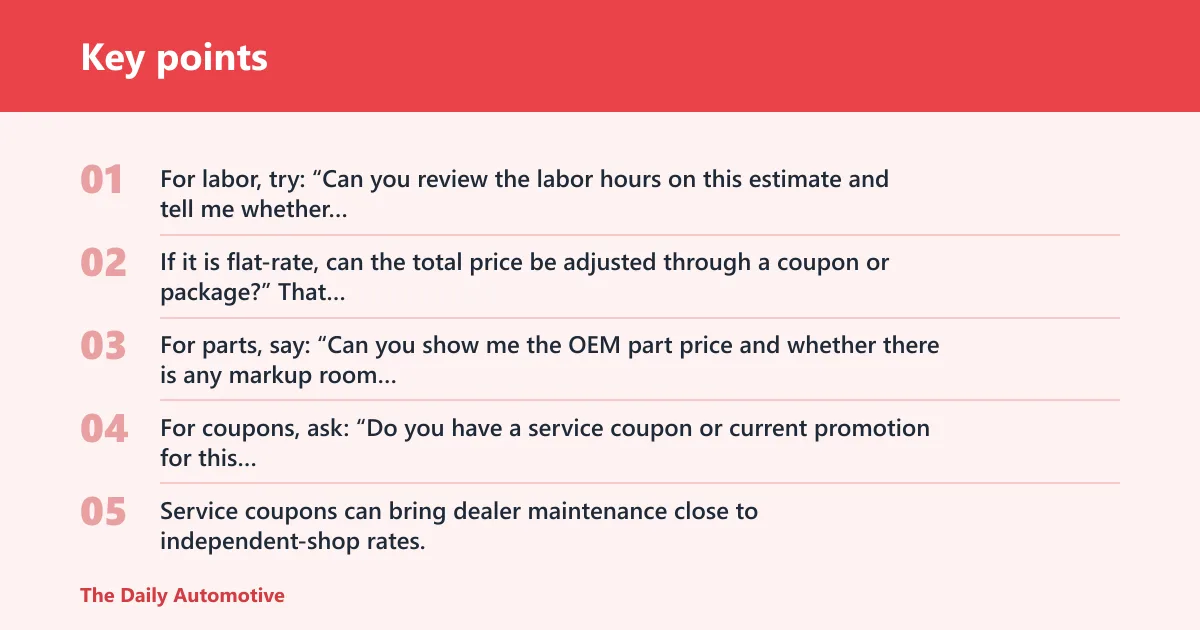
Scripts for labor and diagnostics
For labor, try: “Can you review the labor hours on this estimate and tell me whether there is any package pricing available for this job?” For diagnostics: “If I authorize the repair today, can any part of the diagnostic fee be applied to the final bill?”
For flat-rate work, ask: “Is this billed by posted labor, or by flat-rate time? If it is flat-rate, can the total price be adjusted through a coupon or package?” That keeps the question on the right channel instead of pushing on an hourly rate that may not move.
Scripts for parts and markup
For parts, say: “Can you show me the OEM part price and whether there is any markup room on this larger repair?” If the shop offers an aftermarket choice, ask: “What is the price difference, and does the warranty or repair process change?”
If the bill looks heavy on parts, ask for a comparison: “Can you quote this repair with OEM parts and with an approved aftermarket option so I can compare the totals?” That is more useful than asking for an undefined discount.
Scripts for coupons and promotions
For coupons, ask: “Do you have a service coupon or current promotion for this maintenance item?” That is often more effective than pressing for an across-the-board discount. Service coupons can bring dealer maintenance close to independent-shop rates, and that may solve the pricing problem without a back-and-forth.
A common first-timer mistake is skipping the coupon question and going straight to price pressure. That wastes an easy opening. Many service departments will apply a current special before they will negotiate a custom reduction.
When negotiation works best, and when it usually fails
Negotiation works best on larger repair orders, routine maintenance, and jobs with flexible parts sourcing. It fails most often when the bill is driven by specialty parts, fixed manufacturer pricing, or warranty and recall rules. If the estimate is mostly labor on a hard job, expect less movement.
Dealership service versus independent shops
Dealership service often has more room for coupons and package pricing, especially on scheduled maintenance. Independent shops may have less overhead and a lower starting point, so there may be less room to cut. Mobile mechanics and quick-lube chains can be the least flexible because their pricing is often menu-based.
Specialty parts and fixed-price work
When the repair needs a specialty sensor, a coded module, or a manufacturer-specific component, the shop may have little room to move. That is where a lower quote may be impossible without changing the part source or repair plan. Do not push for a cheaper fix if it changes the outcome or the safety margin.
One-page repair estimate negotiation map
This map shows what usually moves, what to ask for, and when to walk away. Keep it in front of you before you authorize the job. The point is not to force every line down. The point is to know where the real pressure points are.
| Line item | Typical flexibility | Best ask | When to walk away |
|---|---|---|---|
| Diagnostic fee | Moderate on larger jobs; often reviewed first | “Can any of the diagnostic fee be applied if I approve the repair?” | When the shop will not explain the test process or credit policy |
| Labor rate | Low; usually less flexible than total price | “Is there package pricing or a coupon that lowers the total?” | When the shop will only cut quality to cut cost |
| Parts markup | Moderate on larger jobs; varies by item and dealership | “Can you review the OEM price and any markup room?” | When the quote hides part numbers or refuses to itemize |
| Shop supplies | Low to moderate; small dollars, but reviewable | “What does this fee cover, and can it be capped?” | When the fee is vague or repeated across several lines |
| Fluid and consumables | Low to moderate; depends on the repair | “Is this required by the repair or part of the service package?” | When the fluid is listed but not tied to the work |
| Warranty work | None; manufacturer-funded and fixed | “Please confirm this is covered and what remains excluded.” | When anyone treats covered repair as a bargaining item |
| Recall work | None; always free to the owner | “Please schedule the recall repair under the recall number.” | If the shop tries to charge for the recalled defect itself |
Frequently asked questions
Can you negotiate car service charges?
Yes, but the best targets are diagnostics, parts markup, shop supplies, and package pricing. Labor is usually harder to move. Ask for a written estimate first, then use specific wording for the line items you want reviewed. Coupons often work better than a blunt request for a discount.
Can you negotiate car repair costs?
Yes, especially on larger repair orders. A competitor quote can help, and service managers may have more pricing flexibility than service advisors. The strongest asks usually involve the total price, a bundle, or a credit on diagnostics rather than a demand to cut posted labor.
Are labor rates negotiable at auto shops?
Sometimes, but not often. Labor rates are usually one of the least flexible parts of the estimate, whether the shop bills posted hourly or flat-rate time. You will usually get farther by asking for a coupon, package price, or a reduction in the total bill rather than the hourly line.
Should you get a second quote before approving repairs?
For larger repair orders, yes. A second written estimate helps you compare labor, parts, and fees line by line. It is most useful when the first quote seems high, uses specialty parts, or comes from a dealership where the same repair may cost less at another shop.
Which car repairs should not be negotiated?
Warranty repairs and recall work should not be negotiated because they are fixed or free under manufacturer or safety recall rules. Safety-critical repairs also should not be pushed into a cheaper, lower-quality version. If the owner’s manual calls for the service, skipping it to save money can create a bigger bill later.
Products related to this article
Sponsored / affiliate links. As an Amazon Associate I earn from qualifying purchases. I may earn additional commission from eligible campaigns.