Gap Insurance Cost for a Car Loan
Gap insurance for a car loan is often reported to cost about 2% to 5% of the financed loan amount if rolled into the contract. Skip it if you are already near equity. If you buy through the wrong source, you can pay interest on the premium and still owe more than the car is worth after a total loss. This guide compares source-by-source prices, shows when the coverage pays off, and helps you judge the total financed cost.
What gap insurance covers
Guaranteed Asset Protection, or GAP, pays the shortfall between an insurer’s actual cash value payout and the remaining loan or lease balance after a total loss or unrecovered theft. It only applies after comprehensive and collision coverage pay first. It does not pay for repairs, partial damage, or routine wear.
ACV versus loan payoff
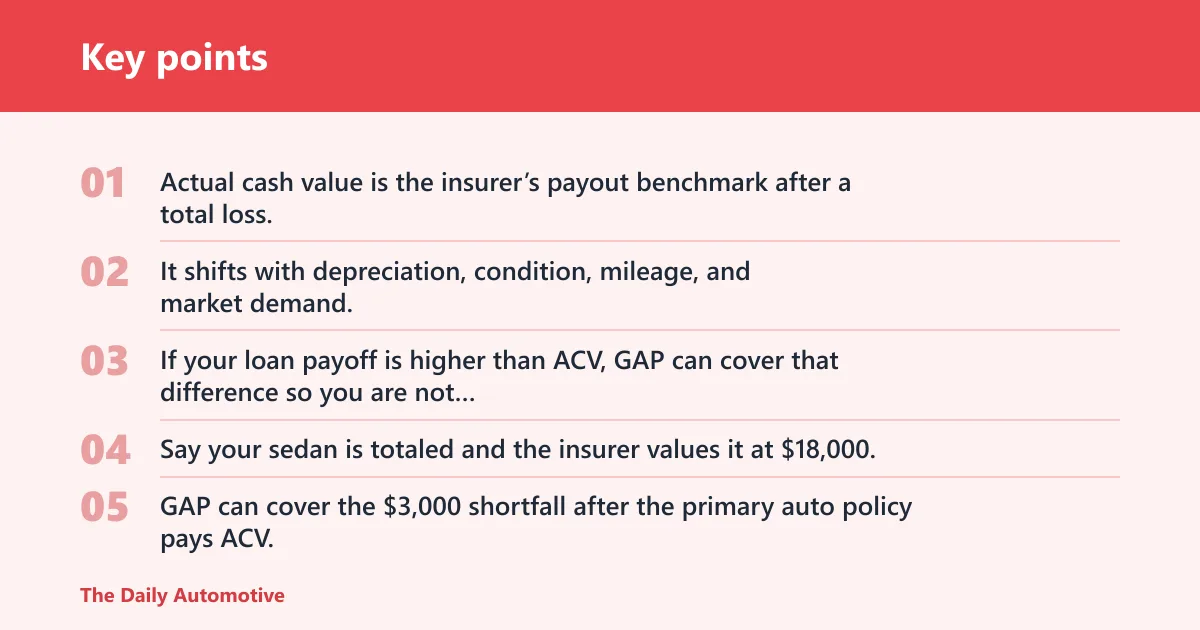
Actual cash value is the insurer’s payout benchmark after a total loss. It shifts with depreciation, condition, mileage, and market demand. If your loan payoff is higher than ACV, GAP can cover that difference so you are not left paying on a car that no longer exists.
Say your sedan is totaled and the insurer values it at $18,000, but your loan balance is $21,000. GAP can cover the $3,000 shortfall after the primary auto policy pays ACV. Without GAP, that $3,000 remains your responsibility unless your contract says otherwise.
Total loss and unrecovered theft
GAP is built for the two events that can wipe out a vehicle’s value in one step: a total loss claim and an unrecovered theft claim. In both cases, the key question is the same. What did the insurer pay, and what do you still owe?
What GAP does not pay
Most contracts exclude repairs, cosmetic damage, missed payments, late fees, and penalties. Some policies also limit or exclude rolled-in negative equity from a prior loan. A higher deductible can still leave you with an out-of-pocket charge even when GAP is active, because GAP does not erase every deductible automatically.
Gap coverage decision table
| Purchase path | Typical upfront price | Usually financed? | Estimated interest added if rolled into a 60-month loan | When it makes sense |
|---|---|---|---|---|
| Insurer add-on | $20 to $40 per year | Usually no | None if paid separately | Best when you want the lowest cost and can add or cancel coverage through your auto insurer. |
| Standalone policy | Often a flat policy price from a specialty provider | Usually no | None if paid separately | Useful when your insurer does not offer GAP or you want a separate policy without dealer pricing. |
| Lender product | Often priced as a contract add-on | Often yes | Varies with APR and term because the premium is added to the loan balance | Works when you want lender paperwork simplicity and accept that financing increases the total cost. |
| Dealer product | $400 to $700 | Often yes | Added loan interest can push the real cost higher over time | Usually only when convenience matters more than price, or when other sources are unavailable. |
How much gap insurance costs by source?
Insurer add-ons are usually the cheapest path, often $20 to $40 a year. Dealer products are commonly much higher, with industry guides placing them around $400 to $700. If the premium is rolled into the loan, the total cost rises again because you can pay interest on the GAP charge itself.
Typical price ranges
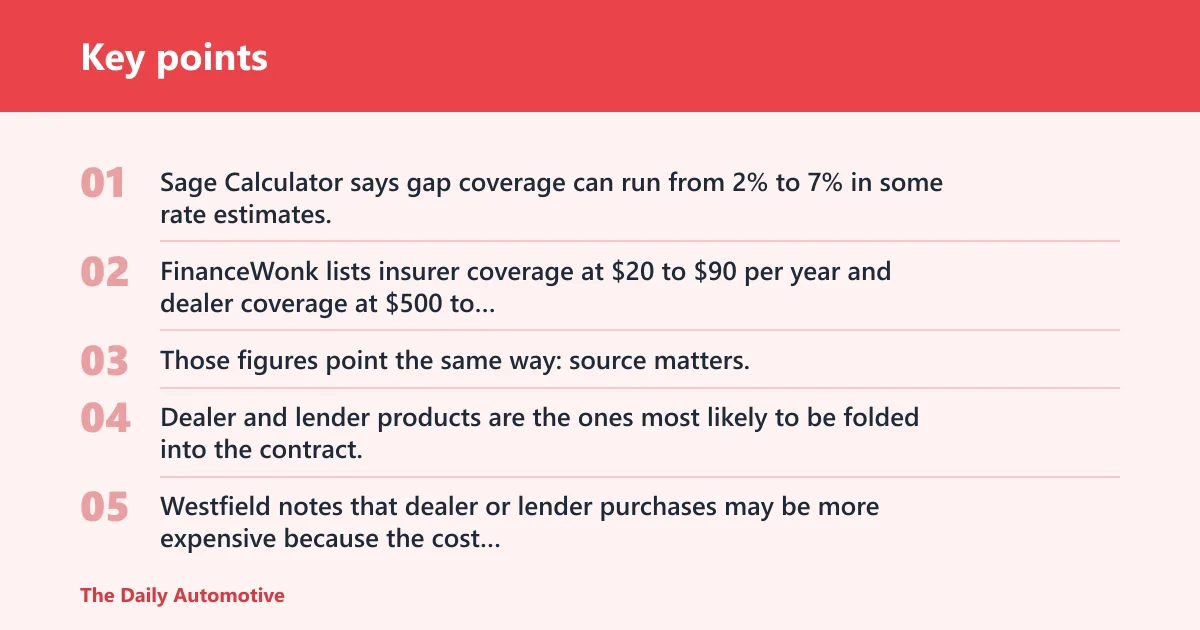
Sage Calculator says gap coverage can run from 2% to 7% in some rate estimates, and it gives a $5,000 gap costing $250 at 5% as an example. FinanceWonk lists insurer coverage at $20 to $90 per year and dealer coverage at $500 to $700. Those figures point the same way: source matters.
Whether the premium is financed
Dealer and lender products are the ones most likely to be folded into the contract. Westfield notes that dealer or lender purchases may be more expensive because the cost is lumped into the loan. That means the premium can accrue interest for the full loan term instead of being a one-time outside payment.
Interest added over a 60-month loan
The exact added interest depends on APR and how much premium you finance, but the math is simple. If a $500 GAP charge is financed, you pay interest on that $500 for as long as it stays in the balance. A small premium can become a larger total cost when it sits inside a long loan.
Is gap insurance worth it on your loan?

GAP is worth buying when your loan starts underwater and is likely to stay that way long enough for a total loss risk to matter. It is less useful when you have a strong down payment, a shorter term, and little or no negative equity. The break-even question is whether the premium buys real protection during the underwater window.
LTV and underwater risk
Loan-to-value ratio, or LTV, shows how much you owe compared with the vehicle’s value. Over 100% means you are underwater. The higher the LTV, the bigger the possible gap between ACV and payoff. CarsCounsel’s calculator even shows an initial LTV result, which is the right place to start.
Down payment and term length
A larger down payment lowers gap risk. A small or no down payment raises exposure, especially on long loans. Shorter terms such as 36, 48, and 60 months reduce the time you spend underwater, while 72- and 84-month loans stretch that period and are commonly flagged as high risk.
Suppose two buyers finance the same car. One puts 20% down on a 48-month loan. The other rolls in taxes, fees, and no down payment on an 84-month loan. The first buyer may exit underwater status quickly. The second may need GAP for much longer.
A simple break-even rule
Use this rule: if the likely underwater window is shorter than the time you expect to keep the policy, and the premium is a meaningful share of that window’s risk, skip or cancel it. If you are still above 100% LTV, especially on a 72- or 84-month loan, GAP is more likely to pay for itself.
- Check your current loan balance.
- Compare it with your car’s ACV, not the sticker price.
- Look at your term, down payment, and any rolled-in negative equity.
- Ask whether the premium is financed or paid separately.
- Buy or keep GAP only while the balance is above value.
When can you skip or cancel gap coverage?
You can usually skip GAP once your loan balance falls below the car’s value and stays there. That is the point where a total loss payout should cover the payoff, or come close enough that GAP no longer adds much. If you already have equity, the policy may be unnecessary extra cost.
When the balance falls below value
The cleanest exit point is when ACV exceeds the loan payoff. At that point, a total loss should not leave a shortfall large enough to justify ongoing GAP charges. Cars that depreciate more slowly, or loans with larger down payments, often reach this point earlier.
Signs you no longer need it
If your monthly statements show the balance dropping faster than the car is depreciating, your gap risk is shrinking. That is especially common after the first year or two on a well-structured loan. A lower LTV, a shorter remaining term, and no rolled-in prior negative equity are all good signs.
How to check for existing coverage
Start with the sales contract, finance paperwork, or insurance declarations page. Ask the lender whether GAP was added to the loan, and ask the insurer whether an add-on policy is active. The CarsCounsel tool includes a gap policy cost input and a break-even time in months, which can help you compare the cost with your current position.
What changes the price you pay?
Loan term, APR, depreciation, deductible, and whether old debt was rolled in all affect the cost side of the equation. Fast depreciation creates a longer underwater window. A high deductible can leave more out-of-pocket exposure. A longer loan can keep the balance above value for months or years.
Loan term and APR
Longer loans increase the time you may spend underwater. That is why 72- and 84-month terms deserve closer attention than 36-, 48-, or 60-month loans. A higher APR can also slow equity buildup because more of each payment goes to interest early on.
Vehicle depreciation
New vehicles lose value fastest. Used vehicles generally depreciate more slowly, so the gap may be smaller. Some EVs and luxury vehicles can depreciate faster than buyers expect, which can keep them underwater longer even with regular payments.
Deductible and roll-in balance
A higher deductible can reduce your premium on the primary policy, but it can also leave a larger out-of-pocket bill after a total loss. If you rolled old negative equity into the loan, the starting balance is worse from day one. That can make GAP useful for longer, or make a policy cap more important to review.
How do I know if I have gap insurance on my car loan?
Check the finance contract, the retail installment agreement, and any insurance or lender disclosures. If GAP was sold by the dealer or lender, it should appear as a line item. If it came through your insurer, it may appear as an endorsement or add-on on the policy declarations page.
Look for terms such as GAP, Guaranteed Asset Protection, loan/lease payoff, or vehicle debt protection. If the paperwork is unclear, call the lender and ask whether the balance includes a GAP charge and whether a separate claim process exists. Do not assume the car loan has it just because the dealer mentioned protection.
How does gap insurance work on a car loan?
After a total loss or unrecovered theft, the primary auto insurer pays ACV first. GAP then covers the remaining difference between that payment and the loan or lease balance, subject to the contract. It does not replace collision or comprehensive coverage, and it does not pay until the first claim is settled.
What the payout sequence looks like
First, the insurer values the vehicle. Next, it subtracts your deductible from the claim payment if the policy requires it. Then GAP may pay the remaining shortfall, up to its limits and exclusions. If the balance includes disallowed charges, those may stay unpaid.
Frequently asked questions
How much does gap insurance cost on a car loan?
The financed version can cost more overall because interest is added to the premium.
How much does gap insurance cost on a car?
For a car, the price depends on where you buy it and whether the premium is financed. Insurer add-ons are often the lowest-cost route, while dealer products are commonly the most expensive. The vehicle’s value, loan size, and term influence whether the premium is worth paying.
What is the difference between dealer and insurer gap coverage?
Dealer GAP is often bundled into the loan and can be the most expensive option. Insurer GAP is usually a low flat-cost add-on that may be easier to cancel later. The key difference is total cost, especially if the dealer product is financed and accrues interest.
Can I buy gap insurance after I finance the car?
Yes. Many buyers add GAP after financing if the lender, dealer, or insurer allows it. That can make sense if you forgot to buy it at signing or if your LTV stays high after the purchase. Ask whether the policy starts immediately or after a waiting period.
Does gap insurance cover my deductible?
Not always. Some GAP contracts leave the deductible on your auto policy unchanged, which means you still pay that amount out of pocket after a total loss. Read the contract closely because deductible treatment varies, and some calculators include it as an input for that reason.
Is gap insurance for the life of the loan?
No. GAP is usually only useful while you owe more than the car is worth. Once the balance drops below ACV, the policy may no longer be worth the cost. That is the point to review cancellation options and stop paying for coverage you no longer need.
Products related to this article
Sponsored / affiliate links. As an Amazon Associate I earn from qualifying purchases. I may earn additional commission from eligible campaigns.