Best Jump Starters for Small Cars & SUVs (2026): We Compared
For small cars and most compact SUVs, start with a jump starter in the about 400 to 1,000 peak-amp range, but match it to the maker’s gas or diesel limit and to how you store it. Pick the wrong size and you can end up with a weak pack, a dead battery that still will not crank, and a tow. Size, temperature, and storage location all matter.
Quick comparison
| Product | Badge | Best for | Price | ||
|---|---|---|---|---|---|
 |
NOCO Boost GB40 12V 1000A UltraSafe Portable Lithium JumpNOCO | Our pick | Portable · 1000A · lithium | $99.95
Price as of 11 Nov 2026
|
View |
 |
YESPER 12V Portable Car Jump Starter 1500A MotorcycleYESPER | Budget pick | Pocket · 1500A · booster | $59.99
Price as of 11 Nov 2026
|
View |
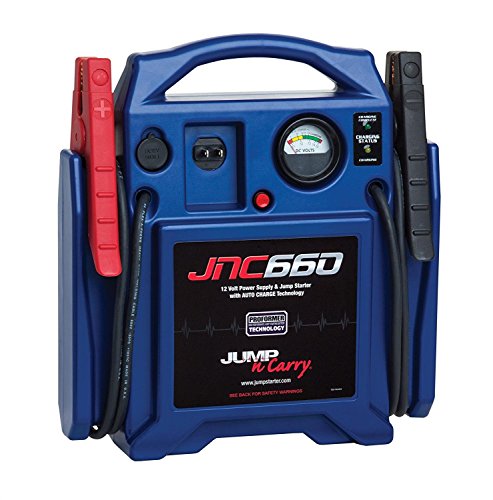 |
Clore Automotive Jump-N-Carry JNC660 1700 Peak Amp 12 VoltClore Automotive | Upgrade pick | Heavy-duty · 1700A · 12V | $126.02
Price as of 11 Nov 2026
|
View |
For most drivers, the best fit is the most compact pack that still covers the engine size and winter conditions you actually face. Bigger numbers help only when they match the vehicle and the weather.
How we chose
These picks are based on manufacturer specs, listing details, and published buyer feedback. The filter was simple: engine-size compatibility, portability, safety features, storage convenience, and whether the unit makes sense for a small car or small SUV.
Peak amps alone were not used as a buying rule. If a listing gave a gas or diesel limit, that limit counted more than the headline amp number.
NOCO Boost GB40: best for compact storage
The NOCO Boost GB40 is the best fit if you want a compact lithium jump starter that can live in the car without taking much space. It is rated at about 1000A, lists support for gasoline engines up to about 6.0 liters and diesel engines up to about 3.0 liters, and weighs about 2.45 pounds.
It also brings spark-proof and reverse polarity protection, a built-in power bank, a flashlight, an IP65 rated enclosure, and USB-style convenience through its lithium platform. For small cars and many compact SUVs, that is the balance most buyers want, usable output without turning the trunk into a toolbox.
The drawback is simple. It costs more than some higher-amp rivals, and you are paying for compact size and brand reputation rather than a bulky emergency booster with a big battery bank.
YESPER portable jump starter: best for small SUVs
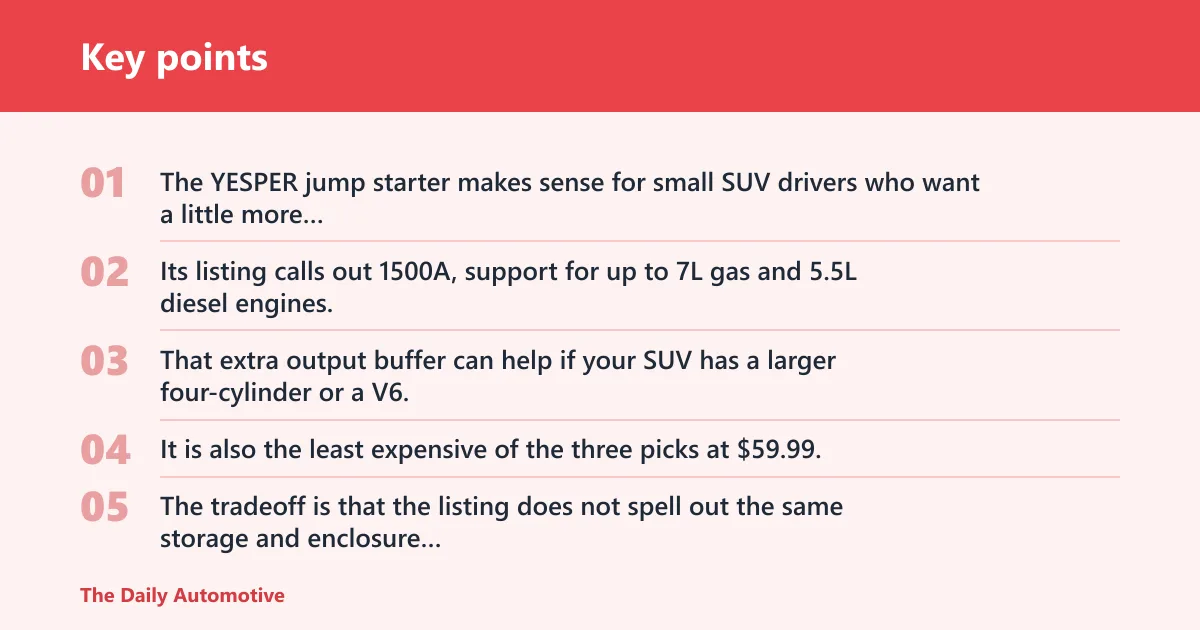
The YESPER jump starter makes sense for small SUV drivers who want a little more headroom without jumping to a heavy booster. Its listing calls out 1500A, support for up to 7L gas and 5.5L diesel engines, 10 built-in safety protections, and USB output for charging devices.
That extra output buffer can help if your SUV has a larger four-cylinder or a V6, or if you want a pack that feels less strained in cold weather. It is also the least expensive of the three picks at $59.99, which matters if you want a backup tool rather than a feature-heavy roadside kit.
The tradeoff is that the listing does not spell out the same storage and enclosure details as the NOCO, so you should confirm case size, recharge cadence, and cable length before you commit. For trunk storage, those details matter as much as amp claims.
Clore Automotive Jump-N-Carry JNC660: best for extra sustained output
The Clore Automotive Jump-N-Carry JNC660 is the pick for drivers who care more about sustained booster style output than compact storage. It is listed at about 1700 peak amps, includes a battery rated around 22Ah, and comes with heavy-duty cables about 46 inches long and a voltmeter. The price is about $126.
That heavier construction can help if you want a more professional-style unit and do not mind the bulk. The longer cables are also a practical advantage when battery placement is awkward or you want easier reach around a crowded engine bay.
The drawback is obvious: this is not the kind of pack you forget about in a glovebox. It is heavier, larger, and less convenient for everyday trunk storage than a compact lithium unit.
A jump starter should match the vehicle, the temperature, and the way you store it. Peak amps can help you compare broad output bands, but the engine-size rating and the design type matter more than a big number on the box.
Peak amps vs engine-size rating
Peak amps are a momentary maximum output. Autoweek describes that burst as lasting 20 to 50 milliseconds for lead-acid units, while lithium-ion units usually deliver high amperage for two to five seconds. That is why peak amps are useful as a general size cue, but not as a strict cross-brand comparison.
For small cars, a jump starter around 400 to 1,000 peak amps is usually the right shopping band. For small SUVs, lean toward the upper end of that range unless the listing gives a clearly higher engine-size limit. Manufacturer-specific gas and diesel limits matter more than a marketing headline.
Lithium-ion vs lead-acid
Lithium-ion jump starters are the compact-storage choice. They usually hold charge for months, fit in a glovebox or small cargo cubby, and often add USB charging support for phones or tablets.
Lead-acid jump starters are heavier and bulkier, but they often provide a longer sustained output profile. They usually need more frequent charging, and they make more sense if you want a booster-style unit rather than a small everyday pack.
Safety features to look
Reverse polarity protection should be near the top of the list. Spark-proof or safety-clamped connections reduce the chance that a beginner mistake becomes a damaged pack or a damaged vehicle.
An IP65 enclosure is a useful target for trunk storage because it adds dust and water resistance. A built-in flashlight helps at night, but it is a backup feature, not a performance feature. USB-C input or output is worth having if you want easier recharging and a phone backup source.
A common first-timer mistake is choosing a jump starter that is too bulky to stow in a small SUV or compact car, even though a slimmer model would be easier to carry and use. If the pack does not fit where you will keep it, it is not an emergency tool anymore. It is a box you leave at home.
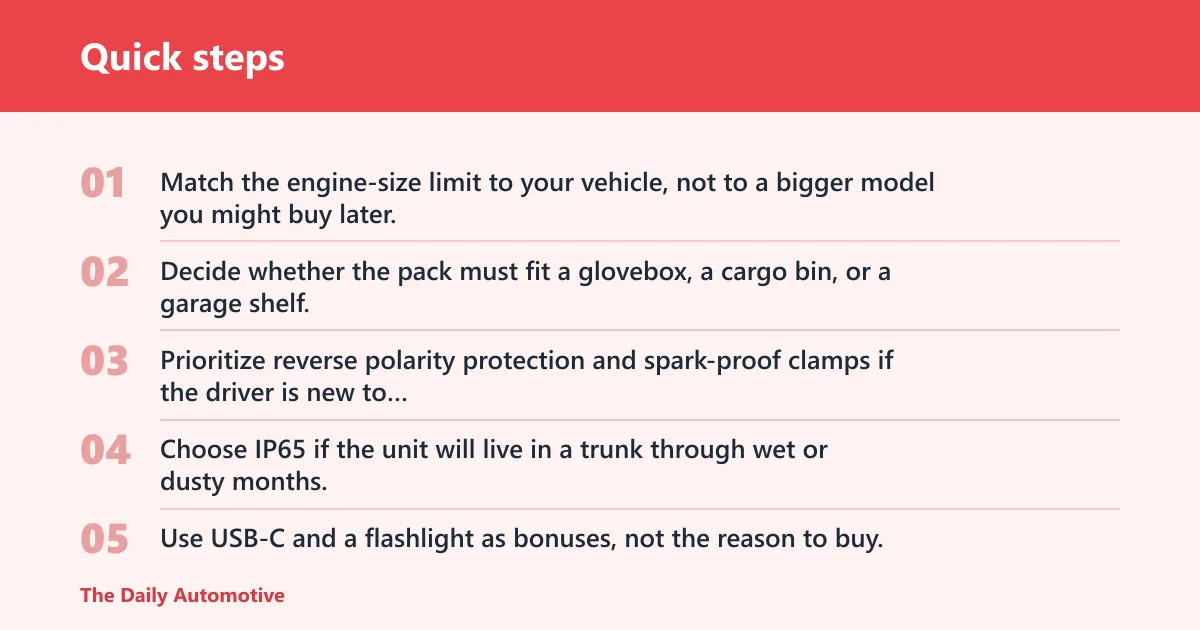
- Match the engine-size limit to your vehicle, not to a bigger model you might buy later.
- Decide whether the pack must fit a glovebox, a cargo bin, or a garage shelf.
- Prioritize reverse polarity protection and spark-proof clamps if the driver is new to jump starting.
- Choose IP65 if the unit will live in a trunk through wet or dusty months.
- Use USB-C and a flashlight as bonuses, not the reason to buy.
- If you want a compressor too, accept the extra bulk and check the listed PSI on the exact model.
Say your compact SUV sits outside in winter and the battery is already tired. A compact lithium pack with a little extra headroom is usually the better choice than a tiny budget unit, because cold starts demand more from the pack and from the battery.
Suppose your small sedan stays in a garage and you only want emergency coverage for road trips. A glovebox-friendly lithium unit with reverse polarity protection and USB charging may be the smarter buy than a heavy booster you will never want to carry.
Jump starter decision table
This table turns the specs into a practical rule. Use the engine-size column first, then decide whether winter use and storage habits point you toward a compact pack or a larger combo unit.
| Vehicle scenario | Gas engine size | Diesel engine size | Suggested peak amps | Cold-climate priority | Compact pack or combo unit? |
|---|---|---|---|---|---|
| Small car, mild weather, glovebox storage | Up to 2.0L | Usually not the focus; confirm manufacturer limit | 400 to 800 | Moderate | Compact pack |
| Small car, winter parking, short city trips | Up to 2.5L | Confirm manufacturer limit | 600 to 1,000 | High | Compact pack |
| Compact SUV, mild climate, trunk storage | 2.0L to 3.0L | Up to 2.0L, if listed by the maker | 800 to 1,000 | Moderate | Compact pack or small combo unit |
| Compact SUV, cold climate, longer cable reach needed | 2.5L to 3.5L | Up to 3.0L, if listed by the maker | 1,000 to 1,500 | High | Compact pack if storage matters; combo unit if utility matters more |
| Small SUV, extra utility for roadside chores | 3.0L to 3.5L | Up to 5.5L only if the listing says so | 1,500 or higher | High | Combo unit if the compressor will actually be used |
For this table, the engine-size ranges are buying rules, not universal laws. Always check the manufacturer’s listing for your exact engine and the owner’s manual for vehicle limits.
Which one should you buy?
If you want the best balance of size, protection, and everyday storage, start with the NOCO Boost GB40. It is the easiest fit for a small car owner who wants a compact lithium pack that is less likely to be left behind at home.
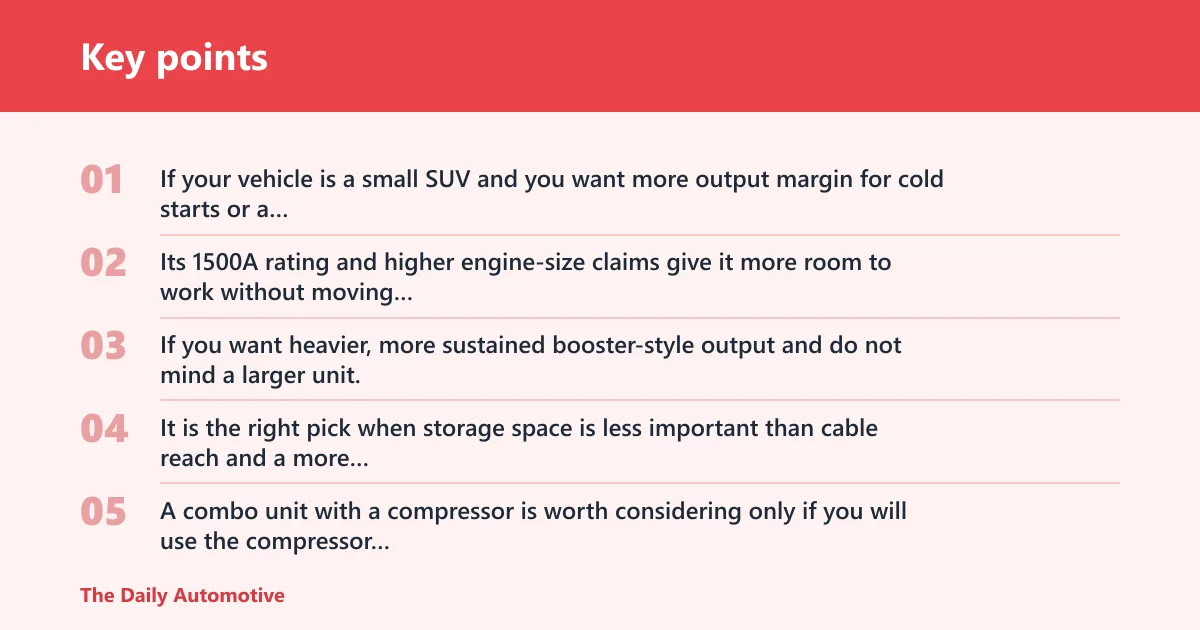
If your vehicle is a small SUV and you want more output margin for cold starts or a larger engine, the YESPER is the better value choice. Its 1500A rating and higher engine-size claims give it more room to work without moving into bulky booster territory.
If you want heavier, more sustained booster-style output and do not mind a larger unit, choose the Clore Automotive Jump-N-Carry JNC660. It is the right pick when storage space is less important than cable reach and a more traditional jump-starter layout.
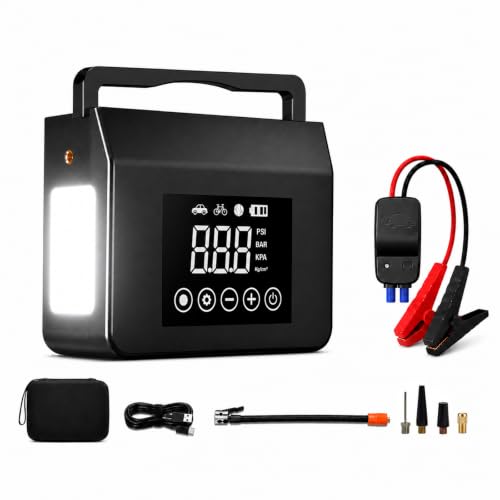
A combo unit with a compressor is worth considering only if you will use the compressor often enough to justify the added weight and size. Walmart examples show that these units can move from 1000 peak amps and a 120 PSI compressor to much larger combo units at 5000A or 8000A with higher-pressure inflators, but bigger is not automatically better for a small car or a compact SUV.
One more thing: a jump starter can help start a dead battery. It will not fix a battery that has failed or a charging system that is not doing its job.
Battery age matters here. If the car keeps dying after every jump, the pack is only treating the symptom. A weak alternator, corroded terminals, or an old battery still needs repair.
For storage, compact lithium packs win most daily-driver situations. The same source notes that compact jump starters can be stored in a glovebox, and that is exactly why many buyers should choose them over larger booster-style units.
Cold weather changes the decision. Average passenger vehicles usually need about 400 to 500 CA or CCA, and cold temperatures make starting harder, so a small SUV in a winter climate should be matched to the upper end of a realistic size range rather than the lowest-possible price.
Check the manufacturer’s listing for your model before you buy. That is where you confirm the engine-size limit, the recharge method, the cable length, and whether the pack fits your storage plan.
Frequently asked questions
Which car jump starter is best?
The best car jump starter for most small cars is a compact lithium unit with reverse polarity protection, a clear engine-size limit, and easy storage. For a balanced choice, the NOCO Boost GB40 is the cleanest fit because it combines compact size, IP65 protection, and a 1000A listing without turning into a bulky roadside box.
What is the best auto jump starter?
The best auto jump starter depends on your vehicle size and where you keep it. For compact cars and many compact SUVs, a lithium pack is usually the best type because it stores easily and holds charge for months. If you want more sustained output and longer cables, a heavier booster-style unit may fit better.
What jump starter size do I need for a small SUV?
A small SUV usually needs more headroom than a sedan, especially in winter. Aim for a unit in the 800 to 1,500 peak-amp range, then confirm the manufacturer’s gas and diesel limits for your exact engine. If storage space is tight, choose a compact pack before moving to a combo unit.
How many peak amps should a jump starter have for a small car?
For a small car, 400 to 800 peak amps is a practical range, with colder climates pushing you toward the higher end. Peak amps are only a momentary maximum output, so the engine-size rating and the battery type matter too. Do not buy only on the biggest number on the box.
Are lithium jump starters better than lead-acid jump starters?
Lithium jump starters are better for most drivers who want compact storage, months-long standby convenience, and USB charging support. Lead-acid units are heavier and often provide a longer sustained output profile, so they make more sense when size is less important than a more traditional booster layout.
Can a jump starter also charge a phone or inflate tires?
Yes, many can. USB ports let a jump starter charge phones or tablets, and some combo units add a tire inflator. The tradeoff is size and weight. Walmart examples show compressor-equipped units with 120 PSI, 150PSI, and even larger inflator setups, but those extras add bulk.
How long does a jump starter hold a charge in storage?
Lithium-ion jump starters are the easiest to keep ready because they usually hold charge for months. That is one reason they suit glovebox or trunk storage well. Lead-acid jump starters generally need more frequent charging, so they require a more deliberate storage routine.
What safety features should a jump starter have?
Reverse polarity protection should be near the top of the list, along with spark-proof clamps or a similar safe-connection design. An IP65 enclosure helps with trunk storage, and a built-in flashlight is useful for night work. Those features do not replace the manual, but they reduce avoidable mistakes.
Will a jump starter work on a dead battery or only a weak battery?
A jump starter is made to help start a vehicle with a weak or dead battery. It does not repair a bad battery, and it does not fix charging-system trouble. If the car keeps failing to start after a jump, the battery, alternator, terminals, or wiring still need attention.
Products related to this article
Sponsored / affiliate links. As an Amazon Associate I earn from qualifying purchases. I may earn additional commission from eligible campaigns.