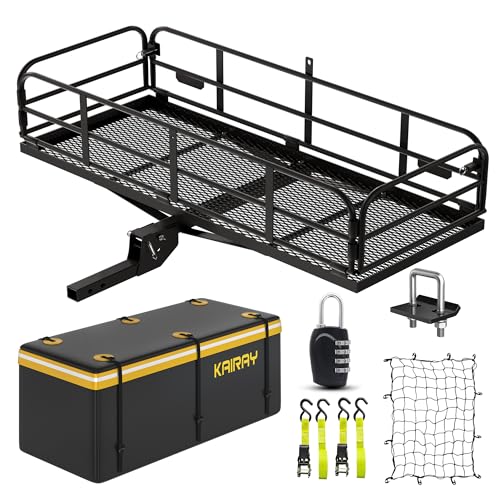
Cargo Rack for Car: Maximize Space with Heavy Duty Hitch Carriers
Choose a hitch cargo carrier that fits your receiver size, stays within the hitch’s tongue-weight limit, and clears the bumper, hatch, and exhaust. Ignore those limits and you can get sway, bent hardware, a blocked liftgate, or a scraped bumper. This guide explains vehicle fit, tongue weight, ground clearance, and the features that matter most when you buy a cargo rack for car use.
Match the carrier to cargo and vehicle


Start with the cargo you need to move, then match the carrier to the vehicle, not the other way around. A sedan with a light hitch setup needs a different answer than a full-size SUV carrying camping bins, a cooler, and wet gear. Basket size matters, but fit, rear clearance, and load limit matter more.
Match the carrier to your cargo type
For luggage, a low-sided basket with a waterproof bag can work well. For bulky coolers, firewood, or camping totes, high side rails give better containment and more tie-down points. If the load is dirty, wet, or awkward, plan for straps and a bag from the start instead of treating them as extras.
Use vehicle fit, not basket size alone
A larger basket does not help if it blocks the liftgate, hangs too low, or sits too close to the exhaust. Common external basket sizes are often around 49 x 22.5, 53 x 19, and 60 x 24 inches. The right choice depends on your rear overhang, hatch swing, and driveway angle as much as on usable floor area.
Decide when a roof carrier makes more sense
Choose a roof carrier when your hitch tongue limit is tight, rear access matters more than easy loading, or the vehicle already has a well-rated roof rack system. A roof setup can also make sense for lighter, bulky items that do not need frequent access. A hitch carrier is often the better call for heavy, awkward cargo that would be hard to lift overhead.
Say your compact SUV has a short rear overhang and a liftgate that opens high. A 60 x 24 basket can still fit on paper, but it may hit the hatch before it opens fully. In that case, a shorter basket or a roof carrier is the cleaner fit.
Hitch fit and tongue weight
Most hitch cargo carriers are designed to fit a 2-inch receiver, but that size still needs to be confirmed before purchase. The carrier’s rating is only part of the story. The real limit is the lower number between the carrier, the hitch, and the vehicle’s tongue-weight rating in the owner’s manual.
Check for a 2-inch receiver
Many carriers are built around a 2 inch by 2 inch hitch shaft. One example is the MaxxHaul 70108, which uses that size. Some specialty carriers fit other receiver sizes, but most mainstream models aim at the 2-inch standard. If the receiver size does not match, do not assume an adapter will solve the problem safely.
Compare carrier rating to hitch and vehicle limits
Advertised capacity can be misleading if the hitch system cannot support it. Some carriers list a maximum distributed weight capacity of about 500 lbs, and many carriers are rated around that level. That figure only matters if the vehicle’s hitch and tongue-weight rating allow it. The load limit is always capped by the weakest rated component.
Leave a weight margin for straps and bounce
Road motion adds stress. A carrier near its limit leaves little room for bounce, shifting cargo, or the weight of tie-down gear and a waterproof bag. Keep margin in reserve, especially on rough roads or steep driveways. A carrier that looks fine in a product listing can become a poor choice once the actual load is packed.
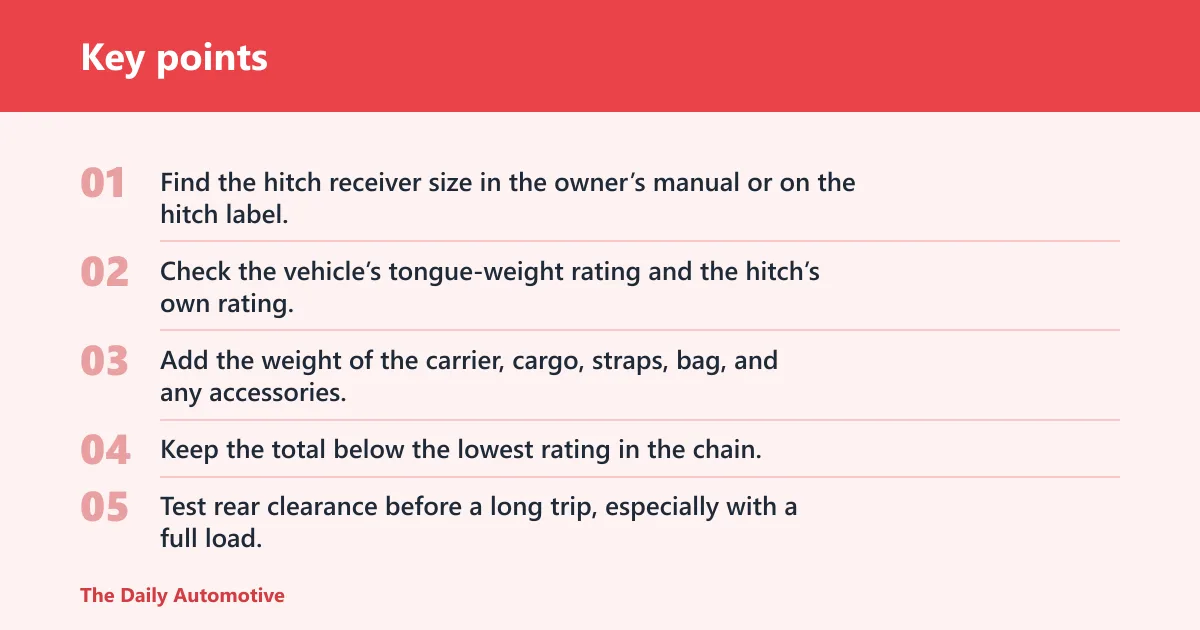
- Find the hitch receiver size in the owner’s manual or on the hitch label.
- Check the vehicle’s tongue-weight rating and the hitch’s own rating.
- Add the weight of the carrier, cargo, straps, bag, and any accessories.
- Keep the total below the lowest rating in the chain.
- Test rear clearance before a long trip, especially with a full load.
Cargo carrier decision checklist
Use this table to match the carrier style to the vehicle, cargo, and clearance needs. The best buy is the one that fits the hitch rating, clears the rear end, and avoids the problems that show up after purchase: sway, blocked lights, hatch interference, and water intrusion.
| Vehicle type | Hitch class and margin | Cargo type | Clearance needs | Recommended carrier style | Do not buy if… |
|---|---|---|---|---|---|
| Sedan | 2-inch receiver only, with ample tongue-weight margin | Light luggage, small coolers, soft bags | Short rear overhang, good hatch and exhaust clearance | Shorter steel or aluminum basket with folding shank if storage is tight | The basket blocks trunk access or hangs low enough to scrape on steep driveways |
| Compact SUV | 2-inch receiver preferred; margin needed for bounce and accessories | Camping bins, groceries, sports gear | Rear hatch must open without hitting the basket | Mid-size basket with high side rails and reflectors | Your hatch touches the carrier before it fully opens |
| Large SUV | 2-inch receiver with a rating that still exceeds the full load | Bulkier totes, firewood, heavy coolers | Check bumper overlap and exhaust heat near the load | High-rail steel basket or a heavier-duty aluminum carrier | The carrier reduces rear visibility or sits too close to the exhaust outlet |
| RV or tow vehicle | Only if the hitch and rear frame rating allow the extra load | Camp chairs, bins, dry goods | Watch approach angle, tail swing, and rear access to lights | Carrier with folding shank, stabilizer, and strong tie-down points | Rear lights, plate, or access steps are blocked by the basket |
Suppose a large SUV can technically accept a 500-lb-rated carrier, but the hitch label allows less once the carrier weight is included. In that case, the larger basket is still the wrong choice. The rating on the box never overrides the rating on the vehicle.
Steel or aluminum cargo carrier?
Steel fits the heavy-duty, budget-to-midrange side of the market. Aluminum is lighter and better for rust resistance. Both can work well, but the better choice depends on how often you remove the carrier, whether you park outdoors, and how much weight you actually plan to move.
When steel makes sense
Choose steel if you want maximum stiffness, lower purchase cost, or a carrier that is likely to see rough use. Steel cargo carriers often come with powder-coated or epoxy-coated finishes. The tradeoff is weight. A steel basket can be harder to mount, store, and remove, especially on a vehicle with limited rear access.
When aluminum is the better fit
Choose aluminum if you want less weight on the hitch, easier handling, and better resistance to corrosion. Aluminum cargo carriers often pair well with high side rails and a 500-lb rating. They are a good match for owners who remove the carrier often or leave it exposed to weather.
Finish, rust resistance, and real weight tradeoffs
Steel needs its coating to stay intact. Scratches can lead to corrosion over time. Aluminum does not rust in the same way, but it still needs a solid structure and good hardware. For many buyers, the real question is not which material sounds tougher. It is which one fits the vehicle, the storage space, and the way the carrier will be used.
What basket size fits your vehicle?
Basket size should be chosen based on rear clearance and cargo shape, not just the largest available size. The common sizes 49 x 22.5, 53 x 19, and 60 x 24 inches each change how much usable space you get, how much hatch access you keep, and how much the basket affects ground clearance and approach angle.
How common basket sizes differ
A 49 x 22.5 basket is a compact choice for smaller vehicles and lighter loads. A 53 x 19 basket offers a narrower footprint that can help with rear clearance. A 60 x 24 basket gives more floor area, but it is the easiest one to overbuy if your vehicle has limited overhang or a low receiver height.
Why bumper overlap and rear hatch clearance matter
Measure from the hitch pin hole to the rear hatch path, not just the outside edge of the bumper. Some carriers sit far enough back to let the hatch open. Others make the liftgate unusable. Bumper overlap also affects how far the basket sticks out, which matters in parking spaces and tight driveways.
How size affects approach angle and ground clearance
The longer the basket hangs behind the axle, the more likely it is to drag on steep driveways or dip transitions. That is why a large basket on a low car can become a scraping problem even when the weight limit looks acceptable. Ground clearance matters as much as floor area.
Which accessories are worth buying?
Straps, nets, and waterproof bags are the most useful add-ons because they secure the load and protect it from road spray. A hitch stabilizer or hitch tightener is also worth considering if the carrier moves in the receiver. Accessory bundles are common, but the best bundle is the one that solves your actual problem.
Ratchet straps versus cargo nets
Ratchet straps are the better choice for heavy or oddly shaped cargo because they pull the load down and keep it from shifting. Cargo nets are faster for lighter items and loose bins, but they do less to stop movement. For most loads, straps do the real work and the net adds a second layer of control.
When a waterproof bag is worth it
Use a waterproof bag when the cargo is soft, weather-sensitive, or easy to contaminate with road spray. Bags matter most for luggage, bedding, clothing, and paper goods. Without a bag, moisture can get into the load during rain, slush, or highway spray even if the basket itself is made from coated steel or aluminum.
Why a hitch stabilizer can help
A hitch stabilizer or hitch tightener can reduce wobble and rattle at the receiver. That can improve road stability and keep the carrier from clunking over bumps. It does not fix overload or bad loading, but it can make a properly sized carrier feel more controlled.
A common first-timer mistake is buying a large basket with no stabilizer and loading it with loose coolers and duffel bags. The result is usually sway, a noisy receiver, and cargo that shifts after the first highway merge. The carrier was not the real problem. The setup was.
What should you check for safety and clearance?
Rear-mounted cargo changes visibility and can hide the license plate, taillights, or backup camera view. It also creates new clearance issues at driveways and gas stations. Check the rear view, lighting, and hatch access before departure, then check them again after the load is strapped down.
Rear visibility and plate visibility
Keep the license plate and rear lamps visible as required by local law. A carrier that blocks either one can create a roadside problem before the trip even starts. If the cargo sits high enough to block the camera, plan to rely on mirrors and a careful walk-around instead of the camera alone.
Reflectors and nighttime visibility
Reflectors matter after dark because a rear-mounted basket is easy to miss in dim parking lots or on roads with little lighting. Red reflectors or corner reflectors help other drivers spot the carrier’s outer edges. That is especially useful when the basket extends farther back than the factory bumper.
Wobble, sway, and hatch access
Wobble usually points to a loose receiver connection, too much weight, or poor packing. Sway can come from tall cargo that catches wind. Hatch access problems show up when the basket sits too close to the liftgate. If any of those issues appear, stop and fix the load before driving farther.
Frequently asked questions
What size hitch cargo carrier do I need for my car or SUV?
Choose the smallest basket that fits your cargo and still clears the hatch, bumper, and exhaust. A 49 x 22.5 basket can suit smaller vehicles, while 53 x 19 and 60 x 24 options give more room for larger loads. Measure rear clearance before buying, not after.
How much weight can a heavy duty hitch cargo carrier hold?
Many carriers are rated for 500 lbs, but that number is only part of the answer. The vehicle’s tongue-weight rating and the hitch rating set the real ceiling. Add the carrier’s own weight, then leave room for road bounce and tie-down gear.
Will a hitch cargo carrier fit a 2-inch receiver?
Most mainstream hitch cargo carriers are built for a 2-inch receiver, and the carrier should state that clearly. The MaxxHaul 70108 uses a 2 inch by 2 inch hitch shaft. If your receiver is a different size, do not assume a simple adapter will preserve the full rating.
Is an aluminum or steel cargo carrier better?
Steel is the better pick for stiffness and budget-minded buyers. Aluminum is the better pick when lower weight and rust resistance matter more. If the carrier will live outside or come off the vehicle often, aluminum usually has the edge. If cost and strength are the priority, steel is hard to beat.
Do I need a cargo bag, net, or straps with a hitch carrier?
Yes. Ratchet straps are the most useful for holding the load down, cargo nets help keep loose items contained, and a waterproof bag protects soft or weather-sensitive cargo. The best setup usually uses straps first, then a net or bag depending on what you are carrying.
How do I keep a hitch cargo carrier from wobbling?
Use a hitch stabilizer or hitch tightener, verify the pin and receiver fit, and keep the load centered over the basket. Wobble often gets worse when cargo is stacked unevenly or the carrier is near its limit. If the movement continues, recheck the hitch and stop using the setup until it is corrected.
Products related to this article
Sponsored / affiliate links. As an Amazon Associate I earn from qualifying purchases. I may earn additional commission from eligible campaigns.