Can You Negotiate Enterprise Car Sales? Proven Savings
Yes, you can absolutely negotiate at Enterprise car sales! With smart preparation and a confident approach, you can secure significant savings on your next vehicle purchase. This guide will show you how.
Buying a car can feel like a big step, and sometimes, the sticker price seems a little daunting. You might wonder if there’s any wiggle room, especially when looking at dealership prices. If you’re considering a used car from a place like Enterprise, you’re probably asking yourself: “Can you negotiate Enterprise car sales prices?” The good news is, yes! It’s not as scary as it sounds, and with a little knowledge, you can feel much more confident walking in and walking out with a great deal.
Enterprise car sales, also known as Enterprise Car Sales, offers vehicles that have been previously used in their rental fleet. These cars are often well-maintained and come with a transparent history. But does that mean the price is set in stone? Not at all! I’m here to walk you through exactly how you can approach negotiating and unlock some proven savings. We’ll cover everything from doing your homework to making your best offer.
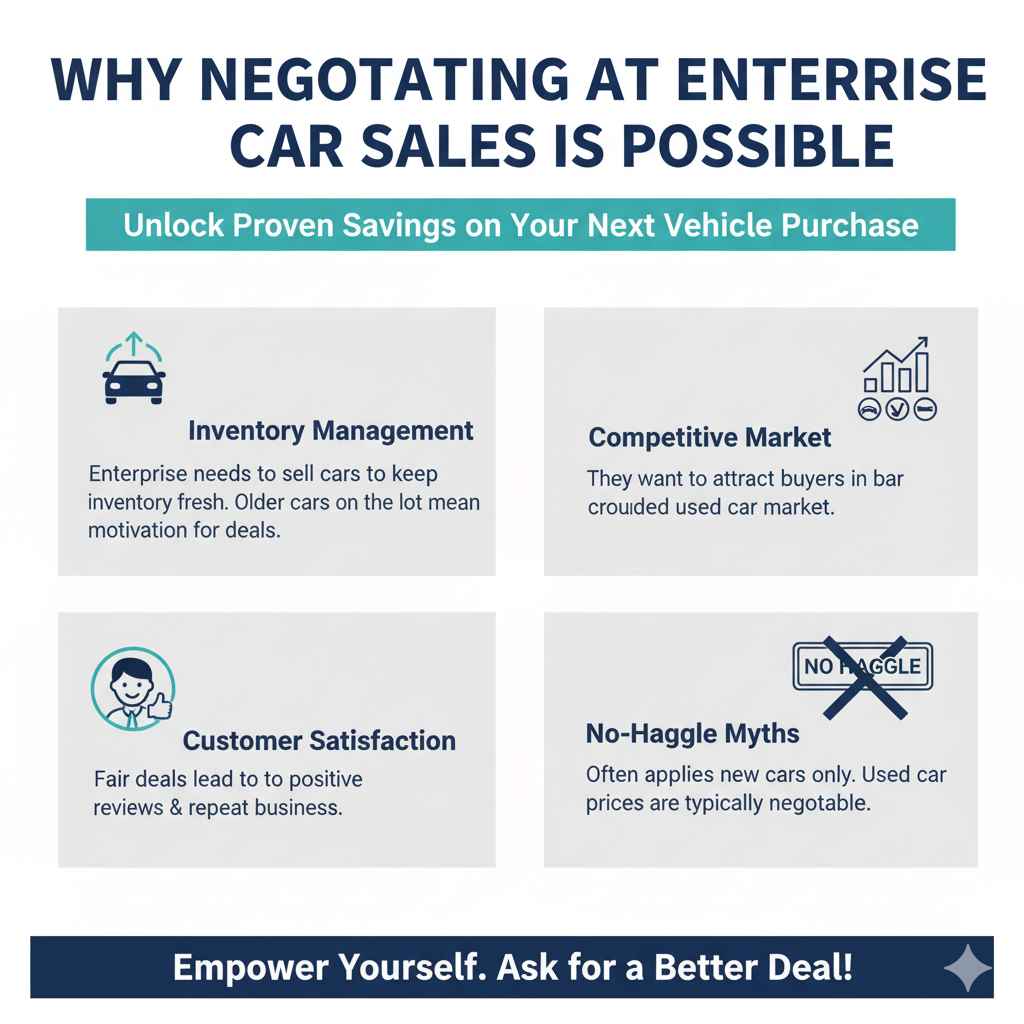
Why Negotiating at Enterprise Car Sales is Possible
You might think a large company like Enterprise has fixed prices, but that’s usually not the case for their vehicle sales. Understanding why negotiation is an option can give you the confidence you need. Here’s a breakdown:
- Inventory Management: Enterprise locations need to keep their inventory fresh. They have targets for selling cars. If a car has been on the lot for a while, they have an incentive to make a deal.
- Competitive Market: The used car market is competitive. Enterprise wants to attract buyers, and being open to negotiation helps them do that compared to other dealerships.
- Customer Satisfaction: Like any business, they value happy customers. A fair negotiation that leaves you feeling good about the price can lead to positive reviews and future business.
- No-Haggle Myths: While some dealerships promote “no-haggle” pricing, this often only applies to new car prices or specific promotions. Used car lots, even those owned by large corporations, typically have room for negotiation on individual vehicle prices.
Before You Go: Essential Preparation is Key
The secret to successful negotiation isn’t walking in and hoping for the best. It’s about being prepared. The more you know, the stronger your position will be when you start talking numbers. Think of this as your power-up stage!
1. Research the Market Value of the Car
This is your most crucial step. You need to know what the specific car you’re interested in is worth in the current market. Don’t just look at Enterprise’s price; look at competitors too.
- Online Valuation Tools: Use reputable sites like Kelley Blue Book (KBB) or the National Automobile Dealers Association (NADA) Guides. Enter the car’s year, make, model, trim, mileage, and condition to get an estimated value. Remember to check both “retail” and “private party” values to understand the range.
- Local Dealership Comparisons: Search online for similar vehicles at other dealerships in your area. See what they are asking for cars with comparable mileage and features. This gives you real-world pricing context.
- Check Against Enterprise’s Price: Once you have your research, compare it to the price Enterprise has listed for the vehicle. This will show you how much room there might be for negotiation.
For example, if KBB suggests a car is worth $15,000-$17,000 and Enterprise has it listed at $18,500, you have a clear target for negotiation. You can learn more about fair market value from resources like the: U.S. Department of Energy on saving money when buying a car.
2. Get Pre-Approved for a Loan
Securing financing before you visit the dealership gives you major leverage. It shows you’re a serious buyer and are not reliant on their financing options, which can sometimes come with higher interest rates.
- Shop Around for Rates: Talk to your bank, credit union, or online lenders. Compare interest rates (APR) and loan terms (length of loan).
- Know Your Budget: Knowing your pre-approved loan amount helps you understand the maximum you can spend and the monthly payments you can afford without overextending.
- Compare Offers: Bring your pre-approval letter with you. You can then ask Enterprise to beat the interest rate offered by your bank. If they can’t, you know you’ve got a great deal on financing elsewhere.
3. Inspect the Vehicle Thoroughly
You’re buying a used car, so a thorough inspection is non-negotiable, both for your safety and your negotiation power. Don’t be afraid to spend time looking over the car.
- Visual Check: Look for any dents, scratches, rust, or mismatched paint that might indicate previous accidents. Check the tires for wear.
- Interior Check: Inspect the seats, carpets, dashboard, and ensure all electronics (radio, A/C, power windows) work.
- Under the Hood: Check fluid levels, look for any obvious leaks, and examine belts and hoses for wear.
- Test Drive: This is where you listen for strange noises, feel how the car handles, test the brakes, and check the transmission.
Consider a Pre-Purchase Inspection (PPI): For an extra layer of confidence, especially if you’re not mechanically inclined, pay an independent mechanic to inspect the car before you buy. Any issues they find can be points to bring up during negotiation. You can find local mechanics through resources like the Automotive Service Excellence (ASE) certified mechanic locator.
4. Understand Enterprise’s Pricing Structure
Enterprise Car Sales often advertises appealing prices upfront. However, this is usually the starting point. They may also have:
- “No-Haggle” but Negotiable: Some Enterprise locations might advertise “no-haggle pricing” on certain vehicles to simplify the process. However, this often refers to a starting price, not a final, immovable one. If they claim it’s truly no-haggle, you can still explore other avenues like financing or vehicle add-ons, but know that price negotiation might be limited.
- Fleet Sales and Volume: Enterprise sells a high volume of cars. Their pricing can reflect this, but they also have targets to move inventory.
Your Negotiation Strategy: A Step-by-Step Guide
Now that you’re armed with knowledge, it’s time to put your strategy into action. Remember, negotiation is a conversation, not a confrontation. Stay calm, be polite, and be firm.
Step 1: Express Your Interest and Initial Offer
When you’re ready to talk numbers, express your genuine interest in the car. Start by making a reasonable offer based on your research. Don’t offer insultingly low, but aim below their asking price.
- Be Specific: “I’m very interested in this [Year, Make, Model]. Based on my research of similar vehicles in the area and its current mileage, I’d like to offer $X for it.”
- Reference Your Research (Gently): You can subtly mention compiled data. “I’ve looked at KBB and local listings, and cars like this are typically selling in the $Y – $Z range.”
Step 2: Listen and Respond to Their Counter-Offer
The salesperson will likely come back with a counter-offer. Listen carefully to their reasoning. They might highlight features or the car’s condition.
- Evaluate Their Offer: Does it fall within your budget and research range?
- Stay Calm: Don’t get emotional. If their offer is still too high, explain respectfully why you can’t meet it. “I understand, but that’s a bit higher than I’m comfortable paying given the current market value and the [mention any minor flaws found during inspection].”
- Have Your Walk-Away Price: Know the maximum amount you are willing to pay and be prepared to walk away if they can’t meet it. It’s one of the most powerful negotiation tools.
Step 3: Use Financing as a Negotiation Tool (or Leverage)
If you have your pre-approval, you can use it to your advantage.
- Compare Rates: “I’ve been pre-approved for financing at X% APR. Can you beat that rate?” If they can, great! If not, you can finance through your bank.
- Separate Price from Financing: Try to negotiate the car’s price separately from the financing. Sometimes dealers will offer a lower car price but a higher interest rate. Focus on getting the best deal on the car itself first.
Step 4: Consider Alternatives to Price Reduction
If the seller is firm on the price, but you still want to buy the car, think about other things you can negotiate.
- Included Services: Can they include a free oil change, a detail, or perhaps an extension on a warranty period if available?
- Accessories: Sometimes, you might be able to get floor mats, a cargo cover, or other accessories added at no extra cost.
- “As-Is” vs. Warranty: Understand the warranty situation. Enterprise cars often come with a limited warranty; see if this can be extended or if they can address any minor issues before you drive off.
Step 5: Finalize the Deal
Once you agree on a price and terms, review all paperwork carefully. Ensure the agreed-upon price, financing terms, and any included extras are all listed correctly.
- Read Everything: Don’t let enthusiasm rush you. Read every line of the contract.
- Ask Questions: If anything is unclear, ask for clarification before signing.
What Enterprise Car Sales Offers (and What to Look For)
Enterprise Car Sales has a specific model that can work well for buyers. Understanding their typical offerings can help you tailor your negotiation.
Pros of Buying from Enterprise
There are several advantages to buying a certified pre-owned vehicle from Enterprise:
- Vehicle History: Cars have been regularly maintained by Enterprise. They often come with service records.
- Inspection and Reconditioning: Vehicles are typically inspected and reconditioned before being put up for sale.
- Limited Warranty: Many vehicles come with a limited warranty, offering peace of mind.
- Hassle-Free Experience: They aim for a straightforward buying process without the high pressure often found at other dealerships.
- Selection: A wide variety of makes and models are available since they come from a large rental fleet.
Potential Downsides to Consider
While generally a good experience, there are a few things to be aware of:
- Higher Mileage: Rental cars typically accumulate more mileage than privately owned vehicles.
- Potential for Wear and Tear: Despite reconditioning, rental cars may have more wear and tear from multiple drivers.
- “No-Haggle” Misconceptions: As mentioned, while they aim for a smooth process, true “no-haggle” on price can be rare, but the perception can sometimes make buyers hesitant to negotiate.
Negotiation Pitfalls to Avoid
To make sure your negotiation goes smoothly, steer clear of these common mistakes:
- Not Doing Your Research: Walking in blind is a recipe for overpaying.
- Falling in Love with the Car Too Quickly: Emotional attachment can cloud judgment and weaken your negotiating stance.
- Focusing Only on Monthly Payments: This can distract from the total price of the car. Always negotiate the out-the-door price first.
- Not Being Willing to Walk Away: If you’re not prepared to leave the deal, you lose leverage.
- Ignoring Fees and Add-Ons: Always scrutinize the final paperwork for unexpected charges.
Table: Comparing Market Values
Here’s an example of how you might compare values using online tools versus the Enterprise asking price. Let’s imagine you’re looking at a 2020 Toyota Camry LE with 40,000 miles.
| Valuation Source | Estimated Value Range |
|---|---|
| Kelley Blue Book (KBB) – Fair Purchase Price | $19,500 – $21,000 |
| NADA Guides – Clean Retail | $20,000 – $21,500 |
| Local Dealership Listings (Similar Cars) | $20,500 – $22,000 |
| Enterprise Car Sales Asking Price | $22,500 |
| Your Target Negotiated Price | <$21,500 |
This table clearly shows that the Enterprise price is above the average market value. This gives you a strong basis to start your negotiation, aiming for a price closer to the higher end of the fair market research ($21,500 in this example).
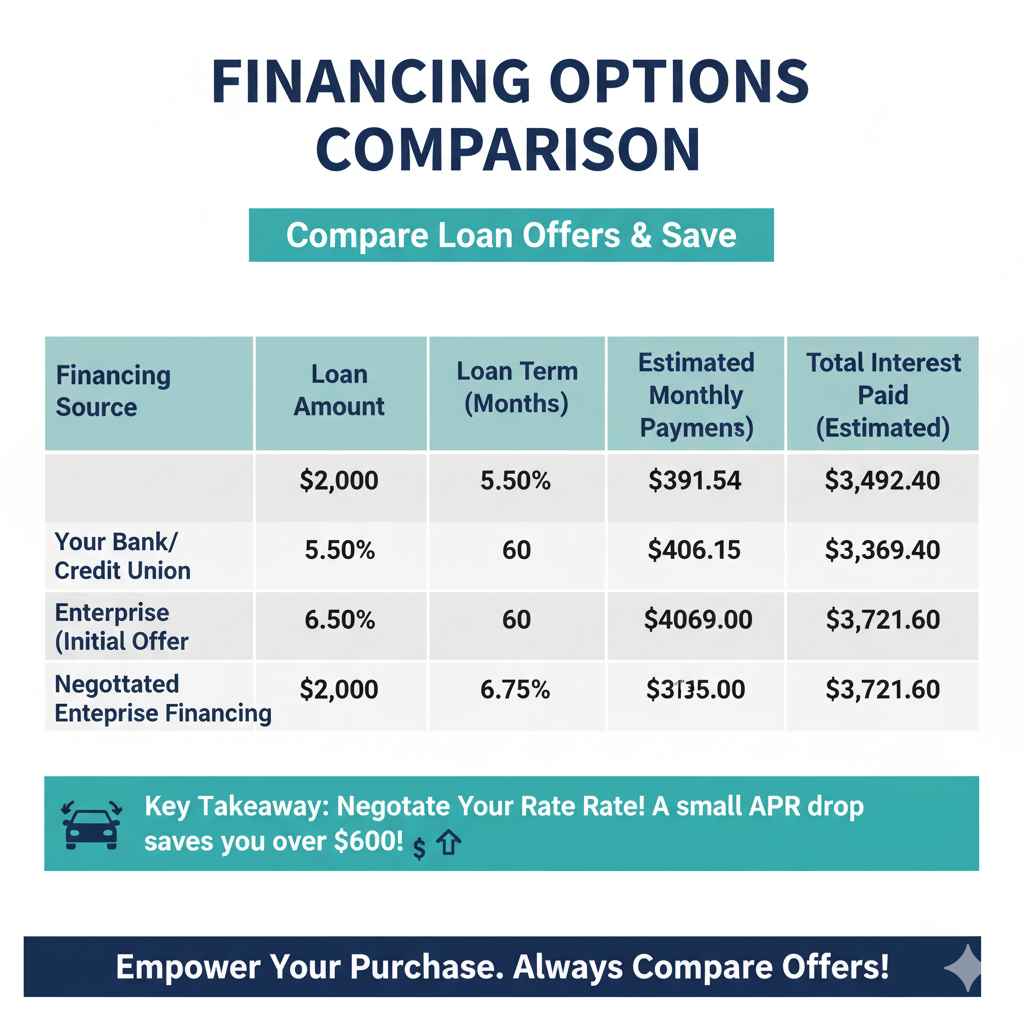
Table: Financing Options Comparison
Once you’ve agreed on a car price, comparing financing is crucial. Here’s how your pre-approval stacks up.
| Financing Source | Loan Amount | APR | Loan Term (Months) | Estimated Monthly Payment | Total Interest Paid (Estimated) |
|---|---|---|---|---|---|
| Your Bank/Credit Union | $20,000 | 5.50% | 60 | $391.54 | $3,492.40 |
| Enterprise Financing (Initial Offer) | $20,000 | 6.50% | 60 | $406.15 | $4,369.00 |
| Negotiated Enterprise Financing | $20,000 | 5.75% | 60 | $395.36 | $3,721.60 |
In this scenario, your bank offers the best rate. However, if Enterprise can negotiate their financing down to 5.75% APR, it becomes a more competitive option, saving you over $600 compared to their initial offer and still providing a decent deal compared to your bank (though your bank remains the cheapest).
Frequently Asked Questions (FAQ)
Can I negotiate the price of a car at Enterprise Car Sales?
Yes, absolutely! While Enterprise aims for a transparent and straightforward buying process, negotiation is usually possible on their used car inventory. Be prepared with your research to make a reasonable offer.
How do I know what a fair price is for a car at Enterprise?
Research the car’s market value using online tools like Kelley Blue Book (KBB) and NADA Guides. Compare this to similar vehicles listed at other local dealerships to understand the going rate.
What if Enterprise says their price is “no-haggle”?
Some Enterprise locations might advertise “no-haggle” pricing to simplify the process. However, this often refers to a starting point. You might still find room for negotiation, especially if the car has been on the lot for a while, or by negotiating other aspects of the deal, like financing or add-ons.
Should I get pre-approved for a car loan before visiting Enterprise?
Yes, it’s highly recommended. Securing pre-approval from your bank or credit union shows you’re a serious buyer and gives you a benchmark interest rate. You can then ask Enterprise to beat your pre-approved rate.
What’s the best way to inspect a car at Enterprise?
Conduct a thorough visual inspection, check the interior, look under the hood, and take it for a comprehensive test drive. For added assurance, consider a pre-purchase inspection (PPI) by an independent mechanic.
When should I bring up negotiation at Enterprise?
After you’ve identified a specific car you’re interested in, done your homework, and inspected it. Once you and the salesperson have discussed the car and you’re ready to talk numbers, that’s the time.