What Cars Can Go 200 MPH? Full List of Verified Hypercars
A small handful of production cars can legitimately reach 200 mph, and an even smaller handful — currently led by the Bugatti Chiron Super Sport 300+ at a TUV-certified 304.77 mph — have broken 300 mph in a straight line.
Most cars sold in the United States top out well under 155 mph, so a genuine 200 mph car is a rare piece of engineering: it needs 600 to 2,000+ horsepower, a drag coefficient tuned for a straight line instead of cornering grip, and a chassis rated to stay planted at speeds where a small aerodynamic mistake becomes dangerous. Fewer than three dozen production models in history have ever officially cleared 200 mph.
Below is the real, currently verified list of cars that can hit 200 mph and beyond, what separates a “manufacturer-claimed” top speed from an independently verified one, what it actually takes to build a car this fast, and what it costs to own one.
What It Actually Takes for a Car to Hit 200 MPH
Top speed comes down to a fight between two things: how much power the engine makes, and how much the car’s shape fights back against the air at speed. Aerodynamic drag rises with the square of velocity, so the horsepower needed to add another 10 mph near 200 mph is dramatically higher than the horsepower needed to add 10 mph near 60 mph. That is why a car needs roughly 300-400 horsepower to reach 155 mph but can need 1,000+ horsepower to push past 250 mph.
Three factors matter most:
- Power-to-weight ratio. A 1,500-horsepower engine in a 4,400-pound car (the Bugatti Chiron) and a 1,020-horsepower engine in a much lighter chassis can both reach similar top speeds — weight matters as much as raw output.
- Aerodynamic drag. Every panel, mirror, and vent is shaped in a wind tunnel to cut the drag coefficient (Cd). Hypercars built purely for top speed, like the Bugatti Chiron Super Sport 300+, use a longer tail and reduced rear wing to minimize drag rather than maximize downforce.
- Gearing and tires. A car needs a top gear tall enough to let the engine keep pulling at 250+ mph without hitting its rev limiter, and tires rated (and speed-tested) for that load — most production tires are not rated past 186 mph (a “Y” speed rating), so genuine 200+ mph cars need specially developed rubber.
The Fastest Verified Production Cars in the World
Manufacturers love to advertise a “top speed” figure, but there is a real difference between a number a computer projects and a number an independent party has actually clocked with a car on pavement. Here is where the fastest production cars in the world currently stand, including America’s own SSC Tuatara (see our full breakdown of what is the fastest car in America), with verified runs called out separately from manufacturer claims.
| Car | Top Speed | Verification Status |
|---|---|---|
| Bugatti Chiron Super Sport 300+ | 304.77 mph | TUV-certified one-way run (2019) |
| SSC Tuatara | 282.9 mph | Independently verified two-way average (Jan 2021); 295 mph is an unofficial one-way peak (2022) |
| Hennessey Venom F5 | ~301 mph | Manufacturer-claimed one-way run, not yet independently verified two-way |
| Koenigsegg Jesko Absolut | 330 mph (projected) | Simulation/engineering projection — no public run above 310 mph yet |
| Bugatti Chiron (standard) | 261 mph | Electronically limited; verified production figure |
| Rimac Nevera | 256 mph | Verified — fastest production electric car |
Note that most of these cars do not ship to customers set to their outright top speed. Bugatti, for example, electronically limits every customer Chiron to 261 mph (or 273 mph on the Super Sport) even though the factory test car proved capable of 304.77 mph, because production tires and structural components are not rated for repeated runs at that speed.
FOR HYPERCAR ENTHUSIASTS
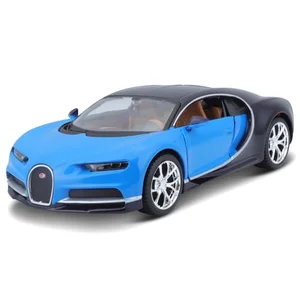 |
Maisto 1:24 Bugatti Chiron Diecast Model – $23.12 A detailed 1:24 scale replica of the Chiron platform behind the 304.77 mph Super Sport 300+ record covered above, for anyone who wants a piece of the fastest verified hypercar on a shelf instead of a driveway.
|
The 200 to 220 MPH Club
Below the ultra-exclusive 300 mph hypercars sits a wider group of cars that genuinely clear 200 mph, and a few of them are closer to attainable than a $3 million Bugatti. This is the group you are more likely to actually see at a track day or a dealer.
| Car | Top Speed | Approx. Starting Price |
|---|---|---|
| Chevrolet Corvette ZR1 | 233 mph | ~$175,000 |
| Lamborghini Revuelto | 217+ mph | ~$608,000 |
| Ferrari SF90 Stradale | 211 mph | ~$549,000 |
| McLaren 750S | 206 mph | ~$332,000 |
| Porsche 911 Turbo S | ~200 mph | ~$237,000 |
The Corvette ZR1 is the outlier here: it is roughly a third of the price of the next car on this list and still runs faster on paper than most of them, thanks to a twin-turbocharged 5.5-liter V8 pushing over 1,000 horsepower in a relatively light American sports car body. That makes it, by a wide margin, the cheapest way into a genuinely 200+ mph production car right now.
Historical Speed Milestones
Cars did not always get anywhere near 200 mph. Getting there took a century of trial and error, mostly through purpose-built record cars long before it was possible in anything resembling a road car.
Early Speed Records
The first land speed record, set in December 1898, belonged to an electric car: the Jeantaud Duc, driven by the Comte de Chasseloup-Laubat, hit 39.24 mph. By 1927, Henry Segrave drove the purpose-built Sunbeam 1000 HP to 203.79 mph on the sand at Daytona Beach — the first vehicle of any kind confirmed to cross the 200 mph mark, though it bore no resemblance to a road-going car.
The First Production Cars to Reach 200 MPH
It took another six decades for a genuine road-legal production car to catch up. In 1987, Road & Track magazine independently clocked the RUF CTR — nicknamed the “Yellowbird,” a heavily modified Porsche 911 built by German tuner RUF — at 211 mph, making it widely credited as the first production-based car verified past 200 mph on a public test track. The Ferrari F40, released the same year, claimed a 201 mph top speed and became one of the first cars a customer could actually order that approached the barrier. It took until 1998 for a naturally aspirated production car to set a record that stood for years: the McLaren F1 was independently verified at 240.1 mph, a record that held for the better part of a decade.
Safety Engineering Behind 200 MPH Cars
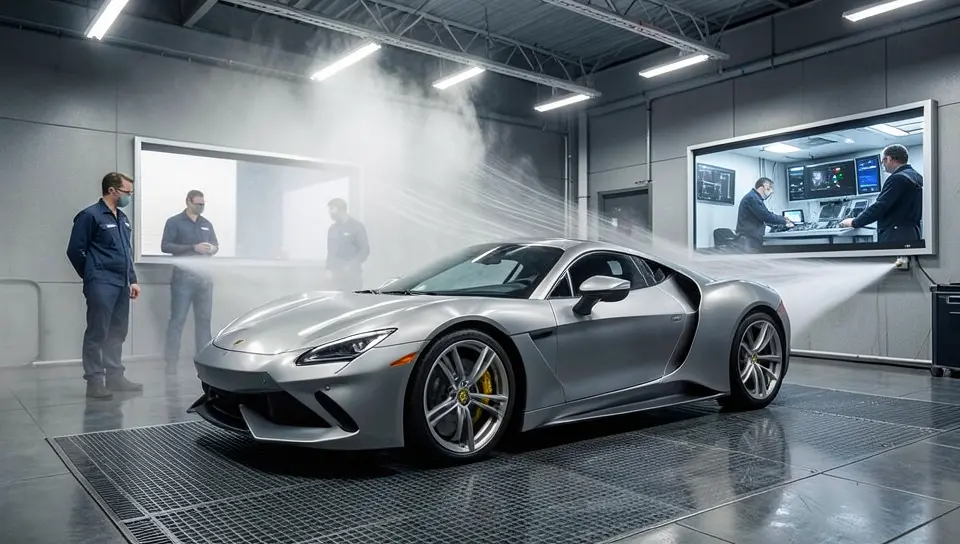
A car capable of 200 mph needs safety systems that go far beyond what a normal road car carries. Carbon-ceramic brakes are standard on nearly every car in this class because steel brakes cannot shed enough heat from repeated high-speed stops without warping. Electronic stability control and traction control constantly adjust individual wheel braking and power delivery to keep the car tracking straight, since even a tiny steering input at 200 mph translates into a huge lateral movement. Reinforced carbon-fiber monocoque chassis structures are also standard, both to save weight and to give the car a survivable safety cell in a crash at speeds a normal steel unibody was never designed to absorb.
The driver matters as much as the car. Manufacturers of true 300+ mph hypercars typically require factory-supervised runs with a professional test driver and closed, purpose-built facilities — the Chiron’s 304.77 mph run, for example, took place on Volkswagen’s Ehra-Lessien test track in Germany, a 5.5-mile straight built specifically for this kind of testing.
What It Really Costs to Own a 200 MPH Car
Purchase price is only the entry fee. The current fastest verified production cars start well past $2 million — the Bugatti Chiron starts around $3 million and the SSC Tuatara starts around $1.9 million — while the “affordable” end of the 200 mph club, like the Corvette ZR1, starts closer to $175,000.
Running costs scale with the car. Specialty tires rated for these speeds can run several thousand dollars per set and often need replacing more often than a normal car’s tires. Carbon-ceramic brake components are expensive to replace. Routine maintenance also costs more, since dealers with the specialized diagnostic tools and factory training for these platforms are limited, and parts are often shipped internationally. Insurance for a car in this class is also substantially higher than for an ordinary sports car, both because of the replacement cost and the risk profile insurers assign to the car’s performance envelope.
Is Driving 200 MPH Legal?
No — not on public roads in the United States. Every U.S. state has a maximum posted speed limit, and the highest in the country, on a stretch of Texas State Highway 130 near Austin, tops out at 85 mph. Driving 200 mph on any public U.S. road is reckless driving at minimum and can be charged as a felony in many states, on top of an automatic license suspension.
There are two legal ways to actually experience a car’s top speed. Some sections of the German Autobahn have no posted speed limit, and manufacturers regularly use them for real-world top-speed validation. In the U.S., the only legal option is a closed circuit — a track day, a manufacturer-supervised event, or a dedicated high-speed testing facility — where the car and the environment are both built for it.
The Future: Electric Hypercars Chasing 300 MPH
Electric hypercars have already closed most of the gap with gas-powered ones. The Rimac Nevera holds the verified record for fastest production electric car at 256 mph, and it does it with instant torque from four independent electric motors instead of a single massive combustion engine. The tradeoff is range: sustained 250+ mph running drains an EV battery in minutes, not the hour-plus a gas hypercar can sustain high-speed running given enough fuel.
Several manufacturers have publicly targeted 300 mph for a future electric model, but as of now no production EV has independently verified a run past Rimac’s 256 mph figure. Expect that gap to keep closing as battery energy density and motor cooling technology improve.
Frequently Asked Questions
What Cars Can Go 200 MPH?
Several production cars can reach 200 mph, including the Bugatti Chiron (261 mph), Lamborghini Revuelto (217+ mph), Chevrolet Corvette ZR1 (233 mph), Ferrari SF90 Stradale (211 mph), McLaren 750S (206 mph), and Porsche 911 Turbo S (around 200 mph).
What Is the Fastest Street-Legal Production Car?
The Bugatti Chiron Super Sport 300+ is widely credited as the fastest street-legal production car, with a TUV-certified 304.77 mph run in 2019. Customer versions of the car are electronically limited to 273 mph for safety.
Is There a Car That Can Go 300 MPH?
Yes. The Bugatti Chiron Super Sport 300+ has an independently certified run of 304.77 mph, and the SSC Tuatara has a verified two-way average of 295.0 mph. The Hennessey Venom F5 claims around 301 mph, though that figure has not yet been independently verified with a two-way run.
What Is the Cheapest Car That Can Reach 200 MPH?
The Chevrolet Corvette ZR1 is currently the cheapest car that can officially clear 200 mph, starting around $175,000 with a verified top speed of 233 mph — roughly a third of the price of most other cars capable of the same speed.
Can You Legally Drive 200 MPH on Public Roads?
Not in the United States. No U.S. state allows speeds anywhere near 200 mph on public roads, and doing so can be charged as reckless or felony driving. Some unrestricted sections of the German Autobahn allow it legally, and in the U.S. a closed track is the only legal option.
How Much Horsepower Do You Need to Hit 200 MPH?
It depends heavily on the car’s weight and aerodynamics, but most cars that reach 200 mph carry at least 600 to 700 horsepower, and the fastest hypercars use 1,000 to 1,600+ horsepower. Power alone is not enough — low aerodynamic drag and a tall enough top gear matter just as much as raw output.
Conclusion
The 200 mph barrier used to take purpose-built record cars and closed salt flats. Today it takes a production car most buyers could theoretically order, though the cars that push past 300 mph — the Bugatti Chiron Super Sport 300+, the SSC Tuatara, and the Hennessey Venom F5 — remain in a class of their own. If you want the fastest number possible, the Chiron Super Sport 300+ currently holds the independently certified record at 304.77 mph. If you want the cheapest way into the 200 mph club, the Corvette ZR1’s 233 mph top speed at roughly $175,000 is the most realistic entry point on this list.
Products related to this article
Sponsored / affiliate links. As an Amazon Associate I earn from qualifying purchases. I may earn additional commission from eligible campaigns.