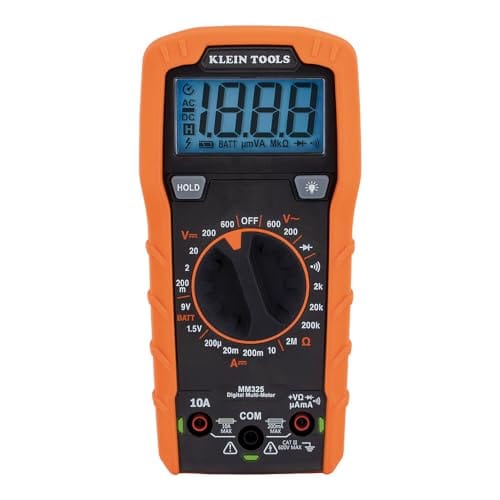
Best Automotive Multimeter: A Mechanic’s Troubleshooting Guide
You’ve just replaced a battery, an alternator, and a starter, and the car still won’t crank. Or maybe the dome light works fine, but the battery dies every single morning. You’re throwing parts at a problem you haven’t actually diagnosed. That’s the moment you need a multimeter, not a guess.
This guide is written for anyone who wants to stop guessing and start measuring. You’ll learn what separates a genuinely useful automotive multimeter from a cheap toy, how to run the three tests that solve 90% of car electrical problems, and exactly which models are worth your money. No fluff, no spec-sheet dumps. Just the stuff that matters when you’re leaning over a fender with a test lead in your hand.
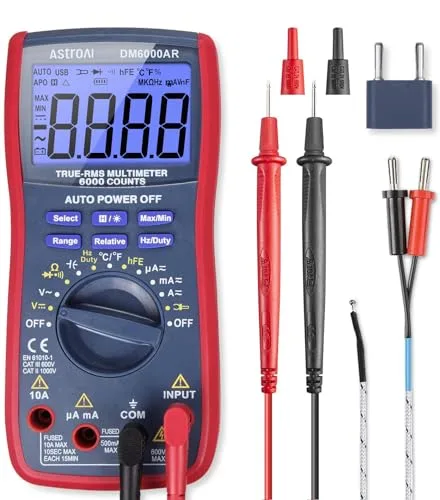
AstroAI
AstroAI Digital Multimeter, True RMS 6000 Counts…
- Versatile Digital Multimeter – Accurately measures AC/DC Current, AC/DC Voltage, Capacitance, Frequency, Duty Cycle, Resistance, D…
- Thoughtful Design – Support Data Hold, Large LCD Backlit Screen, Auto Shut-off and Kickstand make the process of measurements easi…
- Suitable For Many Occasions – This Multimeter is a golden partner to help to troubleshoot a variety of automotive and household el…
If you’re starting from zero, a reliable and affordable option like the AstroAI Digital Multimeter handles AC/DC voltage, current, resistance, continuity, capacitance, frequency, and temperature. It’s the kind of tool that gets you through a weekend wiring repair and then stays in the drawer for the next decade.
Why You Need a Multimeter Specifically for Your Car
A general-purpose multimeter from the hardware store will measure voltage. That’s about where the usefulness ends for modern vehicles. Cars today run on data as much as they run on electrons. The sensors, the ECU, the CAN-bus network that connects everything—they all speak in specific voltage signals and frequency patterns.
Consider a crankshaft position sensor. When it fails, your car won’t start. A basic multimeter can tell you if the sensor has power and ground, but it can’t tell you if the sensor is sending the correct AC voltage signal to the ECU. For that, you need a meter with a frequency or duty cycle function. That’s a feature you won’t find on a $15 hardware store special.
Modern CAN-bus systems also introduce signal noise. A cheap meter might show erratic readings on a perfectly healthy circuit because it can’t filter out the digital chatter. A true RMS meter with a decent bandwidth handles this without breaking a sweat. This is why the best automotive multimeter isn’t just a voltage tester—it’s a diagnostic tool that understands the language of your car’s electronics.
The 5 Best Automotive Multimeters in 2026
I’ve spent years using these meters in real garages, not just reading spec sheets. Here’s how they break down by use case. Prices change constantly, so check current listings before you buy.
| Model | Best For | Key Features | CAT Rating | What It Lacks |
|---|---|---|---|---|
| Fluke 115 | General diagnostics / pros | True RMS, auto-ranging, Min/Max/Average, resistance, continuity, frequency | CAT III 600V | No temperature, no duty cycle |
| AstroAI DM6000AR | Budget / beginners | True RMS, 6000 counts, auto-ranging, temperature, capacitance, duty cycle, backlit display | CAT III 600V | Build quality is not Fluke-level |
| Fluke 88V | Professional automotive techs | Duty cycle, RPM, temperature, Min/Max, low-impedance mode, glow plug test | CAT III 1000V | Expensive, overkill for DIY |
| Innova 3340 | Beginners / quick checks | Auto-ranging, backlit display, built-in thermometer, tachometer for RPM | CAT III 600V | True RMS is missing |
| Klein Tools MM400 | Build quality / electricians | Auto-ranging, temperature, capacitance, frequency, durable rubber over-mold | CAT III 600V | No duty cycle, awkward lead placement |
Best Overall: Fluke 115
The Fluke 115 is the meter I grab when I don’t know what’s wrong. It’s a general-purpose meter that happens to excel at automotive work. The true RMS feature gives accurate readings on modern cars with noisy electrical systems. The Min/Max function is perfect for catching intermittent faults—you can leave it connected to a circuit and it will record the highest and lowest voltage spikes while you wiggle wires.
It’s not cheap, but it’s the last multimeter you’ll buy for a long time. The rotary switch feels solid, the leads are high quality, and the display is easy to read in direct sunlight. My main complaint? No temperature probe and no duty cycle. You’ll need a separate tool for those jobs.
Best Budget: AstroAI DM6000AR
The AstroAI DM6000AR is the meter I recommend to friends who just want to stop paying a shop $100 to diagnose a dead battery. It gives you true RMS and auto-ranging—two features that were once reserved for meters costing three times as much. The 6000-count display is plenty for automotive work, and the backlight means you can read it under the hood at night.
It also includes a temperature probe, which is a nice bonus for checking coolant sensor resistance or ambient air temps. The duty cycle function lets you test fuel injectors and idle air control valves. It’s not built like a tank, and the test leads are average at best, but for the price, it’s an absurd amount of capability.
Best Pro Choice: Fluke 88V
The Fluke 88V is the gold standard for automotive technicians. It’s the meter you see hanging from a hook in a professional shop. It does everything the 115 does, plus duty cycle, RPM, and a low-impedance mode that prevents ghost readings from induced voltages.
The RPM function uses an inductive pickup—you clip it around a spark plug wire and it reads engine speed. That’s a lifesaver when you’re diagnosing a no-start condition on an older car. The glow plug test is another pro-only feature that saves time on diesel trucks.
Here’s the catch: it costs a lot. For a weekend DIYer, that money is better spent on other tools. But if you’re earning a living with your toolbox, the 88V pays for itself in a month.
Best for Beginners: Innova 3340
The Innova 3340 is designed for people who have never used a multimeter before. It’s auto-ranging, so you don’t need to know what setting to use. The display shows the measurement in plain English, and the built-in tachometer reads RPM without any extra accessories.
It’s a great meter for checking battery voltage, testing alternator output, and verifying that a fuse is blown. The included temperature probe is a nice touch. The downside is that it’s not true RMS, which means readings on modern CAN-bus circuits can be slightly inaccurate. For 90% of basic car maintenance, that won’t matter. For chasing a weird electrical gremlin, it might.
Best Build Quality: Klein Tools MM400
Klein Tools makes tools for electricians, and the MM400 feels like it. The rubber over-mold is thick and grippy. It survives drops that would kill a cheaper meter. The leads are also better than what you get with most budget meters—they stay flexible in cold weather.
It measures AC/DC voltage, resistance, continuity, capacitance, frequency, and temperature. The auto-ranging works well. My biggest gripe is the lack of a duty cycle function, which limits its usefulness for testing fuel injectors. It’s also a bit bulkier than the AstroAI, which makes it slightly awkward to hold in tight engine bays.
Automotive Multimeter Buying Guide: The 7 Features That Actually Matter
You don’t need a meter with 47 functions. You need one with the right seven. Here’s what to look for and why it matters.
Auto-Ranging vs. Manual Ranging
Auto-ranging is non-negotiable. I’ll die on this hill. A manual-ranging meter forces you to guess the voltage range before you test. If you guess wrong, you get an overload reading or, worse, a blown fuse. Auto-ranging does the thinking for you—you just touch the leads and read the number.
For example, testing a 12V battery on a manual meter might require you to select the 20V range. Testing a 5V sensor signal might require the 10V range. Get it wrong and you’ll see a ‘1’ on the display, which tells you nothing. An auto-ranging meter handles both without any input from you. That’s not a luxury; it’s a safety feature for your sanity.
True RMS and Why It Matters for Modern Cars
Most multimeters measure AC voltage by assuming a perfect sine wave. That assumption was fine for the 1950s. Modern cars have alternators that produce a modified sine wave, and the PWM (pulse-width modulation) signals used by fuel injectors and transmission solenoids are square waves. A non-true-RMS meter will give you an inaccurate reading on these signals.
True RMS meters use a mathematical calculation to determine the actual heating value of the signal. This gives you an accurate reading regardless of the waveform shape. If you’re working on any car built after 2026, you need true RMS. It’s that simple.
Safety Ratings (CAT III vs. CAT IV)
The CAT rating tells you how much energy the meter can safely handle. CAT III meters are rated for distribution-level circuits, like the wiring in your house or the 12V system in your car. CAT IV meters are rated for utility-level connections, like the main service entrance to a building.
For automotive work, CAT III 600V is the minimum you should accept. It protects you from the high-voltage spikes that can occur when you disconnect a battery while the engine is running. A meter with no CAT rating is a gamble with your safety. Don’t buy one.
Duty Cycle and Frequency
Duty cycle is the percentage of time a signal is ‘on’ versus ‘off.’ Fuel injectors, idle air control valves, and ignition coils all use duty cycle signals. Testing these components with a regular multimeter will show you a voltage reading, but it won’t tell you if the signal is correct.
Frequency is the number of cycles per second. It’s essential for testing crank and camshaft position sensors, which output an AC signal that increases in frequency as the engine speeds up. If you plan on doing any engine diagnostics beyond a battery check, make sure your meter has both functions.
Temperature Measurement
Temperature probes are a cheap addition that saves you from buying a separate infrared thermometer. You can test coolant temperature sensors, check if a catalytic converter is clogged, or verify that a thermostat is opening at the right temperature. Most meters include a thermocouple probe, but check the temperature range—some only go to 200°F, which isn’t enough for exhaust testing.
Backlit Display and Data Hold
A backlit display is not a luxury. You’ll be working under a hood, in a driveway, at dusk. Without a backlight, you’ll be angling the meter toward a streetlight like a caveman. Data Hold is another underrated feature—it freezes the reading on the screen so you can pull the leads away and actually look at the number. Both features cost almost nothing to include, so there’s no excuse for a meter that lacks them.
Low-Impedance Mode (LoZ)
This is a pro feature that solves a common problem: ghost voltage. When you test a wire that’s run alongside another live wire, it can pick up an induced voltage that makes a dead circuit appear live. A low-impedance mode puts a load on the circuit, which drains away the ghost voltage and shows you the truth. The Fluke 88V has it. Most budget meters don’t.
How to Test a Parasitic Battery Drain (Step-by-Step)
This is the #1 real-world car issue that sends people to a mechanic. The car runs fine, but the battery dies overnight. You’ve replaced the battery and the alternator, and it still dies. You have a parasitic drain—something is drawing power when the car is off.
Here’s how to find it without a fancy amp clamp.
- Set up the meter. Set your multimeter to measure DC amps. Use the 10A jack on the meter, not the mA jack. A parasitic drain can easily exceed 200mA, which will blow the fuse on the mA circuit.
- Disconnect the negative battery cable. Do not disconnect the positive cable. You want to meter the path between the negative post and the negative cable.
- Connect the meter in series. Touch the red lead to the negative battery post and the black lead to the disconnected negative cable. The meter is now the only path for current to flow.
- Wait. Modern cars have computers that stay awake for up to 30 minutes after you shut the door. If you read the current immediately, you’ll see a false high reading. Close the door, lock the car, and wait 15-20 minutes for the modules to sleep.
- Read the current. A normal parasitic draw is under 50mA. Anything above that is a problem. If you see a draw of 300mA or more, you’ve got a serious drain.
- Pull fuses. Start pulling fuses one at a time while watching the meter. When the current drops to near zero, you’ve found the circuit that’s causing the problem.
One warning: never start the engine with the meter in series. The starter can draw 200 amps, which will instantly vaporize the meter’s internal fuse and possibly the meter itself. Always disconnect the meter before cranking.
Common Mistakes to Avoid When Buying a Multimeter
I’ve seen too many people waste money on a meter that can’t do the job. Here’s what to avoid.
Cheap Fuses and Bad Leads
The test leads are the weakest link in any multimeter. Cheap leads have high resistance, which throws off your voltage readings. They also break internally, causing intermittent readings that send you chasing a wiring problem that doesn’t exist. Look for leads with silicone insulation and gold-plated connectors. They cost a few dollars more and last years longer.
Also, check the fuses. A quality meter uses ceramic fuses that are rated to break a high-energy fault without shattering. Cheap meters use glass fuses that can explode. If you’re working near a car battery, that’s a real safety concern.
False Safety Ratings
Some manufacturers print ‘CAT III’ on a meter that doesn’t have the internal clearance or component quality to back it up. Look for the UL or CE certification mark. If a meter claims a high CAT rating but costs $10, it’s lying to you. A real CAT III meter has internal spark gaps and reinforced insulation that cost money to build.
Ignoring the Input Jacks
Most meters have three or four input jacks. The 10A jack is for high current, the mA jack is for low current, and the common jack is for the black lead. If you plug the red lead into the wrong jack, you’ll blow the fuse or damage the meter. This isn’t a design flaw—it’s user error, but a good meter will have a beeper that warns you when you’ve selected a function that doesn’t match the jack.
Frequently Asked Questions
What is the difference between a dedicated automotive multimeter and a general-purpose one?
Dedicated automotive meters include features like duty cycle, RPM, and a low-impedance mode that are specifically useful for car diagnostics. General-purpose meters like the Fluke 115 are excellent for electrical work but lack these specific functions. For a DIYer who works on their own car, a general-purpose meter with true RMS and auto-ranging will cover most needs. For a professional tech, the dedicated features are worth the extra cost.
Can I test my car’s alternator with a multimeter?
Yes. Start the engine and set the meter to DC volts. Touch the red lead to the battery positive terminal and the black lead to the negative terminal. A healthy charging system should read between 13.8 and 14.5 volts at idle. If it reads below 13.5, the alternator isn’t charging enough. If it reads above 15 volts, the voltage regulator is failing and could damage the battery.
What does ‘auto-ranging’ mean and why do I need it?
Auto-ranging means the meter automatically selects the correct measurement range for the signal you’re testing. You don’t have to guess whether a voltage is 12V or 120V. This prevents overload errors and makes the meter much easier to use for beginners.
Is a higher CAT rating always better?
Not necessarily. A CAT IV rating is designed for utility-level connections and offers no advantage for automotive work. A CAT III 600V rating is the sweet spot. It’s safe for everything you’ll encounter under the hood, and it’s common on most quality meters.
How do I know if my multimeter leads are bad?
Set the meter to resistance mode and touch the two lead tips together. A good set of leads will read near zero ohms. If you see any resistance above 0.5 ohms, the leads are worn or corroded. Also, wiggle the leads while watching the reading—if it fluctuates, the internal wire is broken. Replace them immediately.
Final Verdict: Which One Should You Buy?
Here’s my honest advice based on your skill level and budget.
- If you’re a weekend DIYer on a budget: The AstroAI DM6000AR is the best value. It has true RMS, auto-ranging, and enough features to handle 95% of automotive diagnostics. It’s not perfect, but it’s more than enough.
- If you’re a professional tech: The Fluke 88V is worth every penny. It’s built for daily abuse and has the pro-only features that save time on complex diagnostics.
- If you never want to think about your meter again: The Fluke 115 is the best general-purpose meter. It lacks a few automotive-specific features, but it’s accurate, durable, and backed by the best warranty in the business.
- If you’re buying a first meter for basic checks: The Innova 3340 is simple and effective. You won’t outgrow it for basic battery and alternator tests.
- If you drop your tools more than you use them: The Klein MM400 can take a beating. It’s a solid backup meter that won’t let you down.
Before you buy anything, think about the actual work you plan to do. If you’re only checking battery voltage, a $15 meter will do the job. If you’re chasing an intermittent electrical fault on a modern car, you need true RMS and a good set of leads. The best automotive multimeter for you is the one that covers the tests you actually run, not the one with the most buttons on the dial.
Whichever you choose, pair it with a good understanding of basic electrical theory. A meter is just a tool. The knowledge in your head is what finds the problem. For more on keeping your car’s electrical system healthy, check out our automotive service tips. And if you’re planning to do wiring repairs, read our wiring repair guide before you start cutting.
Products related to this article
Sponsored / affiliate links. As an Amazon Associate I earn from qualifying purchases. I may earn additional commission from eligible campaigns.