Can You Write Off Car Lease Payments for Business?
Many people wonder, Can You Write Off Car Lease Payments for Business? It sounds complicated, but it’s really not that hard once you know the steps. Some rules can be tricky, especially when you first start your business. We’ll walk you through it simply and clearly.
You’ll learn exactly what you need to do to claim these costs. Let’s get started so you can save money on your business expenses.
Understanding Business Car Lease Write-Offs
When you use a car for your business, you can often reduce the amount of taxes you owe. This is called a tax write-off. One common question is about car lease payments.
Can you deduct these monthly payments from your business income? The simple answer is yes, but there are rules. You can’t just write off the entire lease payment.
Only the part of the lease that is for business use counts. This means you need to track your driving carefully. Keeping good records is key to proving your business use.
This section will break down the basics of how this works.
What Is a Business Car Lease Write-Off
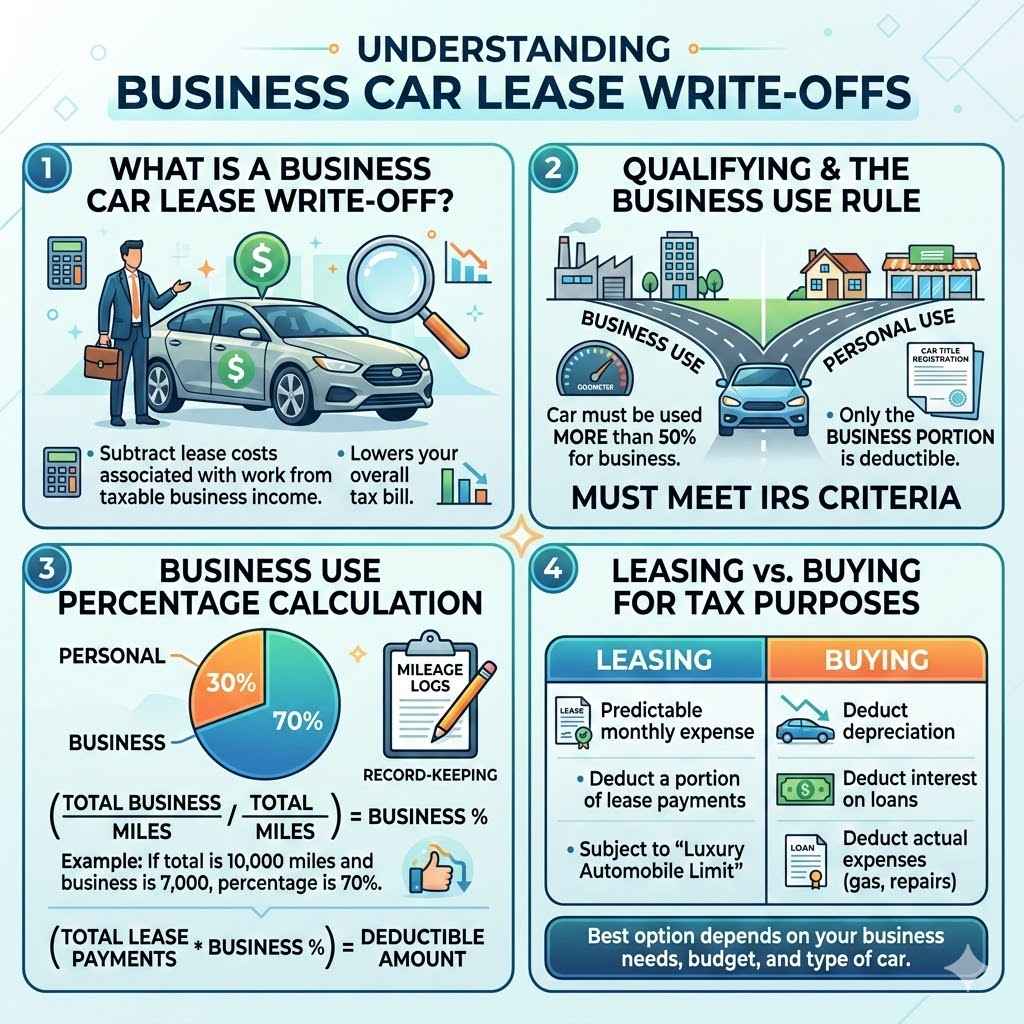
A business car lease write-off means you subtract the costs associated with leasing a car for work from your taxable business income. This lowers your overall tax bill. Think of it like this: if your business needs a car to visit clients, deliver goods, or travel to meetings, the expenses of that car are costs of doing business.
The IRS allows you to deduct these costs. For leased cars, the monthly lease payment is a major expense. However, you must be using the car for business purposes.
Personal driving does not count for deductions.
To qualify for this type of deduction, your car lease must meet certain criteria. The car needs to be registered in your name or your business’s name. It must be used more than 50% of the time for business.
If you only use the car for business sometimes, you can only deduct the business portion of the lease. This requires diligent record-keeping to show how much you drive for work versus personal trips. Without proper documentation, you might not be able to claim the deduction.
Business Use Percentage Calculation
Calculating your business use percentage is vital. You need to know how much of your driving is for business. This is usually done by tracking your mileage.
A common method is to subtract your total personal mileage from your total mileage driven for the year. The remaining mileage is considered business use. For example, if you drive 10,000 miles in a year and 7,000 of those miles were for business, your business use percentage is 70% (7,000 / 10,000).
This percentage is then applied to your total lease costs. So, if your annual lease payments are $6,000 and your business use is 70%, you can deduct $4,200 of those lease payments ($6,000 * 0.70). It’s important to be accurate with your mileage logs.
This is a common area where people make mistakes. Good logs typically include the date, the total miles driven for the trip, the starting and ending odometer readings, and the business purpose of the trip.
Choosing Between Leasing and Buying for Tax Purposes
When deciding whether to lease or buy a car for your business, tax implications are a big factor. Leasing offers a predictable monthly expense, and a portion of that payment can be deducted. Buying a car allows you to deduct the actual expenses, including depreciation, interest on loans, and other costs.
For new cars, depreciation can be significant in the early years. For leased cars, you deduct the lease payments.
The IRS has specific rules for how much of a car you can deduct. For leased vehicles, there’s a limit to the lease payment deduction, often referred to as the “luxury automobile limit.” This means if you have a very expensive car, you might not be able to write off the full business portion of the lease payment. For purchased vehicles, depreciation limits also apply to luxury cars.
The best option depends on your business needs, budget, and the type of car you are considering.
How to Deduct Car Lease Payments
To actually get the tax benefit from your car lease payments, you need to follow specific IRS guidelines. This involves choosing the right deduction method and keeping meticulous records. The two main ways businesses can deduct car expenses are the mileage method and the actual expense method.
For leased cars, the actual expense method is usually the one that applies to lease payments. We will focus on that here. Understanding these methods will help you maximize your deductions correctly.
The Actual Expense Method
The actual expense method allows you to deduct all your operating costs for the car. This includes lease payments, gas, oil, repairs, insurance, registration fees, and even depreciation if you own the car. For a leased car, the lease payment itself is one of the key expenses you can deduct.
You calculate your total actual expenses for the year. Then, you multiply that total by your business use percentage.
For example, let’s say your car lease payments total $7,200 for the year. You also spent $1,000 on gas and $500 on insurance and registration. Your total car expenses, excluding repairs for now, are $7,200 + $1,000 + $500 = $8,700.
If your business use percentage is 80%, you can deduct 80% of $8,700, which is $6,960. This method can be very beneficial if your operating costs are high.
Tracking Your Mileage
As mentioned, good mileage tracking is non-negotiable. You need to log every business trip. This log should include the date, odometer readings (start and end), total miles for the trip, and the business purpose.
A simple notebook can work, but many apps and digital tools are available to make this easier. Some even connect to your car’s GPS.
Here is an example of a mileage log entry:
- Date: October 26, 2023
- Starting Odometer: 15,200
- Ending Odometer: 15,245
- Total Miles: 45
- Business Purpose: Client meeting with ABC Corp.
Without this information, the IRS can deny your deduction. They want proof that the miles driven were actually for business purposes. Imagine you are audited.
You will need to present these logs to support your claim. If the logs are incomplete or inconsistent, it can lead to problems.
Lease Payment Limitations
There’s a catch when it comes to leasing luxury cars. The IRS sets limits on how much you can deduct for leased vehicles. This is to prevent people from deducting the entire cost of very expensive cars used for business.
These limits are adjusted each year. The IRS publishes tables that show the maximum amount you can lease-rent a car and still deduct. If the business portion of your lease payment exceeds this limit, you can only deduct up to the limit.
Let’s say your annual lease payments are $12,000, and you use the car 80% for business. That’s $9,600 ($12,000 * 0.80). If the IRS luxury automobile limit for that year is $7,000, you can only deduct $7,000, not the full $9,600.
You would still be able to deduct other business expenses like gas and insurance, but the lease payment deduction is capped. This makes it important to know these limits before you lease a high-end vehicle.
Record-Keeping Requirements
Proper record-keeping is the backbone of any tax deduction. For car lease payments, you need to keep track of several things. This isn’t just about mileage.
You also need receipts for all expenses and the lease agreement itself. The IRS can ask for these documents at any time. Having everything organized makes tax filing easier and protects you during an audit.
Think of it as your proof of business expense.
Essential Documents to Keep
You must keep your lease agreement. This document shows the terms of your lease, including the monthly payment amount and the lease duration. You also need all receipts for payments made towards the lease.
This includes your monthly payments and any upfront fees or deposits that are part of the lease agreement.
Additionally, keep records of all other car-related expenses. This includes:
- Fuel receipts
- Repair bills
- Insurance premium statements
- Registration and license plate fees
- Maintenance records
Every single expense related to the car should have a receipt. These receipts, along with your mileage logs, form the complete picture of your car expenses for tax purposes.
Mileage Logs
We’ve talked about mileage logs, but it’s worth repeating how critical they are. A complete mileage log is your primary tool for proving business use. The IRS often uses Form 2106, Employee Business Expenses, or Schedule C (Form 1040), Profit or Loss From Business, to report these expenses.
These forms require detailed mileage information.
A good log helps determine the business use percentage. This percentage is then applied to all your car expenses, including the lease payments. Without a consistent and detailed log, the IRS might assume a lower business use percentage, or even deny the deduction altogether.
For example, if you have a very busy year with many client visits, a detailed log can justify a high deduction. If your log is vague, it looks less credible.
Lease Agreement and Payment Proof
Your lease agreement is your contract with the leasing company. It outlines your financial obligation. You need to show the IRS that you are indeed paying for the lease.
This means keeping copies of your monthly bills from the leasing company and proof of payment. This could be copies of canceled checks, bank statements showing the payment, or credit card statements.
This documentation confirms the amount of your lease payments. When you combine this with your business use percentage, you can accurately calculate the deductible portion of your lease. For instance, if your lease costs $500 per month, that’s $6,000 per year.
If you use the car 90% for business, you can deduct $5,400 of those lease payments ($6,000 * 0.90). The lease agreement shows the total cost, and your payment proofs show you paid it.
Common Pitfalls and How to Avoid Them
Many business owners make mistakes when trying to deduct car lease payments. These errors can lead to rejected deductions or problems during an audit. Understanding these common pitfalls beforehand can save you a lot of trouble.
Being aware of the rules and best practices will help you stay compliant and get the deductions you deserve. Let’s look at what can go wrong and how to steer clear of these issues.
Not Meeting the More Than 50% Business Use Rule
This is a big one. The IRS requires that you use the car more than 50% of the time for business purposes to claim the deduction. If your business use falls below this threshold, you cannot use the standard mileage rate, nor can you deduct the business portion of your actual expenses.
Some businesses might think using the car for errands counts as business, but the IRS has specific definitions.
To avoid this, keep your personal and business driving separate. If you use the car for personal trips on weekends or for commuting, this reduces your business use percentage. For example, if you drive 12,000 miles a year and 6,000 of those are personal commutes, and another 1,000 are personal errands, your business use is only 5,000 miles out of 12,000, which is about 41.7%.
This is below the 50% mark. You need to ensure your business mileage is significantly higher than your personal mileage.
Inconsistent or Incomplete Record-Keeping
As we’ve stressed, records are crucial. Inconsistent or incomplete records are a red flag for the IRS. This could mean gaps in your mileage logs, missing receipts, or records that don’t match other financial documents.
If your records are sloppy, the IRS may disallow your deduction entirely.
For example, if your mileage log shows you drove 100 miles on a certain day for a business meeting, but your gas receipts don’t support that amount of driving, it can raise questions. Always make sure your logs are filled out promptly and accurately. Having a system in place, whether it’s an app or a well-organized binder, can prevent these issues.
It’s better to be over-prepared with documentation than to face an audit unprepared.
Misunderstanding Lease Limits
The luxury vehicle limitation is another common trap. Many people lease expensive cars without realizing that the IRS caps how much of the lease payment they can deduct. They might calculate their business use percentage correctly but then try to deduct more than the law allows.
It’s important to research the current year’s IRS lease inclusion tables before you lease a vehicle. These tables will tell you the maximum amount you can add to your deductible expenses based on the lease start date and the car’s fair market value. If your calculated business portion of the lease exceeds this amount, you must use the table amount.
For instance, if the table says you can deduct up to $8,000 for lease costs in a year, and your business portion is $10,000, you can only deduct $8,000.
Using the Car for Personal Commuting
Commuting miles are generally considered personal, not business, miles. This is a critical distinction. Driving from your home to your regular place of business is usually not deductible.
However, if your home is your principal place of business, then driving from home to another work location can be deductible.
To illustrate, if you work from your home office and drive to a client’s office 20 miles away, that 20-mile trip is a business expense. But if you drive from your home office to your company’s main office 20 miles away every day, that’s usually considered commuting and is not deductible. Be very clear about what constitutes a business trip versus a commute.
Keeping detailed logs helps differentiate these types of drives.
Business Car Lease Write-Offs Explained
When you lease a car for your business, you can deduct a portion of your lease payments as a business expense. This is a great way to lower your taxable income. The key is to use the car primarily for business.
The IRS has specific rules to ensure you’re not deducting personal expenses. You must track your mileage carefully to show how much you drive for work. This business use percentage is then applied to your total lease costs.
Key Takeaways for Deducting Lease Payments
To deduct car lease payments, you must use the car more than 50% for business. Keep detailed mileage logs for every trip, noting the date, odometer readings, and business purpose. Save all receipts for lease payments and other car expenses like gas, insurance, and repairs.
Understand the IRS limits on luxury vehicle lease deductions. These steps ensure you can claim the deduction correctly and avoid issues with the IRS.
If you are unsure, consulting with a tax professional is always a good idea. They can help you understand the specific rules that apply to your situation and ensure your records are in order. This will help you maximize your deductions and keep your business compliant.

Frequently Asked Questions
Question: Can I deduct the full car lease payment if I use the car 100% for business
Answer: Even if you use the car 100% for business, you may still be subject to IRS limits on luxury automobile lease inclusions. You can deduct the business portion of your lease payment up to the amount specified by the IRS for that tax year.
Question: What if I use the car for business only 60% of the time
Answer: If you use the car 60% for business, you can deduct 60% of your lease payments and 60% of your other car expenses, provided you meet all other IRS requirements.
Question: Do I need a separate car for business
Answer: You do not necessarily need a separate car for business. You can use your personal car for business, but you must meticulously track business mileage and deduct the business-use portion of expenses, including lease payments if the car is leased.
Question: How do I prove business use to the IRS
Answer: You prove business use primarily through detailed mileage logs that record the date, odometer readings, total miles driven for the trip, and the business purpose. You also need receipts for all expenses related to the car.
Question: Can I deduct lease payments for a sports car
Answer: You can deduct lease payments for a sports car if it is used for business more than 50% of the time. However, sports cars are often considered luxury vehicles, so you will likely be subject to the IRS’s lease inclusion limits, which may restrict the amount you can deduct.
Summary
When considering Can You Write Off Car Lease Payments for Business? remember it’s about business use. Track your mileage diligently and keep all your receipts. Understand the IRS limits, especially for luxury cars.
By following these steps, you can successfully deduct your car lease payments and reduce your business taxes.