How Many People Own Cars in the US? 2026 Ownership Statistics
About 92% of US households own at least one car in 2026 — roughly 133 million homes — and there are now more than 284 million registered vehicles on American roads.
That works out to an average of 1.83 vehicles per household, but the number that matters most is the flip side: 8.4% of US households, about 11 million homes, have no car at all. Whether a family falls into that group depends heavily on where they live, how much they earn, and their age — a household in Provo, Utah averages 2.12 vehicles, while one in New York City averages just 1.19.
This guide breaks down current US car ownership numbers, how ownership varies by state, income, age, and race, what owning a car actually costs in 2026, and the real (not the assumed) state of EV adoption this year.
How Many Americans Own a Car in 2026?
According to the latest US Census Bureau household data, 92% of American households have access to at least one vehicle. That leaves 8.4% of households, or roughly 11 million homes, without a car — down slightly from 8.7% in 2018. Most households don’t stop at one car, either: more than half own two or more.
| Vehicles Owned | Share of US Households |
|---|---|
| Zero vehicles | 8.4% |
| One vehicle | 33% |
| Two vehicles | 37% |
| Three or more vehicles | 22% |
Two-car households are now the most common arrangement in the US, not one-car households — a real shift from decades past, when a single family car was the norm.
Average Vehicles Per Household: Then vs. Now
Car ownership in the US climbed steadily through the 20th century. In 1980, the country had about 120 million registered vehicles. By 1990 that had grown to roughly 140 million, and by 2000 it had passed 190 million — more than double the 1970 total. Owning one car per family became standard in the 1960s and 1970s; owning two or more became common by the 1990s and 2000s.
That growth hasn’t slowed. The US now has more than 284 million registered vehicles, a record high, spread across roughly 133 million car-owning households. The weighted average of 1.83 vehicles per household reflects that lopsided mix from the table above: a bigger share of households now own two or three cars than own just one.
For a longer look at how the national vehicle count grew decade by decade, see our breakdown of how many cars were registered in the US from 1900 to today.
Which States Have the Most Cars and the Highest Ownership Rates?
California has more registered vehicles than any other state by a wide margin, and the gap between the top three states and everyone else is significant.
| State | Registered Vehicles |
|---|---|
| California | 31.1 million |
| Texas | 23.5 million |
| Florida | 19.5 million |
Together, California, Texas, and Florida account for more than a quarter of every registered vehicle in the country — unsurprising given they’re the three most populous states with limited public transit outside their biggest cities.
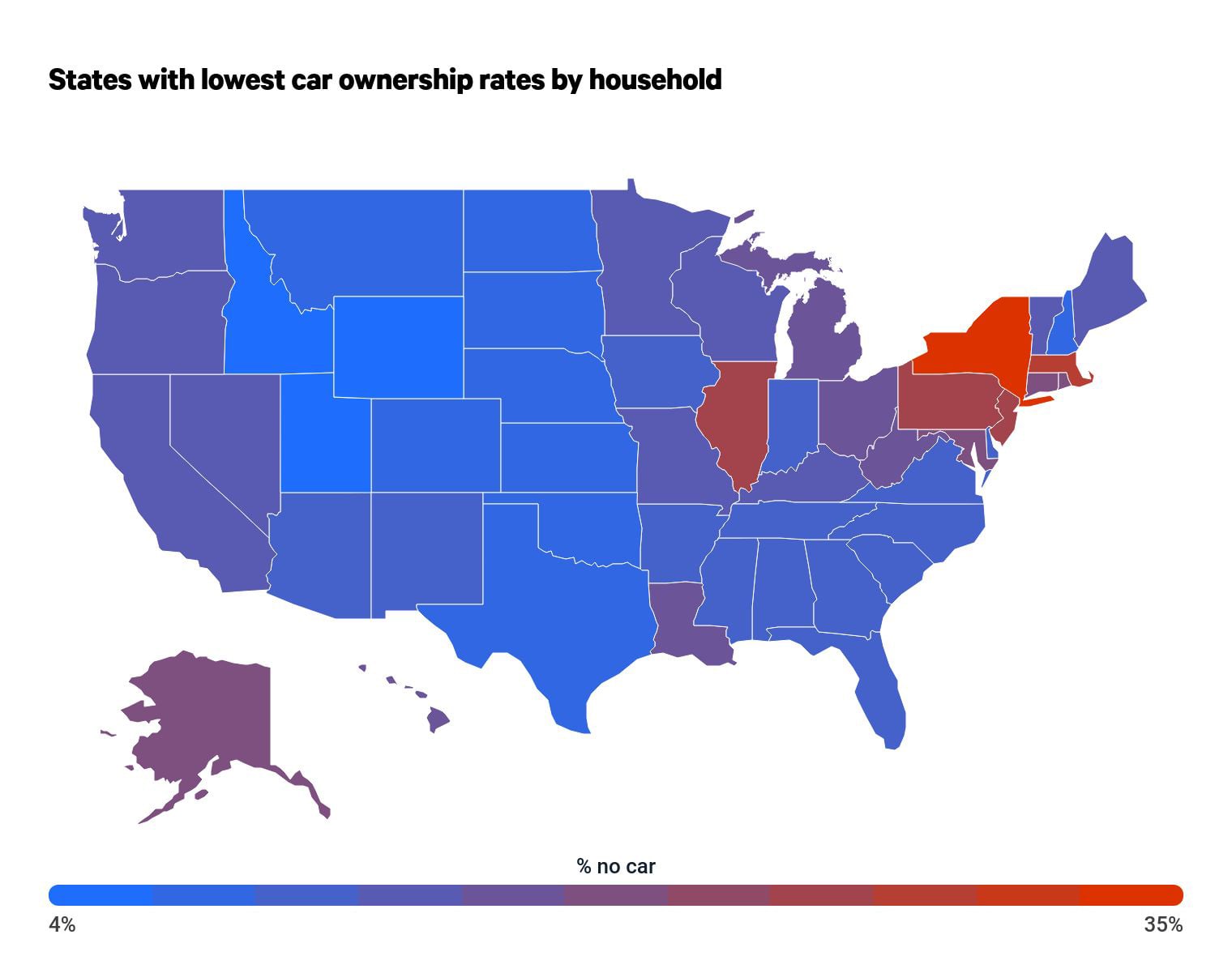
Total vehicle count isn’t the same as ownership rate, though. On a household-access basis, Idaho has the highest car ownership rate in the country at 96% of households, while Washington, DC sits at the bottom at just 64% (New York state, driven by New York City, is close behind at 71%). At the metro level, car-dependent Provo-Orem-Lehi, Utah averages 2.12 vehicles per household — almost double the 1.19 average in the New York-Newark-Jersey City metro area, where subways and buses cover most trips.
Who Owns Cars? Age, Income, and Race
Car ownership isn’t spread evenly across every group. Age plays a clear role: adults 18 to 34 own fewer cars on average, partly because they’re more likely to live in cities and use ride-sharing or public transit, and partly because a new or reliable used car is a bigger stretch on an entry-level income. Households headed by adults 35 to 54 have the highest car ownership rates of any age group, and ownership stays high among adults 55 and older, many of whom depend on a car for independence after they stop working.
Income is an even stronger predictor than age. Higher-income households are significantly more likely to own a car — and to own more than one — because a car expands where someone can realistically work, not just where they can afford to live. Lower-income households that go without a car often face a smaller pool of job options within reach of public transit, which can make it harder to break out of that income bracket in the first place.
Race also shows up in the data: 94% of white households have access to a vehicle, compared to roughly 10 percentage points lower among Black households. That gap tracks closely with income and homeownership disparities rather than existing on its own, but it’s real and it shows up consistently in Census transportation data.
Urban vs. Rural Car Ownership
Where someone lives is one of the biggest single factors in whether — and how many cars — they own. Dense cities with real subway, bus, or light-rail networks (New York, Chicago, Boston, San Francisco) have measurably lower car ownership rates, because a car becomes optional rather than essential for daily life. Suburban and rural areas flip that equation: without reliable transit, a car isn’t a lifestyle choice, it’s how someone gets to work, the grocery store, or a doctor’s appointment.
That divide also shows up regionally. States across the South and much of the Midwest, where cities are more spread out and transit investment has historically been lower, tend to have higher per-household vehicle counts than the Northeast corridor or West Coast cities with older, denser transit systems.
What Owning a Car Actually Costs in 2026
Car ownership isn’t just a one-time purchase — it’s a recurring line item in a household budget, and it’s a big one. AAA’s 2026 Your Driving Costs report puts the average annual cost of owning and operating a new vehicle at $11,577, or roughly $965 a month, once depreciation, financing, insurance, maintenance, and fuel are all added up.
| Cost Category | Approximate Annual Cost |
|---|---|
| Depreciation | $4,334 |
| Finance charges | $1,131 |
| Fuel (at 13.00 cents/mile, 15,000 miles/year) | ~$1,950 |
| Insurance, maintenance, fees, and tires | Remainder |
That figure has actually come down from 2024, mostly because vehicles are depreciating a bit less sharply and financing costs eased as interest rates cooled. Still, at nearly $12,000 a year, cost is exactly why car ownership tracks so closely with income: a used car that needs occasional repairs can be more affordable up front than a new one, but unreliable transportation carries its own cost in missed shifts and job options.
Is EV Ownership Actually Growing in 2026?
It’s tempting to assume electric vehicle ownership only ever climbs. That’s not what 2026 actually looks like. EVs accounted for a peak of 10.6% of new US vehicle sales in the third quarter of 2025 — but that share dropped to roughly 5.8% in the first half of 2026 after the federal EV tax credit expired at the end of September 2025. Sales haven’t collapsed, but growth has clearly stalled without that incentive in place.
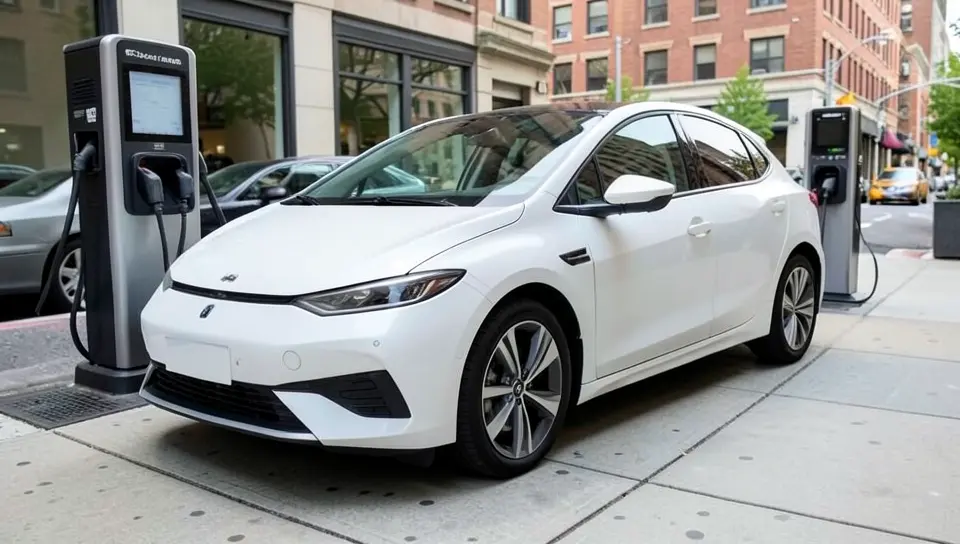
Tesla still dominates what EV sales remain, accounting for roughly 45% of all new EV sales in 2026 despite the overall pullback. Charging infrastructure and battery-electric model choices have both kept expanding, so the long-term trend toward electrification hasn’t reversed — but anyone assuming EVs are on an uninterrupted upward curve in the US right now is working from an outdated picture.
Frequently Asked Questions
What Percentage of the US Owns a Car?
About 92% of US households own at least one car, according to current Census Bureau household transportation data. That figure has been gradually rising over the past several years.
What Percent of the US Doesn’t Own a Car?
About 8.4% of US households don’t own a car. That share is much higher in dense, transit-heavy cities — it reaches 64% without a car in Washington, DC — and much lower in rural and car-dependent states like Idaho.
How Many Vehicles Does the Average US Household Have?
The average US household owns about 1.83 vehicles. Two-car households are now the single most common arrangement, at 37% of all households, followed by one-car households at 33% and households with three or more vehicles at 22%.
Which State Has the Most Registered Vehicles?
California has the most registered vehicles of any state, at about 31.1 million. Texas is second with roughly 23.5 million, and Florida is third with about 19.5 million.
Which State Has the Highest Rate of Car Ownership?
Idaho has the highest household car ownership rate in the country, at 96%. That’s driven by its rural geography and limited public transit, which make owning a vehicle close to essential for most residents.
Is EV Ownership Still Increasing in 2026?
Not the way it was. EV sales peaked at 10.6% of new vehicle sales in the third quarter of 2025, then fell to around 5.8% in the first half of 2026 once the federal EV tax credit expired at the end of September 2025. EVs still make up a real and growing slice of the used-car and charging-infrastructure landscape, but new-vehicle growth has clearly slowed.
Conclusion
Car ownership remains close to universal in the US: 92% of households own at least one vehicle, and more than half own two or more, adding up to over 284 million registered vehicles nationwide. But that average hides real differences — by state, by income, by age, and by whether someone lives somewhere with a real transit system or not.
The one part of the story that’s genuinely shifting is EVs, and not in the straightforward “steady rise” direction most people assume — their share of new sales actually pulled back in 2026 once the federal tax credit went away. Multi-car households, not electrification, are the clearer long-term trend in American car ownership right now.
Products related to this article
Sponsored / affiliate links. As an Amazon Associate I earn from qualifying purchases. I may earn additional commission from eligible campaigns.