Car Lights for Inside: Best Interior LEDs
Pick interior LED kits by fit first: choose plug-and-play replacements for dome, map, and footwell lights, and only add RGB strips if the kit includes dimming and an OEM-style white mode. Poor fit, harsh color, or sloppy wiring can create glare, dead spots, and parasitic battery drain. This guide compares brightness, control types, install difficulty, and vehicle compatibility so you can buy the right car lights for inside.
Best interior LED pick for most cars
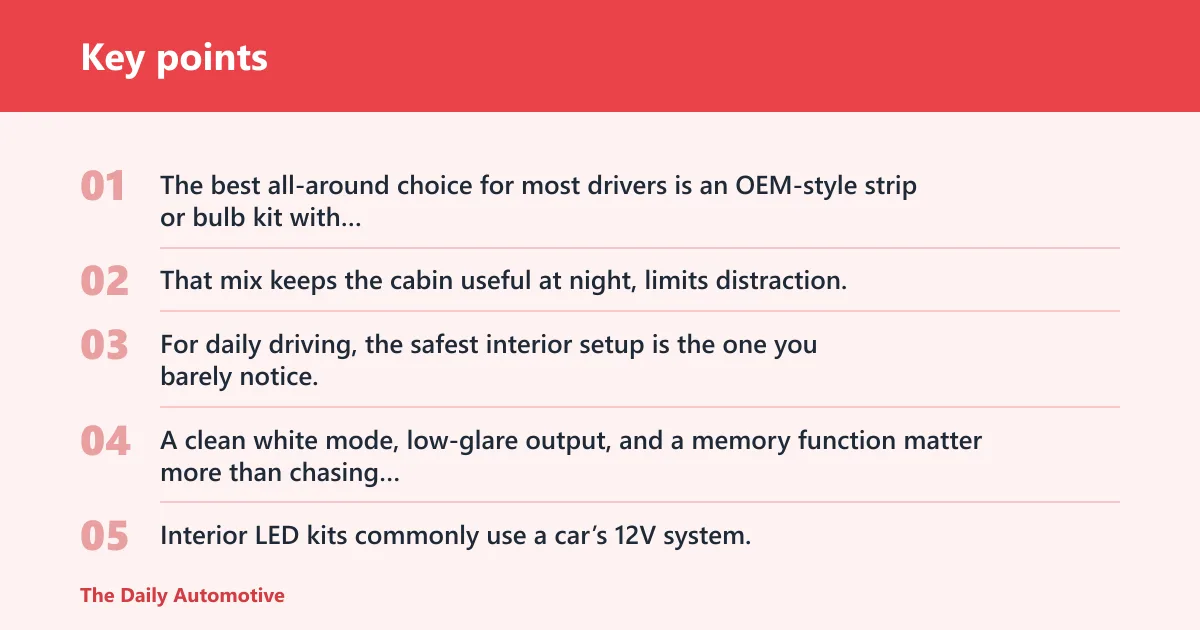


The best all-around choice for most drivers is an OEM-style strip or bulb kit with dimming, a memory function, and a white-light mode for driving. That mix keeps the cabin useful at night, limits distraction, and handles the daily jobs that matter more than effects.
Why an OEM-style kit leads for everyday use
For daily driving, the safest interior setup is the one you barely notice. A clean white mode, low-glare output, and a memory function matter more than chasing effects that distract the driver or spill light onto the windshield.
Interior LED kits commonly use a car’s 12V system, and many run from a cigarette lighter adapter, USB, or fuse-box hardwiring. That range gives you a practical path for compact cars, SUVs, trucks, and older vehicles with different trim layouts and power access.
Who should skip show-mode effects?
Skip bright, color-heavy show modes if the lighting will stay on while driving at night. Blue, red, and fast-chasing effects can pull attention away from mirrors and instruments. If the goal is road use, choose subdued brightness and a stable white or warm-white setting.
Quick picks by install need
Choose the kit that matches your install skill, cabin layout, and how much hidden wiring you want to deal with. The right pick usually fits the power source and zone without forcing extra trim removal.
- Best for easy plug-in installs: USB-powered strips for a smaller cabin zone, or a cigarette lighter adapter kit.
- Best for a factory-look cabin: Fiber optic interior kits tucked into panel gaps for a cleaner, integrated finish.
- Best for color effects and presets: RGBIC lighting with app control, brightness adjustment, and segmented effects.
- Best for direct light replacement: Dome/map bulb kits for dome, map, and trunk lights.
Best for easy plug-in installs
If you want the shortest path from box to cabin glow, choose a USB or lighter-socket kit. USB-powered interior lights are common for smaller lighting zones, and a plug-in power source avoids fuse tapping and most hidden-wire routing.
Best for a factory-look cabin
Fiber optic interior kits are the cleaner pick when you want light to disappear into the trim. Their flexible tubing can be tucked into panel gaps, which helps the install read as OEM-style ambient lighting instead of an obvious add-on.
Best for color effects and presets
RGBIC lighting is the better match if you want segmented color effects, chasing modes, and more layered patterns. RGB still covers basic multi-color output, but RGBIC adds separate segment control, which creates more movement across a longer strip.
Interior LED fit checklist
Use this checklist before you buy. It keeps the choice tied to cabin zone, power source, control method, routing difficulty, and battery-drain risk instead of brand hype.
| Cabin zone | Best power source | Control method | Wire-routing difficulty | Battery-drain risk | Best product type |
|---|---|---|---|---|---|
| Under-dash ambient light | 12V socket or fuse box | Remote or app | Medium | Low if switched power is used | LED strip light |
| Seat base or footwell | USB for a small zone | Remote | Low | Low | USB strip kit |
| Console accent | USB or 12V socket | App or remote | Low to medium | Low to medium | Trim-to-fit strip |
| Dome light | Factory bulb circuit | Switch-controlled by cabin lamp | Low | Low when installed correctly | Dome/map bulb kit |
| Map light | Factory bulb circuit | Switch-controlled by cabin lamp | Low | Low when installed correctly | Plug-and-play bulb kit |
| Trunk light | Factory bulb circuit or fuse tap | Simple switch or remote | Low to medium | Low | Bulb kit or small strip |
Which interior LED type fits your car?
The right type depends on where the light needs to land. Under-dash strips suit broad ambient lighting, bulb kits fit direct lamp replacement, and fiber optic kits suit a tucked-in finish that looks closer to factory ambient lighting.
LED strip lights for ambient cabin lighting
LED strip lights are the most flexible option for under-dash, seat, and console placement. They usually have adhesive backing and can often be trimmed to size, which makes them useful when the cabin shape is narrow or irregular.
Use strips when you want light spread across a larger zone. In compact cars, one short run under the dash may be enough. In SUVs and trucks, longer runs can cover footwells and second-row areas without needing a bulb swap.
Dome and map bulb kits for direct replacement
Dome/map bulb replacement kits are the easiest way to upgrade factory interior lamps. They are designed for dome, map, and trunk lights, and the plug-and-play format keeps the install straightforward if you only want brighter cabin lighting.
These kits make sense when the stock bulb is too dim but the housing already lights the right area. They are less useful for ambient accent work because they replace a single lamp instead of adding a hidden glow line.
Fiber optic kits for a tucked-in look
Fiber optic interior kits often use flexible tubing that can sit inside panel gaps for a cleaner result. That makes them a strong choice when you want the light source to disappear and the cabin to keep an OEM-style outline.
They are also useful when loose strip edges would look messy. A fiber route can be slower to install, but it solves a common failure case: adhesive strips lifting where the trim curves or where heat builds up.
What is the easiest install path?
The easiest path is usually a plug-in kit with a cigarette lighter adapter or USB power, followed by a bulb replacement kit. Hardwiring is only worth it when you want a hidden finish, a switched circuit, or a larger install that would otherwise leave visible cords.
No-hardwire options
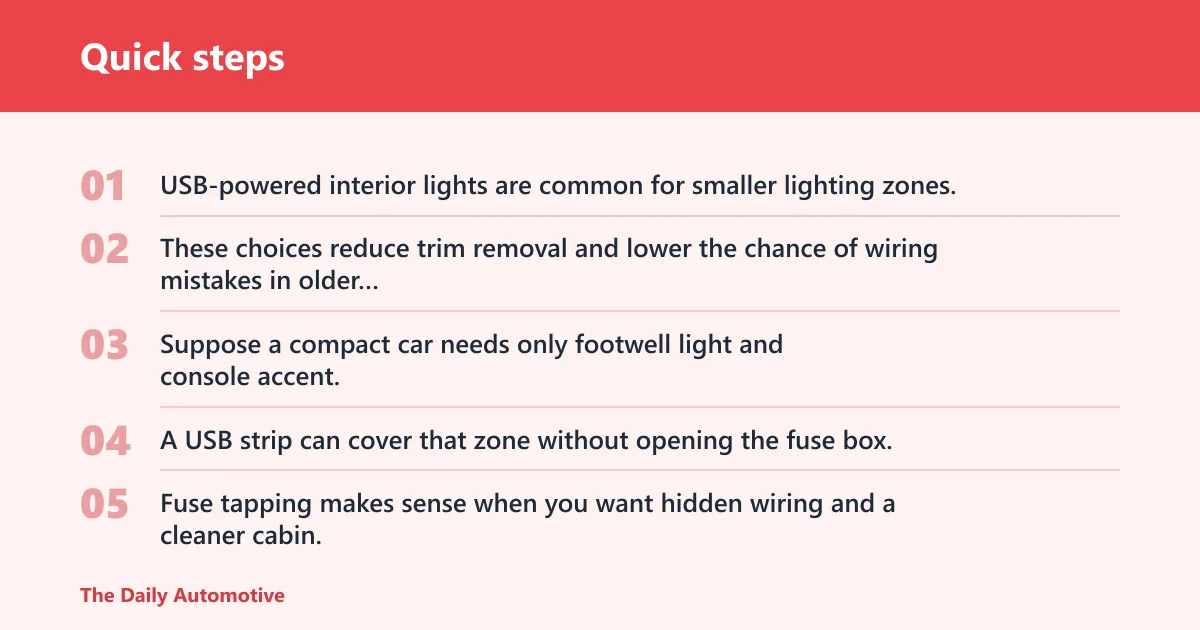
USB-powered interior lights are common for smaller lighting zones, and lighter-socket power works well when the kit stays removable. These choices reduce trim removal and lower the chance of wiring mistakes in older vehicles.
Suppose a compact car needs only footwell light and console accent. A USB strip can cover that zone without opening the fuse box, which keeps the install simple and limits the chance of a dead battery from a bad constant-power tap.
When fuse tapping is worth it
Fuse tapping makes sense when you want hidden wiring and a cleaner cabin. It is most useful if the lighting should turn on with an accessory or cabin circuit, not stay live all the time.
Use it when the light needs to look built in, not plugged in. Avoid it if the vehicle has limited spare fuse locations, brittle trim clips, or a history of electrical faults that would make extra circuit work a bad trade.
Older vehicles and trim-panel routing
Older vehicles can be trickier because trim panels may not leave much room for clean wire routing. In that case, a simple strip or bulb swap is often the better choice than forcing hidden runs that rattle or peel later.
A common first-timer mistake is choosing a long strip for a truck cab with tight trim gaps, then trying to hide every inch of wire. The result is often loose adhesive, visible slack, and a setup that looks more improvised than intended.
How do you avoid battery drain?
Avoid battery drain by choosing switched power, using kits that turn off fully, and keeping standby draw low. If the lights only run when the ignition or accessory circuit is live, the risk is much lower than with a constant-power connection.
Switched power versus constant power
Switched power is the safer choice for most interior LED installs because the light shuts off with the vehicle. Constant power can make sense for a trunk lamp or a specific memory setup, but it needs care so the kit does not stay live after parking.
Some interior kits are designed to avoid battery drain when off, which is the feature to look for if the car may sit for days. That matters more in weekend vehicles, older batteries, and trucks that are not driven daily.
Brightness, standby draw, and memory function
Brightness should be adjustable for comfort and night driving. A strong default setting is not useful if it forces glare in the cabin or reflects off the windshield. Memory function helps because it restores the last setting at startup without repeated setup.
Use the lowest usable brightness for driving, then save the brighter mode for parked use. That keeps the lighting useful without turning the cabin into a distraction source.
When USB or a lighter socket makes more sense
USB and lighter-socket power make more sense when the goal is removable lighting with low risk. They are also practical when you want the option to unplug the kit in an older vehicle or move it to another car later.
Picture an SUV with second-row footwell strips and a driver who wants simple ambient light at night. A USB feed and a remote let the cabin glow without opening the fuse box, which keeps the install clean and easy to reverse.
Choose features in this order: road-safe output first, then power source, then control method, and only then visual effects. That sequence keeps the kit useful instead of flashy, and it reduces the odds of buying a setup that looks good in photos but annoys you at night.
RGB versus RGBIC
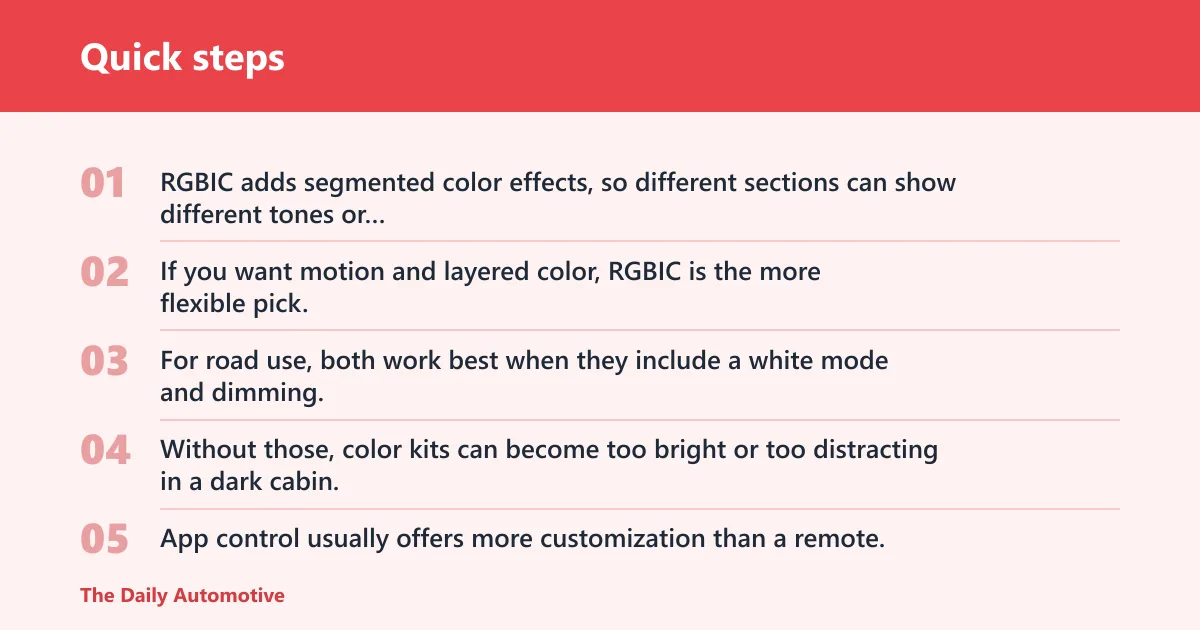
RGB gives you standard multi-color output. RGBIC adds segmented color effects, so different sections can show different tones or chasing patterns. If you want motion and layered color, RGBIC is the more flexible pick.
For road use, both work best when they include a white mode and dimming. Without those, color kits can become too bright or too distracting in a dark cabin.
App control versus remote control
App control usually offers more customization than a remote. Bluetooth connectivity can give you color selection, brightness adjustment, DIY mode, and preset effects, which is useful if you want to fine-tune the cabin later.
Remote control is simpler and often faster for quick changes. If you do not want to pair a phone or troubleshoot Bluetooth, a handheld controller is the better choice. App control is not automatically better if the cabin only needs a few basic settings.
Music sync, presets, and dimming
Music sync is often included in modern interior LED kits, and it uses a microphone-based response to react to sound. It is best for parked use or show-mode lighting, not for calm night driving.
Preset modes help when you want one-touch access to a known setup, and dimming matters any time the lights are on after dark. If the kit lacks a low setting, it is more likely to create glare or look harsh in a small cabin.
Common failure cases to watch
Adhesive failure is common on curved trim, dusty plastic, and hot surfaces. App pairing problems can also appear when the Bluetooth module is buried too deep behind panels or the phone app is unstable. Heat, loose power connections, and poor routing can all shorten the useful life of the install.
Durable materials like high-density silicone or acrylic are worth prioritizing when the kit will live near warm trim or repeated door movement. That is a practical detail, not a style detail.
Frequently asked questions
What are the best interior LED lights for cars?
A practical choice for interior LED lights for cars is the option that fits the job: bulb replacement kits for dome and map lights, strips for footwells and consoles, and fiber optic kits for a cleaner integrated look. For most drivers, a dimmable kit with a white mode and memory function is the safest start.
How do I choose interior car lights that won’t drain my battery?
Pick a kit that uses switched power, turns fully off, and does not depend on constant live power for everyday use. USB or lighter-socket power is often safer for small zones. If you hardwire, use a switched fuse so the lights shut down with the vehicle.
Are app-controlled car interior lights better than remote-controlled ones?
App control usually gives more customization, including color selection, brightness adjustment, DIY modes, and presets. Remote control is simpler and faster for basic changes. If you want simple operation and fewer pairing issues, a remote may be the better choice.
What size and type of interior lights fit my car?
Measure the cabin zone first: under-dash length, console span, or the size of the lamp housing. Strip lights suit long runs and can often be trimmed to size. Dome and map bulbs need the correct socket type, while fiber optic kits work best where trim gaps can hide the tubing.
Can interior LED strips be installed without hardwiring?
Yes. Many kits use a cigarette lighter adapter or USB power, which lets you avoid fuse tapping and hidden wiring. That is often the right choice for smaller installs, leased vehicles, or anyone who wants a reversible setup with less trim removal.
How do music-sync car interior lights work?
Music sync uses a microphone-based controller that reacts to sound and changes the light pattern with the beat or volume. It is common in modern kits and works best as a parked or show-mode feature. For driving, a steady dim setting is usually less distracting.
Products related to this article
Sponsored / affiliate links. As an Amazon Associate I earn from qualifying purchases. I may earn additional commission from eligible campaigns.