Car Magnets for Business: Tested & Reviewed (3 Picks)
A common recommendation for business car magnets is a size of about 24 by 12 inches or larger, with a thickness of about 30 to 60 mil and corners that sit fully flat. Smaller signs lift on highways. Ignore fit and you waste money on warped panels, lost branding, and magnets that peel off at speed. This guide compares three business magnets for highway hold, body-panel compatibility, and logo visibility.
Best overall pick for business routes
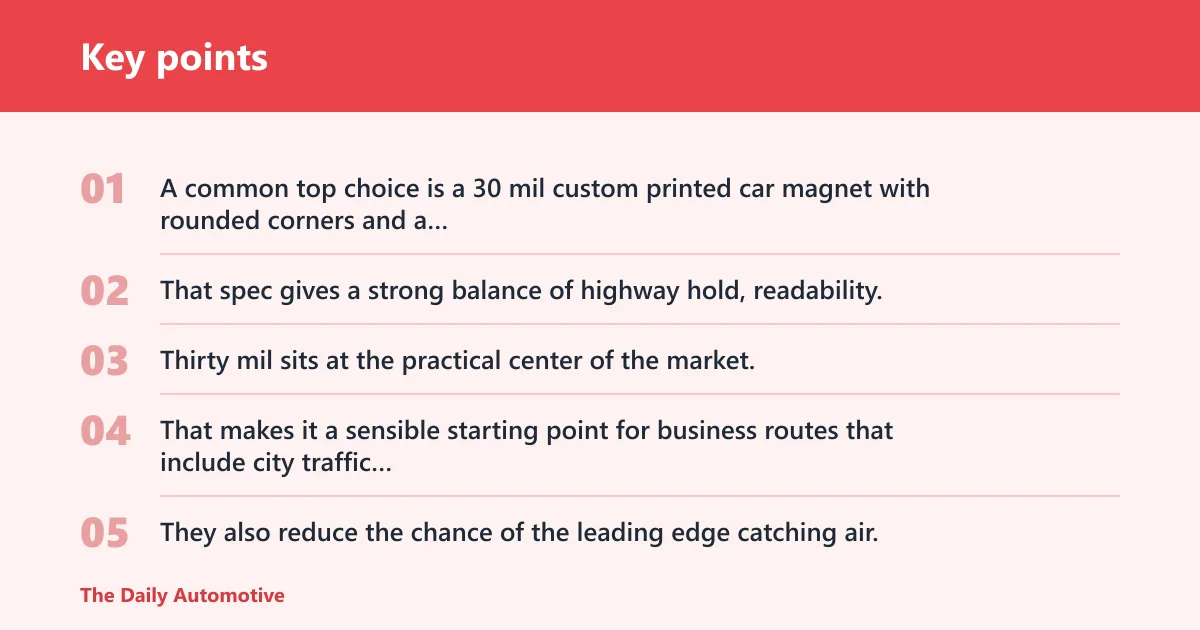


A common top choice is a 30 mil custom printed car magnet with rounded corners and a panel size that fits a flat steel door section without crossing seams, handles, or sensors. That spec gives a strong balance of highway hold, readability, and day-to-day removal for service vans, delivery routes, and local sales calls.
What this pick does best
Thirty mil sits at the practical center of the market. That makes it a sensible starting point for business routes that include city traffic and regular freeway driving.
Rounded corners help prevent edge lift. They also reduce the chance of the leading edge catching air. On a door panel, that matters more than a glossy finish or a louder color choice.
Who should buy it?
Buy this if you want one magnet that can cover weekday driving, rain, sun, and regular branding use without jumping straight to heavy-duty thickness. It fits local contractors, real estate agents, mobile pet services, and small fleets that want visible doors, not billboard-sized graphics.
Where it fits and where it fails
It fits best on flat steel doors or side panels. It fails on aluminum, fiberglass, and plastic, because magnets need magnetizable steel. It also fails on deep curves, raised stamping, and doors with sensors or trim that prevent full surface contact.
Quick picks by business need
If you want the shortest answer, start here. Each pick solves a different route pattern and sign goal, so the right choice depends on speed, panel material, and how often you remove the sign.
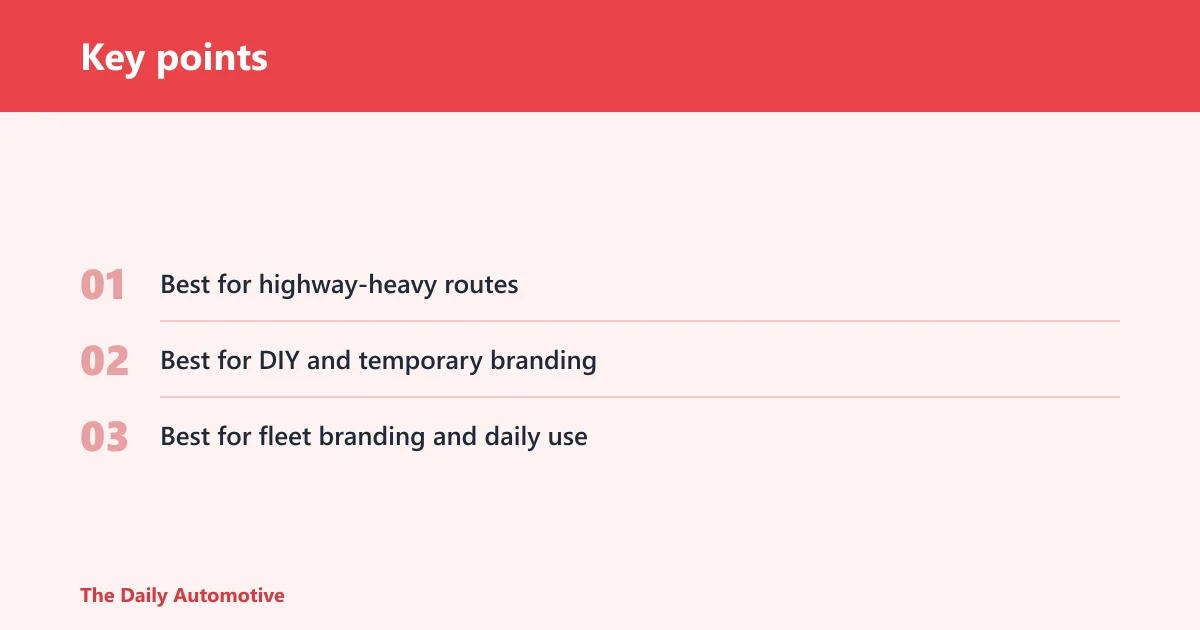
- Best for highway-heavy routes: 40 mil or 47 mil custom printed magnet with rounded corners.
- Best for DIY and temporary branding: 30 mil blank car magnet sheet, especially 24 x 12 inches.
- Best for fleet branding and daily use: 30 mil custom printed car magnet with UV-resistant outdoor ink.
Size options can range from 12×18 inches to 24×36 inches, which shows how quickly business use moves from a door sign to a larger side-panel format. For most small businesses, bigger helps visibility only if the panel can hold it flat.
Best for highway-heavy routes
Choose 40 mil if your vehicle spends long stretches above town speeds, and choose 47 mil when you need the strongest available hold for a compliant flat steel panel.
A common first-timer mistake is buying the thickest magnet available and putting it on a curved, dirty, or partially non-magnetic door. Thickness cannot fix bad contact. It only helps after the surface passes the fit check.
Best for DIY and temporary branding
Choose a blank sheet if you need quick changes, seasonal promotions, or a temporary cover-up for an old logo. That size is large enough for a phone number, logo, and short service line.
Blank sheets are useful when you print in-house or need to swap names for short-term jobs. They are also the easiest option for a seasonal message, like a spring service offer or weekend event parking direction.
Best for fleet branding and daily use
Choose a custom printed magnet when every vehicle needs the same logo, same colors, and the same layout. Full-color printing makes sense for fleets because it keeps branding consistent across multiple doors and multiple drivers.
Look for weatherproof magnetic vinyl and UV-resistant outdoor ink. That combination matters more than a low sticker price.
Will car magnets stay on at highway speeds?
Yes, if the magnet is thick enough, fully seated on flat steel, and sized for the panel. Highway hold depends on surface prep and panel shape as much as thickness. A 20 mil magnet is cheaper but significantly weaker, while 30 mil is the safer minimum for moving vehicle use.
What thickness means in real use
Use 20 mil only for limited, low-speed, or very short-duration placement where the panel is flat and the sign is removed often. For business routes, 30 mil is the baseline.
Thicker magnets hold better only when they sit on clean, flat steel. A 40 mil or 47 mil magnet still fails if trapped grit creates a gap under the edges.
Why rounded corners matter
Rounded corners reduce wind lift and edge peeling. They also help prevent chipping at speed, which matters when the sign sits near a leading edge on a door or quarter panel. Square corners catch air more easily, especially on a panel that flexes slightly at speed.
Speed limits and panel shape
Highway use is safest on flat steel panels with minimal curvature. Deeply stamped doors, recessed body lines, and curved truck skins reduce contact area and weaken hold. If a sign passes the flatness check but still spans a seam, it is the wrong size.
Suppose a 24 x 12 inch magnet fits a flat steel door on a service van, but the same size crosses a body line on a pickup. The first can work at freeway speed; the second can edge-peel because part of the magnet has no true contact.
Do car magnets work on aluminum truck doors?
No. Car magnets do not stick to aluminum, fiberglass, or plastic panels. They need flat steel surfaces. If your truck uses aluminum body panels, the magnet may hold nowhere at all, or only in a nearby steel section that is too small for a proper sign.
Steel body panels vs. non-magnetic panels
Magnets stick best to flat metal doors or panels, and flat steel is the usable surface standard. That means newer aluminum-body trucks need extra caution, because the outer skin may look ideal while being completely non-magnetic. The same warning applies to fiberglass service bodies and plastic trim pieces.
How to check mixed-material doors
Use a simple pass/fail check before you buy. First, confirm the panel is steel. Second, confirm the area is flat and free of seams, rivets, trim, cameras, handles, or parking sensors. Third, check that the full magnet can sit flat without bridging a curve or molding.
- Test the target area with a small magnet.
- Confirm full contact across the whole panel.
- Check for sensors, handles, seams, and rivet lines.
- Measure the usable flat area, not the entire door.
- Choose a sign size that stays inside that flat zone.
Pass/fail fit check before you buy
Pass if the magnet grabs firmly, lies flat, and leaves room on all sides. Fail if any part bridges a seam, crosses a body line, or sits on aluminum. For mixed-material vehicles, the best answer is often a smaller sign on a rear steel panel, not a larger sign on the door you wish were magnetic.
Best blank sheet for DIY branding
The best blank sheet is a 30 mil white magnetic sheet in a size you can print cleanly and fit to the vehicle door. A blank magnet is the right choice when you need temporary branding, cover-up use, or easy message changes for seasonal jobs and short campaigns.
Common sizes like 24 x 12 inches
Twenty-four by twelve inches is a common business size because it balances visibility and fit. It is large enough for a logo, business name, and phone number, yet still small enough for many door panels.
Print compatibility and weather resistance
Blank sheets work best when printed with outdoor-safe ink or covered by a weatherproof magnetic vinyl top layer. If you print labels, decals, or temporary graphics, keep the design simple and avoid dense text blocks that become unreadable from traffic distance.
Cover-up use for temporary jobs
Blank magnets are useful when a vehicle serves more than one purpose. Say your van is wrapping a short-term cleanup contract for six weeks, then returning to regular service calls. A blank magnet can cover an old logo without paint damage, provided the panel is clean and the magnet is removed after each route.
Best custom printed magnet for fleet branding
The best custom printed magnet is a 30 mil or thicker sign with full-color logo support, UV-resistant outdoor ink, and rounded corners. That combination is the right pick for teams that want repeatable branding across several vehicles without moving to permanent wraps.
When full-color printing is worth it
Full-color printing is worth paying for when the brand depends on recognition from the road. It suits fleets, multi-vehicle service companies, and businesses that need a consistent phone number, logo, and short service message on every panel.
UV-resistant outdoor ink and fade control
UV-resistant outdoor ink slows fading in direct sun. That matters more than many buyers expect, because faded black text and washed-out logos are hard to read from the curb. If the vehicle parks outside most days, ink quality is part of the product, not an extra.
Layout basics for readable branding
At common street distances, larger letters outperform dense layouts. Keep the business name short, keep the phone number readable, and avoid stuffing secondary services into the same panel. A larger sign helps only if the type is still legible at a glance.
Picture a 24 x 18 inch magnet on a delivery van parked across a two-lane street. If the layout uses a long slogan and thin script, the message disappears. If it uses a short business name, a simple service line, and a bold phone number, the sign still works from curb distance.
Car magnet decision matrix
This matrix matches magnet type to route speed, panel material, and sign size so you can sort real-world use cases fast. Use it as a pass/fail filter before you compare artwork or price.
| Use case | Panel material | Route speed | Recommended magnet | Sign size and visibility | Fit check | Maintenance checklist |
|---|---|---|---|---|---|---|
| Local contractor | Flat steel door | City routes | 30 mil custom printed magnet | 24 x 12 inches; readable from curbside traffic | Pass if full contact and no seams | Remove weekly, clean back and paint, dry fully |
| Delivery driver | Flat steel side panel | Mixed city and highway | 40 mil custom printed magnet with rounded corners | Large rectangular door magnet; keep text simple | Pass only if panel is flat steel | Inspect for trapped moisture after rain and car washes |
| Real estate agent | Flat steel door | Low to moderate speed | 30 mil blank sheet or printed magnet | 24 x 12 inches; name and phone number only | Pass if the whole edge sits flat | Check for grit before each reattach |
| Fleet branding | Flat steel panels only | Highway and service routes | 47 mil custom printed magnet | Size matched to the door without blocking sensors | Fail on aluminum, fiberglass, or plastic | Rotate signs, clean monthly, replace if curling starts |
Maintenance checklist
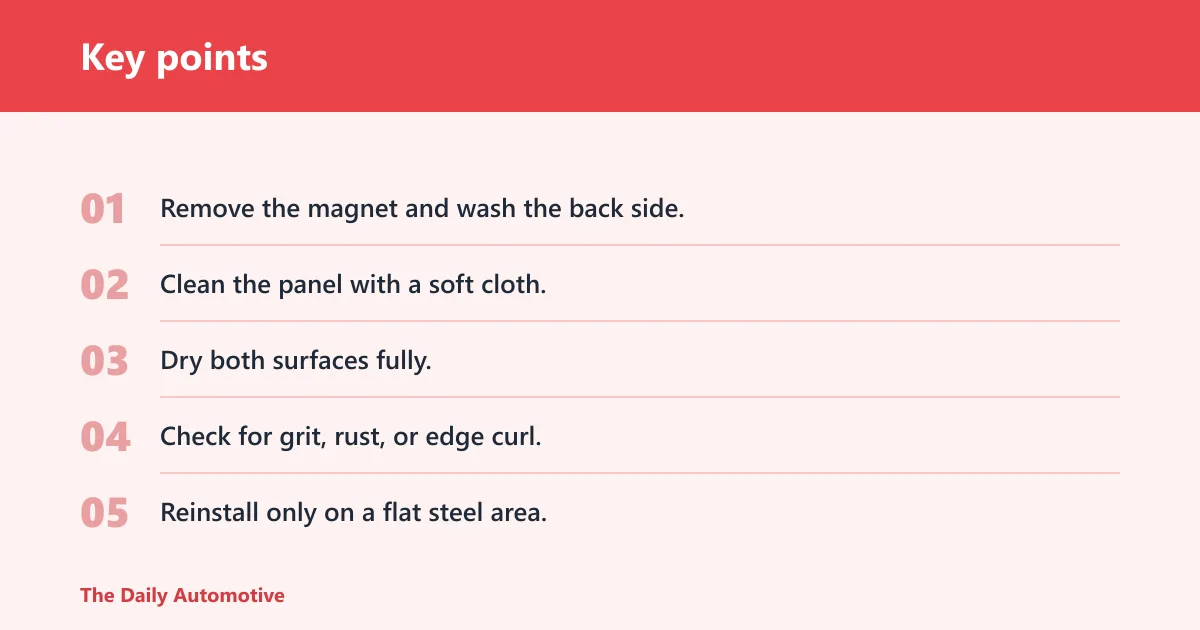
Keep the paint safe by removing the magnet regularly, washing both surfaces, and drying completely before reinstallation. Dirt buildup, trapped moisture, and grit under the edges are the failure points that scratch paint. Magnets do not normally leave residue when used correctly.
- Remove the magnet and wash the back side.
- Clean the panel with a soft cloth.
- Dry both surfaces fully.
- Check for grit, rust, or edge curl.
- Reinstall only on a flat steel area.
Cost should be judged by lifespan, not just sticker price. A cheaper 20 mil magnet can need replacement sooner on freeway-heavy routes, while a 30 mil or 40 mil sign may last longer with less edge lift. Seasonal branding can justify a blank sheet; permanent fleet branding usually favors custom printing and longer service life.
Frequently asked questions
What are the best car magnets for business?
The best business magnets are 30 mil or thicker, use rounded corners, and fit a flat steel door or panel without crossing seams. For most buyers, a 24 x 12 inch custom printed magnet is the best starting point because it balances visibility, fit, and everyday removal.
What thickness should business car magnets be?
For moving vehicles, start at 30 mil. Use 40 mil or 47 mil when the route includes more highway time or you want a stronger hold on a flat steel panel. Choose 20 mil only for limited use, because it is significantly weaker and less suited to road travel.
Are rounded corners important on car magnets?
Yes. Rounded corners help reduce wind lift and edge peeling, and they can reduce chipping at speed. They matter most on highway routes, where square corners and loose edges are more likely to catch air and begin curling.
How do I clean and maintain car magnets?
Remove the magnet regularly, wash and dry the back, and clean the paint underneath so grit cannot scratch the surface. If moisture stays trapped under the sign, the panel can discolor or mar over time. Reattach only after both surfaces are fully dry and clean.
Products related to this article
Sponsored / affiliate links. As an Amazon Associate I earn from qualifying purchases. I may earn additional commission from eligible campaigns.