Best Magnetic Logos for Cars (2026): Based on Specs and Reviews
Top three current blank-magnet picks for car branding are the 30 mil option below for daily routes, the 40 mil option for harder use, and the 20 mil option for budget use. The best magnetic logo for a car depends on your vehicle and route: choose a thicker, larger magnet for vans and highway driving, a medium-duty option for service trucks, and a lighter removable logo for short local runs. Weak magnets can shift, peel paint, or blow off at speed, which wastes money and damages your branding. This guide compares three picks by vehicle type, budget, and daily driving conditions.
Quick comparison
Thicker magnets grip better at speed because they resist lift from air pressure and vibration, but they cost more and need a flatter steel panel to work well. Thinner sheets cost less and are easier to replace, yet they fit short city routes and light branding better than freeway miles.
For small business owners, the right choice is usually the smallest magnet that still gives readable branding at the distance your customers see it from. Start with the panel material, then choose thickness, size, and print style around the route. These three options are blank magnet stock, not custom-printed logo services.
How we chose
We compared options on five practical points: steel-panel compatibility, thickness and speed tolerance, size and roadside readability, outdoor durability, and replacement cost over time. That keeps the focus on use case, not marketing copy.
We also weighed common failure cases. Curved doors, aluminum panels, fiberglass, plastic trim, repaint work, and wrap-covered panels can all reduce or eliminate adhesion.
| Criteria | Best fit | What matters in practice |
|---|---|---|
| Surface compatibility | Steel doors and steel body panels | Vehicle magnets work best on steel surfaces, not aluminum or plastic. |
| Thickness and speed | 30 mil for mixed use; 40 mil for harder use; 20 mil for low-cost local use | 30 mil is described as the industry standard thickness for vehicle magnets. 20 mil sheets are cheaper but weaker than thicker options. 40 mil is a heavy-duty option. |
| Size and readability | 12 x 24 inches, 18 x 12 inches, 24 x 12 inches, 20 x 30 inches | Larger panels improve visibility, but they must fit the door area and avoid handles, body lines, and trim. |
| Outdoor durability | UV-resistant, waterproof construction with rounded corners | UV resistance matters for outdoor use, and rounded corners help reduce edge wear and lifting. |
| Budget and replacement cost | Blank magnets for temporary use; printed magnets for recurring branding | Blank sheets cost less up front. Custom printing costs more, but it saves time and usually reads better from the road. |
BrandMag 30 mil: best for daily delivery routes
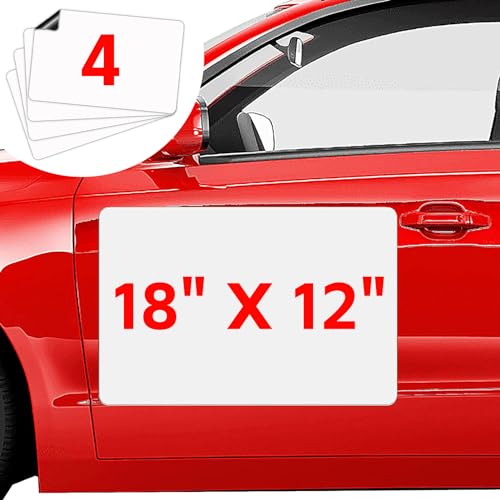
This is the safest all-around pick for many delivery cars, service vans, and mixed local routes because it sits in the middle of the thickness range and uses an 18 x 12 inch format. The rounded corners help keep edges cleaner and reduce lifting.
It is a blank 4-pack, so it works well when you need removable branding, cover-up use, or simple reusable signage. The size is easy to place on many doors, and the blank surface lets you add temporary text or graphics without committing to a fully printed panel.
The drawback is clear: blank magnets are not as attention-grabbing as a fully printed logo panel, and 18 x 12 inches is smaller than the common 12 x 24 inch format many buyers use for bolder roadside visibility. That matters if your vehicle is tall, fast, or parked far from foot traffic.
Why it fits city driving
City routes favor stops, low-to-moderate speeds, and frequent door access, which makes 30 mil a sensible middle ground. It offers more holding power than 20 mil without jumping straight to the stiffest heavy-duty option.
For a service van making short neighborhood runs, that balance matters more than raw thickness alone. You want the logo to stay put through traffic, parking, and repeated removal.
Where it can fail
It can fail on aluminum, fiberglass, plastic, repaint work, and wrap-covered surfaces. The fridge-magnet test is a quick first check: if a simple magnet will not stick to the panel, a vehicle magnet usually will not hold there either.
It can also struggle on curved or contoured doors. The edges are the first place to lift when airflow, door shape, or dirty panels work against the magnet.
LogoPanel 40 mil: best for highway use
A 40 mil magnet is often a better fit when branding will be used at higher speeds, on larger trucks, or on vans with flatter steel doors. The thicker material has more staying power than thinner sheets, and that matters when air pressure, vibration, and long driving stretches work against the edge seal.
This is the conservative choice for road exposure. It is not the cheapest route, but it is the one more likely to hold up when your vehicle sees sustained highway driving and repeated weather exposure.
Why thicker material matters
Thicker magnets generally hold better at speed, and 40 mil is presented as the heavy-duty option. That does not make them magic. It means they are better suited to higher-stress use where thin sheets are more likely to lift or shift.
For drivers who mix city streets with freeway miles, the extra thickness is often the difference between a magnet that stays orderly and one that needs frequent re-positioning.
Best vehicle fit
Flat steel doors on work trucks and cargo vans are the best match. Broad panels give the magnet a better surface to contact, which matters more as size grows and speed rises.
Suppose a plumbing van runs 40-mile highway stretches, parks outdoors, and carries a 12 x 24 inch logo on each door. A thicker magnet is the better match than a thin budget sheet, especially if the doors are steel and clean.
PrintFlex 20 mil: best budget pick
Twenty mil sheets are the cheapest route, and they make sense when you need low-cost temporary branding, short local trips, or a stopgap solution for a new business. They are easier on the budget, but they are weaker than thicker options.
That trade-off is acceptable for slower city use, especially when the magnet will be removed often or used on a vehicle that does not spend much time at speed.
When thinner magnets make sense
Use 20 mil when the priority is price, short-term branding, or a temporary campaign. They work best when the route is local, the panel is flat steel, and the logo is not so large that it becomes harder to keep flat.
They also make sense for businesses that need multiple magnets across a small fleet and plan to replace them sooner rather than later.
What you give up
You give up holding power, especially at speed. You also give up some margin for dirt, edge wear, and imperfect panel fit.
If the panel is slightly curved or the magnet edge catches road airflow, 20 mil is the first thickness likely to show trouble.
Will a magnetic logo stick to your vehicle?
A magnetic logo will stick only if the panel is ferromagnetic, usually steel. Aluminum, fiberglass, and plastic are common problem surfaces, and wrap-covered or heavily repainted panels can also interfere with adhesion. The quickest pre-check is the fridge-magnet test on the exact panel you want to use.
That test is not perfect, but it is useful. If a household magnet will not cling firmly to the door, do not assume a vehicle magnet will behave better.
Paint condition matters too. Fresh repaint jobs, thick body filler, rough edge repairs, and dirty panels can all weaken contact. A magnet that looks fine in a parking lot may still fail once road vibration and airflow start working on its edges.
Logo magnet decision matrix
Use this matrix to match vehicle type, panel material, speed, logo size, and budget to the right thickness and format. It is the fastest way to avoid buying a magnet that is too thin for the route or too large for the door. If you are considering the 20 x 30 inch size, check carefully first, because that format may be impractical for many passenger-car doors even when the panel is steel.
| Vehicle type | Panel material | Driving speed | Logo size | Budget | Recommended thickness and format |
|---|---|---|---|---|---|
| Delivery car | Steel | Local streets, short highway bursts | Small to medium | Low to moderate | 30 mil, 18 x 12 inches or 12 x 24 inches, rounded corners |
| Service truck | Steel | Mixed city and highway | Medium | Moderate | 30 mil or 40 mil, 12 x 24 inches, rounded corners, weather-resistant print |
| Cargo van | Flat steel side panel | Frequent highway driving | Large | Moderate to higher | 40 mil, 24 x 12 inches or 20 x 30 inches if the door area fits |
| Mixed fleet vehicle | Unknown until checked | Variable | Variable | Tight | Start with the fridge-magnet test, then choose 30 mil if the panel is steel and flat enough |
| Aluminum, fiberglass, or plastic panel | Non-ferrous | Any | Any | Any | Do not use a magnetic logo on that panel |
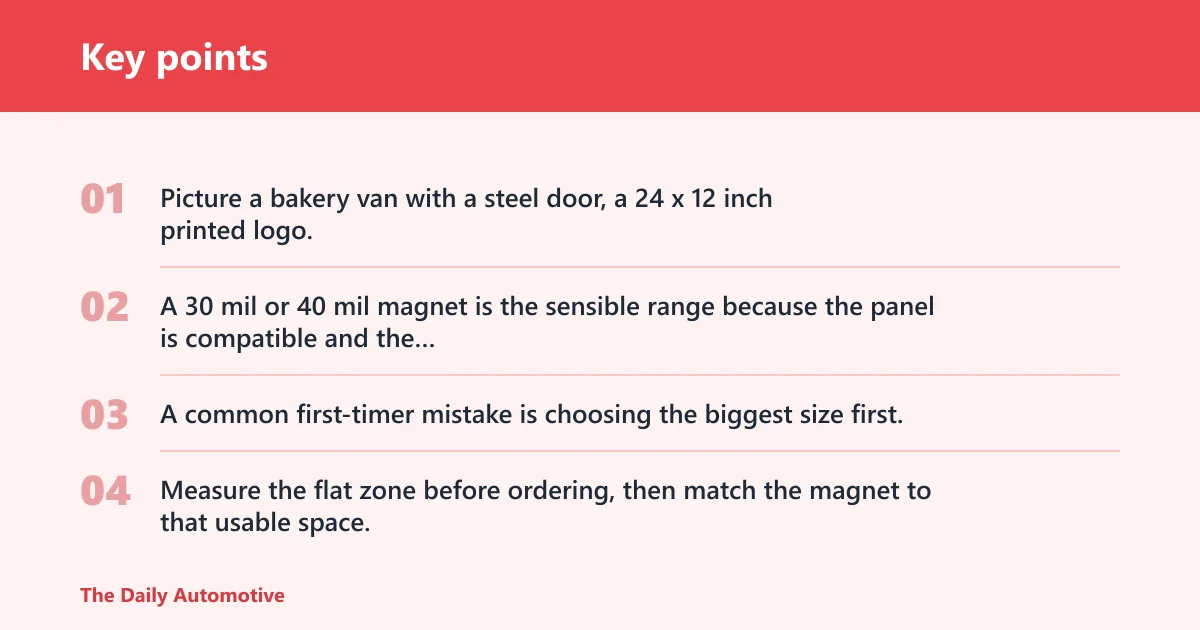
Picture a bakery van with a steel door, a 24 x 12 inch printed logo, and mostly neighborhood driving. A 30 mil or 40 mil magnet is the sensible range because the panel is compatible and the route is manageable.
A common first-timer mistake is choosing the biggest size first, then discovering the door has a handle, crease, or trim line that breaks the contact area. Measure the flat zone before ordering, then match the magnet to that usable space.
Which one should you buy?
Choose the 30 mil option when you want the best balance of cost, flexibility, and everyday use. It is the safest starting point for most steel-panel vehicles that make local deliveries or service calls.
Choose 40 mil if your vehicle spends serious time on highways, your panel is flat steel, or you want a heavier-duty magnet for a larger truck or van. Choose 20 mil only when the budget is tight and the route is mostly local.
If your vehicle has aluminum, fiberglass, or plastic panels, skip magnetic branding for that surface and use another removable signage method instead. If the panel passes the magnet test but the door is curved or recently repainted, move up in thickness or choose a smaller format.
Choose 30 mil if…
Choose 30 mil if your vehicle is a delivery car, service van, or mixed-use truck on steel panels. It is also the best middle-ground choice when you want one magnet format that can cover daily branding without paying for the heaviest option.
Choose 40 mil if…
Choose 40 mil if the route includes highway driving, the panel is flat steel, and you want extra resistance against lift. It is the better choice for larger work vehicles and for branding that stays outside through changing weather.
Choose 20 mil if…
Choose 20 mil if the goal is to keep startup costs down and the vehicle only needs short-term or local branding. It works best when you accept more frequent replacement and less margin for speed, dirt, or imperfect panel shape.
Choose blank over fully printed if…
Choose a blank magnet when you need reuse, temporary messaging, or low-cost cover-up work. Choose a fully printed panel when readability from a distance matters more than flexibility, such as a branded fleet that needs consistent logo presentation.
Choose die-cut or custom print if…
Choose custom print if your logo, text, or photo needs a cleaner presentation than a writable blank sheet can provide. Full-color printing, custom shapes, and matte finishes are useful when the magnet is part of your brand identity rather than a temporary sign.
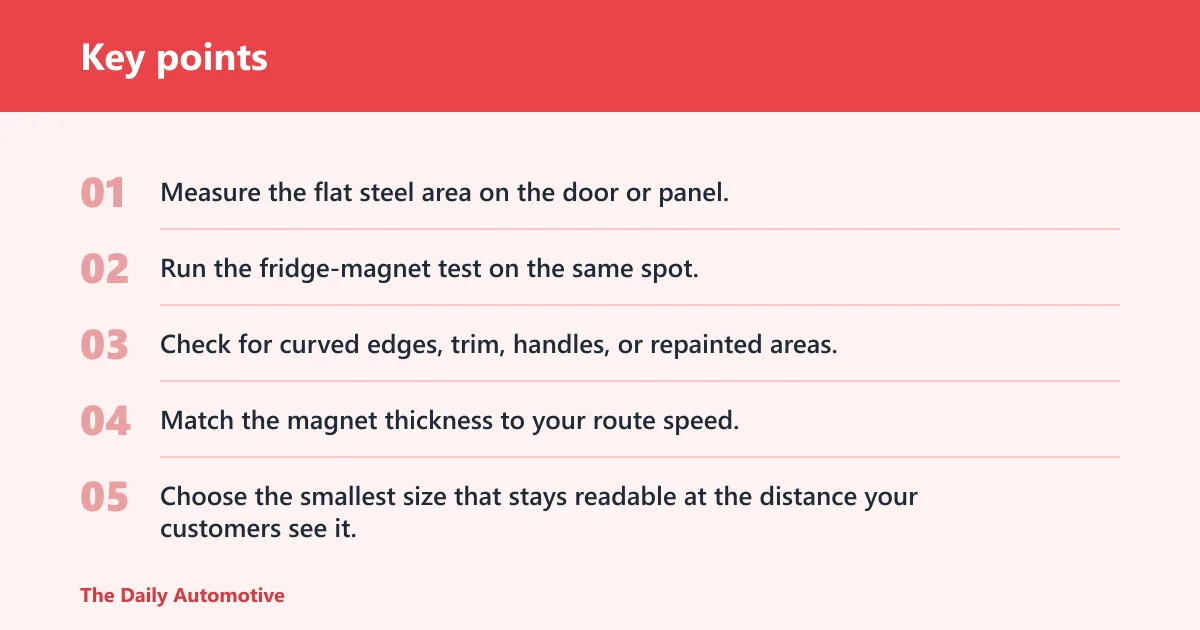
- Measure the flat steel area on the door or panel.
- Run the fridge-magnet test on the same spot.
- Check for curved edges, trim, handles, or repainted areas.
- Match the magnet thickness to your route speed.
- Choose the smallest size that stays readable at the distance your customers see it.
- Plan for cleaning, storage, and periodic removal before you buy.
The cheapest way to get a car magnet with a logo is usually a blank or lightly printed sheet, especially if the design changes often or the message is temporary. Up-front price is only part of the total cost, though. If a thin magnet needs frequent replacement, the cheaper purchase can become the more expensive one over time.
Frequently asked questions
What is the best magnetic logo for a car?
The best magnetic logo for a car is the one that matches your panel material, driving speed, and logo size. For many small businesses, that means a 30 mil magnet on a steel door, because it balances cost, daily use, and holding power better than a thinner sheet.
Are car logo magnets safe at highway speed?
They can be, but the product listings here do not give a brand-specific highway speed limit. The safer answer is to use a steel panel, make sure the surface is flat and clean, and choose 30 mil or 40 mil rather than 20 mil for highway use.
Will magnetic logos stick to aluminum vehicles?
No, not reliably. Vehicle magnets work best on steel surfaces, and aluminum is a common failure case. Fiberglass and plastic are also problematic, so the fridge-magnet test on the exact panel is the easiest way to check before you buy.
What thickness should a vehicle magnet be?
For most commercial use, 30 mil is the practical middle ground and is described as the industry standard thickness for vehicle magnets. Choose 20 mil for low-cost local use and 40 mil when you need a heavy-duty option for harder driving conditions.
What size magnet works best for car doors?
Common sizes include 12 x 24 inches, 18 x 12 inches, 24 x 12 inches, and 20 x 30 inches. The best size is the one that fits the flat steel area on the door without crossing handles, seams, body lines, or trim that can cause lifting.
How long do magnetic logos last outdoors?
Outdoor life depends on UV resistance, waterproof construction, cleaning habits, and how often the magnet is removed. A magnet that stays on a dirty panel or sits through repeated car wash exposure will usually wear faster than one that is cleaned and stored properly.
Products related to this article
Sponsored / affiliate links. As an Amazon Associate I earn from qualifying purchases. I may earn additional commission from eligible campaigns.