Budget-Friendly Tips for a Car-Centric Lifestyle Shift
Cut car costs by trimming insurance, fuel, maintenance, and financing first, then compare your annual ownership total with ride-hail, rentals, or car-share if you drive relatively few miles each year. Skip those fixed costs and a car-heavy budget can leak hundreds of dollars each month. This guide shows where to cut bills, when alternatives make sense, and how to avoid surprise repair costs.
A car-centric lifestyle means daily reliance on a car for commuting and errands. It fits drivers in suburbs, rural areas, and low-transit corridors where walking to work or hopping on a bus is not realistic for most trips. The cost problem starts with ownership, not gasoline.
What does a car-centric lifestyle really cost?



Fixed costs you pay whether you drive or not
Fixed costs are the bills that arrive even in a slow month: insurance, registration, depreciation, and parking permits or monthly garage space. Financing also belongs here if the car still has a loan. These costs do not shrink much just because you stayed home on Tuesday.
Variable costs that rise with each mile
Variable costs include fuel, maintenance, repairs, tolls, and paid parking. Depreciation also has a variable side, because every extra mile and every rough commute nudges resale value down. That is why a short, cheap errand can still turn costly when it adds mileage and downtown parking.
How to estimate your monthly ownership total
Start with the annual total. Add insurance, registration, parking, fuel, routine maintenance, and a repair reserve. Then add loan payments if you have them, and divide by 12. For a cleaner comparison, split the result into fixed and variable parts so you can see which bills are hard to escape.
| Cost category | Example monthly amount | Type | How to estimate it |
|---|---|---|---|
| Insurance | $140 | Fixed | Monthly premium or annual premium ÷ 12 |
| Registration | $18 | Fixed | Annual registration, taxes, and fees ÷ 12 |
| Parking permit / storage | $75 | Fixed | Permit, garage, or lot fee |
| Fuel | $160 | Variable | Miles per month ÷ mpg × fuel price |
| Routine maintenance | $60 | Variable | Oil, tires, fluids, brakes, filters |
| Repair reserve | $50 | Variable | Set aside a monthly contingency fund |
| Total example | $503 | All-in | Before loan payment and depreciation |
A common first-timer mistake is overlooking parking fees, tolls, and routine maintenance when estimating monthly car costs. A $250 insurance bill and a cheap tank of gas can look manageable while registration, parking, and repairs quietly take the bigger share.
How do you cut car costs without giving up the car?
Trim the costs you cannot avoid before chasing small wins. The fastest gains usually come from fuel use, routine maintenance timing, and splitting commute costs with other people. You are not trying to live car-free. You are trying to keep one car from acting like two bills.
Reduce fuel use with trip consolidation and less idling
Group errands into one route, avoid backtracking, and cut warm-up idling unless conditions truly require it. Smooth acceleration and steadier speeds help fuel efficiency more than hard starts and late braking. Route planning apps can also cut wasted miles, especially in towns with awkward one-way streets.
Choose the cheapest safe maintenance schedule, not the cheapest delay
Proper maintenance stops small faults from becoming costly repairs, but the goal is not over-servicing. Follow the maintenance schedule in the owner’s manual for oil, tires, fluids, brakes, battery, and filters. If a shop quote seems high, ask whether the job is urgent, planned, or merely convenient to bundle.
Use carpooling to split fuel and parking
Carpooling works best for repeat commutes. Two or three riders can divide fuel and parking, and in some areas one carpool pass costs less than multiple solo passes. It is a strong fit for office routes, school runs, and any commute with predictable start times.
Suppose a suburban commuter pays around $120 a month for parking and spends about $180 on fuel. A five-day carpool with one other rider can cut both in half, while also reducing wear on tires and brakes. The savings category is simple: fuel, parking, and mileage.
What budget worksheet should you use for car dependence?
Use a one-page worksheet that separates fixed costs from variable costs and includes a repair reserve. The point is not perfection. The point is to see the true monthly burn rate before a battery, tire, or brake bill turns a normal month into a scramble.
Line items to include in a one-page worksheet
Put these lines on one page: insurance, registration, parking, fuel, routine maintenance, contingency repairs, and any loan payment. Add odometer miles for the month so you can spot rising cost per mile. Keep one line for depreciation if you want the full ownership picture, even though it is not a cash bill.
How to set a repair reserve
A practical reserve starts as a monthly set-aside, not a credit card plan. Even a modest car needs cash for a battery, tire repair, alignment, sensor, or brake job. Put the reserve in the worksheet as a real line item, then move money into it each payday.
How to update the worksheet each month
- Record actual fuel, parking, and maintenance spending.
- Compare the total with your target monthly cap.
- Move any unused repair reserve forward.
- Flag any cost that rose because of a habit, not a repair need.
- Recheck the next month before small overruns become normal.
Budget tools help most when they name each cost category. A spreadsheet, envelope system, or budgeting app works if it separates insurance, fuel, parking, maintenance, and repairs. That separation makes it obvious which line is rising.
When does car sharing beat owning a cheap used car?
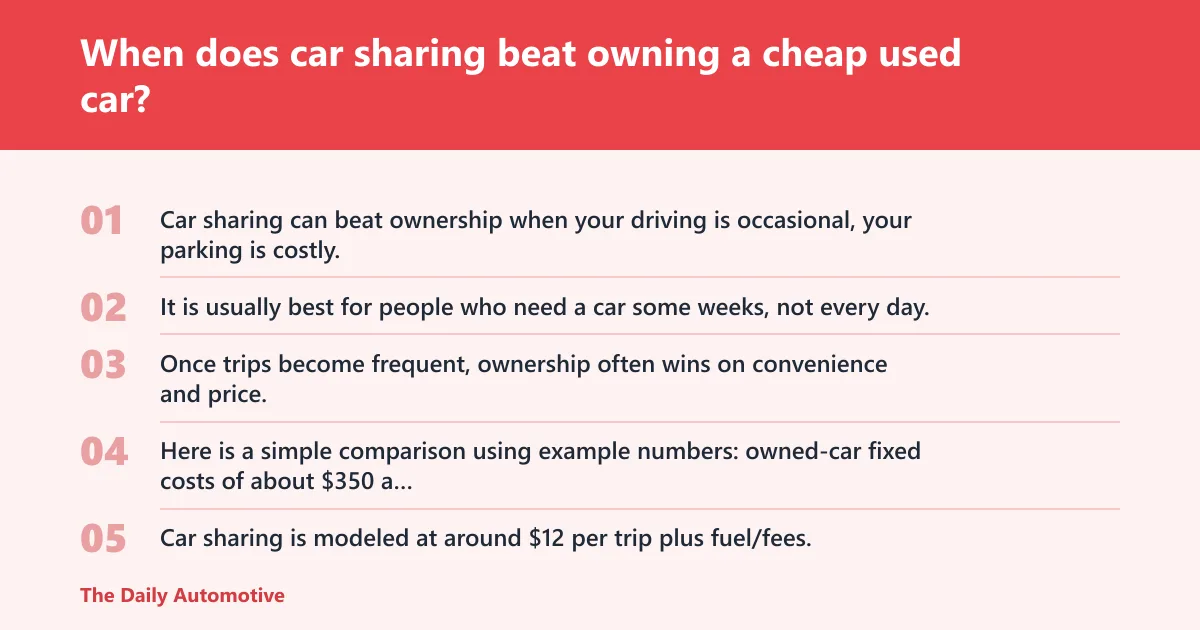
Car sharing can beat ownership when your driving is occasional, your parking is costly, and your monthly miles stay low. It is usually best for people who need a car some weeks, not every day. Once trips become frequent, ownership often wins on convenience and price.
Compare cost by trip frequency: 1, 3, and 5 trips per week
Here is a simple comparison using example numbers: owned-car fixed costs of about $350 a month, plus roughly $0.25 per mile in fuel and wear for a 10-mile round trip. Car sharing is modeled at around $12 per trip plus fuel/fees, and ride-hailing at about $18 per trip before surge pricing. Real local prices will vary, but the structure is useful.
| Trips per week | Owning a car | Car sharing | Ride-hailing |
|---|---|---|---|
| 1 | About $360/month | About $52/month | About $78/month |
| 3 | About $368/month | About $156/month | About $234/month |
| 5 | About $375/month | About $260/month | About $390/month |
That table assumes ownership costs are mostly fixed, which is why the car looks expensive even at low trip counts. Car sharing tends to win when you drive only a few times a month, and ride-hailing may win only when booking a car-share vehicle is awkward or unavailable. Once you approach daily use, ownership usually spreads its fixed costs more efficiently.
Insurance, booking rules, and availability limits
Car sharing is not free insurance. You still need to check coverage terms, deductible exposure, age restrictions, booking windows, and pickup locations. Budget says its membership includes a best rate guarantee. Budget advertises a bonus rental day for members. Budget offers a free upgrade when available. Budget’s free-day offer applies to minimum three-day rentals. The free-day offer covers intermediate through full-size four-door cars. Taxes and fees are extra on the free-day offer. Budget excludes one-way rentals from the free-day coupon. Budget requires an advance reservation for the coupon. Budget says the one free day is one day of daily time and mileage charges. The Tampa Budget page includes a five-star safety reference, and Budget’s Tampa page says NHTSA ratings may change over time.
Where car sharing fits best
It fits best for occasional city errands, airport overflow, weekend use, or when your own car is down for service. It is also useful for drivers who cannot justify a second car but need more flexibility than transit or walking can provide.
How can ride-hailing fit a car-dependent budget?
Ride-hailing can replace a few trips without adding ownership costs, but it is not automatically cheaper than a car. It works best for rare nights out, airport runs, or the occasional errand when parking would be costly. Peak pricing can erase the advantage fast.
Use cases for occasional trips
Ride-hailing makes sense when the alternative is paying for parking, paying for a second vehicle, or leaving a car unused for days. It is also a practical backup during bad weather or while a car sits in the shop. The cost category it can beat is the fixed cost of a second car, not always the first one.
Peak pricing and surge risk
Always compare the trip fare with the cost of driving your own car for that same trip. Add pickup delay, tolls, and parking. Then repeat the check at night, during rain, and after events, because surge pricing can shift the result from convenient to expensive in minutes.
What maintenance stops small problems from becoming big bills?
Oil, tires, fluids, brakes, battery, and filters are the budget maintenance basics that protect against larger repair bills. The cheapest repair is usually the one you never need. Track intervals, inspect wear early, and handle simple tasks before they create tow bills or roadside downtime.
DIY tasks versus shop labor
DIY can save on labor for oil changes, air filters, cabin filters, washer fluid, and basic tire pressure checks. Shops are often the better buy for brakes, alignments, batteries, and any job that needs lifts or diagnostic tools. The labor tradeoff is simple: pay with time for easy tasks, pay with money for complex or safety-critical ones.
Simple interval tracking for preventive care
- Write the mileage and date at each oil change.
- Note tire rotations, brake inspections, and battery checks.
- Track fluid top-offs and filter replacements.
- Set reminders for the next interval before the current one arrives.
- Flag warning signs such as squealing brakes, slow starts, or vibration.
That checklist keeps maintenance tied to mileage, not memory. It also helps you compare shop quotes by knowing whether a job is due now or simply coming up soon.
What are the cheapest alternatives for short trips?
For short trips, walking, biking, car sharing, ride-hailing, and carpooling can cut trip-level spending without changing your whole routine. They do not replace a car-centric life, but they can trim the cost of nearby errands, school drop-offs, and one-off visits where a car is overkill.
Walking and biking for local errands
Walking costs almost nothing and works for the closest errands. Biking stretches that radius while still keeping trip costs low. A second-hand bicycle is often the cheapest rideable option for short, repeat trips, especially when parking is tight or a route is flat enough for comfort.
Buying a second-hand bicycle without overpaying
Check sizing first. A bike that is too small or too tall becomes uncomfortable and discourages use. Inspect tires, brakes, chain wear, wheel true, and frame damage. Ask whether the seller has maintenance records, and treat rust, cracked rubber, or a slipping drivetrain as negotiation points.
Picture a 15-minute grocery run on a calm neighborhood road. A used bike with decent tires and proper fit can beat starting a car, circling for parking, and paying for a downtown stall. The savings category is parking first, then fuel and wear.
Frequently asked questions
How can I live a car-centric lifestyle without spending too much?
Focus on the costs you cannot dodge: insurance, fuel, maintenance, parking, and financing. Then cut the variable side with trip consolidation, smoother driving, and carpooling. If your driving is occasional, compare ownership with car sharing or ride-hailing before keeping a second vehicle.
What are the cheapest ways to reduce car ownership costs?
The biggest levers are insurance, fuel, maintenance timing, and parking. Shop insurance carefully, keep tires inflated, avoid idling, and fix small mechanical issues before they grow. If parking is paid, even small reductions there can matter more than shaving a few cents off fuel.
How do I budget for gas, insurance, and maintenance?
Build separate lines for fuel, insurance, routine maintenance, registration, parking, and repairs. Use monthly averages from actual receipts or annual bills divided by 12. Add a repair reserve so a battery or brake job does not force you to borrow or skip maintenance.
Is car sharing cheaper than owning a car?
It can be, especially when you drive only once or a few times per week and local parking is expensive. Ownership usually becomes cheaper per trip as frequency rises because fixed costs are spread over more use. Check booking fees, insurance terms, and vehicle availability before deciding.
How do I estimate the real total cost of owning a car?
Add up insurance, registration, parking, fuel, maintenance, repairs, depreciation, and financing. Then divide annual total cost by 12 for a monthly number, and divide again by miles driven for a cost-per-mile view. That tells you whether the car is cheap or merely familiar.
What budget tools help me avoid expensive repairs?
A simple spreadsheet, calendar reminders, or a budgeting app can work if they separate maintenance from repairs. Track oil changes, tire rotations, brake checks, battery age, and fluid service by mileage. A dedicated repair reserve is the most useful tool because it turns surprise bills into planned spending.
Products related to this article
Sponsored / affiliate links. As an Amazon Associate I earn from qualifying purchases. I may earn additional commission from eligible campaigns.