Best Auto Wire Strippers for Your Car (3 Real Picks Compared)
For most automotive wiring, the best choice is a self-adjusting stripper, a precision manual stripper for small-gauge terminals, and a cable cutter-style stripper for thick power wire. Pick the wrong type and you risk nicked copper, crushed insulation, or a bad crimp that fails later. This guide compares those three stripper styles by wire size, tight-space use, and failure risk so you can choose the right one.
Manual versus automatic strippers compared
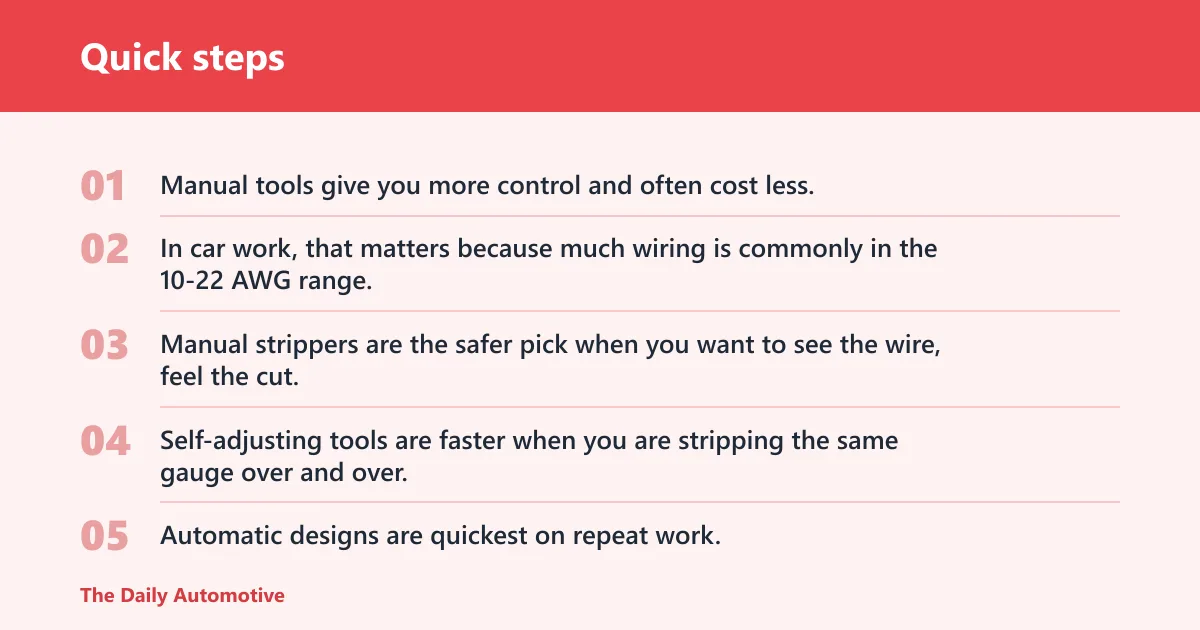


The trade-off is simple. Manual tools give you more control and often cost less, while self-adjusting and automatic tools save time on repeated cuts. In car work, that matters because much wiring is commonly in the 10-22 AWG range, and the same tool may need to handle speaker wire, sensor wire, and accessory leads without damaging strands.
| Tool | Type | AWG range | Best for | Grip or build notes | Extra function | Price position |
|---|---|---|---|---|---|---|
| Milwaukee 48-22-3103 | Manual wire stripper | 10-20 AWG | Controlled stripping on common accessory and power leads | Forged steel construction, cushioned grip | Integrated wire cutter and crimper | Midrange |
| Klein Tools 11055 | Manual wire stripper | 10-20 AWG | Budget automotive work and occasional repairs | High carbon steel, locking mechanism | Stripper and cutter layout | Budget pick |
| IRWIN Vise-Grip 2078307 | Self-adjusting stripper | 10-22 AWG | Repeated cuts on similar wire, comfort-focused use | ProTouch grip | Integrated cutter | Midrange |
| Klein Tools 11061 | Self-adjusting stripper | 10-20 AWG solid, 12-22 AWG stranded | Mixed solid and stranded automotive wiring | Adjustable stopper, tensioning thumb wheel | Automatic stripping action | Midrange |
| Klein Tools 11063W | Automatic wire cutter/stripper | 8-20 AWG solid, 10-22 AWG stranded | Broader coverage and more repeat work | Precision-machined stripping holes | Compound-action stripping | Higher |
| WGGE WG-015 | Multi-function stripper/cutter/crimper | 10-22 AWG | Low-cost general car wiring | High carbon alloy steel | Stripper, cutter, crimper | Budget option |
Manual, self-adjusting, and automatic at a glance
Manual strippers are the safer pick when you want to see the wire, feel the cut, and stop before the conductor is damaged. Self-adjusting tools are faster when you are stripping the same gauge over and over. Automatic designs are quickest on repeat work, but they still need a clean fit to avoid slipping on odd insulation or worn wire.
Tight under-dash and engine-bay spaces make bulky heads awkward. A compact manual body can fit where a larger compound-action tool feels clumsy, especially near fuse panels, pedal brackets, and branch points.
Key differences in AWG range, grip, and extras
Gauge range matters because automotive circuits vary a lot. Speaker wire, sensor wire, and accessory wiring often sit in the lower to mid-range of common automotive sizes, while some power and ground leads need heavier capacity. A tool that tops out too low forces awkward workarounds.
Integrated cutter or crimper features are useful extras, but they do not replace dedicated tools in every case. A combo tool can save space in a small kit. It can also be the wrong choice when you need cleaner crimps or when the tool body gets in the way of access.
Which stripper for which car job?
Match the tool to the job, not the name stamped on the handle. Stereo work, trailer wire repairs, sensor circuits, and older wiring all fail in different ways, so the best choice changes with wire type, space, and how fragile the insulation is. A tool that is fine for 14 AWG speaker lead may be a poor fit for brittle factory wiring.
| Project type | Common wire gauge | Best tool style | Risk of nicking strands | When to choose a separate crimper |
|---|---|---|---|---|
| Stereo installs | 10-22 AWG, often stranded | Self-adjusting or automatic stripper | Moderate if wire is soft and repeated cuts are needed | Choose separate crimpers if you are using open-barrel or non-insulated terminals |
| Trailer harness repair | 10-16 AWG, often stranded | Manual stripper with solid grip and cutter | Moderate to high if insulation is hardened or dirty | Use a separate crimper for weatherproof connectors and heat-shrink terminals |
| Sensor and ECU wiring | 18-22 AWG, often stranded or fine solid | Precision manual stripper or adjustable self-adjusting tool | High if the tool grabs too hard or the wire is very small | Use a separate crimper when the repair calls for exact terminal compression |
| Older hardened wiring | 12-22 AWG, mixed solid and stranded | Manual stripper with controlled jaws | High because cracked insulation and oxidation increase failure risk | Use a separate crimper if the repair needs a fresh terminal instead of a splice |
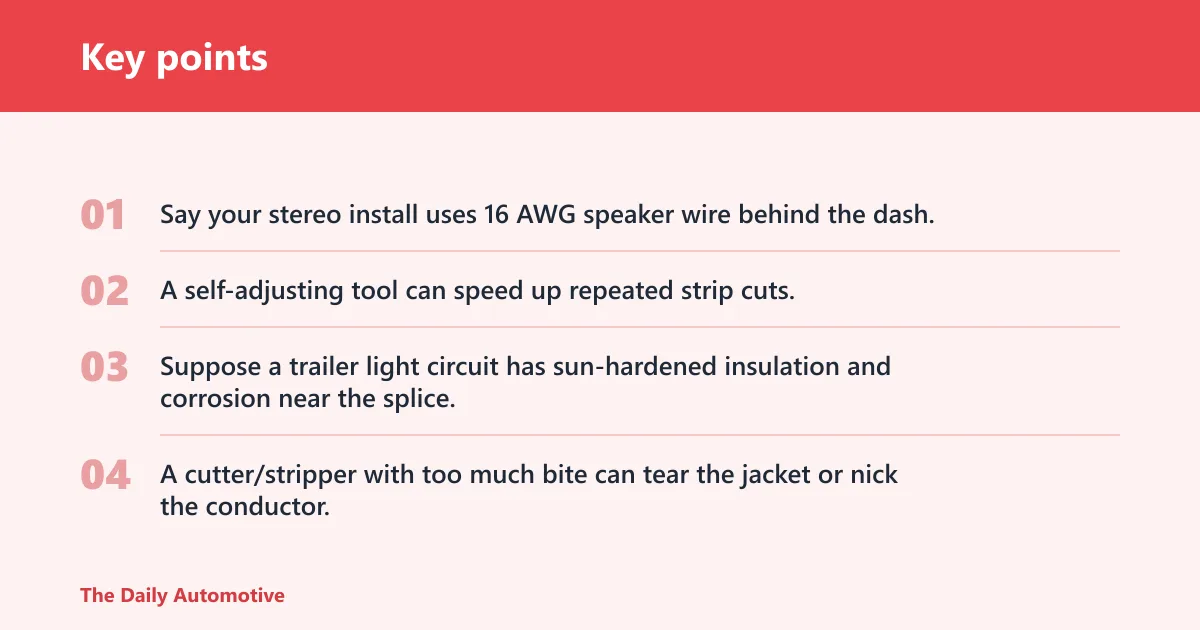
Say your stereo install uses 16 AWG speaker wire behind the dash. A self-adjusting tool can speed up repeated strip cuts, but if the radio cavity is cramped, a slimmer manual tool may be easier to aim without scraping nearby wiring.
Suppose a trailer light circuit has sun-hardened insulation and corrosion near the splice. A cutter/stripper with too much bite can tear the jacket or nick the conductor, so a manual tool with steadier control is usually safer.
Should you buy a self-adjusting wire stripper for automotive work?
Yes, if you strip a lot of similar wire and want speed without constant jaw adjustment. Self-adjusting tools save time on repeated cuts, and they are especially useful for accessory wiring, speaker runs, and other jobs where the gauge stays fairly consistent.
When self-adjusting tools save time
Klein Tools 11061 is a strong fit when you need to move between 10-20 AWG solid wire and 12-22 AWG stranded wire. Its adjustable stopper and tensioning thumb wheel help keep strip length more consistent, which matters when you are landing multiple terminals in a wiring repair.
IRWIN Vise-Grip 2078307 is another comfort-focused option. Its self-adjusting mechanism and ProTouch grip make it easier to repeat the same motion many times, and the 10-22 AWG range covers a lot of common automotive wire.
Where they can struggle
Self-adjusting tools can be less happy with odd insulation, hardened jacket material, or oil-contaminated wire. They can also feel bulky around pedals, fuse blocks, and kick panels. In those spots, the extra mechanism may get in the way more than it helps.
Why compound-action or adjustable-stop designs matter
A compound-action stripper can help keep effort low while still improving control on a consistent gauge. Adjustable stops matter when strip length has to match a terminal body or connector seal. That is one reason the Klein Tools 11063W stands out for broader automotive work, while the 11061 is a better fit when you want a more controlled setting on mixed wire types.
What AWG range do you need for car wiring?
For automotive work, 10-22 AWG is the practical range to watch. Most accessory, speaker, and sensor circuits live somewhere in that span, but the wire construction matters just as much as the gauge. Solid wire and stranded wire do not behave the same under the jaws.
Solid wire versus stranded wire
Solid wire is less common in accessory work but still appears in some wiring and sensor applications. Stranded wire is more common in speakers, add-on accessories, and many repair jobs because it tolerates vibration better. A tool that fits both styles is useful, but only if it is rated for each type.
Klein Tools 11061 is a good example because it separates the guidance: 10-20 AWG solid wire and 12-22 AWG stranded wire. That split matters because a tool that handles one well may not grip the other cleanly.
Matching the tool to speaker, accessory, and sensor circuits
Speaker wire usually calls for a clean strip on small stranded conductors. Sensor and ECU wiring often needs even more care, because small-gauge wire leaves less margin for error. Accessory wiring may be thicker and easier to strip, but an oversized jaw can still crush insulation if the fit is poor.
A common first-timer mistake is grabbing one tool for every circuit in the car. That works until a small 22 AWG lead or a brittle factory wire gets pinched, and then the repair becomes larger than the original job.
How do manual and automatic wire strippers differ?
Manual tools trade speed for control, and that is often a fair trade in automotive wiring. Automatic and self-adjusting tools are faster on repeated cuts, while manual tools give you more say over where the blades land and how much force goes into the strip.
Control and budget value from manual tools
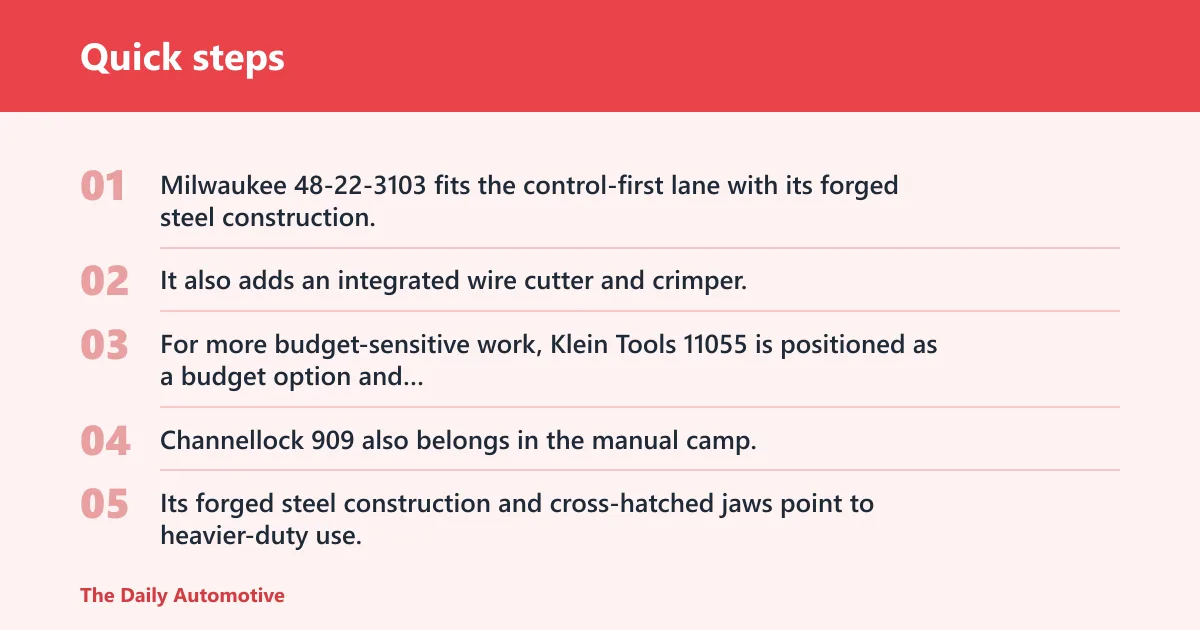
Milwaukee 48-22-3103 fits the control-first lane with its forged steel construction, cushioned grip, and 10-20 AWG range. It also adds an integrated wire cutter and crimper, which can help save space in a small tool pouch. For more budget-sensitive work, Klein Tools 11055 is positioned as a budget option and still stays in the same 10-20 AWG band.
Channellock 909 also belongs in the manual camp. Its forged steel construction and cross-hatched jaws point to heavier-duty use, and the bulkier design can be helpful when you want a firmer grip, even if it is less nimble in tight quarters.
Speed and repeatability from self-adjusting tools
Automatic tools are best when the same gauge shows up again and again. The IRWIN Vise-Grip 2078307 covers 10 to 22 AWG, and the self-adjusting mechanism reduces setup time. That is useful in trailer wire runs or stereo work where several similar connections need stripping in sequence.
WGGE WG-015 is the budget version of that idea. It is an 8-inch wire stripper/cutter/crimper with a 10-22 AWG range and high carbon alloy steel construction, which makes it appealing for light-duty general use when cost matters more than finesse.
Where integrated cutters and crimpers help
Integrated cutters are useful for shortening leads before stripping. Integrated crimpers help when you are doing simple connector work in one pass. Still, a combo tool is not always the best choice. If the connector is picky or the repair is in a cramped spot, a dedicated crimper often gives better control and cleaner compression.
Choose Milwaukee 48-22-3103 if… / Choose Klein Tools 11055 if…
Choose Milwaukee 48-22-3103 if you want a manual stripper with more durable feel, an integrated cutter and crimper, and a 10-20 AWG range that fits a lot of common vehicle wiring. It makes sense if you value controlled stripping and a cushioned grip for repeated use.
Choose Klein Tools 11055 if your priority is lower cost and straightforward manual control. Its 10-20 AWG range still suits many automotive repairs, and the locking mechanism helps keep it compact in a kit or drawer. That makes it a sensible pick for occasional work or a backup tool.
If the job is frequent and mostly similar gauge, the self-adjusting path may be better than either manual option. If the work is one-off, cramped, or on damaged wire, manual control usually wins.
Frequently asked questions
What is the best wire stripper for car wiring?
The best choice depends on the job, but a self-adjusting stripper is usually the most versatile for general car wiring. A manual stripper is better when you want control, especially on delicate terminals or tight spaces. For repetitive cuts on similar wire, an automatic or self-adjusting model is the faster choice.
Can one wire stripper handle both solid and stranded automotive wire?
Sometimes, but only if the tool is rated for both and the gauge range matches the wire. Solid and stranded wire do not strip the same way, and stranded copper is easier to nick. Check the tool’s separate ratings for each wire type before buying.
What is the difference between manual and automatic wire strippers?
Manual strippers rely more on your hand pressure and placement, so they usually give more control and lower cost. Automatic or self-adjusting tools use a mechanism that adapts to wire size, which speeds up repetitive work. The trade-off is more bulk and sometimes less finesse in tight spots.
Do I need a crimper too for car wiring repairs?
Often yes, especially if you are installing terminals, butt splices, or heat-shrink connectors. A combo stripper/crimper is handy for simple work, but a dedicated crimper is better when connector quality matters. If the repair is critical, separate tools usually give cleaner results.
Which wire stripper is best for budget automotive work?
Klein Tools 11055 is the budget manual pick, while WGGE WG-015 is the low-cost multi-function option. Choose the Klein if you want simple control and a familiar layout. Choose the WGGE if you want stripper, cutter, and crimper functions in one inexpensive tool.
Products related to this article
Sponsored / affiliate links. As an Amazon Associate I earn from qualifying purchases. I may earn additional commission from eligible campaigns.