Best Air Conditioners for Cars: 2 Picks Compared
For actual cabin cooling, a portable air conditioner is the only option here that can lower air temperature. Evaporative coolers mainly help in dry heat, and personal fans only move air. Pick the wrong type, and you get battery drain, humid cabin air, or almost no relief while parked. This guide compares two practical picks and explains which cooling type fits commuting, camping, RV use, climate, and power source.
Which car cooler is the best pick?
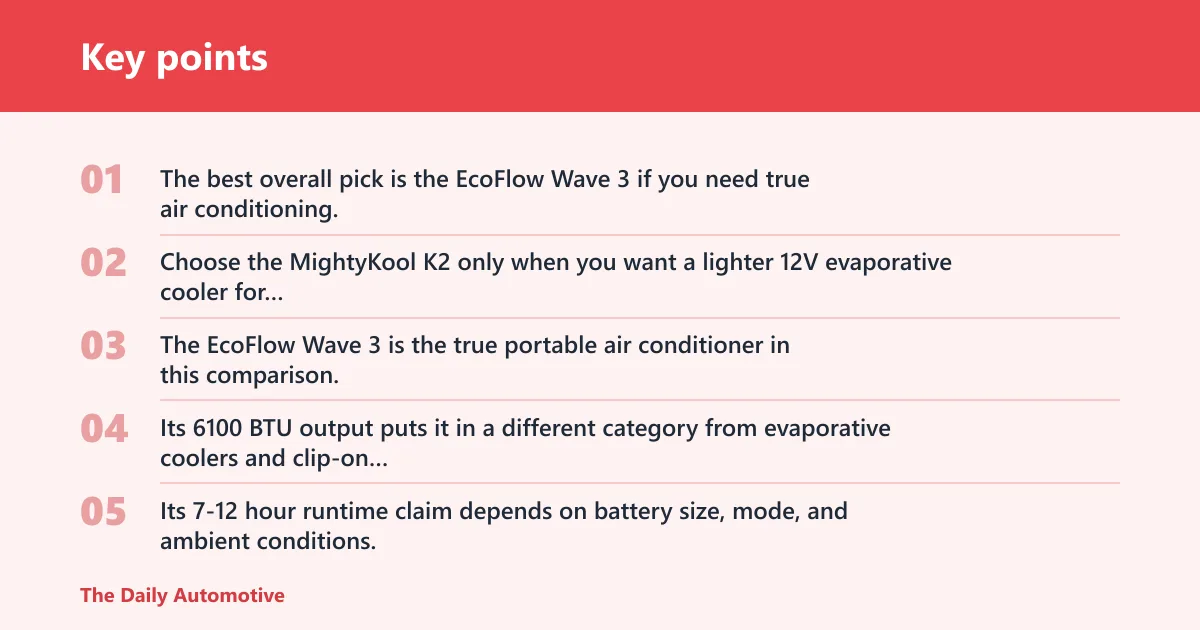

The best overall pick is the EcoFlow Wave 3 if you need true air conditioning, because it is a portable compressor unit with 6100 BTU output and multiple power options. Choose the MightyKool K2 only when you want a lighter 12V evaporative cooler for open-air use in dry weather, not sealed-cabin cooling.
Quick picks at a glance
| Pick | Best for | Key spec | Where it fails |
|---|---|---|---|
| EcoFlow Wave 3 | Parked cooling, camping, RV use, weak factory AC backup | 6100 BTU, AC/DC/battery power, 7-12 hours runtime claim, 32 lbs | Needs proper exhaust and ventilation; bulky; battery use can drain power fast |
| MightyKool K2 | Open-air or partially open car use in dry heat | Evaporative cooler, 12V adapter, 5 lbs, up to 8 hours on low | Poor fit for humid weather, sealed cabins, or rear-seat cooling |
| Evapolar evaCHILL | Close-range personal cooling at a desk, tent, or front seat | 10W, USB powered, 4 fan speeds, about 3-5 feet | Too small for whole-cabin relief; works best below 70% humidity |
| Clip-on car fan | Localized airflow for a driver or passenger | 360° rotation, 199 speed settings | Moves air only; no real cooling |
EcoFlow Wave 3
The EcoFlow Wave 3 is the true portable air conditioner in this comparison. Its 6100 BTU output puts it in a different category from evaporative coolers and clip-on fans, because it can lower air temperature when you set it up with proper exhaust and airflow.
Its 7-12 hour runtime claim depends on battery size, mode, and ambient conditions, so treat that number as a range rather than a promise. At 32 lbs, it is also the least convenient option to move between a vehicle, campsite, and storage.
That weight matters because true portable AC units are not grab-and-go accessories. They need hot-air exhaust, drainage, and a fixed place to sit. In a closed parked car, poor venting can trap heat inside the cabin instead of pushing it out.
MightyKool K2
The MightyKool K2 is an evaporative cooler, not a true air conditioner. It uses a 12V adapter power source, weighs 5 lbs, and can run up to 8 hours on low, but that runtime depends on water tank level, airflow setting, and how dry the air is.
This type makes the most sense in open-air car use, such as a parked vehicle with windows cracked or a partially open setup. It is a weak fit for a sealed cabin, humid weather, or rear-seat cooling, because evaporative cooling falls off as humidity rises.
It also does not behave like a compressor unit. It cools by evaporation, so it can make the immediate airstream feel better, but it will not work like a true AC in a closed car or in traffic with all windows up.
Car AC decision matrix
The right choice depends on climate, vehicle state, and power source. A cooler that works in dry heat can fail badly in humid weather, and a unit that runs from a 12V outlet can still be the wrong answer if it cannot vent hot air or if it drains the battery too far.
| Cooling type | Climate fit | Vehicle state | Power source | Runtime | Noise | Best use case | Failure case |
|---|---|---|---|---|---|---|---|
| True portable AC | Hot or humid heat | Parked, camping, RV setup | AC, DC, or battery | Battery-dependent; Wave 3 listed at 7-12 hours | Noticeable fan and compressor noise | Weak factory AC backup, sleeping in a camper, cooled parking setup with exhaust | Do not buy for a closed car with no exhaust path or where battery drain is a risk |
| Evaporative cooler | Dry heat, below 70% humidity | Open-air, cracked windows, light airflow | 12V or USB, depending on model | Water-tank dependent; K2 listed up to 8 hours on low | Usually lower than compressor units, but still audible | Short solo drives, front-seat relief, dry-climate parking use | Do not buy for sealed cabins, rear seats, or humid weather |
| Personal fan | Any climate, but only for airflow feel | Driving or parked | USB or 12V | Depends on vehicle power | Usually low to moderate | Moving air across one person | Do not buy if you need actual cooling |
How to choose the right cooler
The first decision is simple: choose true AC when you need temperature drop, evaporative cooling when you live in dry heat and can tolerate zone-only relief, and a fan when you only want moving air. That order matters because the wrong category is the most common buying mistake.
True AC vs evaporative cooler vs fan
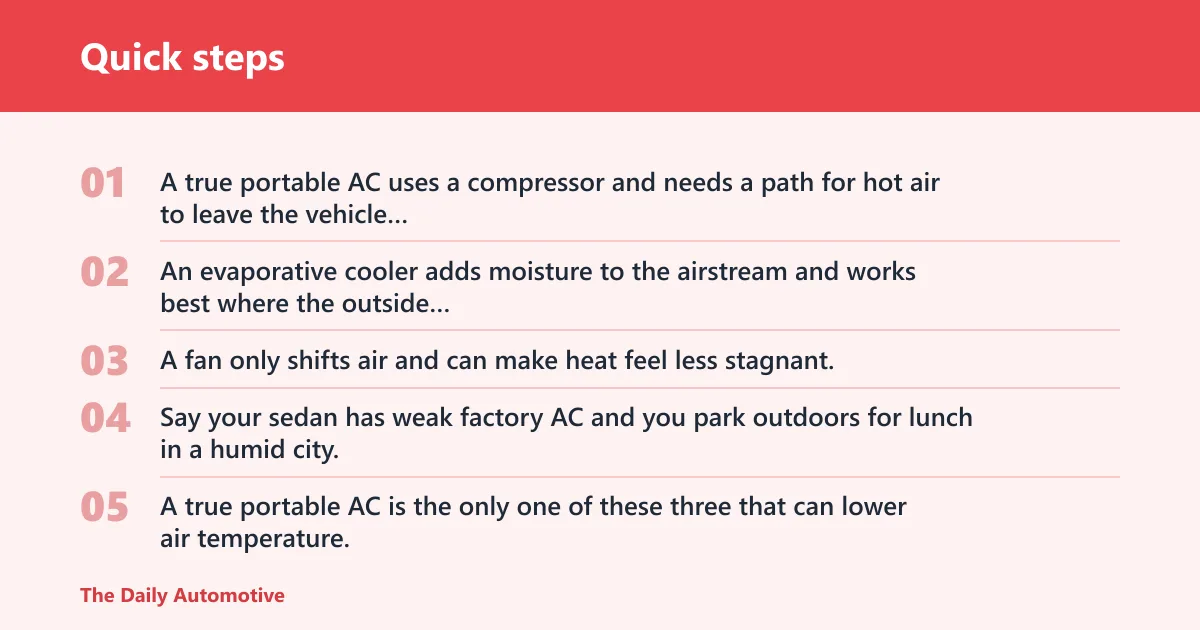
A true portable AC uses a compressor and needs a path for hot air to leave the vehicle area. An evaporative cooler adds moisture to the airstream and works best where the outside air is dry. A fan only shifts air and can make heat feel less stagnant, but it does not cool the air itself.
Say your sedan has weak factory AC and you park outdoors for lunch in a humid city. A true portable AC is the only one of these three that can lower air temperature, but it still needs venting and power planning. A fan will not solve the heat load, and an evaporative cooler will struggle in humid air.
What 12V, USB, AC, and battery power really change
A 12V outlet is convenient, but it does not make every cooler safe or suitable. A battery-powered or battery-assisted true AC can work, yet battery drain is real, and poor planning can leave the vehicle unable to start. USB units are lower power by design and are usually personal coolers, not cabin coolers.
For the Evapolar evaCHILL, the draw is only 10W and it needs 5V/2A input. That makes it practical for close-range use, but it is still a personal cooler, effective at about 3 to 5 feet and best in dry climates below 70% humidity. It is not a whole-car solution.
Noise, water spill risk, maintenance, and venting
Noise matters if you plan to drive, sleep, or talk in the vehicle. Compressor units are louder than a small USB cooler, and even quiet units become distracting in a small cabin. Water-based coolers also add spill risk, refills, and filter upkeep.
A common first-timer mistake is buying a water-based cooler for a sealed parked car and expecting it to behave like an AC. If the cabin is closed and the unit has no clear airflow path, the result is often damp air, limited relief, and poor performance.
Are portable car air conditioners worth it?
They are worth buying when you match the cooling type to the job. A true portable AC is the right answer for weak factory AC, camping, or an RV setup with real venting. Evaporative coolers are worth it only in dry climates and mostly for one person at a time.
Best match for weak factory AC
If your factory AC is weak, start with the EcoFlow Wave 3 class of product only if you can manage exhaust and power. It can help where cabin air needs actual cooling, but it is not a magic replacement for a broken vehicle system. For a small pickup, camper, or parked setup, the output makes more sense than a fan or evaporative cooler.
Whole-cabin cooling vs personal cooling
Do not expect most portable units to cool every seat evenly. The Evapolar evaCHILL is effective within about 3 to 5 feet. The clip-on fan with 360° rotation and 199 speed settings is also a personal airflow tool, not a cabin solution. Even the Wave 3 needs careful placement and venting to deliver useful cabin-level results.
What size setup fits a car, truck, or RV
For a car, the right size is less about a room-style square-foot number and more about whether the unit can move enough air, vent heat, and run without draining the battery. For a truck or RV, you need more output, more installation space, and a better power plan than a small USB unit can provide.
Picture a rideshare driver with a front-seat cooler, cracked windows, and a humid afternoon. A personal fan may make the driver more comfortable for a short trip. The rear seat and cabin, though, still need real AC if passengers expect the whole vehicle to feel cooler.
Frequently asked questions
What is the best air conditioner for a car if my factory AC is weak?
The best option here is the EcoFlow Wave 3, because it is the only pick in this group that is a true portable air conditioner with 6100 BTU output. It is best when you can support exhaust and power, and it makes the most sense for parked use, camping, or RV-style setups.
Are portable car air conditioners actually worth buying?
Yes, but only when the device matches the job. True portable AC can be worth it for actual cooling, while evaporative coolers are worth it mainly in dry weather. If you want a whole-cabin fix without venting or power planning, the answer is usually no.
What is the difference between an evaporative cooler and a true portable AC for a car?
An evaporative cooler adds moisture and cools best in dry air, while a true portable AC uses a compressor and can lower air temperature more directly. In a car, that difference decides whether the unit can help in humid weather or only in a dry, partially open setup.
Can I run a portable car air conditioner from a 12V outlet?
Some units can run from 12V, including the MightyKool K2 and some portable AC setups with DC support. The catch is power draw and battery drain. If the unit pulls too much power for too long, the vehicle battery can be too low to restart the car.
Which car cooler works best in humid weather?
A true portable AC works best in humid weather because evaporative cooling loses effectiveness as humidity rises. The Evapolar evaCHILL is specified as best below 70% humidity, which is a good reminder that humid conditions are the wrong match for most evaporative coolers.
How long do portable car air conditioners run on water or battery?
That depends on type. The MightyKool K2 can run up to 8 hours on low, but that depends on water tank level, airflow, and dry air. The EcoFlow Wave 3 is listed at 7-12 hours with multiple power sources, but runtime varies with battery size, mode, and temperature.
Products related to this article
Sponsored / affiliate links. As an Amazon Associate I earn from qualifying purchases. I may earn additional commission from eligible campaigns.