Best Cooling Fans for Cars (4 Picks Compared)
The best cooling fan for a car matches the job: a 12V clip-on fan for rear-seat airflow, a solar or vent fan for parked-car ventilation, and an engine-cooling fan only for cooling-system needs. Pick the wrong type, and you waste power, add noise, or leave hot spots in the cabin. This guide compares four picks by power source, mounting, noise, cabin placement, and the use case each one fits best.
Quick comparison
| Product | Badge | Best for | Price | ||
|---|---|---|---|---|---|
 |
Hynoo 12V Car Clip Fans, Adjustable Dual Head Clip Fan 360°Hynoo | Our pick | 4-inch · 12V · dual-head clip | $23.79
Price as of 25 Oct 2026
|
View |
 |
CRAFTZONE 12V Portable Fan RV | Truck Cooling Heavy Duty 9"CRAFTZONE | Also great | 9-inch · 12V · metal fan | $20.99
Price as of 25 Oct 2026
|
View |
 |
BETTERCLOUD Universal 16-Inch Slim Electric RadiatorBETTERCLOUD | Upgrade pick | 16-inch · 12V · radiator kit | $48.98
Price as of 25 Oct 2026
|
View |
The main split is simple: cabin fans move air for people, while a radiator fan kit manages engine heat. That matters more than marketing claims about airflow, because mounting position, vehicle power, and seat location decide whether the fan helps in real use.
How we chose
We compared four criteria that matter in daily use: power source, mounting stability, noise tolerance, and whether the fan fits a parked car, active driving, or engine-cooling job. Also check whether the airflow claim matches the intended placement, because a high CFM number can still underperform if the fan sits in the wrong spot.
Safety and fitment also matter. A child seat, a bumpy commute, or an older SUV with weak USB ports changes the answer fast.
- Power compatibility: USB, 12V cigarette-lighter, or direct-fit radiator wiring.
- Mounting stability: clip-on, headrest strap, dash placement, or plug-in install.
- Noise and comfort: especially for babies, sleeping passengers, and road trips.
- Use case fit: rear-seat comfort, front-seat coverage, or overheating control.
Airflow claims versus real cabin use
CFM tells you how much air a fan can move in ideal conditions, but cabin cooling depends on where the air goes. A fan with a smaller claim can feel better than a louder, bigger one if it is aimed at a face, torso, or child seat instead of a door panel.
That is why mounting matters as much as the number. For radiator fans, higher CFM matters more because the fan has a mechanical job. For cabin fans, placement and stability usually come first.
Hynoo dual-head clip fan: best for backseat cooling
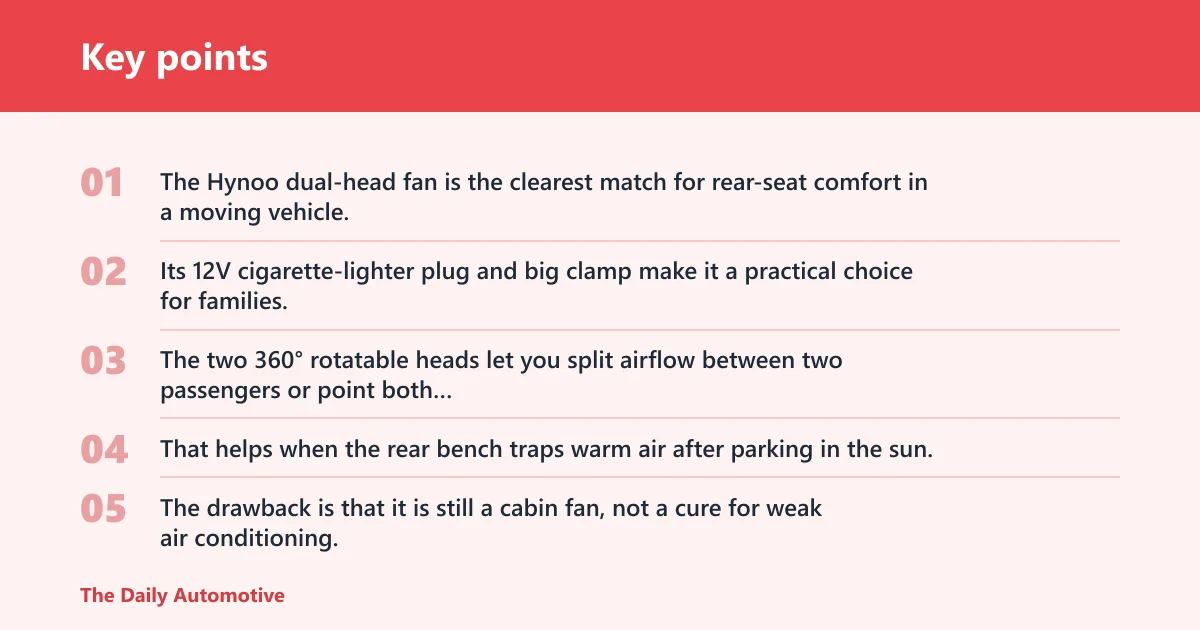
The Hynoo dual-head fan is the clearest match for rear-seat comfort in a moving vehicle. Its 12V cigarette-lighter plug and big clamp make it a practical choice for families, SUVs, and older cars where simple installation matters more than a fancy feature list.
The two 360° rotatable heads let you split airflow between two passengers or point both heads at one heat pocket. That helps when the rear bench traps warm air after parking in the sun.
The drawback is that it is still a cabin fan, not a cure for weak air conditioning. If your vehicle has poor vent output or a hot third row, the fan helps with circulation, but it will not replace missing cold air.
Why 5V/2A matters
USB fans commonly need 5V/2A to run properly. That is a real limiter in cars with weak USB ports, because a low-output port can reduce speed or make the fan feel underpowered. A powered charger or power bank can solve that, but runtime then depends on the charger or battery pack, not the car alone.
For parked-car use, USB power is convenient. For steady rear-seat cooling while driving, 12V is usually the simpler choice.
Clip-on and headrest mounting
Clip-on fans are easy to place, but the clamp must stay stable on bumpy roads. Headrest-mounted fans can feel steadier for backseat passengers because the seat structure holds the fan in place, and the airflow stays aimed where the passengers sit.
If the fan shifts whenever the road gets rough, the air path changes too. That is where “more airflow” stops mattering.
CRAFTZONE 9-inch metal fan: best for active driving
The CRAFTZONE 9-inch fan is the better fit for drivers who want stronger cabin air during active use. It is a 12V portable fan, and that plug-and-play vehicle power makes it easier to rely on in older cars or trucks with weak USB ports.
Based on the listed details, it is built for harsh conditions and low-noise operation. That combination suits work vehicles, campers, and utility rigs where the fan may face vibration, dust, or long hours on the road.
The trade-off is size and placement. A metal fan with a more forceful airflow can be less forgiving in a small cabin, so you need to pay attention to where it mounts and where the blade area sits relative to passengers and pets.
Why cigarette-lighter power helps
A 12V cigarette-lighter fan is often the better option when the car is moving and the fan needs to stay on for hours. It does not depend on a battery pack, and it avoids the weak-output problem that some USB ports create.
That matters in older vehicles. It also matters in vehicles that only have a low-power USB port designed for charging a phone, not running an airflow device.
Noise and install trade-offs
Lower noise is easier to value than to trust. A fan marketed as quiet may still be noticeable in a small cabin if the blades are close to the front seats or the mount rattles on rough pavement.
Metal construction can improve durability, but it also raises the need for solid mounting and a safe blade guard. If the fan wobbles, the noise will usually follow.
BETTERCLOUD radiator kit: best for overheating
The BETTERCLOUD kit is not a cabin comfort fan at all. It is a 16-inch slim electric radiator cooling fan kit for engine-cooling work, so it belongs in the overheating, towing, or modified-engine category rather than the passenger-comfort category.
Its thermostat, relay, wiring loom, and mounting kit make sense when you need a complete cooling-system replacement or upgrade. That is the right tool for high-load driving, not for cooling a child in the back seat.
The drawback is scope. If your goal is better airflow for passengers, this is the wrong product. It also asks for installation work that is far beyond a clip-on cabin fan.
Why CFM matters more here
For radiator fans, airflow numbers matter because the fan is doing mechanical cooling work at the engine bay. This kit is a 12V, 100W setup, and the radiator job depends on proper fit, wiring, and thermostat control.
That is very different from a cabin fan, where a big airflow claim can still miss the person who needs the air.
Car fan decision matrix
This table matches the fan type to the job, power source, noise tolerance, seating position, and vehicle age. Use it as a filter before you look at airflow claims.
| Use case | Best fan type | Power source | Noise tolerance | Seating position | Vehicle age or condition | Final recommendation |
|---|---|---|---|---|---|---|
| Parked cabin airflow | USB-powered cabin fan | 5V/2A USB charger or power bank | Low to medium | Front seat or rear seat | Any vehicle with usable USB power | Choose USB if you need portable ventilation while parked. |
| Rear-seat comfort | Dual-head clip fan | 12V cigarette-lighter plug or strong USB setup | Low preferred | Back seat | SUVs, minivans, family cars | Choose dual-head if two passengers need split airflow. |
| Front-seat or multi-passenger coverage | Triple-head fan | Usually vehicle power | Low-noise preferred | Front row or centered mount | Cars with stable headrest or dash mounting | Choose triple-head if one mount needs to serve more than one seat. |
| Overheating, towing, modified engines | Thermostat-controlled electric radiator fan kit | 12V direct wiring | Not the main concern | Engine bay | Older, modified, or heavy-use vehicles | Choose a radiator kit only for cooling-system work, not cabin comfort. |
Mounting, stability, and safety
Clip-on, headrest strap, sun visor, and plug-in installations all solve different problems. Clip-on mounts are fast, headrest straps are steadier for rear passengers, sun visor mounts can work in front-seat setups, and plug-in installs make sense when the fan is meant to live in one place.
Safety grille design matters too. A smaller finger-safe gap is important for children and pets, especially in a back seat where curious hands can reach the fan.
Say your SUV has a hot third row and weak center vents. A dual-head 12V fan on a headrest can send one head toward each child, which usually works better than a single fan pointed between them.
Suppose your older sedan has one aging USB port and no rear vents. A USB fan can still help at a stoplight or in a parked car, but a 12V fan is the safer buy if you want steadier airflow on the road.
USB car fan: best for parked cabin airflow
A USB car fan is the right pick when you need portable cabin airflow and already have a 5V/2A source. It works with car chargers and power banks, so it is useful for short commutes, rear-seat comfort, and parked ventilation.
Most USB models are clip-on or headrest-mounted, which helps aim the airflow where the cabin traps heat. They are also common in backseat use, where a passenger needs direct air more than a whole-cabin blast.
The drawback is output ceiling. USB power is convenient, but it is not ideal when the car’s port is weak or when you need strong airflow for more than one seat.
When USB power is enough
USB power is enough when the goal is targeted relief rather than whole-cabin cooling. It works best for one passenger, a child seat, or a parked car where the fan only needs to keep air moving.
If the car’s USB port cannot supply 5V/2A, the fan may run slower than expected. In that case, a car charger or power bank can be a better source, but the fan still depends on that external supply.
12V car fan: best for active driving
A 12V cigarette-lighter car fan is the better choice when the fan needs to stay useful while the car is moving. It is plug-and-play, does not require battery maintenance, and works especially well in older vehicles without strong USB ports.
This type fits drivers who want straightforward installation and a fan that draws from the vehicle itself. It is usually the better answer for commuters, work trucks, and older SUVs.
The drawback is that 12V convenience can still depend on mount quality. If the fan is fixed poorly, bumpy roads can create noise and change the airflow direction.
Older vehicles and weak USB ports
Older vehicles often have fewer charging options, and some newer ones still have USB ports meant for charging phones, not running a fan at full speed. A 12V fan avoids that mismatch.
That makes it a safer default when you do not know the port output or when you want consistent fan speed on long drives.
Dual-head fan: best for rear passengers
A dual-head fan is the better call when rear passengers need coverage from one mount. Independent or simultaneous airflow control lets you point both heads where the heat builds up, and many dual-head designs offer 3 speeds with 360° rotation or similar adjustability.
This type works well for back seats because it can split airflow between two people or send both heads at one seat row. It is also easier to tailor than a single fixed fan.
The drawback is that dual-head designs still need a secure mount. If the clamp is weak or the headrest strap slips, the airflow becomes inconsistent fast.
When two heads beat one
Two heads beat one when the cabin has uneven heat pockets, especially in the back row. One head can face the window side while the other points toward the center seat or child seat.
That is more useful than a single stronger blast when the goal is comfort, not raw airflow.
Triple-head fan: best for wider cabins
A triple-head fan is the broader coverage choice for front-seat or multi-passenger airflow. It is usually mounted on a headrest or dash, and many designs use two speeds or low-noise operation to keep cabin sound under control.
It makes sense in larger cabins where one fan needs to serve more than one person. That includes family haulers and some vans, where front-row and second-row comfort can both matter.
The drawback is bulk. More heads can mean more mounting stress, and a poorly positioned triple-head fan can block sightlines or feel excessive in a small car.
Front-seat and multi-passenger coverage
A triple-head design is most useful when passengers sit across a wider area and one direction of airflow is not enough. It is not about maximum force. It is about reaching more seats with less repositioning.
For road trips, that usually matters more than chasing the biggest claim on the box.
Choose Hynoo if… / Choose CRAFTZONE if… / Choose BETTERCLOUD if…
Choose Hynoo if you want a rear-seat fan with simple clamp mounting, dual 360° heads, and a 12V plug for family use. It fits the common backseat comfort job well.
Choose CRAFTZONE if you drive often, need stronger active airflow, or own an older vehicle with weak USB ports. Its 12V plug and rugged build make more sense for work or long-haul use.
Choose BETTERCLOUD if your problem is engine heat, not passenger heat. It belongs in overheating or towing scenarios where a thermostat-controlled radiator fan kit is the actual fix.
Which one should you buy?
For families, start with a dual-head 12V fan. It gives the best mix of rear-seat coverage, mounting stability, and simple power use.
For commuters who want one fan aimed at the driver or front passenger, a USB fan is fine if the port can supply 5V/2A. If the port is weak, move up to 12V.
For older vehicles, a 12V cigarette-lighter fan is usually the safer buy because it avoids USB output limits. For overheating, towing, or modified engines, skip cabin fans and buy a thermostat-controlled electric radiator fan kit instead.
Battery-powered fans are worth it only when portability matters more than runtime or output. They can help for short use, but they are not the best choice for daily car cooling.
Frequently asked questions
Which fans are best for cooling a car?
The best fan depends on the job. Use a USB or 12V cabin fan for people in the cabin, a dual-head or triple-head model for rear-seat coverage, and a radiator fan kit for engine cooling. Do not use the same rule for all three problems.
What is the best cooling fan for a car?
The best cooling fan for a car is the one that matches your power source, seat position, and noise tolerance. For most passenger needs, a 12V dual-head fan is the most flexible answer. For overheating, the correct answer is a thermostat-controlled radiator fan kit.
Which car cooling fan is quietest?
The quietest models are usually brushless portable fans marketed under 30 dB, such as the Hayousui style of fan. Quiet claims matter most for babies, sleeping passengers, and long road trips, but mount stability still affects what you hear in the cabin.
Should I buy a USB car fan or a 12V car fan?
Buy USB if you need portable airflow, a power-bank option, or parked-car ventilation and your source can supply 5V/2A. Buy 12V if you drive often, want steadier speed, or have older USB ports that may not provide enough power for real cooling.
Do dual-head car fans cool better than single fans?
Yes, when the goal is coverage rather than raw force. Dual-head fans are better for rear passengers because they can split airflow between two seats or target one hot zone from two angles. A single fan can still work if the cabin is small and the mount is solid.
Can a car cooling fan help if my AC is weak?
Yes, but only as a helper. A cabin fan can move air across your body and reduce dead spots, especially in the rear seat, but it will not repair weak refrigerant, a failing compressor, or a blocked vent. If the AC is weak, the car still needs service.
What size fan works best for backseat cooling?
For backseat cooling, size matters less than coverage and mounting. Dual-head clip fans usually work well because they aim air at two rear passengers or a child seat plus a second seat. In larger cabins, a triple-head design can cover more space from one mount.
Are battery-powered car fans worth it?
Sometimes, but only for short runs or temporary use. Battery-powered fans are portable, yet runtime and output limits make them a poor substitute for a wired 12V fan in daily use. If you want reliable cabin airflow, car power is usually the better answer.
Products related to this article
Sponsored / affiliate links. As an Amazon Associate I earn from qualifying purchases. I may earn additional commission from eligible campaigns.
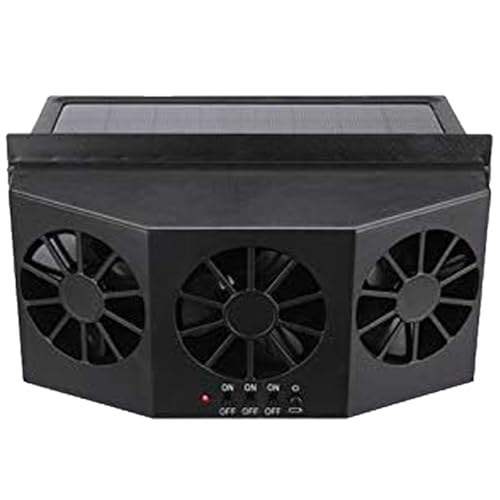 Riloer Car Fan, 1-Pack Car 3.6V DC 3 Fans Cooling Fan Exhaust Fan, Solar Powered Cooler Fan Compatible with Car Camper Boat Trailer (Black)
 Syohoxi 24V Portable 3-Head Car Cooling Fan, Heavy Duty Truck Fan with 360°Rotation,2 Speeds,Dashboard Fans for Truck/SUV/RV/Van,Cigarette Lighter Plug (3-Head 24V)