Best Fans for Cars: Stay Cool with 360° Rotating Portable Fans
The best fan for a car is the one matched to the cooling problem: clip-on 360° fans for a driver hot spot, dual fans for rear-seat passengers, and battery or USB models for parked-cabin airflow. Pick the wrong style and you waste power, block sightlines, or still leave one seat hot. This guide shows which fan design fits each use case, and which specs matter most.
Quick comparison
| Product | Badge | Best for | Price | ||
|---|---|---|---|---|---|
 |
Hynoo 12V Car Clip Fans, Adjustable Dual Head Clip Fan 360°Hynoo | Our pick | 4-inch · dual-head · clip fan | $23.79
Price as of 1 Nov 2026
|
View |
 |
XOOL Clip Car Fan, Adjustable Dual Head 4 Inches 12V FanXOOL | Also great | 4-inch · stepless speed · clip fan | $25.64
Price as of 1 Nov 2026
|
View |
 |
CYDZSW 12v Clip Fan for Car,10 inch Portable 90° RotationCYDZSW | Upgrade pick | 10-inch · oscillating · clip fan | $32.99
Price as of 1 Nov 2026
|
View |
 |
OpenBay Clip on Fan, Rechargeable USB Fan with SturdyOpenBay | Pair with it | 5.5-inch · rechargeable · clip fan | $25.99
Price as of 1 Nov 2026
|
View |
 |
Dealswin Car Fan for Backseat, Dual Head USB Car Seat Fans,Dealswin | Budget pick | Dual-head · rear-seat · USB fan | $18.99
Price as of 1 Nov 2026
|
View |
This table ties each fan to the job it has to do. That matters because a fan that helps a solo driver can miss the mark for a rear bench, a sleeping child, or a parked cabin with weak airflow.
How we chose
We compared manufacturer specs, listing details, and published buyer feedback. The filter was simple: pick the fan type that matches a real cabin problem, then check power source, mounting style, noise claims, and any family-safety detail that affects use in a car.
We also separated front-seat, rear-seat, and parked-car use, because those are different problems. A fan that moves air well is still a poor buy if it cannot mount where the hot spot actually is.
Hynoo 12V car clip fans: best for a driver hot spot
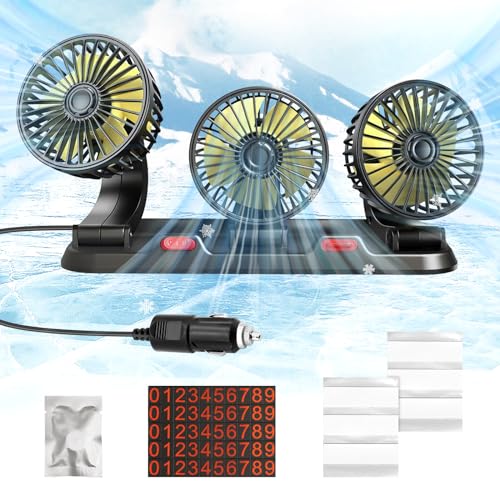
If your main complaint is a warm driver side, this is the type that fits: a clip-on 360° rotating fan with a dual-head layout and a cigarette-lighter plug. That setup lets you aim airflow at the driver, passenger, or a second-row rider without using much space.
Hynoo lists a large clamp for easier mounting and a 2.5m cigarette-lighter cord, which helps in larger cabins where the nearest outlet is not right next to the seat. The tradeoff is that clip fans can be position-sensitive. If the clamp sits wrong, the air may blow across the cabin instead of at the person who needs it.
Use this style when you want a practical hot-spot fix more than broad cabin cooling. It is a better match for a driver who feels heat on one side than for a family that needs two rear passengers cooled evenly.
XOOL clip car fan: best for adjustable front-seat cooling
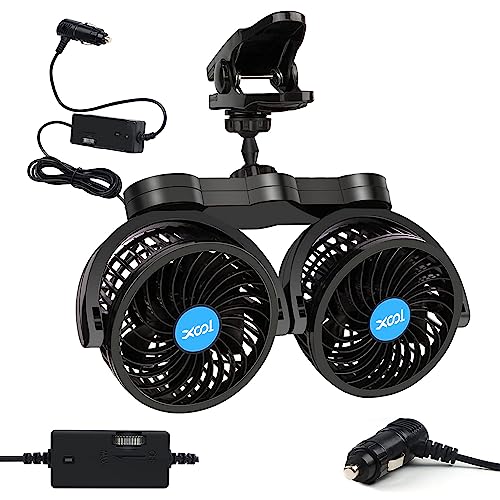
This model suits drivers and front passengers who want more control over airflow. Based on the listing details, the XOOL uses dual 4-inch heads, 360° rotation, and stepless speed control, so you can fine-tune airflow instead of jumping between fixed levels.
Its low-noise design helps on commutes and during conversation, especially if the fan sits close to the front seats. The drawback is simple: a compact dual-head fan still depends on good placement. If you point it at the wrong surface, it can recirculate warmer cabin air instead of improving comfort.
Choose this one if you want a front-seat fan that adapts well to changing conditions, such as a sunny morning commute followed by a parked return trip.
CYDZSW 12v clip fan: best for broader cabin airflow
This is the option to look at when a small clip fan feels too narrow. The listing calls out a 10-inch fan, 90° oscillation, 360° adjustment, and two speed settings, which points to broader airflow coverage for larger cabins or shared seating areas.
That wider sweep can help in SUVs, trucks, and RVs where rear airflow is uneven. The drawback is size: a bigger fan can be harder to place discreetly, and a larger housing may be more visible in your line of sight if you mount it near the dashboard.
If your problem is dead rear vents or a hot second row, this is the style that is more likely to move enough air to matter.
OpenBay clip on fan: best for USB convenience
This fan is the easiest setup choice when you already have a usable USB port or a power bank. OpenBay lists USB-C rechargeable power, a 3000mAh battery, 100 speed settings, an LED display, and 360° rotation, so it fits drivers who want quick placement and portable use.
The drawback is the same one that comes with most USB-powered fans: it depends on external power or charging discipline. That makes it a weaker fit for long, high-speed use if your vehicle USB port is weak or already needed for pass-through charging a phone.
For compact clips, USB power is often the simplest route. Just check whether your vehicle port can support the fan while also charging what else you need in the cabin.
Dealswin backseat fan: best for rear passengers and kids
This is the most focused rear-seat option in the group. Dealswin lists a dual-head USB setup, 360° rotation, rear headrest mounting, and a child-safe grid design, which makes it a sensible fit for families, pets, and second-row riders who need airflow in two directions.
The big advantage is coverage. A dual-head backseat fan can send air to both sides of the rear row, which helps when one child runs hot and the other sits in a different sun angle. The drawback is that it is less useful if your main problem is the driver seat, because the mounting and airflow are built around the rear cabin.
If you are buying for babies or toddlers, check the grille gap and the vehicle manual as well as the car-seat manual. Aftermarket seat accessories must be allowed by both.
Which one should you buy?
Start with the cooling problem, then match the fan format to the cabin layout. A 360° clip-on fan is the default for a driver hot spot. A dual-head rear fan is the better call for kids, pets, and second-row comfort. A bigger clip fan with oscillation makes more sense when the cabin is larger and the airflow issue is broader.
Say your SUV has weak rear vents and two children in the second row. A dual-head backseat fan is more useful than a single front clip fan, because the problem is rear-seat airflow, not driver-side heat. The best fan is the one that reaches the seat that stays hot.
If you want the simplest power setup, choose USB. If you need stronger, continuous use on longer drives, a 12V cigarette-lighter model is usually the better fit. If you need portable use with the car off, check battery capacity and expected runtime before you buy.
Suppose you park for 10 minutes in a hot lot and then drive home with a sleeping toddler in the back. A rechargeable fan can help with cabin ventilation while the vehicle is stationary, but it still will not turn the cabin into air conditioning. Placement matters just as much as power.
What the product listing should say
Battery capacity and runtime
Battery capacity is listed in mAh, and it tells you how much stored power the fan has available. Runtime still depends on speed setting, so a high setting can drain a cordless fan much faster than a low one. For road trips, check the manufacturer’s listing for your model if runtime is not clearly stated.
Two examples from the supplied products show why this matters. Gaiatop lists a 2000 mAh battery with runtime from 3.5 to 10 hours, while Socool lists a 14500 mAh battery. Those figures are not interchangeable; the actual runtime depends on the fan’s speed and design.
Noise and motor type
If the listing mentions a quiet brushless motor, that usually points to lower noise and better efficiency. That matters most when a sleeping child, a pet, or a conversation in the front seat matters more than maximum airflow.
One supplied example is TriPole, which is reported at around 30 dB and reaches up to 3630 rpm. Treat that as a listing-specific claim, not a universal rule for all portable car fans. If noise is a priority, look for that type of motor detail before you look at extra speed claims.
Mounting location and cabin layout
Dashboard, vent-clip, headrest, and clip-on mounting do different jobs. Dashboard and vent-clip styles can help the driver hot spot, while headrest mounting usually makes more sense for second-row use. Tripod-style setups fit parked use better than moving-car use, but always keep dash and windshield items out of airbag zones and the driver’s view.
A common first-timer mistake is buying a fan that is powerful but badly placed. If the fan sits too low, it may stir warm footwell air. If it sits too high, it may blow around the cabin and leave the face or child seat unchanged.
Car fan decision matrix
| Cooling problem | Best fan format | Ideal power source | Mounting location | Noise tolerance | Common failure mode |
|---|---|---|---|---|---|
| Driver-side hot spot | 360° rotating clip-on fan | 12V cigarette-lighter or USB | Dashboard or strong clip near the front seat | Moderate to high | Blows across the cabin instead of at the driver |
| Backseat child comfort | Dual-head backseat fan | USB or 12V | Headrest or rear-seat clip | Low | Grille too open for child-safe use or airflow too narrow |
| Dead rear vents | Triple-head car fan | 12V for continuous use | Front seat, center area, or shared-cabin mount | Moderate | Creates airflow only for one row if aimed poorly |
| Parked-cabin heat | Rechargeable USB fan | Battery or power bank | Clip-on or portable tripod location | Low to moderate | Battery drains faster than expected at higher speeds |
| Family trips with pets | Dual-head or triple-head fan | 12V or higher-capacity rechargeable battery | Rear headrest or central cabin | Low | Noise or vibration bothers sleeping passengers |
How should you choose?
Match the fan format to the vehicle layout first. A compact clip-on works well for a front-seat hot spot, while a dual-head or triple-head fan is a better fit when the second row is the problem. Broader cabins usually need broader coverage, not a stronger single stream.
Match the power source to trip length. USB-powered fans are easy to set up and portable, but they rely on external power. A 12V cigarette-lighter fan is the better pick for longer drives and models that need continuous operation while the vehicle is on.
Match noise level to who rides in the car. Quiet brushless motor designs are better for conversation, naps, and pets. If the listing does not clearly state the motor type or sound claim, assume you should verify it before buying.
Also check the safety grille, especially for babies and toddlers. Smaller gap design is the detail to look for, along with a mounting position that keeps fingers away from the blades. If you are fitting it near a child restraint, confirm that both the car-seat manual and the vehicle manual allow the accessory.
Check the listing for pass-through charging if you plan to charge a phone at the same time. Some USB fans may be convenient, but a weak in-car USB port can limit what else you can run.
Frequently asked questions
What is the best fan for cars with weak air conditioning?
The best choice is usually a 360° rotating clip-on fan or a dual-head fan aimed at the hot seat, because those designs let you direct airflow where the cabin is failing. If the rear row is the problem, a backseat fan is more useful than a stronger front fan that never reaches the second row.
Are 360-degree rotating car fans actually better?
They are better when your problem is placement. A 360° rotating head lets you aim at a driver hot spot, a passenger seat, or a backseat rider without moving the whole fan. If airflow is already reaching the right place, rotation matters less than mounting stability and noise.
Should I get a USB car fan or a 12V cigarette lighter fan?
Choose USB if you want easier setup, portability, and the option to use a power bank. Choose 12V if you want a vehicle-powered fan for longer drives or continuous operation. The better choice depends on whether convenience or always-on power matters more in your cabin.
What car fan is best for backseat passengers and kids?
A dual-head backseat fan is usually the strongest fit because it can send air in two directions and is often mounted near the rear headrest. Look for a child-safe grille and a smaller gap design. For larger families or shared cabins, a triple-head fan can cover more space.
How quiet are portable car fans?
Quiet models are available, but you should judge them by the motor type and listing details, not by the fan format alone. Brushless motor fans are the best bet for low noise. For sleeping children or pets, lower noise matters more than the highest airflow setting.
Do battery-powered car fans last long enough for road trips?
Sometimes, but runtime depends on battery capacity and speed setting. A battery listed at 2000 mAh will not behave like one listed at 14500 mAh, and higher speeds shorten runtime. For road trips, check the manufacturer’s runtime claim for your exact model before relying on cordless use.
Products related to this article
Sponsored / affiliate links. As an Amazon Associate I earn from qualifying purchases. I may earn additional commission from eligible campaigns.