Cream Leather Conditioner vs Spray Conditioner
Spray conditioner is often preferred for perforated seats, tight seams, and detailed bolsters, while leather conditioner is commonly chosen for smoother panels and heavier wear when product placement can be controlled. The wrong format can leave residue in holes, slicken bolsters, and waste product. This guide compares Leather Conditioner vs Spray Conditioner and gives a simple decision rule for factory-finished seats.
| Decision factor | Leather Conditioner | Spray Conditioner | Winner |
|---|---|---|---|
| Perforations and seams | Thicker wipe-on product can sit in holes if you overapply. | Light mist reaches seams and perforations with less buildup. | Spray Conditioner |
| Large smooth seat panels | Good control on broad, worn sections and bolsters. | Covers wide areas quickly, but overspray can waste product. | Tie |
| Residue control | More precise placement, but higher over-application risk. | Lower buildup risk if used lightly, higher waste if misted too heavily. | Spray Conditioner |
| Application control on high-wear spots | Better for targeted treatment on seat edges and driver bolsters. | Harder to limit to one small zone. | Leather Conditioner |
| Speed on a daily-driver interior | Slower because it needs wipe-on placement and buffing. | Faster on broad seating surfaces and repeated touch points. | Spray Conditioner |
Cream vs spray: the core trade-off
Leather Conditioner gives you tighter placement. Spray Conditioner gives you faster coverage and often fits modern factory-coated seats better when the surface includes perforations, seams, or narrow stitching lines.
The real difference is not shine. It is where the product lands, how much stays behind, and whether the seat design helps or hurts cleanup.
Leather Conditioner control
Leather Conditioner is usually thicker, so you can wipe it onto a small worn section instead of fogging the whole panel. That helps on driver-side bolsters, outer seat edges, and other spots where you want to limit spread.
The trade-off is over-application. If you lay it on too heavily, it can leave a greasy feel and require more buffing with a clean, dry microfiber towel.
Spray Conditioner coverage
Spray Conditioner works faster across a broad seat panel because the mist spreads easily. On factory-coated automotive leather with perforations, that lighter application is often the safer fit because it reduces the chance of clogging holes.
The downside is waste. If you spray too freely, product can drift onto trim, pile up in seams, and end up on a towel instead of the leather.
Leather conditioner decision table
Read this table from left to right: seat design first, wear level second, then the format that fits the job. The best choice changes when perforations, bolsters, or seam density change.
| Leather type | Perforated / non-perforated | Wear level | Application speed | Residue risk | Recommended format | Cautions |
|---|---|---|---|---|---|---|
| Factory-coated automotive leather | Perforated | Light to moderate | Fast | Higher if over-applied | Spray Conditioner | Use a light mist only; avoid flooding holes. |
| Factory-coated automotive leather | Non-perforated | Moderate to heavy on bolsters | Moderate | Moderate | Leather Conditioner | Buff after application; do not leave product sitting on high-wear edges. |
| Factory-coated automotive leather | Perforated with dense seams | Light | Fast | Lower with careful use | Spray Conditioner | Use a microfiber towel to catch overspray before it reaches trim. |
| Factory-coated automotive leather | Non-perforated | Light maintenance only | Fast | Low if applied sparingly | Spray Conditioner | One pass is usually enough; more product is not better. |
| Older dry factory-coated leather | Non-perforated | Heavy wear | Slower | Higher if you chase softness with too much product | Leather Conditioner | Condition lightly and in stages; do not soak the surface. |
How to read the table
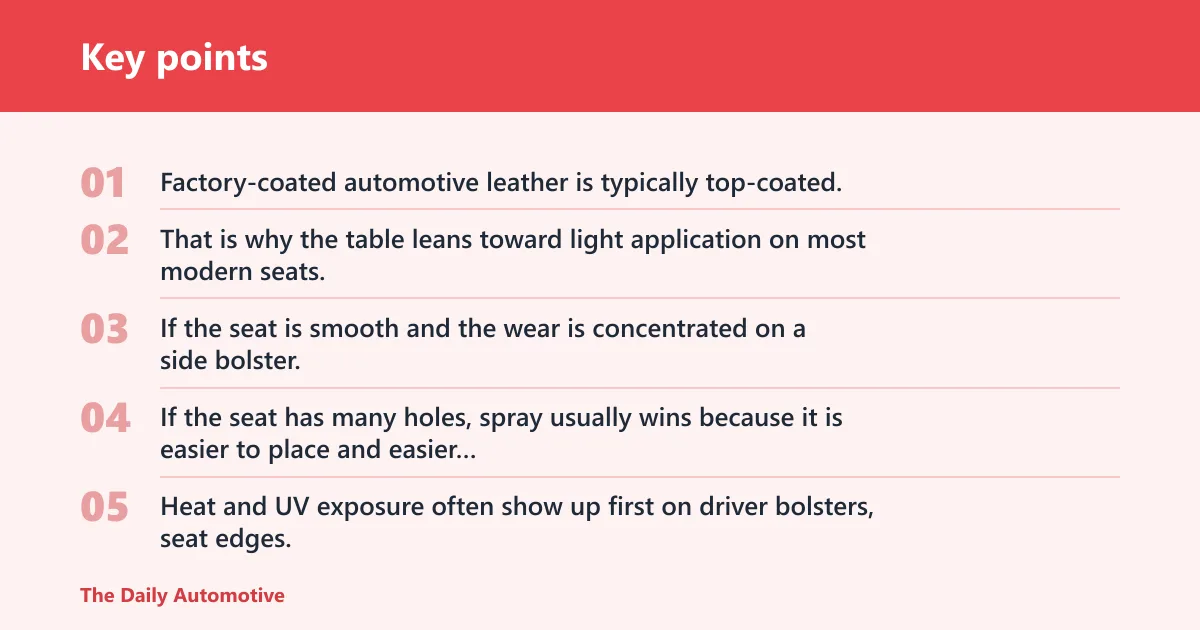
Factory-coated automotive leather is typically top-coated, so it usually calls for surface-safe conditioning rather than saturation. That is why the table leans toward light application on most modern seats, especially when the design includes perforations.
If the seat is smooth and the wear is concentrated on a side bolster, the thicker format can give you more control. If the seat has many holes, spray usually wins because it is easier to place and easier to limit.
Seat condition and format match
Heat and UV exposure often show up first on driver bolsters, seat edges, and frequently touched surfaces. Those areas benefit from targeted treatment, which is where Leather Conditioner has an advantage.
Large passenger panels with light soiling and perforations are a better fit for Spray Conditioner. The format choice should follow the seat shape, not a habit of always reaching for the same bottle.
Main cautions by seat design
Perforated leather is more sensitive to product buildup because the holes can trap residue. Overspray is easier to manage than thick buildup in the holes, so light passes matter more than a heavy first coat.
Seams and bolsters are another risk area. Product that pools along stitching can leave a slick feel and collect dirt faster, so both formats should be wiped back with a microfiber towel.
Which works better on perforated seats?
Spray Conditioner usually fits perforated seats better because the mist lands lightly and reaches small openings without forcing product into them. Leather Conditioner can still work, but only if you apply it sparingly and keep it off the holes as much as possible.
Why spray usually fits perforations better
Perforated leather has many small holes across the seating surface. A lightweight mist is easier to control there, especially on factory-coated leather where the goal is light maintenance, not deep soaking.
Apply a small amount to the towel or to the seat from a short distance, then wipe immediately. That lowers the chance of clogging and keeps residue from collecting around each opening.
When cream can still work with care
Leather Conditioner can still be used on perforated seats if the surface is mostly smooth and the product is placed on a towel first. That gives you more control on a small worn section, but it also demands a careful wipe-off step.
Say your rear bench has a perforated center section and a smooth outer bolster. A targeted wipe on the bolster can make sense, while the perforated middle is better handled with Spray Conditioner.
Which format leaves less residue?
Spray Conditioner usually leaves less visible buildup when it is applied lightly because it is easier to spread in a thin film. Leather Conditioner can leave a greasy finish if you place too much in one spot or skip the buffing step.
Residue risk on seams and bolsters
Seams and bolsters collect extra product because they catch it as you wipe. That is true for both formats, but thick conditioner is easier to over-apply on those raised areas, which can leave a slick transfer point.
Use a microfiber towel to level the finish after either product. A clean, dry towel is best for even removal and for catching product that settles around stitching.
How over-application creates greasy transfer
Too much conditioner can move from the seat surface to clothing, center consoles, and steering-wheel contact points. That is a common failure case on daily-driver interiors because the seat feels fine at first, then transfers residue later.
Suppose the driver bolster feels dry but the seat still has visible body oils on the surface. Adding more conditioner before cleaning first often makes the residue problem worse, not better.
Which is easier to apply on car seats?
Spray Conditioner is usually faster to apply across large panels, while Leather Conditioner gives better control on narrow or worn areas. Ease of use depends on whether speed or placement matters more on your seat design.
Speed on large seat panels
On a broad bench or large front seat, Spray Conditioner reduces the number of passes needed to cover the surface. It often pairs with a microfiber towel for immediate wipe-off and quick leveling.
That speed matters on family vehicles with multiple seats, but only if you keep the mist light. Heavy spraying erases the time savings because you end up chasing overspray and residue.
Control on narrow or worn areas
Leather Conditioner is easier to aim at a single bolstered edge, an armrest, or a worn entry point on the driver seat. The thicker texture helps keep the product where you put it.
That control is valuable on neglected leather, where you may want to treat one panel at a time. It is less useful on perforated sections, where precise placement becomes harder.
Clean first, then condition
A leather cleaner is usually used before either format. A pH-balanced interior formula removes body oils and dirt, which lowers residue risk and gives the conditioner a clean surface to sit on.
Leather cleaner before either format
Use leather cleaner on factory-finished automotive leather before conditioning. That matters on seats with heat exposure and daily contact, because grime can block even application and make the finish look uneven.
A soft brush can help lift contamination from the grain and seams. Keep the pressure light; the goal is to loosen dirt, not scrub the coating.
Where a microfiber towel and leather brush fit
A microfiber towel is the finishing tool. It removes extra product, buffs the surface, and helps keep residue out of seams and stitching lines.
A leather brush is for gentle agitation, not aggressive scrubbing. Use it on grain and around seams before conditioning, then switch to a dry towel for wipe-off.
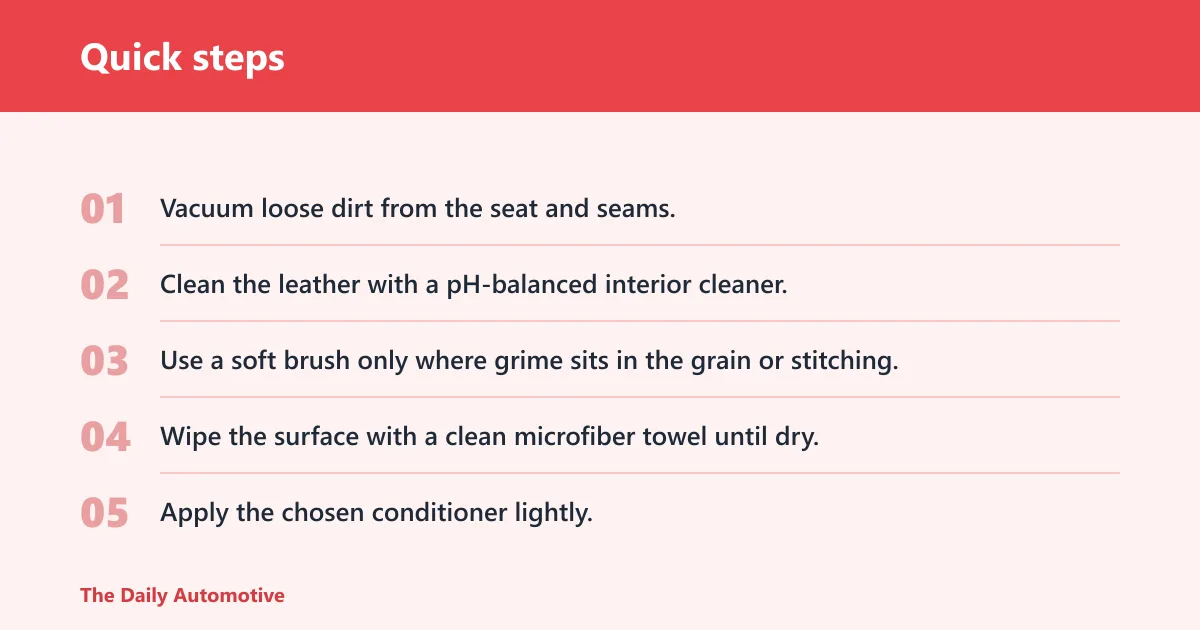
- Vacuum loose dirt from the seat and seams.
- Clean the leather with a pH-balanced interior cleaner.
- Use a soft brush only where grime sits in the grain or stitching.
- Wipe the surface with a clean microfiber towel until dry.
- Apply the chosen conditioner lightly.
- Buff again with a dry microfiber towel if any sheen or residue remains.
Choose Leather Conditioner if… / Choose Spray Conditioner if…
Choose Leather Conditioner if the seat is smooth, the wear is concentrated on a bolster or edge, or you want tighter control over where product lands. Choose Spray Conditioner if the seat has perforations, tight seams, or broad panels and you want faster, lighter coverage.
Choose leather conditioner if…
Pick it when you need to treat one worn spot instead of the whole seat. It also makes sense when residue control depends on careful placement and follow-up buffing.
It is the better fit for non-perforated factory-coated leather with concentrated wear, especially on side bolsters and seat edges.
Choose spray conditioner if…
Pick it when the seat design has perforations, narrow seams, or a lot of stitched detail. It is also the better format for quick maintenance on large seating surfaces.
If you are maintaining a daily-driver cabin with modern top-coated leather, spray usually matches the seat shape more cleanly.


Frequently asked questions
Is cream leather conditioner better than spray conditioner?
Not by default. Leather Conditioner is better when you need targeted control on smooth, worn areas, while Spray Conditioner is better when the seat has perforations, seams, or broad panels that need light coverage. The seat design should decide the format.
Does spray conditioner work better on perforated leather seats?
Usually, yes. Spray Conditioner is easier to apply lightly across perforated sections, which lowers the chance of clogging the holes. Use only a small amount and wipe back any excess quickly with a clean microfiber towel.
Can I use cream conditioner on car leather seats?
Yes, but use it sparingly on factory-finished automotive leather. It is best on smooth panels and wear spots where you can place the product precisely. Avoid heavy saturation, especially on perforated seats or stitched surfaces.
How often should I condition leather car seats?
Use condition as needed, not on a fixed schedule that ignores the seat’s condition. A neglected daily driver in sun and heat may need treatment more often than a garage-kept car, but the leather should be cleaned first and only conditioned when it looks and feels dry.
How do I avoid streaks and residue when conditioning leather?
Clean the seat first, apply only a light amount, and remove the extra with a dry microfiber towel. Work in small sections so the product does not dry unevenly. On perforated leather, keep the application especially light to avoid buildup in the holes.
What is the best conditioner for old dry leather seats?
For old dry factory-coated seats, Leather Conditioner often makes more sense because you can treat one worn area at a time. Start with cleaning, then apply a small amount and buff it thoroughly. If the seat is perforated, switch to a very light spray application instead.
Products related to this article
Sponsored / affiliate links. As an Amazon Associate I earn from qualifying purchases. I may earn additional commission from eligible campaigns.
 Leather Restoration Cream, Leather Conditioner Maintenance Cream, 100 ml – Leather Care Balm for Car Seats, Couches, Shoes, Bags & Jackets, Helps Polish & Revitalize Finished Leather Surfaces (2)Leather Restoration Cream, Leather Conditioner Maintenance Cream, 100 ml – Leather Care Balm for Car Seats, Couches, Shoes, Bags & Jackets, Helps Polish & Revitalize Finished Leather Surfaces (3)