Best Coolant Sensors for Budget Repairs (2026): We Compared
The best budget coolant temperature sensor is the cheapest OE-spec unit from a known brand, but the safest buy is still the exact OE match when connector shape, engine family, or scan data is uncertain. A weak sensor can cause hard starts, false fuel-trim corrections, overheating warnings, and repeat labor costs. This guide ranks the lowest-risk options from exact-fit OEM parts to budget aftermarket picks that still make sense for specific makes.
Quick comparison
Here’s the short version: buy by OE number first, then by connector and engine family. GM owners usually do best with ACDelco or GM Genuine Parts, Honda owners with genuine Honda references, and Ford owners with Motorcraft. Bosch and Delphi can be smart value buys when the application is exact and the harness is healthy.
| Product | Badge | Best for | Price | ||
|---|---|---|---|---|---|
 |
Genuine Honda 37870-RTA-005 Engine Coolant TemperatureHonda | Our pick | Genuine OEM · direct-fit · Honda | $34.00
Price as of 28 Oct 2026
|
View |
 |
ACDelco Gold 213-4514 (19236568) Engine Coolant Temperature SensorACDelco | Also great | Premium aftermarket · direct-fit · ACDelco | $19.81
Price as of 28 Oct 2026
|
View |
 |
Motorcraft Temperature Sensor – DY1145Motorcraft | Pair with it | OE-spec · direct-fit · Motorcraft | $34.94
Price as of 28 Oct 2026
|
View |
 |
BOSCH 0280130122 Original Equipment Engine CoolantBosch | Budget pick | OE-style · direct-fit · Bosch | $12.72
Price as of 28 Oct 2026
|
View |
How we chose
Selections were screened for direct-fit language, OE-number coverage, and enough vehicle detail to reduce return risk. In practice, the safest coolant sensor replacement is the one that matches the old part’s connector, sealing shape, and temperature curve, not just the year/make/model headline. That matters most on repeat-fault repairs.
Why the sensor matters in real repairs
Coolant temperature sensors affect cold-start fueling, idle quality, fan strategy, and overtemperature warnings. HELLA notes that an out-of-range temperature can trigger a warning message and help prevent engine damage, including head-gasket-related damage. In the shop, failed sensors often show up as implausible scan data before they create a drivability complaint.
1. Genuine Honda 37870-RTA-005: best for Honda exact-fit repairs
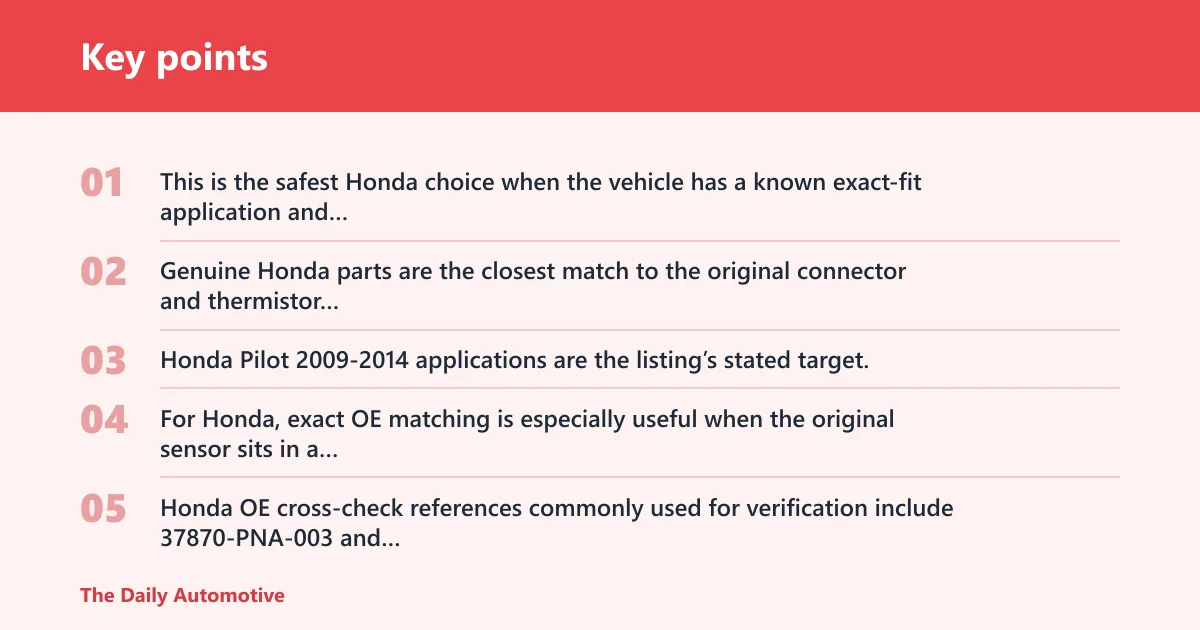
This is the safest Honda choice when the vehicle has a known exact-fit application and you want the least comeback risk. Genuine Honda parts are the closest match to the original connector and thermistor calibration, which matters when the code is temperature-signal related rather than a broad cooling-system issue.
Who it fits
Honda Pilot 2009-2014 applications are the listing’s stated target. That is the key fitment gate. For Honda, exact OE matching is especially useful when the original sensor sits in a tight location and the harness has little slack, because even small connector differences can create a repeat repair.
OE refs and connector notes
Honda OE cross-check references commonly used for verification include 37870-PNA-003 and 37870-PLC-004. Before ordering, confirm the connector keying and terminal layout against the old part. Honda sensors often fail by connector heat damage or brittle locks, not just by internal drift, so a visual harness check matters.
Risk level and when not to buy it
Risk level: low. Don’t buy it if your vehicle doesn’t match the listed Honda application or if the real problem is a thermostat, low coolant, or corroded pigtail. An OEM part cannot fix an air pocket or a broken ground, and that is where many “new sensor” comebacks start.
Coolant temperature sensors table
| Brand | OE/OEM reference | Use case | Fitment note |
|---|---|---|---|
| Honda | 37870-RTA-005 | Direct OEM replacement | Best when the listing matches the exact model-year application |
| Honda | 37870-PNA-003 | Cross-reference check | Verify connector and engine family before ordering |
| Honda | 37870-PLC-004 | Cross-reference check | Use as a number-match step, not a broad compatibility claim |
2. ACDelco Gold 213-4514: best for GM budget reliability
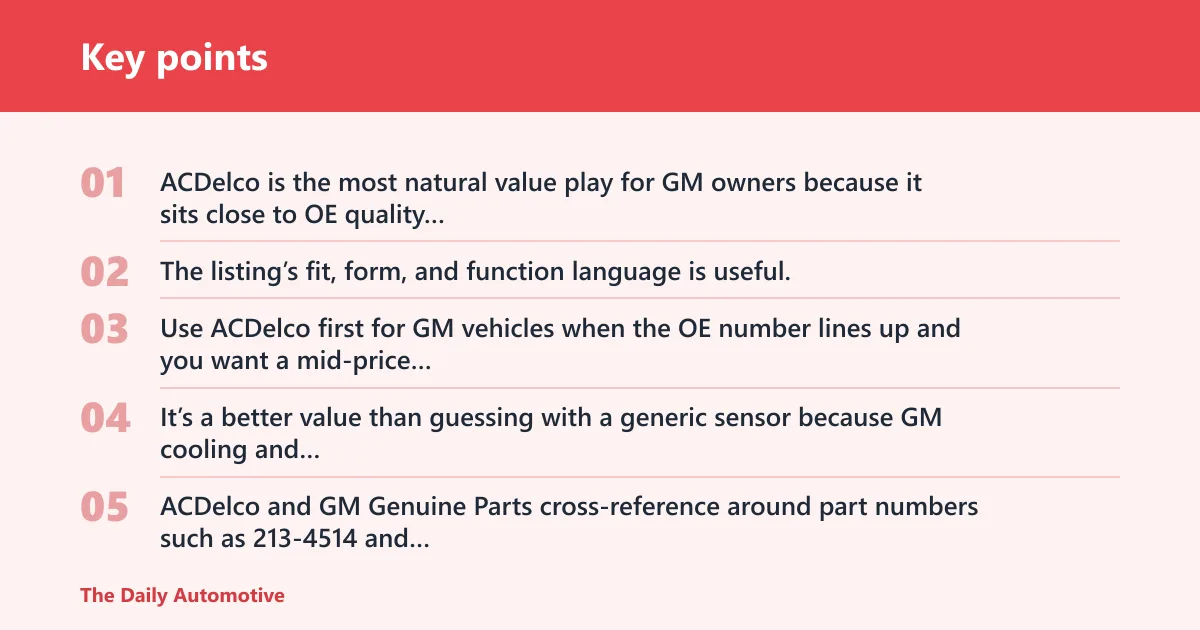
ACDelco is the most natural value play for GM owners because it sits close to OE quality without forcing dealer pricing. The listing’s fit, form, and function language is useful, but the real-world win is simpler: fewer surprises on GM applications where the original sensor was part of a broader OE ecosystem.
OE refs and connector notes: aCDelco and GM Genuine Parts
ACDelco and GM Genuine Parts cross-reference around part numbers such as 213-4514 and 19236568, depending on application. Inspect the connector shell for heat whitening, broken lock tabs, or coolant residue in the cavity. Those are common comeback causes because they can mimic a bad sensor even after replacement.
Risk level and when not to buy it: risk level: low
Risk level: low to moderate. Don’t buy it if the old connector is damaged and you aren’t also repairing the terminal fit, or if your GM application requires a specific OE number not shown in the listing. If the scan tool already shows an implausible temperature with the engine cold, verify wiring before parts.
Coolant temperature sensors table
| Brand | OE/OEM reference | Use case | Fitment note |
|---|---|---|---|
| ACDelco | 213-4514 | Professional aftermarket replacement | Good value when GM application and connector match exactly |
| GM Genuine Parts | 19236568 | OE-number match | Safer when repeat faults or connector ambiguity are present |
| GM | Application-specific OE reference | Exact replacement validation | Always verify engine family and terminal count before ordering |
3. Motorcraft DY1145: best for OE-spec Ford fit
Motorcraft is the right answer when the Ford application is known and you want OE-spec behavior without forcing a dealer-only purchase. The key advantage is consistency: Ford modules can be picky about signal plausibility, so a matched OE-spec sensor is often safer than a generic piece with vague application wording.
OE refs and connector notes: motorcraft listings typically emphasize part-number
Motorcraft listings typically emphasize part-number match and fit, form, function alignment. Before buying, compare the connector body and seal profile to the original sensor. On Ford repairs, pin tension and terminal spread are common comeback causes when an old pigtail has been unplugged repeatedly.
Risk level and when not to buy it: risk level: low
Risk level: low. Skip it if you have not confirmed the exact Ford application or if the harness insulation is brittle from heat. In those cases, a perfect sensor still won’t cure a signal dropout caused by damaged wiring, and that’s a classic “new part, same code” result.
4. Bosch 0280130122: best for low-cost aftermarket value

Bosch is the lowest-cost option here, and that makes it useful on straightforward repairs where the OE reference is clear and the vehicle history is clean. The value is in the price, not in broad compatibility claims, so the part should be treated as a number-matched replacement rather than a guess-fit solution.
OE refs and connector notes: bosch often publishes OE-style cross-reference
Bosch often publishes OE-style cross-reference language. That helps, but it is not a substitute for checking the old sensor’s cavity shape, sealing ring position, and terminal count. Connector corrosion on GM vehicles usually shows up as green residue or pushed-back terminals, so inspect the harness before assuming the sensor failed alone.
Risk level and when not to buy it: risk level: moderate
Risk level: moderate. Don’t buy it if the listing is vague, if the car has already had wiring repairs, or if you need absolute OE calibration certainty. In those cases, the price savings disappear fast because the comeback usually costs more than the part difference.
5. Delphi TS10270-11B1: best when OE-style detail matters
Delphi is a strong OE-style choice when the listing includes the details you actually need for fitment validation, such as included seals or retention hardware. It is a better buy than a generic “fits many vehicles” sensor when the car has a history of cooling-system work, because exact hardware details can save a second trip.
OE refs and connector notes: delphi TS10270-11B1 is often treated
Delphi TS10270-11B1 is often treated as a direct-replacement style part, and some listings include O-ring and circlip details. That matters because coolant sensors do fail in practice from seepage, brittle seals, or harness corrosion at the connector end, not just from bad thermistor readings.
Risk level and when not to buy it: risk level: moderate
Risk level: moderate to low. Skip it if the OE reference is missing from the listing or if the connector has been modified. If the scan tool already shows a believable temperature but the engine still runs badly, the problem may be elsewhere in the cooling or fuel system.
Coolant temperature sensors table
| Brand | OE/OEM reference | Use case | Fitment note |
|---|---|---|---|
| Dodge / Chrysler / Jeep / Ram | 5149077AB | OE-reference check | Verify exact engine application before ordering |
| Dodge / Chrysler / Jeep / Ram | 514909AB | OE-reference check | Confirm connector keying and seal depth |
| Delphi | TS10270-11B1 | OE-style direct replacement | Best when hardware details match the original part |
6. 2018 Chevrolet Silverado 1500 example: how to match the part number
The cleanest Silverado workflow starts with the exact OE number, not the broad vehicle listing. For a 2018 Chevrolet Silverado 1500, the price snapshot in this article shows a range of $23.99 to $39.99 and an average price of $30.59, which is normal for a high-volume GM application. The part choice still depends on the exact engine and connector.
Exact matching workflow
First, read the OE number from the old sensor or the vehicle’s parts documentation. Second, compare the connector shape, terminal count, and seal style. Third, confirm the engine family. If the listing only says Silverado 1500 without the exact engine and OE reference, treat it as incomplete and keep cross-checking.
Why this matters on Silverado repairs
Silverado sensors can be easy to misorder because several engines and harness variations appear under the same model year. That makes “fits 2018 Silverado 1500” too broad by itself. The part-number workflow is what reduces repeat repairs, especially if the connector has heat aging or prior coolant exposure.
Price snapshot with access date
Advance Auto Parts’ Silverado 1500 pricing snapshot shows the low end at $23.99, the average at $30.59, and the high end at $39.99 for the exact page referenced in this article. Access date: 28 Oct 2026. Use that as a shopping band, not as proof that any one sensor is correct for your engine.
Which one should you buy?
Choose by failure risk, not by the cheapest label. If you drive a Honda and the application is exact, the genuine Honda part is the lowest-risk choice. If you drive a GM vehicle, ACDelco is the best middle-ground buy. If you drive a Ford, Motorcraft is the safest OE-spec option. Bosch is the value play when the OE number is confirmed.
Spend more when the car has already had cooling-system comebacks, when the connector is heat-cycled or corroded, or when scan data looks implausible with a cold engine. That is where the labor costs dwarf the part savings, and where the wrong sensor can hide the real fault.
How do I know if my coolant temperature sensor is bad?
A bad coolant temperature sensor usually shows up as poor cold starts, odd fuel behavior, or a temperature reading that doesn’t make sense for ambient conditions. The catch is that low coolant, thermostat problems, corroded connectors, or wiring faults can create the same symptoms, so diagnosis should start with the circuit, not the part number.
Check the clues before replacing the part
Start with scan data if you have it. A cold engine should read close to ambient temperature. If the reading is already hot, jumps around, or drops out, inspect the connector for corrosion, broken locks, coolant residue, or pushed-back terminals. Those patterns are common comeback causes after a rushed parts swap.
- Confirm coolant level is correct when the engine is cold.
- Compare scan temperature to ambient temperature before warm-up.
- Inspect the connector and harness near the sensor.
- Check thermostat behavior if the engine warms too slowly or too quickly.
- Verify the OE number and application before buying a replacement.
What symptoms can a bad coolant temperature sensor cause?
Bad sensor data can affect starting, idle quality, fuel management, fan behavior, and warning messages. The same source notes that if coolant temperature exceeds a fixed target value, a warning message is triggered, which is part of how the system helps avoid engine damage, including head-gasket-related damage. That’s why the signal matters even when the engine still runs.
Separate sensor symptoms from cooling-system faults
A sensor fault usually looks like implausible data, while a thermostat fault changes warm-up behavior and a wiring fault can create dropouts or intermittent spikes. In practice, a corroded connector often causes the “bad sensor” complaint long before the sensor itself is worn out.
How much should a coolant temperature sensor cost?
Budget pricing is wide because fitment and brand matter. Advance Auto Parts shows 183 sensors priced from $0.01 to $24.99, 188 sensors priced from $25 to $49.99, and 69 sensors priced from $50 to $74.99. Access date: 28 Oct 2026.
What that price spread means
The cheapest safe buy is usually a known-brand aftermarket sensor with a direct-fit listing and a matched OE reference. Paying more makes sense when the exact connector style is hard to find, the vehicle is sensitive to repeat faults, or the application has a history of repeat repairs.
Do I need an OEM sensor or is aftermarket okay?
Aftermarket is fine when the OE number, connector style, and engine family all line up. OEM or OE-spec is the better choice when repeat-fault risk is high, the vehicle is sensitive to temperature signal quality, or the original part has a specific connector shape that generic listings do not describe well.
When OE is the safer buy
Choose OE over aftermarket if the vehicle has had repeated sensor faults, if the harness is short and hard to access, or if the cooling-system fault has already caused an overtemperature warning. In those cases, the extra part cost is usually cheaper than a second repair.
Will a coolant temperature sensor fit my exact car?
Fitment depends on the OE number or the exact vehicle application, not on a broad label like “fits select models.” The part must match the vehicle’s connector style and engine family as well. Honda OE references such as 37870-PNA-003 and 37870-PLC-004, plus Dodge/Chrysler/Jeep/Ram references like 5149077AB and 514909AB, are the kind of cross-reference numbers that help verify exact fit.
Use this fitment order
First, find the OE number printed on the old part or listed in vehicle documents. Next, confirm the connector style. Then match the engine family and model year application. If any of those steps conflict, stop and re-check before ordering. That workflow is the safest way to avoid comeback repairs.
How do I choose the right coolant temperature sensor by OE number?
Use the OE number as the first filter, then verify the aftermarket listing against the vehicle application. That approach cuts the risk of getting a sensor that looks close but reports the wrong temperature curve or uses the wrong connector. For budget repairs, the best part is the one that avoids a second labor charge.
Use the number, then the connector
OE number or OEM reference is the fastest way to narrow fitment because it is the exact replacement identifier used on the part or in vehicle documents. After that, cross-reference the connector and engine family in the listing. If a listing is vague, choose the more specific option, especially on GM and Honda vehicles.
Honda, GM, and direct-replacement examples
For GM shoppers, ACDelco and GM Genuine Parts are the most straightforward choices when reliability matters and the application is clearly identified. For direct replacement language, Delphi TS10270-11B1 is an OE-standard unit that may include an O-ring and circlip, which helps when the listing matches your exact engine bay setup. HELLA is positioned for precise fit and OE-quality demands, but the exact vehicle listing still decides the buy.
Those numbers matter more than a generic “compatible” label.
Why some brands are safer on specific makes
GM owners usually do better with ACDelco because it aligns with OE behavior and parts logic. Honda owners are safest with genuine Honda because the connector and curve are less ambiguous. Ford owners benefit from Motorcraft because the platform’s temperature logic is often happiest with a true OE-spec replacement.
Coolant sensor decision table
| Symptom pattern | Likely failure risk if ignored | Recommended price tier | OE-number verification step | When to choose OE over aftermarket |
|---|---|---|---|---|
| Hard starting when cold, temp reading seems too low | Fuel management error, poor cold-start behavior | Budget aftermarket from a known brand | Match the OE number printed on the old sensor or in vehicle documents | Choose OE if the engine family is picky or the connector has heat damage |
| Gauge or scan data jumps around with no pattern | False diagnosis, repeat labor, missed wiring fault | OE-spec or OE-grade aftermarket | Cross-check connector style and terminal count against the OE listing | Choose OE if the harness has been repaired before or corrosion is present |
| Overtemperature warning message | Possible engine damage, including head-gasket-related risk | OE or exact OE-match replacement | Verify exact application, not just model name | Choose OE if you need the closest signal match and highest repeat-repair protection |
| Slow warm-up plus cool running temp | Thermostat issue may be the real fault | Hold parts purchase until diagnosis is clearer | Check OE number only after thermostat behavior is confirmed | Choose OE only if the sensor tests bad after thermostat checks |
| Corroded connector or damaged pigtail | Intermittent signal loss and repeated fault codes | OE-standard direct replacement | Verify connector shape and sealing features before checkout | Choose OE when the original connector design is hard to match |
Frequently asked questions
What is the best coolant temperature sensor for a budget repair?
The best budget choice is the cheapest OE-spec unit from a known brand that matches the exact vehicle application. For GM, ACDelco is the safest value pick when the OE number lines up. Spend more only when connector fit, engine family, or repeat-fault risk makes the cheaper part too risky.
Which coolant temperature sensor brands are worth buying?
ACDelco, GM Genuine Parts, Delphi, HELLA, Bosch, Honda OEM, and Motorcraft are the brands or references worth shortlisting here, but only when the listing matches the exact application. Bosch is the lowest-cost value option in this group, while GM Genuine Parts and Honda OEM references are better when fit certainty matters most.
Sources
- HELLA coolant temperature sensor warning/function documentation
- ACDelco and GM Genuine Parts fitment references for coolant temperature sensors
- Honda OE fitment references for 37870-RTA-005 and related cross-reference numbers
- Delphi fitment references for TS10270-11B1
- Motorcraft fitment references for DY1145
- Advance Auto Parts price snapshots for coolant temperature sensors and 2018 Chevrolet Silverado 1500 access date
Products related to this article
Sponsored / affiliate links. As an Amazon Associate I earn from qualifying purchases. I may earn additional commission from eligible campaigns.