Do Front Wheel Drive Cars Have a Drive Shaft? Explained
Do front wheel drive cars have a drive shaft? The short answer is no — front-wheel-drive (FWD) vehicles use a different system to transfer power to the wheels. Instead of a long drive shaft running from the front to the back, FWD cars rely on a transaxle and half shafts. This article explains exactly how front-wheel drive works, why there is no drive shaft, and what components replace it — see our related guide, How to Engage 4 Wheel Drive on a Chevy Tahoe.
You will learn the key differences between FWD, RWD, and AWD drivetrains, along with practical insights into maintenance and performance. Whether you are a new driver or an automotive enthusiast, this guide clears up a common mechanical misconception.
Simply put, no, front-wheel-drive cars do not have a conventional drive shaft. Instead, they use a compact transaxle unit that combines the transmission and differential, plus two half shafts (axles) to deliver power directly to the front wheels. This design saves weight, space, and improves fuel efficiency.
Key Takeaways
- Front wheel drive cars lack a traditional drive shaft because the engine and transmission are mounted transversely over the front axle.
- FWD systems use half shafts (also called axle shafts) that connect the transaxle to each front wheel.
- The absence of a drive shaft reduces vehicle weight, improves cabin space, and lowers manufacturing costs.
- Rear-wheel-drive (RWD) and all-wheel-drive (AWD) vehicles still require a drive shaft to send power to the rear or all wheels.
What Is a Drive Shaft and Why Does It Matter?
A drive shaft is a rotating metal tube that transmits torque from the transmission to the differential, which then turns the wheels. In rear-wheel-drive (RWD) cars, the drive shaft runs the length of the vehicle under the floorpan. It connects the transmission at the front to the differential at the rear axle.
Drive shafts must balance high rotational speeds and handle significant torque. They are typically made of steel or aluminum and include universal joints or CV joints to accommodate suspension movement. Without a drive shaft, RWD vehicles cannot move because power cannot reach the rear wheels.
In contrast, front wheel drive cars integrate the differential into the transmission housing. This combined unit, called a transaxle, sits directly between the front wheels. Power leaves the transaxle through short half shafts that turn the front wheels instantly.
- Drive shafts are found in RWD, 4WD, and many AWD vehicles.
- They require regular maintenance (balancing, joint lubrication).
- Failure of a drive shaft can cause vibration, noise, or complete loss of drive.
- FWD eliminates the need for a long spinning tube under the passenger compartment.
Important: Even though FWD cars lack a traditional drive shaft, they still have shaft-like components (half shafts) that perform a similar job — just much shorter and located at the front axle.
How Does a Front Wheel Drive Drivetrain Work?
In a front wheel drive layout, the engine is mounted transversely (sideways) over the front axle. The transmission is bolted directly to the engine, and together they form a transaxle. Inside the transaxle are gears for both the transmission and the differential.
Power flows from the engine through the transmission, then immediately to the differential ring gear. From there, torque splits to two half shafts — one for the left front wheel, one for the right. These half shafts have constant velocity (CV) joints at both ends to allow steering and suspension movement.
- Engine rotates the crankshaft.
- Torque converter or clutch transfers power to the transmission.
- Transmission selects the gear ratio.
- Differential splits torque between left and right front wheels.
- Half shafts rotate the front wheels.
This compact arrangement means no long drive shaft is required. The entire drivetrain fits in the front of the car, leaving more room for passengers and cargo.
Tip: If you hear clicking noises when turning, your CV joints on the half shafts may need inspection. Unlike drive shafts, half shaft CV joints wear faster due to constant angular movement.
What Parts Replace the Drive Shaft in FWD Cars?
Instead of one long drive shaft, front-wheel-drive vehicles use several shorter components that collectively perform the same function. The primary replacements are the half shafts (also called axle shafts) and the transaxle.
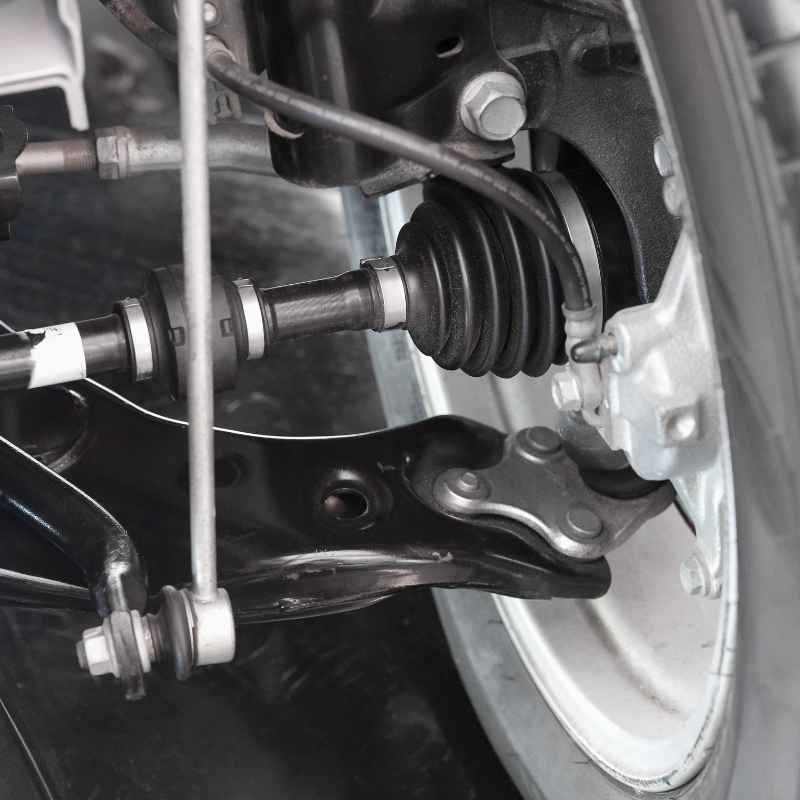
Each half shaft is roughly 2–3 feet long depending on the vehicle width. It has an inner CV joint near the transaxle and an outer CV joint near the wheel hub. The inner joint handles in-and-out movement, while the outer joint allows the wheel to turn.
A typical FWD half shaft assembly includes:
- Steel or aluminum shaft rod
- Rubber boot covering each CV joint (protects grease from contamination)
- Grease fittings (sealed, not serviceable on most modern cars)
- Snap rings to secure the shaft into the transaxle and hub
According to the Automotive Aftermarket Industry Association (AAIA), over 60% of new passenger cars sold in the US are front-wheel drive — meaning the vast majority on the road use half shafts instead of a drive shaft.
| Component | FWD | RWD |
|---|---|---|
| Drive shaft | None | One long shaft |
| Half shafts | Two (left + right) | None (uses axle shafts from differential) |
| Transaxle | Yes (transmission + differential) | Separate transmission and differential |
| Transfer case | Not needed | Not needed (RWD only) |
This comparison shows that the key difference is the lack of a central drive shaft in FWD. The half shafts serve the same torque-transmitting purpose but are much shorter and integrated differently.
Are There Any Exceptions Where FWD Cars Have a Drive Shaft?
Technically, some front wheel drive based all-wheel-drive systems do use a drive shaft. For example, many modern AWD cars (like the Subaru Impreza or Toyota RAV4) are built on FWD platforms. In those cases, the vehicle is front-wheel drive most of the time, but it sends power to the rear wheels when needed via a drive shaft and rear differential.
However, in a pure FWD configuration (where only the front wheels receive power at all times), there is no drive shaft. The presence of a drive shaft indicates the car can also drive rear wheels, making it AWD or 4WD.
Here are the key distinctions:
- Standard FWD: No drive shaft, no rear differential.
- FWD-based AWD: Adds a drive shaft and rear differential, but the base platform is still FWD.
- Rear-wheel drive: Always has a drive shaft from front to rear.
If you look under a typical Honda Civic, Toyota Corolla, or Ford Focus — all FWD — you will see a flat exhaust system and suspension components, but no rotating metal tube running front to back.
Warning: Do not confuse FWD with “front-engine, rear-wheel drive.” Many cars have a longitudinally mounted front engine and a drive shaft running under the cabin. Those are RWD, not FWD — even though the engine is in front.
How Does FWD Compare to RWD and AWD in Terms of Drive Shaft?
Understanding the layout helps answer the question more deeply. RWD vehicles have a drive shaft that connects the transmission at the front to the differential at the rear. AWD vehicles typically have a drive shaft too, plus a transfer case to split power front-rear.
FWD eliminates that entirely. This design choice affects many aspects of the car:
- Weight distribution: FWD cars have more weight over the front axle (engine + transaxle).
- Interior space: No drive shaft tunnel means a flat rear floor.
- Fuel efficiency: Lighter drivetrain and fewer rotating parts improve MPG.
- Traction: FWD pulls from the front; RWD pushes from the rear.
| Feature | FWD | RWD | AWD |
|---|---|---|---|
| Drive shaft? | No | Yes | Yes (usually) |
| Half shafts | 2 (front) | 2 (rear axle) | 4 (front and rear half shafts) |
| Transaxle? | Yes | No | Yes (front) + separate rear differential |
| Cabin tunnel? | Flat floor | Drive shaft hump | Drive shaft hump |
The table clarifies that only FWD completely avoids a drive shaft. Even some AWD systems based on FWD platforms include a small drive shaft, but the car can still operate in FWD mode without it engaged.
What Are the Advantages of FWD Having No Drive Shaft?
Eliminating the drive shaft brings several tangible benefits. Manufacturers choose FWD for subcompact, compact, and mid-size cars primarily for cost and packaging reasons. The front wheel drive layout without a drive shaft offers:
- More interior space: No large tunnel running down the middle, so rear passengers have more legroom and a flat floor.
- Lower curb weight: Removing a steel or aluminum shaft plus its mounting hardware saves 30–50 pounds.
- Better fuel economy: Fewer rotating parts mean less drivetrain friction. The U.S. Department of Energy notes that FWD cars typically achieve 5–10% better highway MPG than comparable RWD models.
- Reduced manufacturing cost: Simpler drivetrain reduces assembly complexity and parts count.
- Improved traction on snow/ice: Weight over the driving wheels (front) helps in slippery conditions.
These advantages make FWD the dominant choice for economy cars, crossovers, and family sedans. However, the lack of a drive shaft also means no ability to send power to the rear wheels unless you add a separate system.
Tip: If you are buying a used car and see a driveshaft tunnel under the rear seats, it is either a RWD or AWD platform. FWD cars have a completely flat rear floor pan.
Common Misconceptions About FWD and Drive Shafts
Many people assume that all cars have a drive shaft because they see one on trucks or older sedans. Here are the most frequent myths:
- “All front-engine cars have a drive shaft.” False — only if the driven wheels are at the rear. Front-engine, FWD cars do not.
- “Half shafts are the same as drive shafts.” They serve a similar function but are much shorter, use different joints, and are not considered a traditional drive shaft.
- “FWD cars cannot have a drive shaft under any condition.” Incorrect — some FWD-based AWD systems add a drive shaft, but the base FWD mode does not use it.
- “No drive shaft means less power transmission.” Not true; modern FWD transaxles can handle over 400 horsepower (e.g., Honda Civic Type R).
Understanding these distinctions helps when diagnosing drivetrain noises or planning modifications. If you hear a clunking sound from the middle of the car that suggests a failing drive shaft, you likely do not have one — check the half shaft CV joints instead.
What About All-Wheel Drive Versions of FWD Cars?
Many popular models offer both FWD and AWD variants. For example, the Toyota RAV4, Honda CR-V, and Ford Escape all come in FWD as standard with optional AWD. In these AWD versions, a drive shaft connects the front transaxle to a rear differential.
But in the FWD version, that shaft is absent.
This means if you own an AWD model, you do have a drive shaft — even though the base platform is FWD. The distinction is important when searching for parts or doing maintenance. A FWD model uses only half shafts; an AWD model uses half shafts plus a drive shaft.
Vehicle identification numbers (VIN) can tell you which driveline system is installed. You can also look under the rear bumper: if you see a metal tube or a rear differential case, it is AWD. If you see only an exhaust pipe and suspension arms, it is FWD.
Important: Never assume a car is FWD just because it shares a platform with an AWD version. Always check the driveline directly — especially when buying a used car advertised as “AWD.”
Frequently Asked Questions
Do front wheel drive cars have a drive shaft for the rear wheels?
No. In a standard FWD car, all power goes to the front wheels only. There is no drive shaft or rear differential.
If you see a drive shaft under a car, it means the rear wheels can also receive power (RWD, AWD, or 4WD).
What is the difference between a drive shaft and a half shaft?
A drive shaft is a long rotating tube that connects a transmission or transfer case to a differential located at a distance (usually front to rear). A half shaft is a shorter axle that connects a differential (or transaxle) directly to a wheel hub. FWD cars use half shafts, not drive shafts.
Can a FWD car be converted to RWD or AWD?
Technically yes, but it is extremely complex and expensive. You would need to add a new transmission, drive shaft, differential, and custom suspension. In most cases, it is cheaper to buy a car originally built as RWD or AWD.
Why do some FWD cars have a driveshaft tunnel?
Some vehicles share platforms with AWD or RWD versions, so the floor pan is stamped with a tunnel for manufacturing efficiency. Even if the car is FWD, the tunnel may remain but is unused. Many modern FWD cars have a completely flat floor with no tunnel.
Does a CV joint fail more often than a drive shaft?
Generally, yes. CV joints on half shafts wear out faster because they operate at sharper angles (due to steering and suspension travel). A failing CV joint produces a clicking noise when turning.
Drive shaft universal joints (U-joints) also wear but typically last longer in RWD vehicles.
Final Thoughts
Front wheel drive cars do not have a drive shaft. They use a transaxle and half shafts to deliver power directly to the front wheels. This design saves weight, improves cabin space, and increases fuel efficiency.
Understanding this fundamental difference helps you maintain your vehicle correctly and diagnose issues more accurately. Whether you drive a FWD, RWD, or AWD car, knowing what is under the car is key to smart ownership.
Sponsored / affiliate links. As an Amazon Associate I earn from qualifying purchases. I may earn additional commission from eligible campaigns.
Products related to this article