Car Phone Mount Bracket: Dashboard, Vent or Windshield?
Pick dashboard first for most cars. Use vent mounts only when the vent is strong and centrally placed. Use windshield mounts only where local law allows it and the glass angle gives you a low, clear spot. A poor match can block controls, heat the phone, or let it fall at the worst time. This guide compares dashboard, vent, and windshield mounts by cabin fit, climate, phone weight, and visibility.
Fit the mount to your car, not just your phone


The best mounting surface depends more on cabin shape, vent design, and where your eyes naturally fall than on brand. Dashboard mounts usually hold heavier phones better, vent mounts stay compact and move fast, and windshield mounts can give the highest sight line when the glass angle and local rules allow it.
Think in failure modes. Dashboard mounts struggle on coarse or curved plastics. Vent mounts can twist loose if the blades are thin or oddly angled. Windshield mounts can lose suction in temperature swings or sit in the driver’s view if you place them too high.
A common first-time mistake is choosing charging features first. That can leave you with a mount that fits the phone, but not the car. Fit the car first, then narrow the feature set.
When cabin shape matters more than brand
If your dash is textured, a suction pad or adhesive base may need a smooth patch or an included dashboard pad. If the vents are slim, curved, or soft, a clip-on mount may wobble or stress the blade. If the windshield is steeply raked, the mount may sit too far from your hand or too close to your line of sight.
Quick rule for choosing the surface
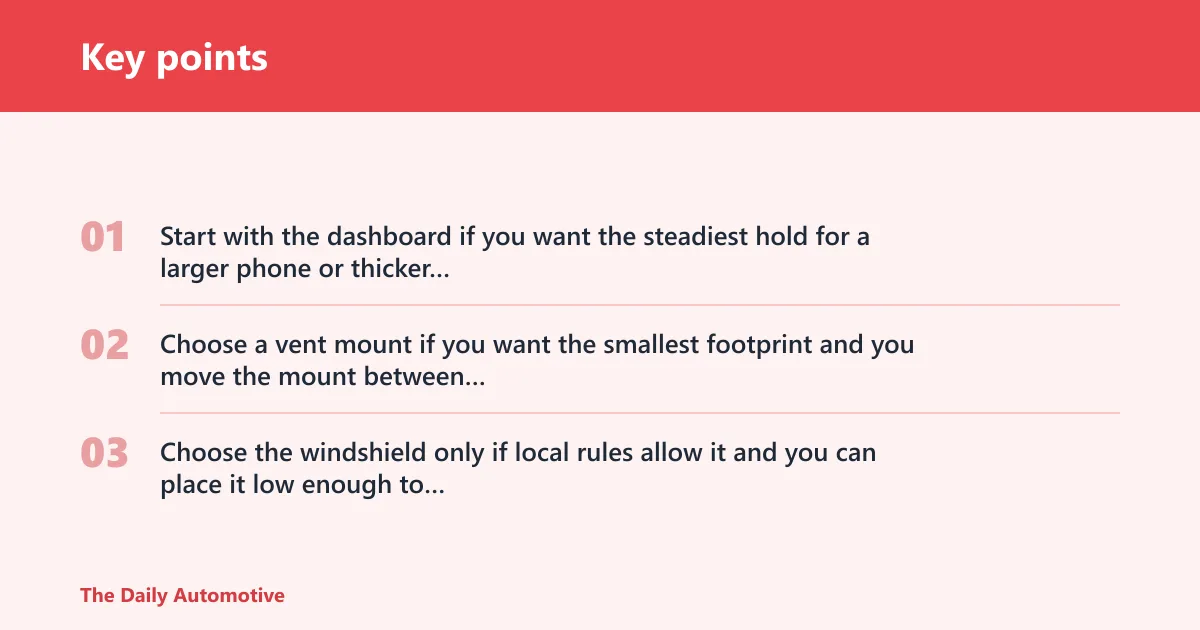
- Start with the dashboard if you want the steadiest hold for a larger phone or thicker case.
- Choose a vent mount if you want the smallest footprint and you move the mount between vehicles often.
- Choose the windshield only if local rules allow it and you can place it low enough to avoid blocking the road view.
Mount choice comparison table
| Mount surface | Installation and removal | Stability on rough roads | Visibility and heat | Best use case | Likely failure mode |
|---|---|---|---|---|---|
| Dashboard | Suction pad or adhesive base; may leave residue on removal | Best of the three for heavier phones when the surface is smooth | Usually mid-level visibility; heat can build on hot dashboards | Daily commuters, larger phones, heavier cases | Poor grip on textured or curved dash surfaces |
| Vent | Clips onto vent blades; quick to move with no adhesive | Moderate if the vent is strong; weaker on thin or flexible blades | Can sit out of the way, but may block airflow and warm the phone | Switching cars often, compact cabins, minimal look | Blade stress, twisting, or airflow blockage |
| Windshield | Suction cup on glass; easy to place and remove | Good when suction is fresh and the glass angle is friendly | High sight line, but may be restricted locally and can block view if poorly placed | Rideshare and delivery drivers, low dash layouts | Suction loss in heat or cold swings |
Dashboard mount fit and failure modes
Dashboard mounts attach with adhesive pads or suction cups, so they usually feel steadier than vent mounts once placed on a good surface. They also handle larger smartphones and heavier cases better than many clip-on vent designs. The weak point is the dashboard itself: texture, curvature, and heat can all work against the base.
Textured or curved dashboards
Flat, smooth dashboards are the easiest match. Coarse grain, soft-touch coatings, and sharply curved panels can reduce the contact patch and let the mount creep over time. Some mounts include an optional dashboard pad for textured surfaces, which can help when the base needs a flatter landing zone.
Curved dashboards also change the arm angle. If the phone sits too far forward, it may vibrate more on rough pavement. If it sits too close, it can crowd climate controls or the hazard switch.
Large phones and residue risk
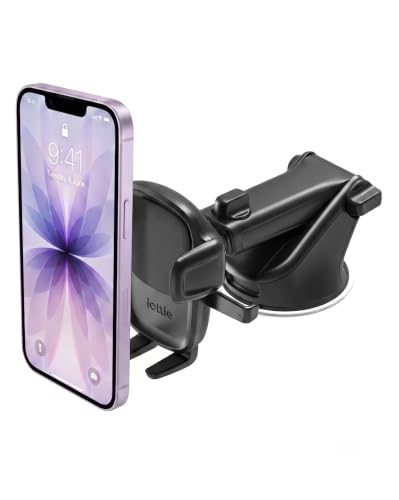
For large phones, dashboard mounts usually make more sense than vent clips because the load hangs from a more stable base. The iOttie Easy One Touch 5 is one example: it has a telescopic arm that extends from 4.5 to 6.75 inches, pivots through 260 degrees, works on both dashboard and windshield, and the cradle accommodates larger phones and cases.
The trade-off is removal. Adhesive bases can leave residue, and suction pads can leave a mark or fail if the dashboard finish is dusty or uneven.
Vent mount fit and failure modes
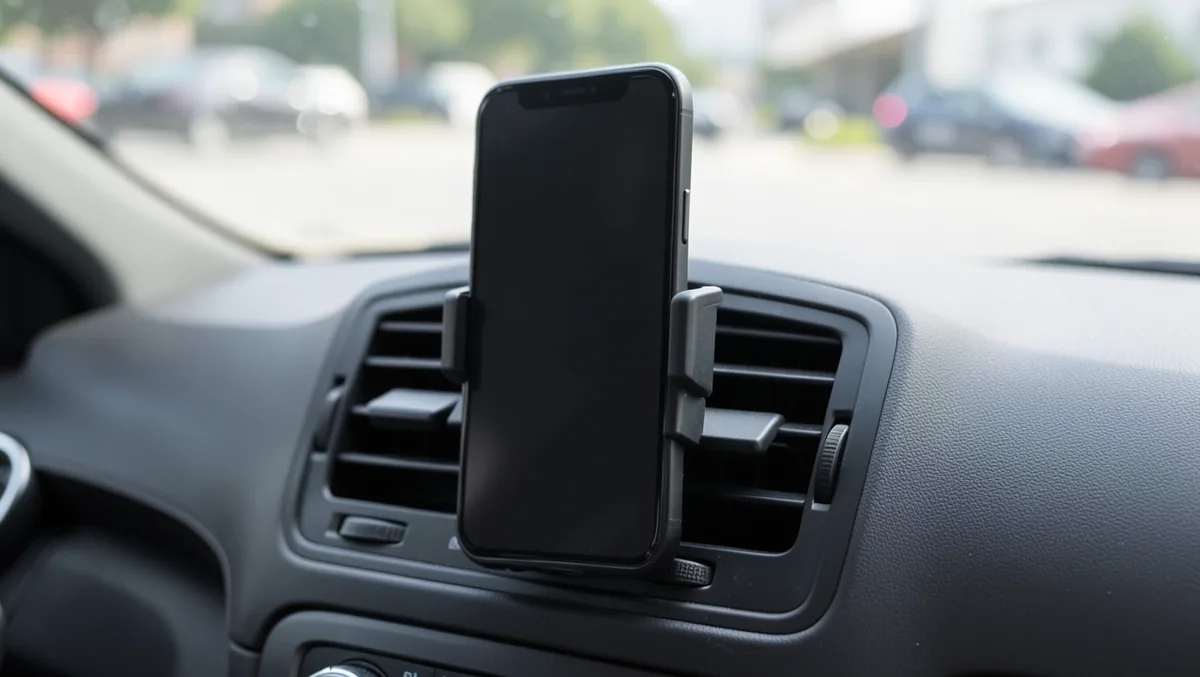
Vent mounts clip directly onto air vent blades, which makes them fast to install and easy to transfer between cars. They are also compact and less visually bulky than many dash or windshield mounts. The problem is structural: the mount depends on the vent blades carrying the load.
Clip style and vent blade type
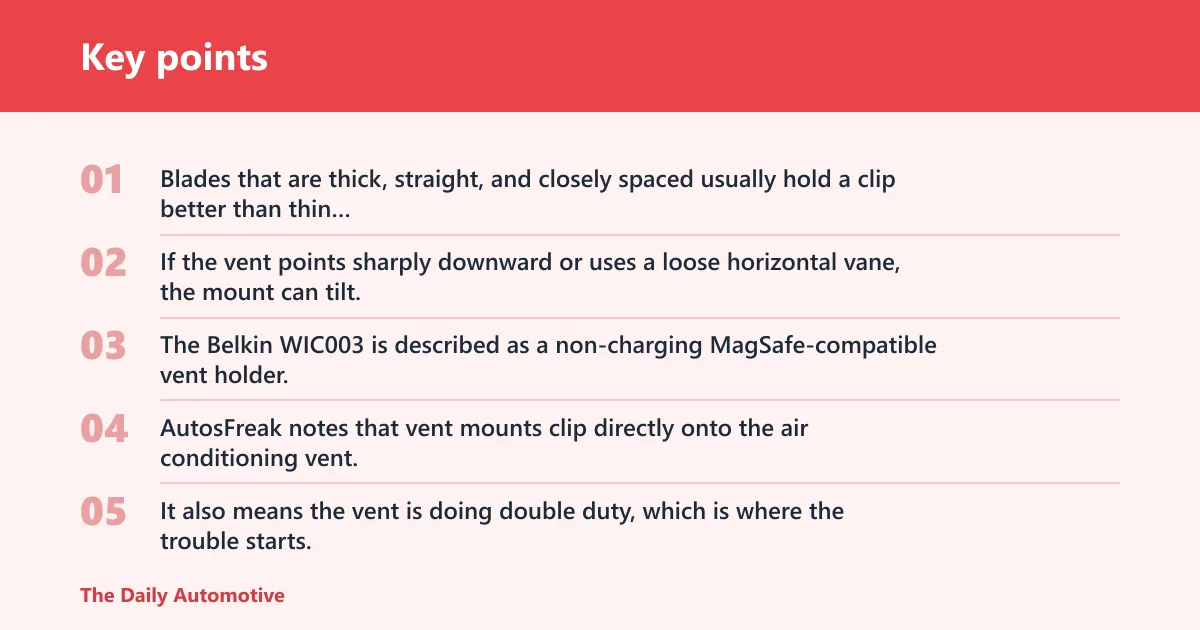
Blades that are thick, straight, and closely spaced usually hold a clip better than thin or curved blades. If the vent points sharply downward or uses a loose horizontal vane, the mount can tilt, bounce, or slide. The Belkin WIC003 is described as a non-charging MagSafe-compatible vent holder, so its fit will still depend on vent shape and case thickness.
AutosFreak notes that vent mounts clip directly onto the air conditioning vent. That simplicity is the appeal. It also means the vent is doing double duty, which is where the trouble starts.
Airflow blockage and cooling
Vent mounts can block airflow, which matters in heat and in winter defrost mode. A phone sitting in the airflow may stay cooler than one stuck to a sun-baked dash, but the vent itself can warm or cool unevenly depending on the cabin settings. A vent-mounted charger with an internal fan, such as the Pioneer Qi Wireless Charging Cradle, can help: it supports Qi2 wireless charging at up to 15 watts and attaches to the vehicle’s air vent.
Still, that cooling benefit disappears if the vent is closed, blocked by the mount body, or aimed away from the phone.
When vent blades are too weak
If the blades flex when you touch them, a vent mount can wobble under the weight of a large phone and heavy case. Over time, that can stress or damage the blade. In that case, dashboard or windshield mounting is the safer fit choice.
Windshield mount fit and failure modes
Windshield mounts use a suction cup on the glass and can put the phone near eye level, which is why they are common in rideshare and delivery setups. The higher sight line can reduce glances away from the road, but the placement must stay clear of the driver’s view and must follow local rules.
Suction hold on glass
Glass is usually a more reliable suction surface than textured dash material. Even so, suction can loosen in temperature swings, especially when the cabin goes from cold morning air to strong sun or vice versa. Car Accessories and Parts describes windshield mounts as using a suction cup on the glass.
That makes windshield mounts a strong pick for drivers who want flexible placement, not a permanent-looking setup.
Steep windshield angles
On a steeply raked windshield, the arm may need to stretch farther to place the phone within reach, which can add vibration. The mount can also sit closer to the driver’s line of sight, which raises visibility risk if you place it too high or too far inward.
Say your sedan has a steep windshield and a deep dashboard. A windshield mount may put the phone in the right place for glance-down navigation, but only if the suction point stays low and outside the swept view of the wipers and the driver’s direct sight line.
Visibility and local law checks
Windshield placement is the option that most often runs into legal limits. Rules vary by location, so check local laws before you buy. Keep the mount out of the driver’s view and out of airbag zones, and do not let the phone block the road or mirrors.
The Spigen OneTap Pro 3 is a dashboard or windshield charging mount with up to 15W output, and its stock status can change. That matters because the mounting surface still has to work in your car, even if the charging spec looks right on paper.
Fit checklist by mounting surface
| Mount type | Dashboard texture | Vent blade type | Windshield angle | Phone size | Case thickness | Heat exposure | Legal visibility risk | Most likely failure mode |
|---|---|---|---|---|---|---|---|---|
| Dashboard | Best on smooth, flat plastic; weaker on grainy or soft-touch texture | Not applicable | Works well if the dash has a flat area below the glass | Good for larger phones | Handles thicker cases better than many vent clips | High if the dash bakes in direct sun | Low to moderate if kept below the driver’s sight line | Residue or slow lift on textured or curved panels |
| Vent | Not applicable | Best on thick, straight blades; weaker on thin, curved, or loose blades | Not applicable | Best with medium or smaller phones unless the clip is built for weight | Thick cases can interfere with MagSafe alignment or clip clearance | Moderate; can benefit from airflow but may block it | Low if the vent is central and the phone stays low | Blade stress, rotation, or airflow blockage |
| Windshield | Not applicable | Not applicable | Best on glass that allows a low suction point; difficult on steep glass if it lands too high | Good for medium to large phones if the arm and suction hold | Case thickness affects MagSafe grip and magnetic alignment | High sun exposure can loosen suction and heat the phone | Highest risk if local rules limit glass-mounted accessories | Suction loss or blocked sight line |
Choose dashboard if… / Choose vent if…
Choose dashboard if you want steadier support for a heavier phone. Choose it if your dashboard has a flat or lightly textured section, if you keep the mount in one car, or if your phone has a thick case that would strain a clip-on holder. It is also the better pick when rough roads are part of the route.
Choose vent if you switch cars often and want a small mount with no adhesive cleanup. Choose it if your center vents are strong, straight, and easy to reach, and if you want a mount that can be removed in seconds. Avoid it if the blades flex or if airflow matters more than a tidy install.
Choose windshield if you want the highest sight line and your local rules allow it. It suits drivers who need quick glance visibility and have a glass angle that lets the suction cup sit low and out of the way. It is a poor choice if your windshield is steep, reflective, or crowded by sensors and mirrors.
Suppose a truck has a coarse, curved dash and thin vertical vents. In that case, a windshield mount may look attractive, but only if local law allows it and the suction point can stay low. Otherwise, the dash and vent options both fail for different reasons: texture on one side, blade stress on the other.
Frequently asked questions
Which is better for a car phone mount: dashboard, vent, or windshield?
There is no single winner. Dashboard is usually best for heavier phones and rough roads, vent is best for quick removal and a small footprint, and windshield is best for a high sight line when local law allows it. The right choice depends on your cabin shape, phone size, and heat exposure.
Are windshield phone mounts legal where I live?
Rules vary by location, and some places restrict windshield accessories more than others. Check local law before buying, especially if the mount could sit in the driver’s field of view. Even where it is allowed, place it low enough to avoid blocking the road, mirrors, or airbags.
Will a vent phone mount damage my air vents?
It can. A vent mount that hangs on thin or flexible blades may stress the vent over time, especially with a heavy phone or rough roads. If the blades bend easily or the vent twists when touched, a dashboard or windshield mount is the safer pick.
What is the most stable car phone mount for rough roads?
Dashboard mounts are commonly reported as more stable on rough roads because they anchor to a broader surface instead of hanging from vent blades. A suction or adhesive base on a smooth dashboard tends to resist bounce better than a clip-on vent mount, especially with a larger phone and thicker case.
Which phone mount is best for a large phone or heavy case?
Dashboard mounts are usually the best match for large phones and heavy cases. A stronger base helps with the extra weight, while vent clips can sag or twist. The iOttie Easy One Touch 5 is one example with a cradle that accommodates larger phones and cases.
Do dashboard phone mounts work on textured dashboards?
Sometimes, but fit is less reliable. Texture reduces the contact area, which can weaken suction or adhesive grip. Some mounts include a dashboard pad to improve fit on textured surfaces, but very curved or grainy dashboards still raise the chance of lift or residue.
Which mount keeps the phone coolest in hot weather?
A vent mount can be the coolest if it sits in active airflow, and a vent-mounted charger with a cooling fan can help further. Dashboard and windshield mounts absorb more sun load, so they can heat soak faster in parked or slow traffic conditions. That said, vent cooling disappears if airflow is blocked.
What should I choose if I switch cars often?
A vent mount is usually the easiest to move between cars because it clips on without adhesive. That matters if you rent, use multiple family vehicles, or change cars often. Just check that the vent blades are sturdy enough, because convenience means little if the mount shakes loose.
Can I use a MagSafe phone mount on a non-MagSafe phone?
Yes, but only with a compatible case or magnetic ring made for that purpose. Fit still depends on case thickness and alignment, so a thick or slippery case can weaken the hold. A MagSafe-compatible vent holder such as the Belkin WIC003 still needs the phone to sit correctly on the magnet.
How do I choose a phone mount that does not block my view?
Place the mount low, near the edge of the dashboard or glass, and keep it out of the driver’s direct line of sight and airbag zones. If the windshield is steep or the dash is crowded, a vent or low dash position may be safer. Always confirm the local windshield rules before installation.
Products related to this article
Sponsored / affiliate links. As an Amazon Associate I earn from qualifying purchases. I may earn additional commission from eligible campaigns.