Driveshaft vs Axle: How to Tell Which Part Failed Fast
A driveshaft often runs front to rear on rear- or all-wheel-drive vehicles and sends power to the axle; an axle or CV axle sits at the wheel and turns it. Misidentifying the part can send you buying the wrong shaft, leave the actual fault untouched, and let the vibration or clunk get worse. This guide maps layout, symptoms, and failure clues so you can tell which part needs attention before you buy anything.
Driveshaft vs axle: the quick diagnosis-first comparison
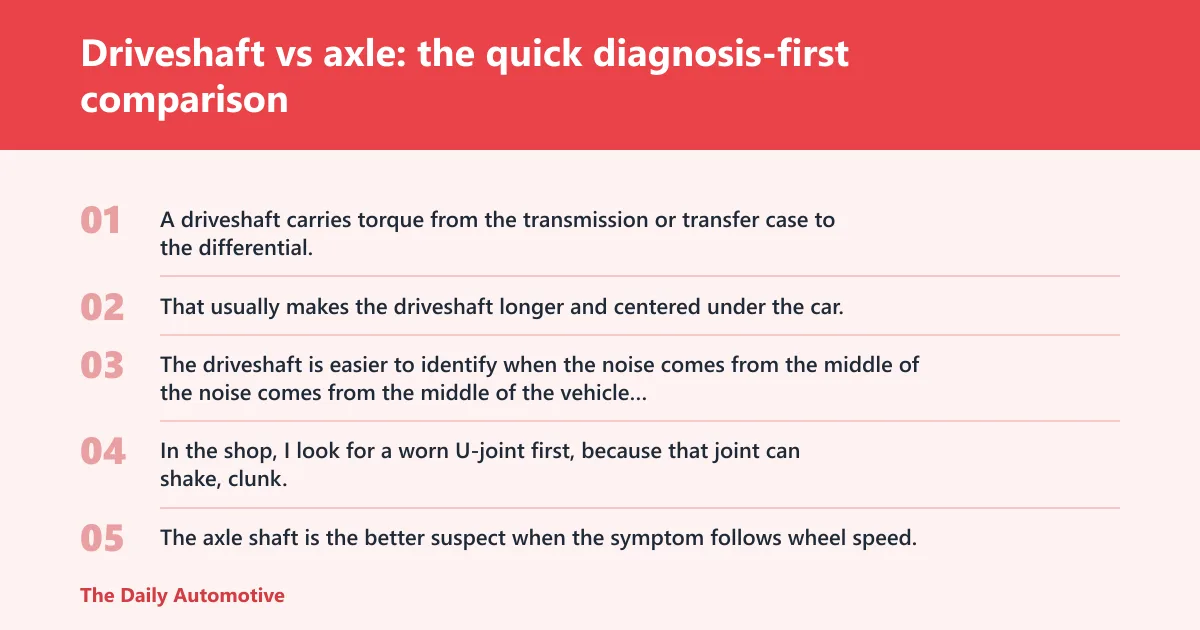


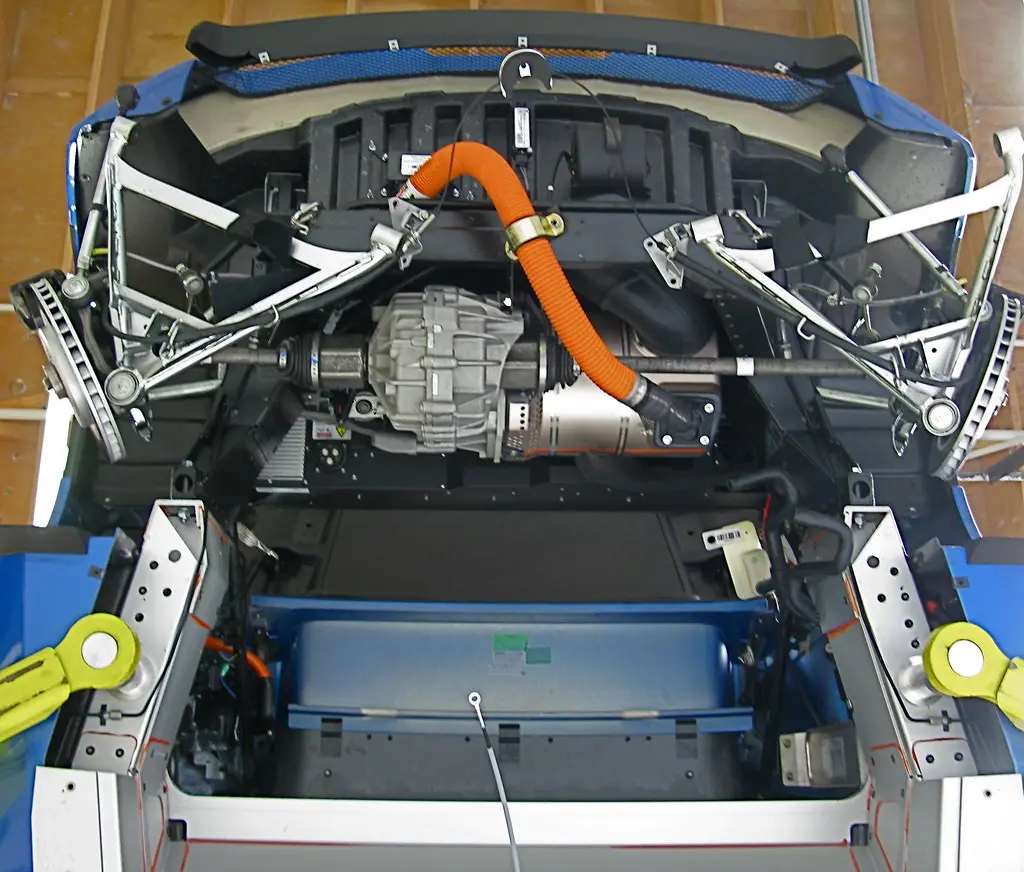
The core split is location and behavior. A driveshaft carries torque from the transmission or transfer case to the differential, while an axle shaft carries torque from the differential or transaxle to the wheels. That usually makes the driveshaft longer and centered under the car, while axle shafts sit near the wheel hub assemblies and follow steering and suspension movement.
| Decision factor | Driveshaft | Axle | Winner |
|---|---|---|---|
| Where it sits | Runs under the center of the vehicle between the transmission or transfer case and the differential | Sits near the wheel hub assembly between the differential or transaxle and the wheel | Axle for easy visual ID |
| Typical noise when failing | Clunking on gear changes, vibration at speed, squeaking from worn U-joints | Clicking or popping on turns, especially at low speed | Tie |
| Steering effect | No steering angle change; it only transmits torque over distance | Moves with steering and suspension travel on many FWD and AWD layouts | Axle |
| Common layouts | RWD, 4WD, and some AWD vehicles | FWD and AWD vehicles, especially where a transaxle feeds the front wheels | Tie |
| Stop-driving risk | High if vibration is severe or the shaft is visibly damaged | High if a boot is torn, grease is lost, or the joint is making loud turn noise | Tie |
Where the driveshaft wins the diagnosis
The driveshaft is easier to identify when the noise comes from the middle of the vehicle and changes with throttle, load, or gear engagement. In the shop, I look for a worn U-joint first, because that joint can shake, clunk, or squeak in a way that feels far from the wheels.
Where the axle wins the diagnosis
The axle shaft is the better suspect when the symptom follows wheel speed, steering angle, or suspension travel. A clicking noise on a tight turn usually points away from the center tunnel and toward a CV axle or CV joint near the hub.
Why the tie happens on some symptoms
Both parts can create vibration or clunking when wear gets bad enough. The clue is where it starts and what makes it change. Centerline vibration points toward the driveshaft; turn-dependent noise points toward the axle side.
Layout matters more than part names
FWD cars usually use axle shafts or CV axles, while RWD cars usually use a driveshaft. AWD and 4WD vehicles can use both in the same vehicle, which is why a single symptom may point to one shaft near the transmission and another near the wheel. (caranddriver.com)
Where is the driveshaft located on a car?
In many rear-, four-, and some all-wheel-drive layouts, the driveshaft runs under the vehicle and links the transmission or transfer case to the differential. On most RWD, 4WD, and some AWD layouts, it is the long tubular shaft you can see from underneath, usually protected by the exhaust tunnel and crossmembers.
What it looks like during an underbody inspection
A driveshaft is usually a straight or slightly sectioned tube with a yoke and universal joints at the ends. It sits farther from the wheels than an axle shaft, and it does not move with steering input. If it has dents, missing balance weights, rust at the joints, or loose play at the U-joints, suspect it early.
Why it runs under the center of the vehicle
The driveshaft exists to move torque over distance. The transmission or transfer case sits near the front of the drivetrain, while the differential may sit at the rear axle or another driven axle, so the shaft bridges that gap along the vehicle’s centerline.
Where is the axle shaft located on a car?
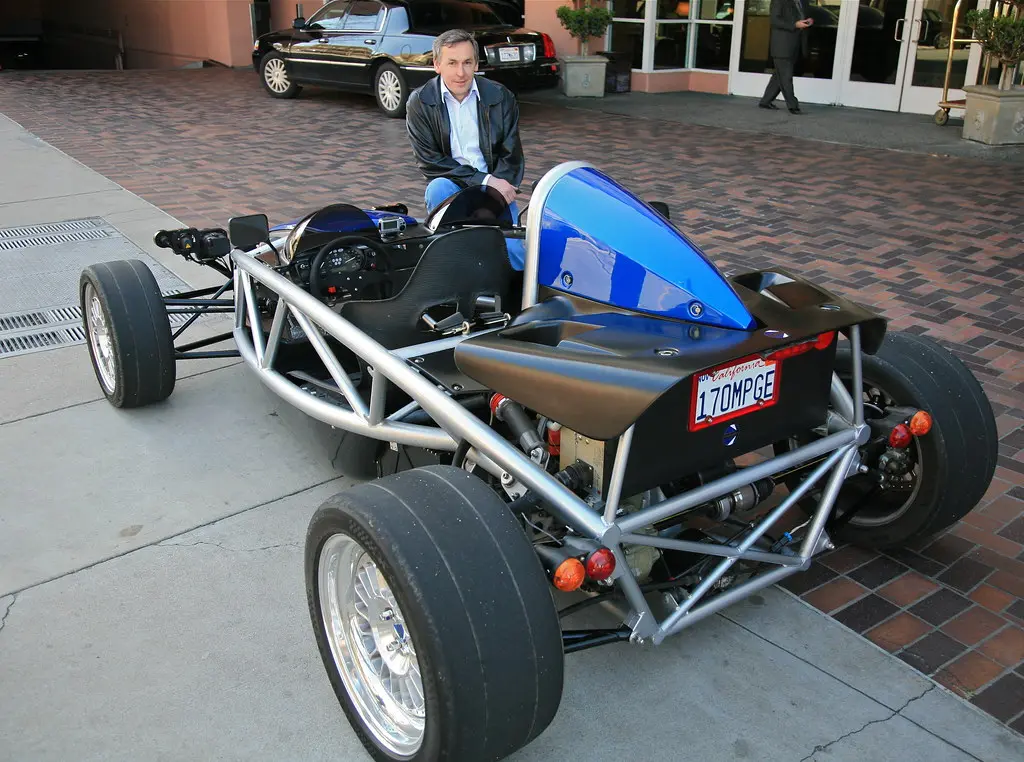
The axle shaft is located closer to the wheels, running from the differential or transaxle to the wheel hub assembly. In FWD vehicles, the transaxle sends power directly to the front wheels through axle shafts, and those shafts move with steering and suspension travel.
Why front-wheel-drive cars can hide the part
On FWD cars, the axle shaft sits behind the front wheels, brake components, and splash shields. That makes inspection harder from above. A torn CV boot or grease sling on the inner fender is often easier to spot than the shaft itself.
How axle shafts move on the car
Unlike a driveshaft, an axle shaft must handle angle changes as the suspension rises and falls. On many layouts, it also turns with the steering knuckle. That is why CV joints are used at either end on CV axles: they keep rotation smooth while the shaft changes angle.
Driveshaft, axle shaft, or CV axle?
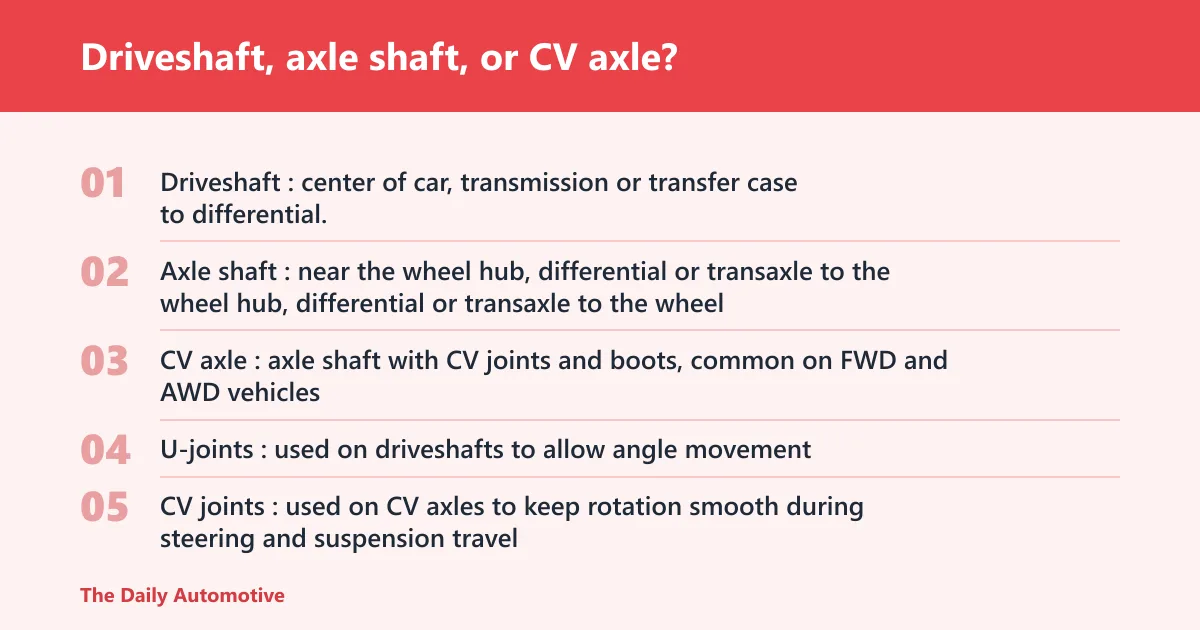
The terms overlap, but they are not the same part. A driveshaft uses U-joints and sits between the transmission or transfer case and the differential. A CV axle uses CV joints and rubber boots packed with grease, and it sends power from the transmission or transaxle to the wheels.
Why people mix up the names
Some regions call the shaft at the wheel a drive axle, half shaft, or axle shaft. The wording changes with layout too. On a FWD car, the shaft near the wheel is often called a CV axle or half shaft; on a RWD truck, the long tube under the floor is the driveshaft.
Fast terminology check
- Driveshaft: center of car, transmission or transfer case to differential, usually long and tubular
- Axle shaft: near the wheel hub, differential or transaxle to the wheel
- CV axle: axle shaft with CV joints and boots, common on FWD and AWD vehicles
- U-joints: used on driveshafts to allow angle movement
- CV joints: used on CV axles to keep rotation smooth during steering and suspension travel
Use the one-page diagnosis matrix
Read the vehicle layout first, then match the sound and the steering behavior. That order cuts down on wrong parts fast. A center-of-car vibration on a RWD sedan points somewhere else than a clicking front wheel on a FWD hatchback.
| Drivetrain layout | Component location | Common noise | Steering behavior | Likely failed part | Stop-driving risk |
|---|---|---|---|---|---|
| RWD | Long shaft under the center tunnel from transmission to rear differential | Clunk on shifts, vibration at speed, squeak from U-joints | No change with steering | Driveshaft or U-joints | High if vibration is severe |
| FWD | Short shafts near the front wheel hubs from transaxle to wheels | Clicking or popping on turns | Noise changes with steering angle | CV axle or CV joint | High if boot is torn and grease is gone |
| AWD | May have both a center driveshaft and axle shafts at the wheels | Center vibration or wheel-end clicking | Depends on which shaft is failing | Driveshaft, axle shaft, or CV joint | Varies by symptom |
| 4WD | Front and rear shafts with transfer case in the middle | Clunk, vibration, or joint noise | Usually little steering effect unless the front axle is involved | Driveshaft, U-joint, or front axle shaft | High if shaft is loose or damaged |
How do I know if my driveshaft is bad?
A bad driveshaft often shows up as vibration, clunking, or a speed-related shake that does not follow steering input. If the clunk appears when shifting gears, or if the shaft has visible rust, dents, or U-joint play, the driveshaft side should move to the top of the list.
What to look for first
Inspect the U-joints for rust dust, missing grease, or looseness. Worn U-joints can produce squeaking noises that worsen with speed, and a failing driveshaft can cause clunking noises when shifting gears. A bent or out-of-balance shaft can also shake under load.
What the road test tells you
If the vibration is present whether the wheels are straight or not, and it rises with vehicle speed more than steering angle, the driveshaft becomes a stronger suspect. A noise that fades when coasting can also point to the shaft, joint, or balance problem rather than a wheel-end issue.
How do I know if my CV axle is bad?
A bad CV axle often announces itself with clicking or popping on turns, especially at low speed. Grease on the suspension, wheel well, or inside of the wheel points to a torn boot and a joint that has started to lose lubrication. That is the classic CV axle path.
Why the boot matters
The rubber boots hold grease inside the CV joints and keep dirt out. Once a boot tears, the joint wears faster. A shaft can still move for a while, but the noise usually gets louder and more frequent as the wear grows.
What the turn test suggests
If the noise appears mainly while turning left or right, and it changes with steering angle more than vehicle speed, the axle side is the better bet. That is especially true on FWD and AWD vehicles where CV axles are common.
Can a broken driveshaft or axle leave me stranded?
Yes. A broken driveshaft or axle can leave the vehicle stranded, depending on layout and where the failure occurs. If the shaft can no longer transmit torque to the driven wheels, the car may move nowhere, or it may move badly enough that continued driving risks more damage.
When to stop driving now
Stop driving if the shaft is visibly hanging, the vibration is severe, the vehicle bangs hard on acceleration, or grease is flung from a torn CV boot with loud joint noise. Those signs suggest a part that may fail fully and damage nearby components.
When short-distance caution may be reasonable
Short-distance caution may be reasonable only when the symptom is mild, unchanged by steering, and the vehicle still drives normally without heavy vibration or metal noise. Even then, the safest move is to limit distance and inspect the part before more road use.
Choose Driveshaft if… / Choose Axle if…
Choose a driveshaft if the noise or play is under the center tunnel on a RWD, AWD, or 4WD vehicle, if the symptom shows up during throttle changes or gear shifts, or if the vibration follows road speed rather than steering. Choose an axle shaft or CV axle if the noise follows wheel speed, steering angle, or a torn boot near the wheel.
Choose driveshaft if…
- The vehicle is RWD, 4WD, or an AWD layout with a center shaft
- The sound is a clunk on shift, a vibration at speed, or a squeak from the U-joints
- The problem is centered under the floor, not at the wheel
- Visual inspection shows loose U-joints, dents, or imbalance signs
Choose axle shaft or CV axle if…
- The vehicle is FWD or AWD with shafts at the wheel hub assembly
- The noise is clicking or popping on turns at low speed
- There is grease around a torn boot or inner fender
- The symptom changes with steering angle or suspension movement
Frequently asked questions
What is the difference between a driveshaft and axle shaft?
A driveshaft moves torque from the transmission or transfer case to the differential. An axle shaft moves torque from the differential or transaxle to the wheels. The driveshaft is usually longer and centered under the vehicle, while the axle shaft sits closer to the hub and wheel end.
What is the difference between driveshaft and cv axle?
A driveshaft uses U-joints and usually runs under the middle of the car. A CV axle uses CV joints and rubber boots, and it sits near the wheel hub assembly. A clicking noise on turns points much more often to the CV axle than to the driveshaft.
Is a driveshaft the same as an axle shaft?
No. The terms are often confused, but they describe different positions in the drivetrain. A driveshaft connects the transmission to the differential. An axle shaft connects the differential or transaxle to the wheel. Some markets also use half shaft or drive axle wording for the wheel-end part.
How do I know if my driveshaft is bad?
Look for vibration at speed, clunking during shifts, or squeaking that gets worse with vehicle speed. Check the U-joints for looseness, rust, or missing grease. If the symptom stays centered under the vehicle and does not change with steering, the driveshaft moves up the suspect list.
How do I know if my CV axle is bad?
A CV axle often makes clicking or popping on low-speed turns. Torn rubber boots, grease on nearby suspension parts, and noise that changes with steering angle all point in that direction. If the sound comes from the wheel end rather than the center tunnel, suspect the CV axle first.
Can a broken driveshaft or axle leave me stranded?
Yes, both can. If the failed part can no longer send torque to the driven wheels, the vehicle may stop moving. A broken shaft can also damage nearby parts, so a loud bang, severe vibration, or a hanging shaft means the safest choice is to stop and inspect the car.
Products related to this article
Sponsored / affiliate links. As an Amazon Associate I earn from qualifying purchases. I may earn additional commission from eligible campaigns.