
Does Alfa Insurance Cover Rental Cars
Alfa Insurance may cover a rental car if your auto policy includes collision, comprehensive, and liability, but the same deductibles and limits usually apply. Check your declarations page before you decline the counter offer. If you assume coverage that is not there, you can face repair bills, towing, loss-of-use charges, and claims that land on your own policy. This guide explains what Alfa may pay, what it usually will not, and which policy, card, and rental-agreement details to verify first.
How policy types and travel locations affect coverage
The short answer you can verify
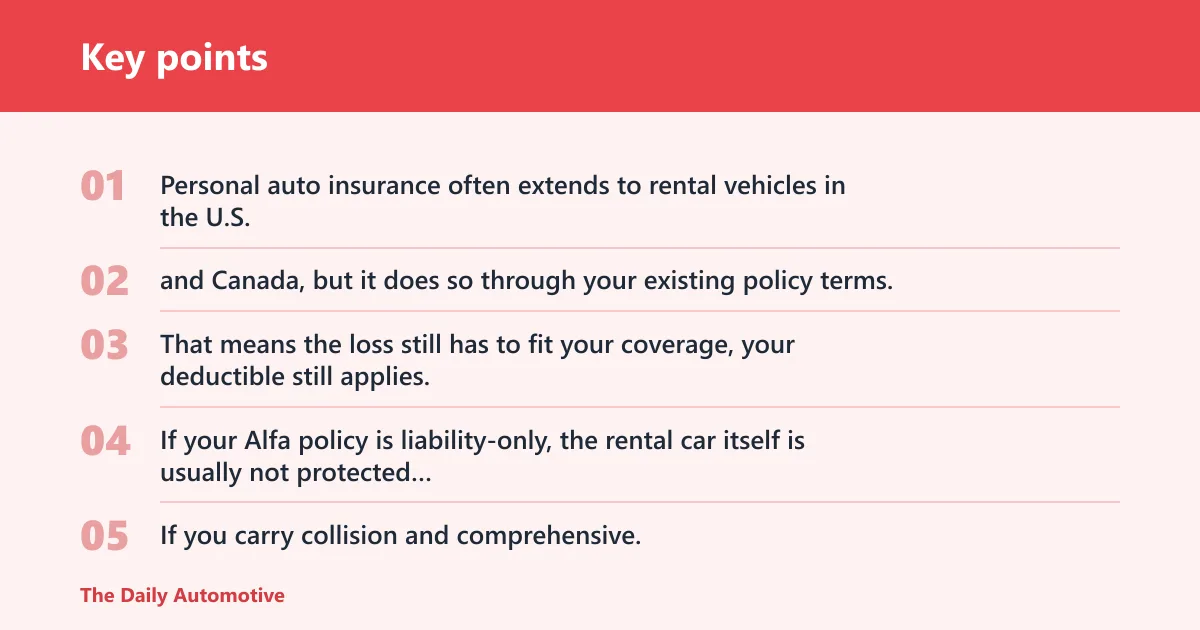
Personal auto insurance often extends to rental vehicles in the U.S. and Canada, but it does so through your existing policy terms, not a separate rental promise. That means the loss still has to fit your coverage, your deductible still applies, and some charges may fall outside the policy.
If your Alfa policy is liability-only, the rental car itself is usually not protected for damage or theft. If you carry collision and comprehensive, those coverages can often follow you into the rental, subject to the same limits and exclusions.
Why policy type matters before you rent
The policy label matters more than the rental counter pitch. Collision covers damage from a crash. Comprehensive covers non-collision losses such as theft or weather, if present on your personal policy. Liability covers injury or property damage you cause to others, and many credit card rental benefits do not cover it.
That means a policyholder with collision and comprehensive may have far better rental protection than a driver who only bought liability. The difference shows up fast after a fender-bender or a theft claim.
What changes when you leave the U.S. and Canada
Outside the U.S. and Canada, personal auto insurance typically does not cover rental vehicles. That is the biggest border line to check before you book. Overseas rentals often require a separate policy review, and the rental company may require you to buy coverage at pickup.
Do not assume a policy written for the U.S. and Canada follows you into Europe, Mexico, or another destination. Verify the destination first, then verify the policy language.
Rental car coverage verification checklist
Use this checklist before you rent. It is the fastest way to separate likely coverage from likely gaps.
| Yes/no check | What to verify | Why it matters |
|---|---|---|
| 1. Destination | Are you renting in the U.S., Canada, or overseas? | Domestic rentals are usually simpler; overseas rentals often need separate coverage. |
| 2. Policy type | Does your Alfa policy include liability, collision, and comprehensive? | That mix usually determines whether the rental car and other claims are covered. |
| 3. Collision limit | Is your collision coverage high enough for the rental vehicle? | Your own limit, not the rental price, governs the payout. |
| 4. Comprehensive limit | Does comprehensive apply to theft, hail, glass, or other non-collision losses? | This is the main check for non-crash damage to the rental. |
| 5. Deductible | What deductible applies to collision and comprehensive claims? | You may still owe the deductible even when the loss is covered. |
| 6. Liability limits | Are your bodily injury and property damage limits enough for the trip? | Liability protects you if you hurt someone or damage another car or object. |
| 7. Loss of use exposure | Does your policy address loss of use if the rental sits out of service? | This charge is a common gap and may not be covered. |
| 8. Admin fees | Are administrative or processing fees included anywhere in your coverage? | Rental agreements often add fees that can survive a damage claim. |
| 9. Overseas travel | Does your policy specifically allow rental coverage outside the U.S. and Canada? | This is the point where many policies stop extending protection. |
| 10. Backup coverage | Will a credit card benefit or non-owned auto endorsement help if the policy does not? | Backup coverage may fill a gap, but it rarely replaces liability. |
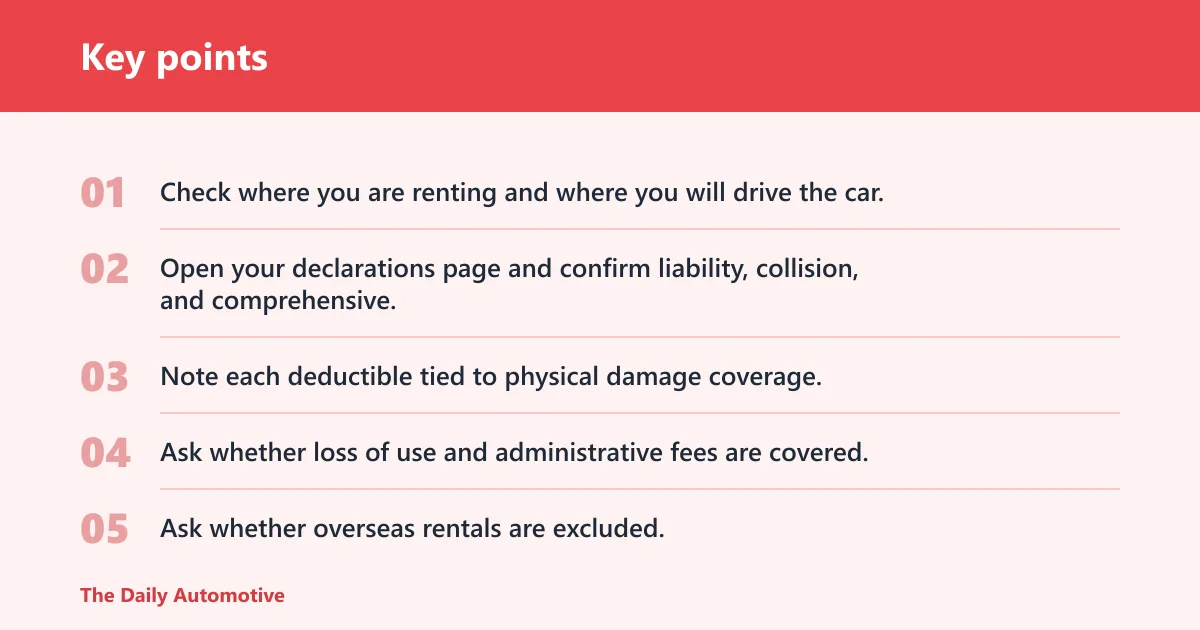
- Check where you are renting and where you will drive the car.
- Open your declarations page and confirm liability, collision, and comprehensive.
- Note each deductible tied to physical damage coverage.
- Ask whether loss of use and administrative fees are covered.
- Ask whether overseas rentals are excluded.
- Check whether a credit card benefit applies and what it excludes.
- Confirm whether a non-owned auto endorsement changes the answer.
- Call Alfa before you sign anything at the counter if the trip is outside your normal coverage pattern.
What does your Alfa policy usually pay for?
A typical personal auto policy may pay for damage to the rental car, theft, and liability claims if those coverages exist on your Alfa policy. It can also cover damage you cause to other vehicles or property, subject to your limits. Medical bills or injury claims to others fall under liability, not under damage coverage.
Collision damage to the rental car
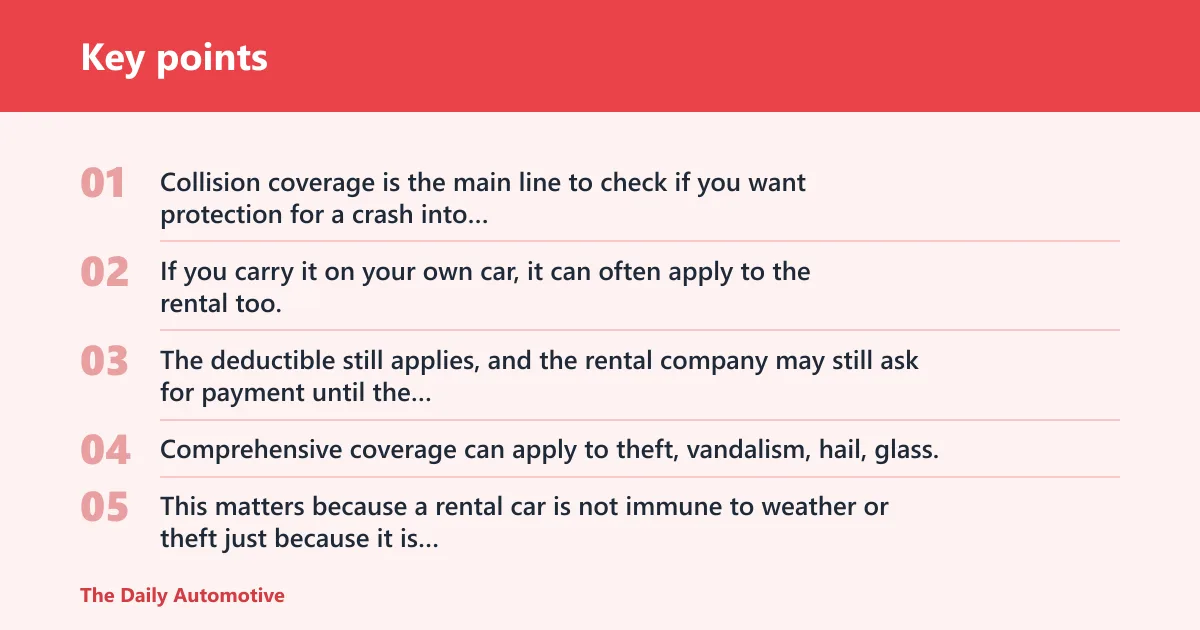
Collision coverage is the main line to check if you want protection for a crash into another vehicle or a fixed object. If you carry it on your own car, it can often apply to the rental too. The deductible still applies, and the rental company may still ask for payment until the claim is settled.
Theft and other covered non-collision losses
Comprehensive coverage can apply to theft, vandalism, hail, glass, or similar non-collision losses if it is part of your Alfa policy. This matters because a rental car is not immune to weather or theft just because it is temporary. If you do not carry comprehensive, those losses may fall on you.
Damage to other vehicles or property
Liability coverage protects you if the rental driver is at fault and another car, mailbox, storefront, or guardrail is damaged. This is separate from damage to the rental itself. Liability limits may be required to rent a car in some places, so the amount on your policy can matter.
Medical bills or injury claims to others
Liability also addresses injury claims from other people if the accident is your fault. Credit card rental benefits usually do not cover this. That is why declining the rental company’s damage waiver is a different decision from carrying enough liability for the trip.
Say your Alfa policy has collision and comprehensive on a 2022 sedan, and you rent a midsize SUV for a weekend trip in North Carolina. If the SUV is backed into in a parking lot, the damage claim usually follows your policy limits and deductible, not the rental company’s sticker price.
Does Alfa cover rental cars in the U.S. and Canada?
Personal auto insurance usually extends to rental vehicles in the U.S. and Canada, so this is the simplest case to verify. The policy still controls the result, though. Limits, deductibles, and excluded losses still matter, and state liability rules can change what a renter needs to have in place.
Why domestic rentals are usually simpler
When the rental stays in the U.S. or Canada, many policies treat it as a temporary substitute vehicle. That means collision and comprehensive may follow the rental if you already bought them for your own car. Liability still matters because it protects against claims from others.
How state liability rules can change the picture
Liability requirements are not uniform from state to state, and renters can face different minimums depending on where the trip starts and where it is driven. That is one reason a policy that feels adequate at home may still leave a gap on the road. Check the policy limits, not just the state minimum.
What to confirm if you are crossing borders
If you are driving between the U.S. and Canada, confirm where the rental agreement says the vehicle can go and whether your Alfa policy follows that route. Do not rely on the counter agent’s general statement. Ask whether the vehicle is covered on both sides of the border under the same terms.
Does Alfa cover rental cars overseas?
Outside the U.S. and Canada, personal auto insurance typically does not cover rental vehicles. That means an overseas trip often needs a separate review before you book or before you decline the rental company’s insurance. Credit card benefits may help with damage, but they usually do not fill every gap.
Why overseas rentals often need a separate review
Many auto policies limit rental coverage to North America. If your trip is international, the safest assumption is that your domestic policy may not follow you. That is especially important when the rental is expensive or the destination requires proof of insurance at pickup.
What the rental company may require at pickup
Rental companies may sell collision damage waiver, loss damage waiver, liability, personal accident, and personal effects coverage at the counter. These add-ons can cost $9 to $42 per day or more. They can be useful, but the price adds up quickly on a weeklong trip.
When a credit card benefit is not enough
Credit card rental coverage is commonly secondary and usually covers collision or comprehensive damage, or the deductible tied to those losses. It does not extend to liability, personal injury, or personal effects. That is why an overseas rental can still need more than a card benefit.
When you may still need rental car insurance
You may still need the rental company’s coverage even if you have Alfa Insurance. Liability-only policies leave the rental car itself exposed. High deductibles can make a small claim expensive. Expensive rentals can also create a mismatch between the car you own and the car you are driving.
Liability-only policies
If your Alfa policy covers only liability, the rental car itself usually has no collision or theft protection from your auto policy. That leaves you exposed for the rental vehicle’s damage and any bill the company adds after a loss. This is the clearest reason to buy extra coverage.
High deductibles or limited physical damage coverage
A deductible can turn a covered claim into a costly repair bill. If your collision or comprehensive deductible is high, a small parking-lot scrape may not feel worth filing through your policy. The same is true if your physical damage limits are narrow or your policy excludes the rental destination.
Expensive rental vehicles
Do not assume your own car’s value matches the rental’s value. A compact sedan policy may not feel like enough for a premium SUV or specialty vehicle. If the rental is worth far more than your daily driver, ask what happens if the repair bill is larger than expected.
A common first-timer mistake is assuming a newer, more expensive rental is covered the same way as an older personal car. Suppose you normally drive a 10-year-old compact sedan but rent a luxury SUV for a family trip. The coverage still follows your policy terms, not the rental’s sticker price.
Business travel or destination-specific exclusions
Some policies and card benefits have restrictions tied to business use, country, or vehicle type. If the trip is work-related or the destination is unusual, do not guess. Verify the trip purpose and the rental country before you accept the keys.
What rental company and credit card coverage can add
The rental counter can offer collision damage waiver, loss damage waiver, liability, personal accident, and personal effects coverage. Credit cards may add another layer, but they usually focus on damage or theft and often stay secondary. That means they can help, but they rarely replace your auto policy.
CDW and LDW at the counter
Collision damage waiver and loss damage waiver are the common rental-company terms for shifting responsibility for damage or theft. They are similar, but not always identical in how each rental company writes the contract. Read the agreement before you sign, because the waiver may narrow what you still owe.
What rental company add-ons may include
Rental company insurance may bundle liability, personal accident, personal effects, and damage waivers. That bundle can be useful if your own policy is thin or the destination is outside your coverage area. It can also be expensive, which is why the daily cost matters so much on longer trips.
What credit card benefits usually exclude
Credit card rental coverage is commonly secondary, not primary. It usually covers collision or comprehensive damage, or the deductible tied to those losses, and it does not extend to liability, personal injury, or personal effects. That means you should not treat a card benefit as a full substitute for auto insurance.
Why secondary coverage matters
Secondary coverage pays after another source pays, which can slow the claim and leave some costs uncovered. If your Alfa policy already covers the rental, the card benefit may still help with the deductible. If your Alfa policy does not cover the trip, the card benefit may leave major gaps.
Frequently asked questions
Does my Alfa Insurance cover rental cars?
It may, if your policy includes collision, comprehensive, and liability. Those coverages often extend to rental vehicles in the U.S. and Canada, but your limits, deductibles, and exclusions still apply. Check your declarations page before you decline the rental company’s offer.
Does Alfa Insurance cover rental cars in the U.S. and Canada?
Personal auto insurance usually extends to rental vehicles in the U.S. and Canada. That does not mean every loss is covered. Collision, comprehensive, liability, and deductible terms still control the claim, and state liability rules can affect what you need to carry.
Does Alfa Insurance cover rental cars overseas?
Usually not. Outside the U.S. and Canada, personal auto insurance typically does not cover rental vehicles. If you are traveling overseas, verify the policy before you leave and ask whether you need rental company coverage or a separate policy review.
What rental car coverage does Alfa Insurance provide?
In general, the useful parts to check are liability, collision, and comprehensive. Liability addresses injury or property damage to others. Collision and comprehensive can apply to the rental itself if they are on your policy, but deductibles and limits still apply.
Do I need rental car insurance if I already have Alfa Insurance?
Not always, but you should verify the destination, policy type, and deductible first. If you have liability only, travel overseas, rent an expensive vehicle, or face a high deductible, the counter offer may be worth considering. Loss of use and admin fees matter too.
Does Alfa Insurance cover loss of use fees on rental cars?
Loss of use fees may not be covered by personal auto insurance, and that gap is easy to miss. Ask Alfa before you rent, because the rental company may charge for the time the vehicle is out of service. Administrative fees can appear alongside those charges.
Products related to this article
Sponsored / affiliate links. As an Amazon Associate I earn from qualifying purchases. I may earn additional commission from eligible campaigns.