How Much Does Roadside Assistance Coverage Cost?
Roadside assistance coverage is often reported at about $10 to $50 a year as an insurance add-on, while membership plans often run about $50 to $170 a year. Skip it, and one tow, lockout, or jump-start can cost more than the coverage itself. This guide compares add-ons, memberships, and pay-per-use towing so you can judge which option fits your driving.
What roadside assistance covers
Roadside assistance usually covers towing, jump-starts, lockouts, tire changes, and fuel delivery. It is usually an optional add-on to auto insurance, but you can also buy it through a membership club or pay directly for each call. Each option can set its own mileage caps, reimbursement limits, and service rules.
Common services and limits
Most plans include dispatch help for a dead battery, flat tire, empty fuel tank, and minor roadside lockout. Many plans cap towing at a set distance, such as 5 to 15 miles, or cap reimbursement to a dollar amount instead of paying the full bill.
Some plans also limit the number of calls per year. Trip interruption, winching, and parts replacement are often excluded or capped separately, so read the fine print before you count on a full rescue package.
Coverage exclusions that catch drivers off guard
Common exclusions include commercial use, off-road use, pre-existing breakdowns, and vehicles not listed on the policy. A tow to a repair shop may be covered, but a recovery from mud, a job-site breakdown, or a vehicle used for deliveries may fall outside the plan.
Roadside assistance cost comparison table
The real price difference shows up when you compare an annual add-on with a one-time service bill. The table below uses common price ranges, not a single national quote, because state rules, vehicle type, service area, and carrier pricing can all change the final total.
| Scenario | Insurance add-on | Standalone membership | Pay-per-use cost | Likely exclusions or limits | Break-even point |
|---|---|---|---|---|---|
| Flat tire | $10-$50 per year | $50-$170 per year | $75-$150 for a service call | May exclude off-road tire changes or use on an unlisted vehicle | One flat on a direct-pay basis can exceed a low-end add-on |
| Dead battery | $10-$50 per year | $50-$170 per year | $50-$125 for a jump-start | Some plans cap battery replacement help and only cover the jump | One jump-start can match a full year of cheap add-on pricing |
| Lockout | $10-$50 per year | $50-$170 per year | $75-$200 for lockout service | Some policies cap locksmith reimbursement or exclude key replacement | One lockout often pays for the add-on |
| Short tow, 5-10 miles | $10-$50 per year | $50-$170 per year | $100-$250 with hook-up and mileage | Hook-up fees, minimum charges, and after-hours surcharges may apply | One short tow often exceeds an annual add-on |
| Long tow, 20-50 miles | $10-$50 per year | $50-$170 per year | $200-$500 or more | Mileage caps can leave you paying the extra miles out of pocket | One long tow usually costs far more than a year of coverage |
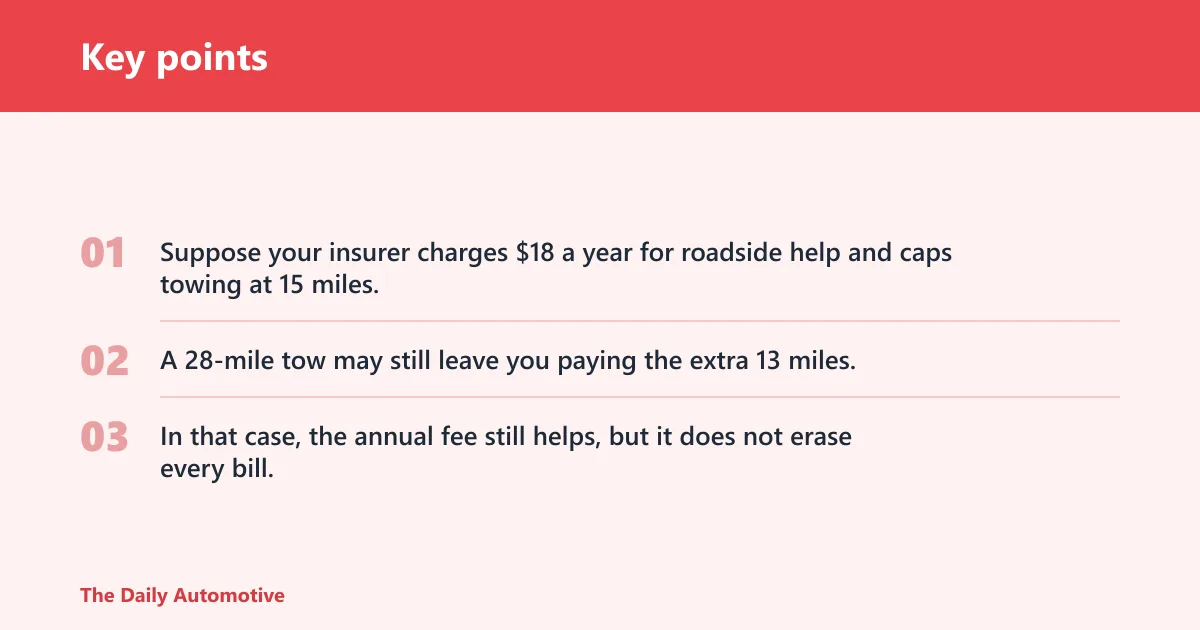
Suppose your insurer charges $18 a year for roadside help and caps towing at 15 miles. A 28-mile tow may still leave you paying the extra 13 miles, plus any after-hours surcharge. In that case, the annual fee still helps, but it does not erase every bill.
How much does roadside assistance cost with insurance?
With insurance, roadside assistance usually adds about $10 to $50 per year, though some carriers quote it as a small monthly bundle charge. Pricing can be per vehicle or per policy, and the rules vary by insurer, state, vehicle type, and policy setup.
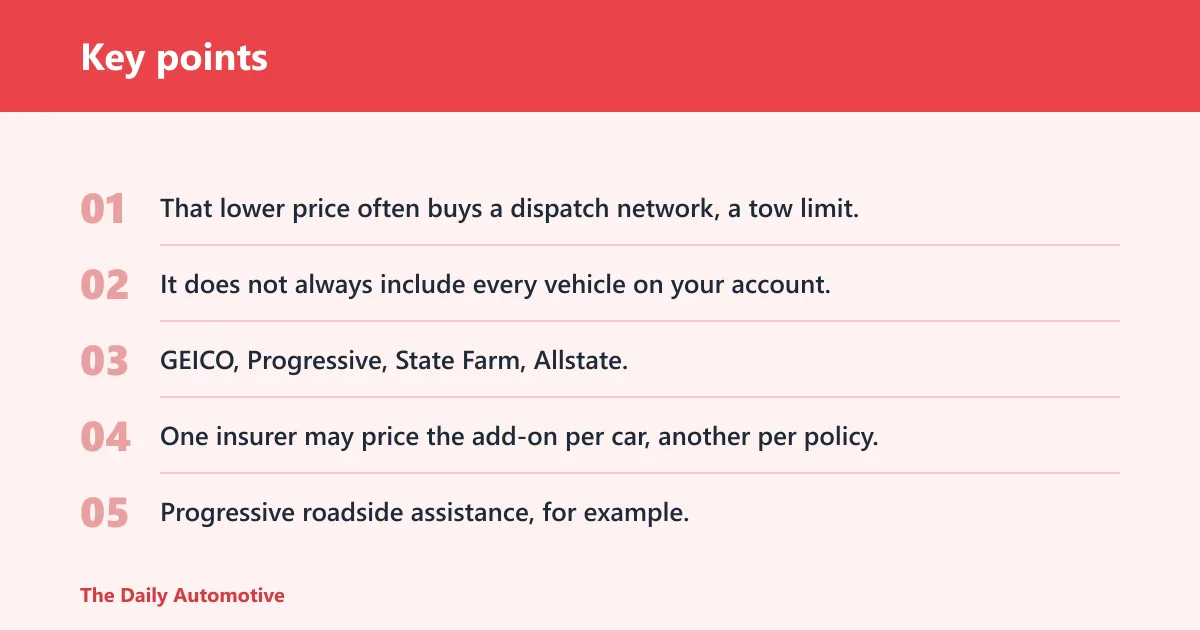
That lower price often buys a dispatch network, a tow limit, and basic help for flat tires, dead batteries, lockouts, and fuel delivery. It does not always include every vehicle on your account, and it does not always mean unlimited service calls.
Insurer roadside programs at a high level
GEICO, Progressive, State Farm, Allstate, and USAA all offer roadside programs in many markets, but the details are not identical. One insurer may price the add-on per car, another per policy; one may offer towing distance, another may reimburse up to a dollar limit.
Progressive roadside assistance, for example, is commonly sold as an add-on that may be priced by vehicle and bundled with the policy. GEICO roadside assistance, State Farm emergency road service, Allstate Roadside, and USAA roadside assistance can all differ by state, vehicle, and eligibility rules.
Do not assume the same benefit set across carriers. One plan may cover towing but cap mileage tightly. Another may include lockout help but limit reimbursements for a locksmith or battery service.
How much does it cost without coverage?
Without coverage, towing service pricing usually starts with a hook-up fee and then adds per-mile charges. A short tow can still cost more than a cheap annual add-on once you add after-hours surcharges, waiting time, or a second stop for vehicle storage.
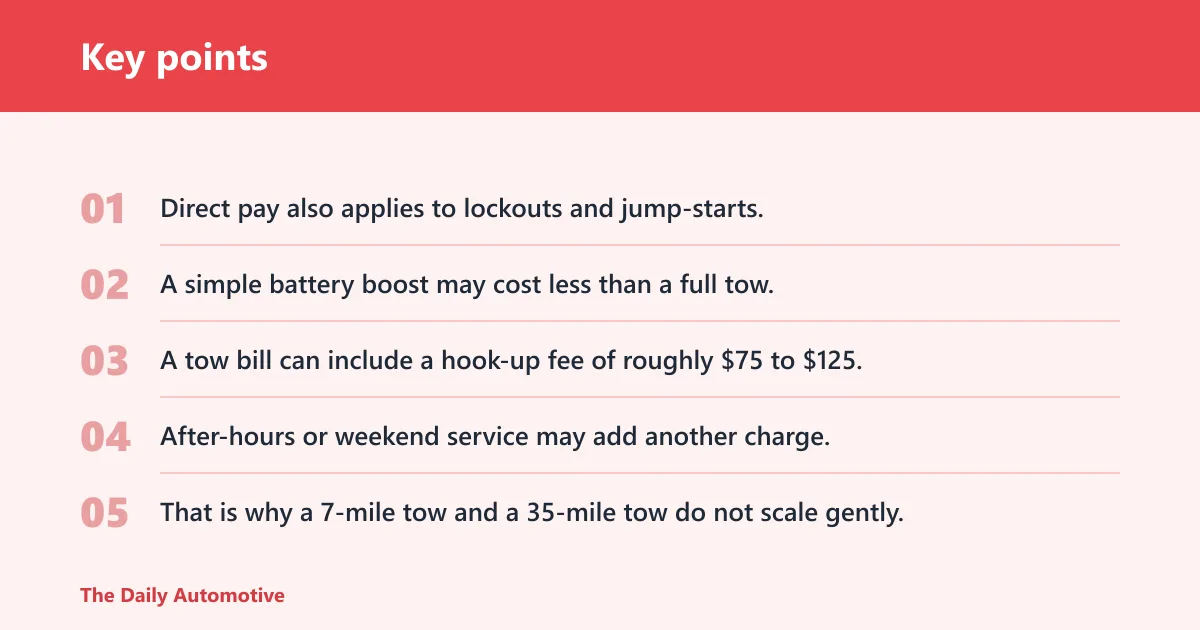
Direct pay also applies to lockouts and jump-starts. A simple battery boost may cost less than a full tow, but it can still run high enough to make a year of roadside coverage look inexpensive.
What direct-pay towing usually includes
A tow bill can include a hook-up fee of roughly $75 to $125, plus about $3 to $10 per mile. After-hours or weekend service may add another charge, and some operators set a minimum bill even for very short distances.
That is why a 7-mile tow and a 35-mile tow do not scale gently. The first can land near $100 to $180, while the second can rise well past $250 once distance and surcharges stack up.
When a short tow still beats paying for a plan
If you rarely break down, a cheap direct-pay call can cost less than a full year of membership or insurance add-on pricing. That is most common for drivers with low annual mileage, newer cars, and a cash reserve set aside for car emergencies.
A common mistake is assuming a roadside assistance plan always costs the same no matter whether it covers towing, lockouts, or fuel delivery. A 3-mile tow from a parking lot to a nearby shop may cost less than a yearly membership, but the same driver could face a much larger bill on a holiday night or outside a metro area.
Insurance add-ons vs membership plans
Insurance add-ons and membership plans both help with breakdowns, but they do not work the same way. Insurance roadside help is usually tied to a vehicle on the policy, while a membership may be driver-based or household-based, with separate rules for who can call.
Membership clubs often have their own dispatch network and may offer broader service menus or different tow limits. Insurance add-ons may be cheaper, but they can be narrower and more closely tied to the insured vehicle.
Which rule set matters most?
- Vehicle-based rules: coverage follows the listed car, not the person.
- Driver-based rules: the member can request help in any eligible vehicle, depending on the plan.
- Household rules: some plans cover family members in the same home.
- Network rules: one plan may send a contractor from its network, while another reimburses you after you pay.
When a membership can fit better
If you drive multiple cars, switch vehicles often, or take long trips far from home, a membership can be a better fit than a low-cost add-on. The extra fee may buy broader towing distance, higher reimbursement limits, or coverage that follows the driver instead of one insured vehicle.
What changes the price
Three things move the total quickly: tow distance caps, call limits, and eligibility rules. The headline annual price can look low, but a limited tow allowance or a reimbursement ceiling can shift part of the bill back to you.
Tow caps and reimbursement limits
Some plans pay only up to a fixed mileage limit, such as 10 or 15 miles. Others reimburse up to a dollar cap, which matters when the tow truck charges a hook-up fee plus per-mile pricing. If the bill runs past the cap, you pay the difference.
Call limits and vehicle use
Many plans limit service calls per year, often to a small number of events. Commercial use, off-road use, and vehicles not listed on the policy can void the benefit. A plan can sound broad and still reject a claim if the vehicle was being used outside its stated rules.
Is roadside assistance worth it?
Roadside assistance is usually worth it for older cars, long commutes, and drivers who would rather cap surprise towing costs than pay out of pocket. It is less compelling if you drive rarely, already have an emergency fund, and can handle the occasional small bill yourself.
For a driver with a 20-mile commute and an aging battery, the odds of needing help are higher than for a weekend-only car. For a low-mileage driver with cash on hand, a single direct-pay call may be cheaper than years of add-on fees.
When paying out of pocket can make sense
- Set aside a small emergency fund for car trouble.
- Compare the plan fee with one likely service call in your area.
- Check tow mileage caps before you count the plan as full protection.
- Ask whether your car is listed and whether your use fits the policy.
- Choose coverage only if the annual fee is easier than a surprise bill.
Picture a driver with a 12-year-old sedan and a 35-mile commute. One dead battery and one tow home in the same year can wipe out the savings from skipping coverage, especially if the tow lands after hours. A weekend-only driver with a garage-kept car may see the opposite result.
Frequently asked questions
How much does roadside assistance insurance cost?
Roadside assistance insurance usually costs $10 to $50 a year as an add-on, though some carriers bundle it into a slightly higher monthly policy payment. The exact price depends on state, vehicle, insurer, and whether the benefit is priced per car or per policy.
How much does roadside assistance cost without coverage?
Without coverage, a single call can run from about $50 for a jump-start to $200 or more for a short tow, and a longer tow can go much higher. Hook-up fees, mileage charges, and after-hours surcharges are the biggest cost drivers.
How much does towing insurance cost?
Towing insurance usually means a roadside add-on, not a separate auto policy. Expect roughly $10 to $50 per year for many insurance-based plans, though some insurers price it differently by vehicle or bundle it with the policy payment.
Does insurance cover roadside assistance?
Sometimes, but usually only if you add it to the policy or buy a package that includes it. Coverage often includes towing, jump-starts, lockouts, tire changes, and fuel delivery, with limits on miles, reimbursements, and yearly calls.
How much does progressive roadside assistance cost without coverage?
Without the add-on, Progressive roadside assistance would not apply, so you would pay direct-pay towing or service rates. That can mean a hook-up fee plus mileage charges, and the total may easily exceed the cost of a year of add-on coverage.
How much does roadside recovery cost without insurance?
Roadside recovery without insurance is usually priced by the service provider. A tow may start with a hook-up fee and add per-mile charges, while lockouts, jump-starts, and winching each carry their own fee. After-hours calls often cost more.
Products related to this article
Sponsored / affiliate links. As an Amazon Associate I earn from qualifying purchases. I may earn additional commission from eligible campaigns.