How Much Profit Does a Dealer Make on a New Car?
A dealer may often make roughly $1,000 to $3,000 in gross profit on a new car, but invoice-to-sticker math can hide factory money and finance, trade-in, and add-on profits that can change the total. Miss those pieces, and a low sticker price can still leave you paying more than you should. This guide breaks down dealer holdback, incentives, fees, financing, and trade-ins so you can see where the real room to negotiate is.
Factors that shape dealer profit per sale
There is no single figure that fits every deal. On one sale, the store may make only a few hundred dollars on the car itself and still come out ahead through holdback, dealer cash, finance reserve, and trade-in spread. On another, the front-end gross may be healthy and the back end may add more.
The useful question is not “what is the dealer’s profit?” but “where is the profit coming from?” A quote near invoice can still be profitable if the dealer gets factory money, a trade allowance with room built in, or reserve from the lender.
Why there is no single profit number
New-car profit changes with trim, demand, region, month-end targets, and how aggressively the dealer is moving inventory. A popular SUV in short supply can sell for close to sticker with little discount, while a slow-moving sedan may need a deeper cut. The same store can make very different amounts on two cars parked side by side.
MSRP is the manufacturer suggested retail price, the sticker price on the window. It is not the dealer’s cost. Invoice price is what the dealer is billed by the manufacturer, but it is also not the dealer’s net cost because holdback and incentives can sit below that line.
MSRP, invoice, and dealer cost
MSRP is the starting point for negotiation, not a profit figure. Invoice is usually below MSRP, but it still does not tell you what the dealer truly has tied up in the car after holdback, dealer cash, and other factory support. That is why invoice-based shopping can be useful without being the whole story.
What MSRP actually means
MSRP gives shoppers a common reference point. It is the number many ads use, and it is often the ceiling from which discounts are measured. It does not tell you whether the dealer has incentives available or whether a factory bonus is attached to the sale.
Why invoice is not the dealer’s net cost
Invoice is close to the dealer’s billed amount, but dealers may receive holdback, model bonuses, stair-step payments, and other incentives after the sale. Some cars also carry a dealer pack, which is a built-in cost added by the store to cover overhead or profit. That means invoice is not the bottom line.
Where dealer pack and fees fit
Dealer pack is a fixed amount the store adds to the car’s cost structure, often a few hundred dollars, sometimes more. Admin fees, documentation fees, and electronic filing fees can also appear on the worksheet. Some are legitimate processing costs; others are pure store revenue. Either way, they affect margin.
Holdback and factory incentives
Holdback and incentives can materially change dealer profit. Holdback is a manufacturer-paid amount returned to the dealer, often figured as a percentage of MSRP or invoice. Dealer cash, stair-step bonuses, and other monthly programs can lower the dealer’s effective cost even when the selling price looks thin.
How holdback works
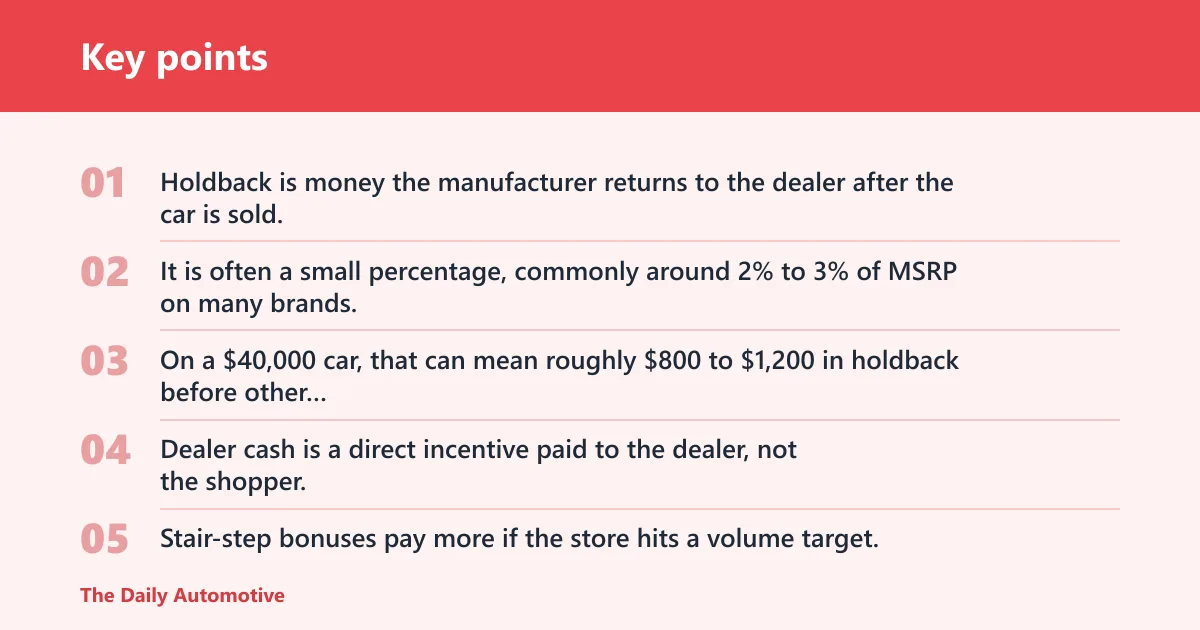
Holdback is money the manufacturer returns to the dealer after the car is sold. It is often a small percentage, commonly around 2% to 3% of MSRP on many brands, though formulas vary. On a $40,000 car, that can mean roughly $800 to $1,200 in holdback before other incentives.
Dealer cash and stair-step bonuses
Dealer cash is a direct incentive paid to the dealer, not the shopper. Stair-step bonuses pay more if the store hits a volume target. That matters because a dealer can accept a thinner front-end gross on one car if it helps unlock a larger monthly or quarterly payout.
Suppose a dealer needs one more unit to hit a bonus tier worth several thousand dollars. A low gross on that final car can still make sense because the bonus is spread across the entire batch of vehicles sold that month. The profit is in the stack, not only in the sticker math.
Why incentives can change dealer profit fast
Incentives move by model and month. A car that was hard to discount in March may carry dealer cash in May. That means the same advertised price can mean very different profit depending on when the deal closes.
Dealer profit stack table
The table below uses simple, hypothetical examples to show how a dealer can profit from different parts of the deal. The numbers are not universal. They are a practical way to see how MSRP, invoice, holdback, incentives, finance, and trade-in gross can combine.
| Scenario | MSRP | Invoice | Holdback | Dealer cash | Front-end gross | F&I add-on profit | Trade-in gross | Estimated net dealer profit per unit |
|---|---|---|---|---|---|---|---|---|
| High-demand model | $48,000 | $46,000 | $960 | $0 | $2,000 | $900 | $0 | $3,860 |
| Average-demand model | $35,000 | $33,500 | $700 | $500 | $1,200 | $800 | $400 | $3,600 |
| End-of-month clearance deal | $32,000 | $30,500 | $640 | $1,500 | -$800 | $700 | $300 | $2,340 |
The last row shows the key point: a negative front-end gross does not always mean the dealer loses money. In real life, the store may also be chasing a volume bonus that is not shown in a single-unit table.
What parts of a deal make dealers money?
Dealers make money in more than one place. The front-end gross is the profit on the vehicle sale itself. Back-end profit comes from financing, service contracts, GAP insurance, prepaid maintenance, and accessory markup. Trade-in gross can also add hidden profit if the appraisal leaves room.
Front-end gross profit
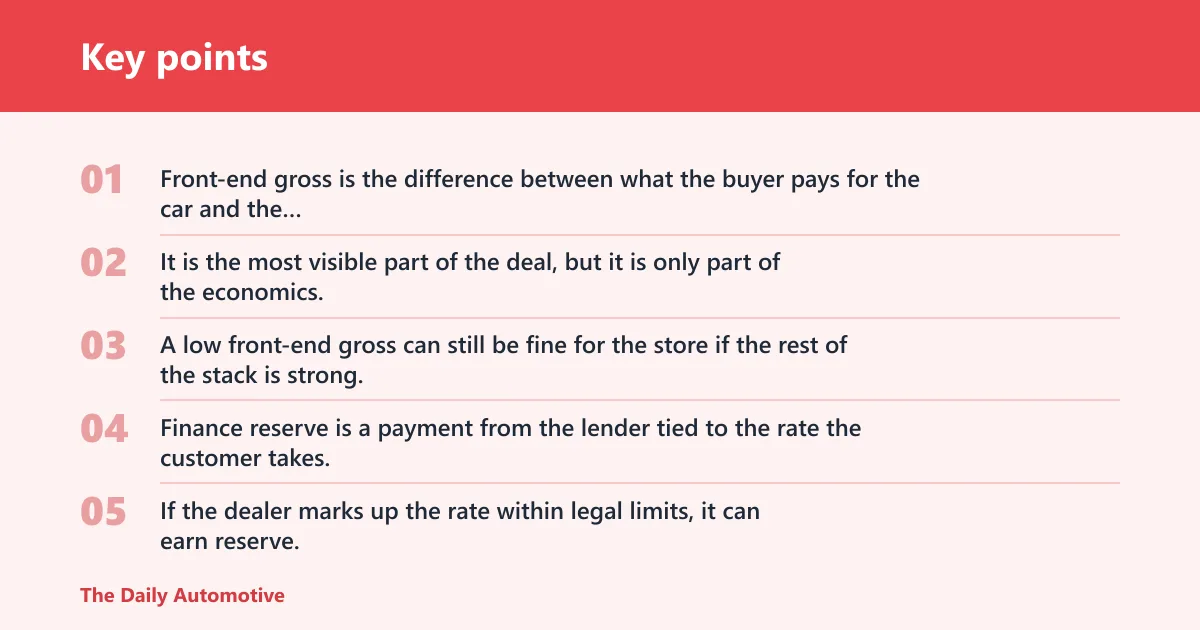
Front-end gross is the difference between what the buyer pays for the car and the dealer’s effective cost after invoice, holdback, and incentives. It is the most visible part of the deal, but it is only part of the economics. A low front-end gross can still be fine for the store if the rest of the stack is strong.
Back-end profit from finance and add-ons
Finance reserve is a payment from the lender tied to the rate the customer takes. If the dealer marks up the rate within legal limits, it can earn reserve. Add-ons such as extended warranty, GAP insurance, and prepaid maintenance can carry strong margins too, especially if the buyer rolls them into the contract.
Trade-in gross and appraisal spread
Trade-in gross is the amount the store builds into the used car side of the transaction. A dealer may offer a lower trade value while keeping the new-car price attractive, or vice versa. Picture a shopper focused only on the new-car discount: a shortfall of about $1,500 on the trade can erase a seemingly great $1,000 price cut.
Can a dealer sell below invoice and still profit?
Yes. A dealer can sell below invoice and still make money if holdback, dealer cash, finance reserve, trade-in gross, or a volume bonus helps offset the thin front-end margin. Below-invoice pricing is more likely at month-end, on slow-moving inventory, or when the store is pushing to hit a manufacturer target.
How volume bonuses change the math
Volume bonuses can turn a weak single-car deal into a profitable month. If the store earns a sizeable quarterly payout for hitting a sales target, it may accept a smaller margin on one unit to keep the whole batch on track. The bonus is often invisible to shoppers, which is why the posted price can look sharper than the dealer’s actual position.
When below-invoice pricing is more likely
Below-invoice pricing shows up most often on aging inventory, unpopular trims, and deals where factory incentives are unusually strong. It is less common on short-supply models. If a car is in demand and available in limited numbers, the dealer has less reason to cut deep on the front end.
How can you tell if a quote is close to dealer invoice?
Start by comparing the selling price to invoice, then add back any dealer cash, holdback estimate, and fees that are not built into the advertised number. A quote that sits near invoice may still leave profit room if the dealer packs in accessories, a large doc fee, or a trade allowance with hidden spread.
What to compare on the worksheet
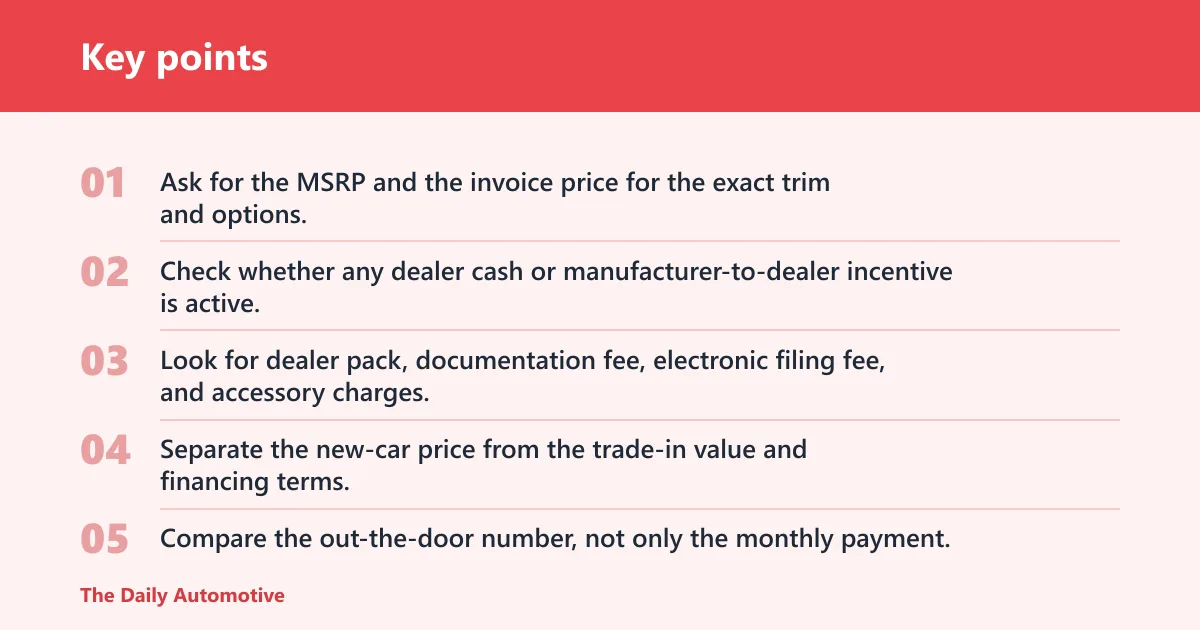
- Ask for the MSRP and the invoice price for the exact trim and options.
- Check whether any dealer cash or manufacturer-to-dealer incentive is active.
- Look for dealer pack, documentation fee, electronic filing fee, and accessory charges.
- Separate the new-car price from the trade-in value and financing terms.
- Compare the out-the-door number, not only the monthly payment.
Fees, add-ons, and hidden profit points
A low advertised price can be padded elsewhere. Common profit points include nitrogen tire fills, paint protection, wheel protection, VIN etching, and preinstalled accessories. Some of these may have real value; others are simply margin items. If the store cannot explain each line clearly, treat it as negotiable.
A common first-timer mistake is focusing on the payment alone. Suppose a shopper gets $500 off the sticker on a compact crossover but accepts a high APR and a trade allowance that is about $1,200 below market. The monthly number can look fine while the deal still leaves room for the dealer to profit.
Questions to ask before you sign
Ask for the selling price, all fees, the rate markup if financing, the value assigned to the trade, and which add-ons are optional. Then ask whether any dealer cash, incentive, or bonus is already built into the quote. If the answers are vague, the offer is not fully transparent.
Frequently asked questions
How much profit does a dealer make on a new car?
A common range is about $1,000 to $3,000 gross profit per new car, but that figure can move a lot by model and market. The final result depends on front-end gross, holdback, incentives, finance reserve, and trade-in spread. A low selling price does not always mean low dealer profit.
What is the average profit margin on a new car?
There is no stable margin that fits every new-car sale. On the vehicle itself, the gross margin can be thin, especially on competitive or heavily discounted models.
How much profit does a dealership make?
That depends on the store’s mix of new cars, used cars, service, parts, finance, and manufacturer bonuses. A dealership can earn very different profits from two similar new-car deals if one includes a trade-in with spread and a finance contract with reserve, while the other does not.
What parts of a new-car deal make the dealer money?
Dealer pack and admin fees also matter because they raise the store’s effective cost structure or add direct revenue. The full deal matters more than the sticker price alone.
Can a dealer sell below invoice and still make money?
Yes. A dealer can still profit below invoice if holdback and factory incentives reduce the effective cost, or if the store earns money from financing, add-ons, trade-in spread, or a volume bonus. That is why a below-invoice quote is not automatically a loss leader.
How can I tell if a new-car offer is close to dealer invoice?
Compare the quote to invoice on the exact trim, then look for dealer cash, holdback, doc fees, accessories, and finance markup. Also separate the trade-in and financing terms from the vehicle price. If the dealer will not itemize those pieces, the quote may hide profit elsewhere.
Products related to this article
Sponsored / affiliate links. As an Amazon Associate I earn from qualifying purchases. I may earn additional commission from eligible campaigns.