Do You Need Rental Car Insurance If You Have Your Own?
If you already carry liability, collision, and comprehensive on your own auto policy, you may not need the rental counter’s damage waiver. Skip the wrong coverage, and you can end up paying for a stolen car, a smashed bumper, or a denied claim. This guide shows when your policy is enough, when a credit card fills the gap, and when the rental desk add-on still makes sense.
This guide is part of our Car Dealer Money Guide: Negotiating, Financing, Leasing, Trading In and Selling series.
Do you already have enough coverage?
Maybe, but only if your current policy, your card benefit, and the rental terms all line up. Personal auto insurance often extends to rental cars for personal use in the U.S. and Canada, but coverage can vary and may exclude some countries or rentals booked abroad. Liability and vehicle damage are separate checks. A waiver at the counter does not replace liability coverage.
What personal auto insurance usually covers
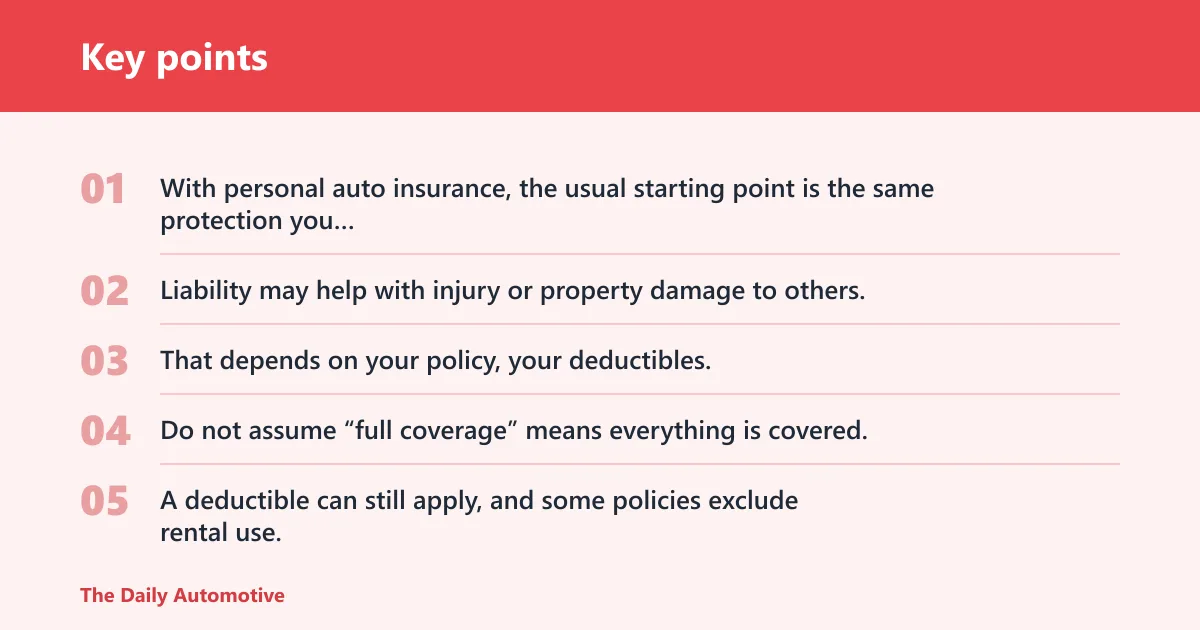
With personal auto insurance, the usual starting point is the same protection you already carry on your own car. Liability may help with injury or property damage to others, while collision and comprehensive may help with damage to the rental car itself. That depends on your policy, your deductibles, and whether the rental fits the policy terms.
Do not assume “full coverage” means everything is covered. A deductible can still apply, and some policies exclude rental use, certain vehicle classes, or trips outside your normal territory.
Where the gaps start
The gaps usually show up in four places: deductible exposure, limited rental value, excluded vehicles, and misuse. Your policy may cover a rental car for personal use, but some policies exclude certain vehicle classes, so a large SUV or specialty vehicle may fall outside your coverage. It may also leave you exposed if the rental company charges loss-of-use or towing and your policy does not.
Credit card benefits can help with damage to the rental car, but they commonly skip liability, personal belongings, and medical bills. That is why the decision has to be split by coverage type.
Why liability is a separate check
Liability is not the same thing as damage coverage. CDW or LDW waives your responsibility for damage or theft of the rental vehicle, but it does not automatically pay for injuries or property damage you cause to others. If your own policy does not travel with you, or does not provide enough liability, SLI may matter.
Rental coverage matrix
This matrix separates what you already have, what is usually covered, what may still be missing, and whether the rental company add-on is worth buying. Use it as a quick filter, then confirm the details with your insurer and card issuer before you book.
| What you already have | What is usually covered | What is still missing | Buy the rental company add-on? |
|---|---|---|---|
| Personal auto insurance only | Often liability, and if you carry collision and comprehensive, damage or theft of a rental used for personal travel in the U.S. and Canada | Deductible, rental exclusions, some vehicle types, loss-of-use charges, and possibly limited rental value | Maybe. Consider it if the deductible is high, the car is expensive, or the policy has exclusions |
| Credit card only | Usually damage protection for the rental car; some premium cards offer primary coverage | Liability, personal belongings, medical expenses, and often claim friction or coverage tied to card rules | Often yes for liability and possibly CDW or LDW, especially if you have no personal auto policy |
| Both coverages | Damage and theft may be covered by your policy or card, while liability may come from your auto policy | Deductible, policy limits, exclusions, and any mismatch between card rules and rental terms | Usually no for damage, but SLI or other add-ons may still help if liability is thin |
| No personal car insurance | Credit card damage coverage may apply if the rental qualifies; some cards convert secondary to primary if there is no other policy | Liability, medical costs, personal items, and often business or international gaps | Usually yes. You may need CDW or LDW, plus liability protection if it is not already included |
How personal auto insurance applies to rentals
Personal auto insurance often covers rental cars for personal trips in the U.S. and Canada, but only within the limits of your policy. If you carry collision and comprehensive, those coverages may extend to a rental car. Liability usually comes from the same policy, but the rental agreement can still create extra charges.
Damage, theft, and deductibles
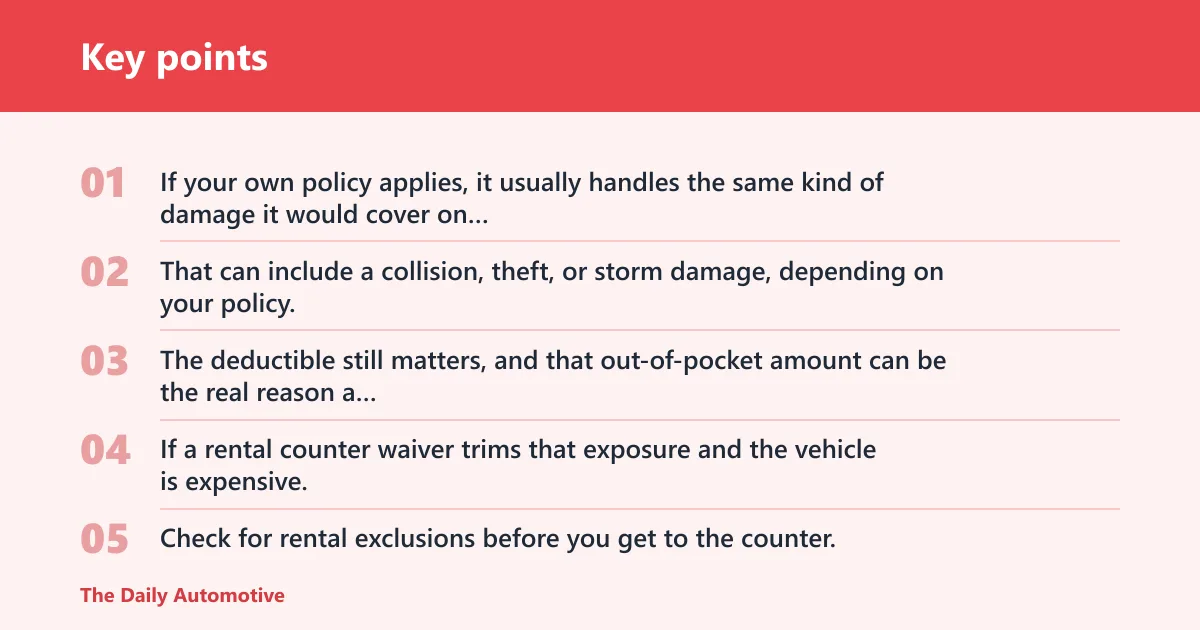
If your own policy applies, it usually handles the same kind of damage it would cover on your own car. That can include a collision, theft, or storm damage, depending on your policy. The deductible still matters, and that out-of-pocket amount can be the real reason a traveler buys the waiver.
Deductibles can be substantial. If a rental counter waiver trims that exposure and the vehicle is expensive, the fee may be easier to justify than a large claim bill later.
Rental exclusions in your policy
Check for rental exclusions before you get to the counter. Some policies exclude certain vehicles like pickup trucks, vans, and motorcycles. Others limit coverage by country, business use, or vehicle type. Coverage can also fail if the driver is not authorized under the rental contract.
Say your policy covers a compact sedan for a weekend trip, but you switch to a full-size cargo van on the spot. That one change can move you from covered to uncovered if your policy excludes vans.
Business trips and international trips
Business rentals and international rentals are often reported as common failure cases. A personal auto policy may not apply to business use, and many card benefits are written for rentals in certain countries only. If the trip is outside the U.S. or Canada, or the rental is for work, ask both your insurer and card issuer before you reserve.
Some rental-company coverage in Europe starts with collision damage, theft, and third-party coverage, but the structure can differ from what U.S. travelers expect. Do not rely on that difference without reading the contract line by line.
What credit card rental coverage really does
Credit card rental coverage usually helps with damage to the rental car, not everything around it. Some cards provide secondary coverage, so they pay after your personal policy. Premium cards can offer primary rental car insurance, which can simplify the claim if the rental car is damaged or stolen.
Secondary versus primary coverage
Secondary coverage means the card benefit steps in after any other valid insurance pays. Primary coverage can pay first, which may reduce hassle and keep the claim away from your personal auto insurer. Some credit cards may convert secondary coverage to primary if you have no other policy, but you still need to meet the card’s rules.
What cards usually exclude
Card benefits often exclude liability, personal belongings, and medical expenses. They may also exclude certain vehicles and certain countries. Coverage may fail if you do not pay with the card, if the rental is not in your name, or if the vehicle is outside the card’s size or class limits.
That matters at the counter. A card that covers damage to the rental car still leaves you exposed if you hit another vehicle or injure someone.
What you must do to qualify
- Pay for the rental with the qualifying card.
- Rent in your own name.
- Decline the rental company’s duplicate damage waiver when the card requires it.
- Verify country and vehicle-class limits before booking.
- Ask the card issuer whether the benefit is primary or secondary for your trip.
Do you need the counter add-ons?
You do not always need the rental company’s add-ons, but some of them fill real gaps. CDW or LDW handles damage or theft of the rental car. SLI can cover injury or property damage to other people. PAI and PEC are separate products, and they are usually worth buying only when you lack better coverage already.
CDW and LDW
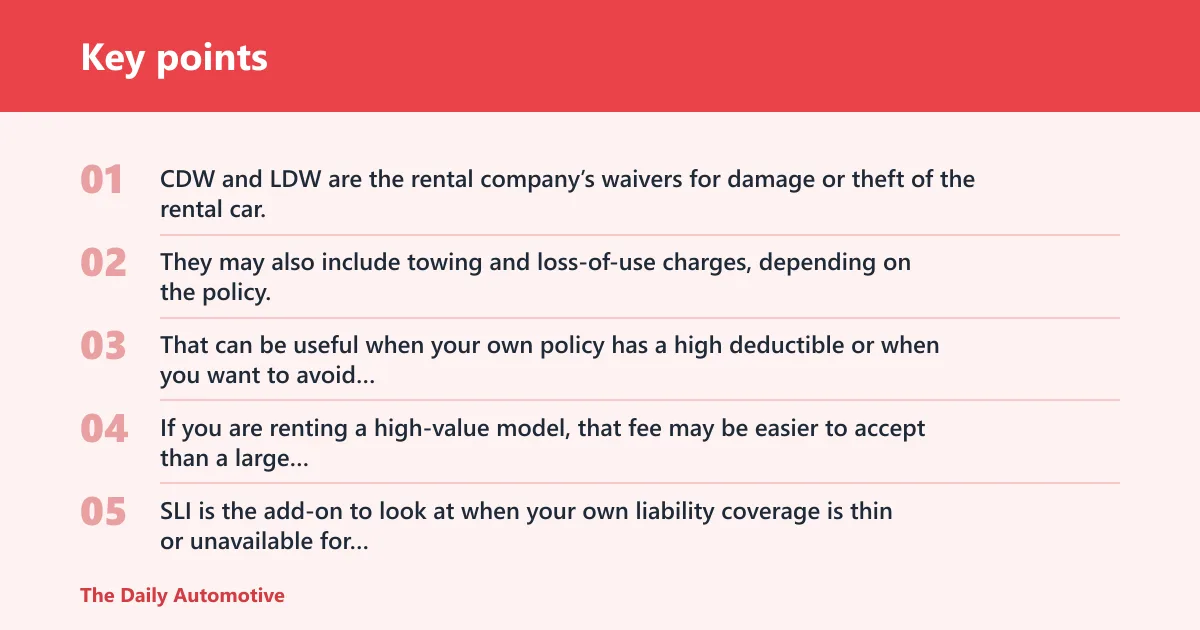
CDW and LDW are the rental company’s waivers for damage or theft of the rental car. They may also include towing and loss-of-use charges, depending on the policy, and many major rental-company waivers vary by location and brand. That can be useful when your own policy has a high deductible or when you want to avoid a claim on your personal insurance.
Rental car insurance can add a daily fee. If you are renting a high-value model, that fee may be easier to accept than a large repair bill plus claim friction.
Supplemental liability insurance
SLI is the add-on to look at when your own liability coverage is thin or unavailable for the trip. Rental companies may sell separate liability coverage. That can matter if your personal policy does not follow you, or if the country’s minimums are lower than you want.
Rental companies may provide minimum liability coverage in some states, but the amount and availability vary by state and contract. That minimum may not be enough for a serious crash, so check your own limits before you skip SLI.
Personal accident and personal effects coverage
PAI helps with medical costs for the driver and passengers after an accident. PEC covers belongings stolen from the rental car. Both are separate from collision and liability coverage, and both can overlap with health insurance, MedPay, PIP, homeowners, or renters coverage.
These add-ons are usually not the first things to buy. If you already have health coverage and decent property coverage, they may be redundant.
When declining coverage can backfire
Declining the rental company’s offer can save money, but it can also leave you exposed if the rental terms are strict or if your own coverage does not respond the way you expected. Problems often show up after an accident, during a claim review, or when the rental company charges fees your policy does not cover.
Accidents and claim delays
If you decline the waiver and the car is damaged, the rental company may bill you first and let the insurers sort it out later. That can mean a deductible, paperwork, and a delay before reimbursement. If your card benefit is secondary, your personal policy may have to answer first.
Suppose you back a mid-size SUV into a pillar and crack the rear bumper. If your policy has a $1,000 deductible and the rental company adds loss-of-use charges, the damage total can be larger than the repair itself.
Vehicle type and country limits
Some rental coverage may exclude certain vehicles like pickup trucks, vans, and motorcycles. International rentals can add another layer of risk because your personal policy and card benefit may not apply in the country you chose. Even where coverage exists, the contract can define the limits more narrowly than you expect.
Misuse and contract violations
Violating the rental contract or using the vehicle contrary to the agreement can void protection. Unauthorized drivers can do the same. If you breach the rental terms, the waiver may not protect you, and you could be fully responsible for the damage, theft, or fees tied to the incident.
That is why the counter script matters. Ask whether the waiver covers windows, wheels, interior damage, towing, and loss-of-use charges. A CDW may still leave windows, wheels, or interior damage uncovered.
What to check before you rent
Before you decline anything, check four things: your auto policy, your card benefit, the rental country, and the vehicle class. Ask your insurer whether the rental is covered for personal or business use. Then ask your card issuer whether the benefit is primary, what it excludes, and whether you must decline the rental company waiver to qualify.
If the answers do not line up, buy what closes the gap. That may be the waiver, SLI, or simply a different vehicle choice.
Frequently asked questions
Do you need rental car insurance if you have your own car insurance?
Not always. If your policy includes liability, collision, and comprehensive, it may already cover a rental for personal use in the U.S. or Canada. Still, check the deductible, rental exclusions, vehicle class limits, and whether the policy covers business or international travel before you decline the counter offer.
Does my personal auto insurance cover a rental car?
Often, yes, for personal use. Many policies extend liability and, if you carry collision and comprehensive, damage coverage to a rental car. That coverage is not automatic in every case, so confirm the country, the vehicle type, and any deductible that would apply if there is a claim.
What rental car insurance do credit cards cover?
Most card benefits focus on damage to the rental car, and some are secondary rather than primary. Premium cards can offer primary rental car insurance. These benefits commonly exclude liability, medical costs, and personal belongings, so a card is not a full substitute for every kind of coverage.
Does rental car insurance cover liability too?
Usually not by itself. CDW and LDW cover damage or theft of the rental vehicle, while liability covers injury or property damage to other people. If your own auto policy does not provide enough liability, SLI may be the add-on that matters more than the damage waiver.
When should I buy the rental company’s collision damage waiver?
Buy it when your deductible is high, your own policy has exclusions, the vehicle is expensive, or you want to avoid claim friction. It can also make sense when you are renting outside your normal coverage area or when you do not want a claim on your personal insurance record.
Does my insurance cover rental cars for business or international trips?
Not reliably. Business use and international travel are common gaps in personal auto policies and card benefits. Before you book, ask both the insurer and the card issuer whether the trip is covered, which countries qualify, and whether a business rental changes the answer.
Products related to this article
Sponsored / affiliate links. As an Amazon Associate I earn from qualifying purchases. I may earn additional commission from eligible campaigns.