How Much Is SR-22 Insurance for a Car?
SR-22 insurance usually adds about a $15 to $50 filing fee, but the larger cost is often the higher premium your insurer may charge after a serious violation. Ignore it, and you can lose your license, face reinstatement fees, or pay more after a lapse. Here’s how SR-22 cost breaks into monthly premium, filing fee, and state-related surcharges for owners, non-owners, and new car buyers.
What does SR-22 insurance actually cost?
SR-22 cost has three parts: your monthly insurance premium, the one-time filing fee, and the price increase tied to your driving record and state minimums. The filing itself is usually cheap. The premium is where the bill grows, especially after DUI, no-insurance, a suspended license, or repeat violations.
How the bill is built
The SR-22 is a proof-of-financial-responsibility form filed by your insurer with the state DMV or its equivalent agency. It is not a standalone policy. You still need an insurance policy underneath it, and that policy can be an owner policy or a non-owner policy depending on whether you have a car.
Monthly cost changes because insurers price the underlying policy, then add the risk tied to the violation. State minimum liability limits also matter. A state with higher required bodily injury and property damage limits usually pushes the premium up more than a state with lower minimums.
SR-22 cost calculator
| Policy type | Estimated monthly premium range | One-time filing fee range | Notes |
|---|---|---|---|
| Owner SR-22 | $85 to $325 | $15 to $50 | Usually required if you own a vehicle. Price rises with DUI, suspended license, prior claims, or a recent lapse. State minimum liability limits drive part of the premium, and adding collision or comprehensive increases it further. |
| Non-owner SR-22 | $45 to $180 | $15 to $50 | For drivers who do not own a car and do not have regular access to one. Liability-only coverage while driving borrowed cars. Usually cheaper than an owner policy, but state rules and violation history still affect the price. |
How to estimate your monthly payment
Start with the policy type. An owner SR-22 usually costs more than a non-owner filing because it covers a car you own and may include optional physical damage coverage. Then add the violation penalty. A first DUI often costs more than a short lapse in coverage, and a repeat offense usually costs more than either.
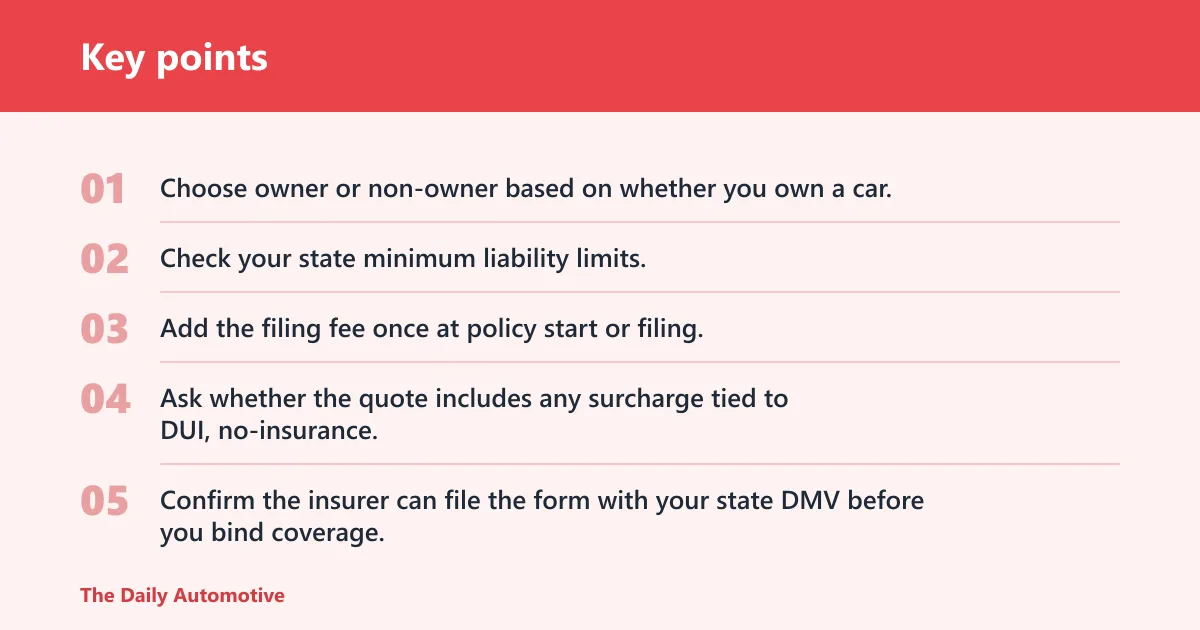
- Choose owner or non-owner based on whether you own a car.
- Check your state minimum liability limits.
- Add the filing fee once at policy start or filing.
- Ask whether the quote includes any surcharge tied to DUI, no-insurance, or suspension history.
- Confirm the insurer can file the form with your state DMV before you bind coverage.
Say your state requires higher liability limits and you have a recent DUI. An owner policy may land near the top of the range because the insurer is rating both the car and the violation. A non-owner policy in the same state can still be noticeably cheaper, but it will not erase the high-risk surcharge.
How much is SR-22 without a car?
Without a car, a non-owner SR-22 is often the cheaper path. It fits drivers who do not own a vehicle, do not have regular access to one, and need proof of liability coverage for reinstatement or a court order. It usually costs less because it does not insure a car you own.
What non-owner coverage does and does not cover
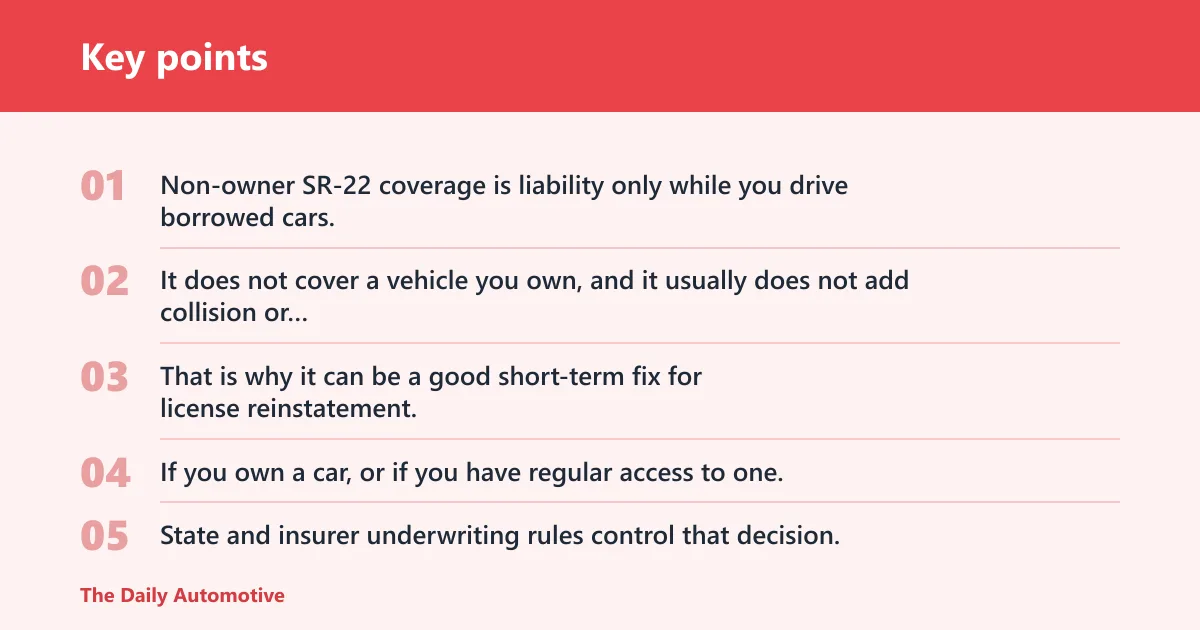
Non-owner SR-22 coverage is liability only while you drive borrowed cars. It does not cover a vehicle you own, and it usually does not add collision or comprehensive for a car sitting in your name. That is why it can be a good short-term fix for license reinstatement, but not a substitute for owner coverage.
Eligibility matters. If you own a car, or if you have regular access to one, an insurer may refuse a non-owner policy. State and insurer underwriting rules control that decision. If you buy a car later, the policy usually has to change right away so the filing stays valid.
Why it is usually cheaper
The insurer is taking on less exposure with a non-owner policy. There is no owned vehicle to repair, replace, or insure for physical damage. Even so, the high-risk driver surcharge can still be substantial if the filing follows a DUI, suspended license, or a lapse in prior coverage.
Picture a driver who is trying to reinstate a license after a no-insurance violation. A non-owner SR-22 may be enough if that driver does not own a vehicle and only borrows one occasionally. If the same driver buys a sedan next month, the policy has to move to an owner form or the filing can become invalid.
How much is SR-22 in South Carolina?
South Carolina SR-22 costs are shaped by the state’s liability minimums, the violation that triggered the filing, and the insurer’s filing fee. South Carolina’s minimum auto liability limits are commonly listed as 25/50/25: about $25,000 bodily injury per person, $50,000 bodily injury per accident, and $25,000 property damage per accident.
Why South Carolina rates vary
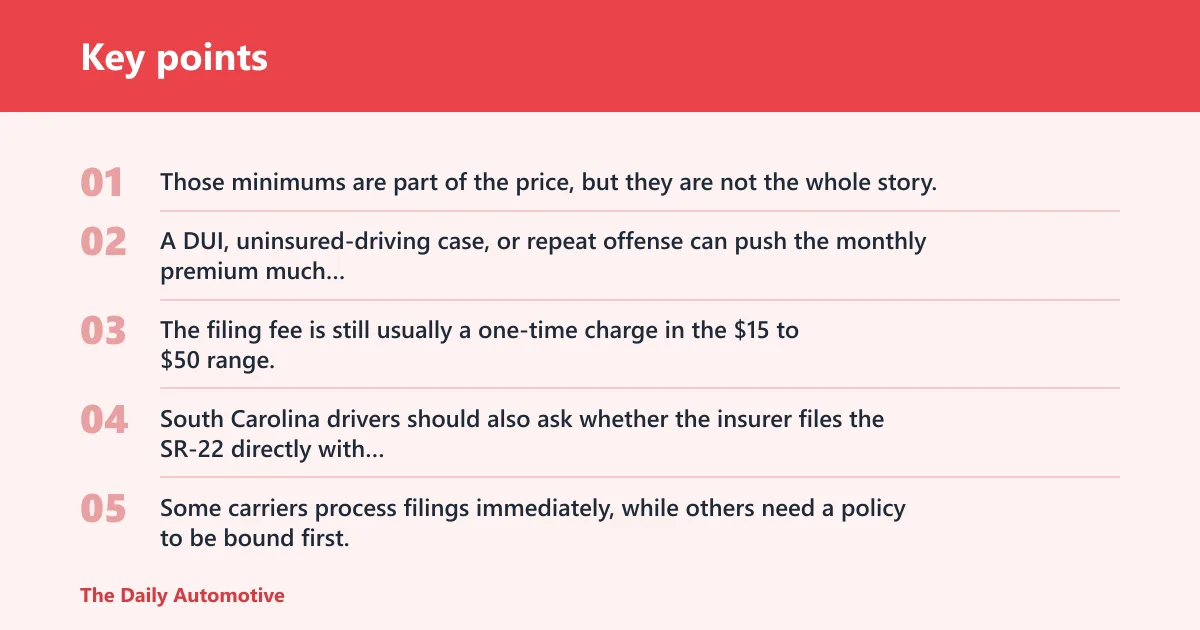
Those minimums are part of the price, but they are not the whole story. A DUI, uninsured-driving case, or repeat offense can push the monthly premium much higher than the same policy would cost for a driver with a clean record. The filing fee is still usually a one-time charge in the $15 to $50 range.
South Carolina drivers should also ask whether the insurer files the SR-22 directly with the DMV and when the filing becomes active. Some carriers process filings immediately, while others need a policy to be bound first. If there is any gap, the state can treat it as a lapse.
What to ask when you compare quotes
Ask for the premium, the filing fee, and the exact liability limits in the quote. If the policy includes collision or comprehensive, ask for those prices separately. A quote that looks low can jump once the insurer adds the SR-22 filing and the higher limits tied to state rules.
Do not compare monthly premium alone. That can hide the filing fee, the liability limits, and the surcharge tied to the violation. Compare the first month’s total cost, then the ongoing monthly payment for the full SR-22 period, from each insurer that can file in South Carolina.
South Carolina and north Carolina are not the same
North Carolina generally does not use SR-22 filings in the same way South Carolina and many other states do. If you are licensed or moving there, you may need a different form or DMV process instead of a standard SR-22. Check the state’s exact requirement before you assume an insurer can file the same paperwork.
What happens if you buy a car after filing?
If you start with a non-owner SR-22 and later buy a car, the policy usually has to switch to an owner SR-22. That change matters because the insurer now has to cover a specific vehicle and meet the state’s minimum liability limits for an owned car. The new premium is usually higher.
How the policy changes
An owner SR-22 can include the required liability limits plus optional collision and comprehensive coverage. Collision pays for crash damage to your car. Comprehensive covers losses like theft, fire, or weather-related damage. Those coverages are optional, but lenders often require them when a car is financed.
Update the insurer before the purchase is final if possible. That gives the carrier time to refile the SR-22 under the new policy type. If you buy the car first and wait, the state may see a coverage gap or an incorrect filing on the record.
What the cost can look like
Moving from non-owner to owner coverage usually raises the monthly premium because the insurer now rates the vehicle itself. The filing fee usually stays in the same low range, but the premium can jump enough to change your monthly budget quickly. That is why drivers should ask for both quotes before buying a car.
How do lapses and reinstatements change the cost?
A lapse can reset the filing requirement and trigger more fees. If your policy cancels, the insurer may notify the state, and you may need a new SR-22 immediately to keep or regain driving privileges. Future quotes can also rise because insurers see the lapse as added risk.
Why continuous coverage matters
SR-22 filings often stay in place for multiple years, and the coverage usually must remain continuous the whole time. If the policy is canceled for nonpayment, switching insurers without a clean handoff, or letting it expire, the state can treat the filing as broken. That can mean reinstatement fees or a longer filing period.
Suppose a driver changes jobs and misses one payment. If the policy cancels, the insurer may stop the filing and the DMV can require proof again. The cheapest way to avoid that spiral is simple: pay on time, keep the policy active, and make sure the new insurer files before the old one ends.
How to lower the premium over time
Compare quotes from several insurers, because SR-22 pricing varies by carrier as well as by state. Ask whether the filing fee is separate from the premium. Then ask whether the insurer offers a lower rate after a clean period, because many drivers pay less once the violation ages and the record improves.
Keep the policy active with no missed payments or coverage gaps during the SR-22 period. Do not add new tickets. Those steps will not erase the filing requirement overnight, but they can reduce the surcharge as the insurer sees fewer problems on the record.
Frequently asked questions
How much is SR-22 insurance without a car?
Non-owner SR-22 insurance often costs about $45 to $180 per month, plus a one-time filing fee of $15 to $50. It is usually cheaper than owner coverage because it does not insure a car you own, but the violation and state rules still shape the price.
How much is SR-22 insurance in South Carolina?
In South Carolina, an SR-22 policy often starts around the same national high-risk range, but the exact amount depends on the violation, the insurer, and the state’s 25/50/25 minimum liability limits. Expect the filing fee to be separate from the monthly premium.
How much is SR-22 insurance in North Carolina?
North Carolina generally does not use SR-22 filings the same way many other states do, so the better question is which form or proof the DMV requires for your case. If an insurer offers related coverage, the price still depends on the violation, vehicle ownership, and liability limits.
How much does SR-22 insurance cost a month?
For many drivers, SR-22 insurance lands around $45 to $325 per month, depending on whether it is a non-owner or owner policy. The biggest swing comes from the violation behind the filing. DUI, suspended-license history, and recent lapses usually push the premium higher.
Can I buy a car with SR-22 insurance?
Yes, but if you buy a car after getting a non-owner SR-22, you usually need to switch to an owner policy and update the filing. That change can raise your monthly cost because the insurer now has to cover the car itself and meet the state’s minimum liability limits for an owned vehicle.
Do I need insurance to get a SR-22?
Yes. The SR-22 is a filing attached to an insurance policy, not a policy on its own. Your insurer files the form with the state after the policy is active or about to become active, so you need qualifying coverage in place before the filing is complete.
Products related to this article
Sponsored / affiliate links. As an Amazon Associate I earn from qualifying purchases. I may earn additional commission from eligible campaigns.