Electronic Ignition Conversion Kits for Classic Cars Explained
An electronic ignition conversion kit replaces a classic car’s breaker points and condenser with a solid-state trigger, most often a Hall-effect module like the PerTronix Ignitor, that bolts inside the stock distributor housing.
Breaker points are a mechanical switch: a rubbing block rides on a cam inside the distributor and opens and closes the points to fire the coil. Over time the contact surfaces pit and wear, the dwell angle drifts out of spec, and at high RPM the points can bounce off the cam lobe and cause misfires. A magnetic or optical trigger has no moving contact surface to wear or bounce, so ignition timing stays accurate for tens of thousands of miles instead of a few thousand.
Most conversion kits, including the three below, install with the factory coil, cap, rotor, and wiring still in place and need no separate ignition box. Budget roughly 30 to 60 minutes of work with basic hand tools, plus a check of base timing with a timing light once the new module is in.
How an Electronic Ignition Conversion Kit Works
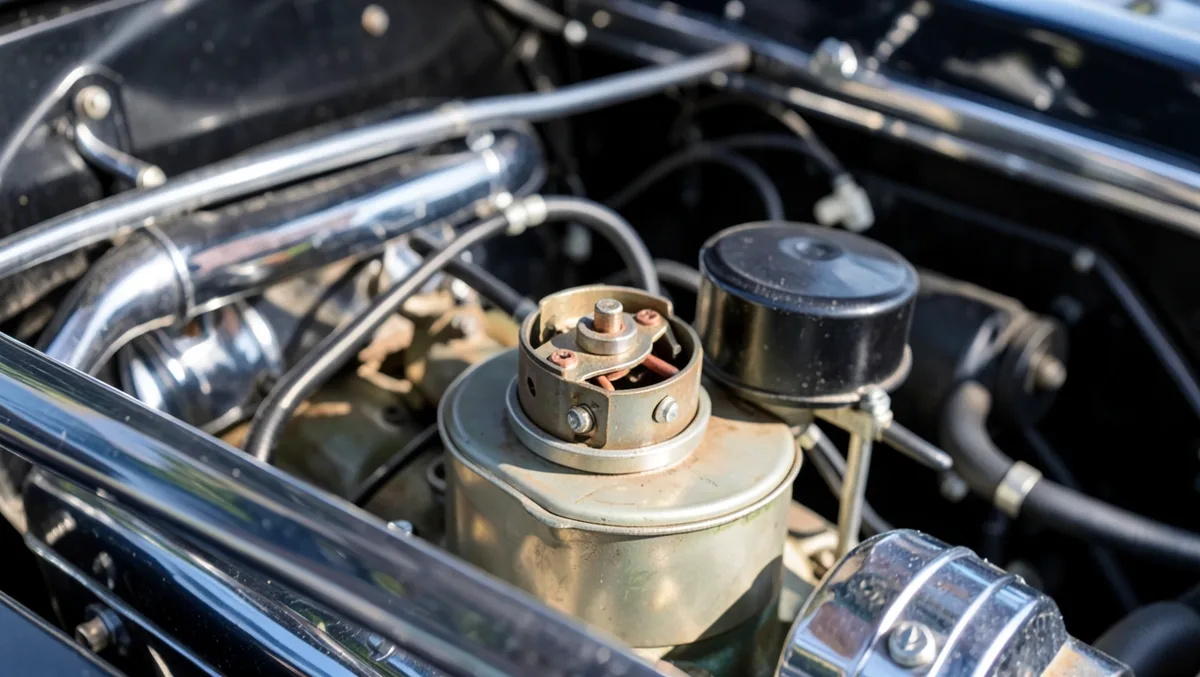
Inside the distributor, the points and condenser get unbolted and pulled out, and the conversion kit’s module takes their place on the breaker plate. A magnet, usually mounted on a rotating vane or on the distributor shaft itself, sweeps past a Hall-effect sensor in the module once per cylinder firing event. The sensor has no physical contact and nothing to wear, so it keeps triggering the coil at the same precise point in the rotation whether the engine has 500 miles or 50,000 miles on the new setup.
Because the module also manages dwell electronically, the coil gets full saturation time at both idle and high RPM, which is what actually produces a hotter, more consistent spark; points-based systems lose dwell as RPM climbs, weakening the spark right when the engine needs it most. The tradeoff is that these kits are matched to a specific distributor family and cylinder count, so confirm your distributor’s application, Ford Motorcraft, Delco, Autolite, or another maker, before ordering.
Sherryberg 4 Cylinder 10 Piece Set Electrical Dky4a Electronic Ignition Kit
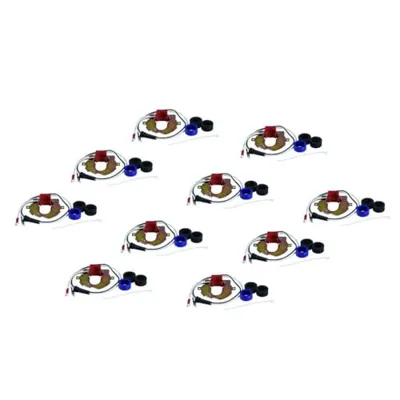
The SherryBerg 4 Cylinder Electronic Ignition Kit is built for 4-cylinder classic car and motorcycle distributors from 1939 to 1954. It swaps the points and condenser for a magnetic Hall-effect trigger, so owners get a modern, wear-free ignition without changing anything visible under the hood.
Pros:
- Compatible with a wide range of classic 4-cylinder distributors from this era.
- No points or condenser to wear, re-gap, or replace.
- Installs on the existing breaker plate with comprehensive instructions included.
- Restores consistent spark timing that a worn points set can no longer hold.
Cons:
- Only suitable for 4-cylinder engines, not larger V8 or inline-6 distributors.
- Listed as a 10-piece bulk set, not a single kit, so double-check the listing quantity before ordering if you only need one for a single car.
- Some installers still prefer a timing light check after fitting for peace of mind.
This kit uses the same Hall-effect trigger principle as the two PerTronix kits below: the points and condenser are removed, and a self-contained magnetic module takes their place, so there is no rubbing block left to wear and no dwell to reset every few thousand miles. Installation reuses the existing coil and wiring, and the included instructions make it approachable even for a first-time distributor rebuild.
To buy this product, click here.
PerTronix Ignitor Electronic Ignition Conversion Kit for Ford, 1247
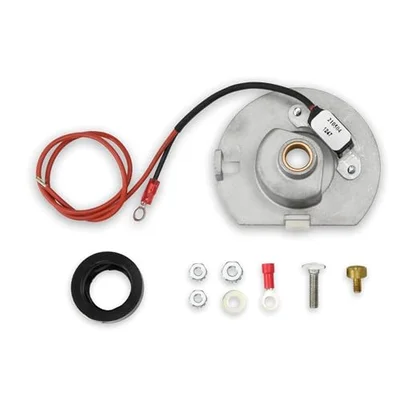
The PerTronix Ignitor 1247 is built specifically for Ford 4-cylinder Motorcraft distributors. It replaces the mechanical points with a solid-state Ignitor module to improve reliability, spark consistency, and timing accuracy, and it installs directly in place of the points on 12-volt negative-ground systems without needing an external ignition box.
The trigger itself uses rotating cobalt magnets that activate a Hall-effect module with no moving parts to wear out, which eliminates point float at high RPM and cuts routine ignition maintenance down to almost nothing. As with any distributor-specific part, fit and results vary by application, so confirm your exact distributor model against the listing before buying.
To buy this product, click here.
Replacement for Pertronix 1181 Ignitor Electronic Ignition Conversion Kit, for 1957-1974 Delco 8 ...
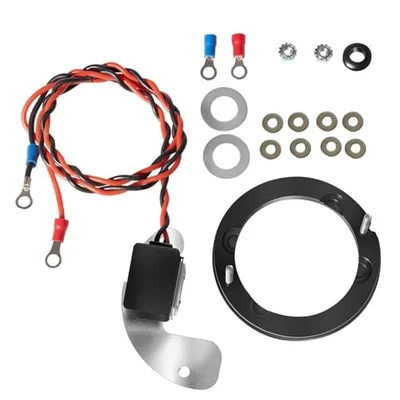
This kit is a direct replacement for the PerTronix 1181 Ignitor, built for 1957 to 1974 Delco 8-cylinder distributors used across GM, Chevrolet, Buick, Oldsmobile, GMC, and Pontiac V8s, plus a handful of 1957 to 1959 and 1963 to 1974 AMC V8s, 1957 to 1974 Buick V8s, 1964 to 1974 Checker V8s, and 1965 to 1966 Studebaker V8s that also used the Delco 8-cylinder distributor.
Because one Delco distributor casting was shared across so many GM brands for nearly two decades, this kit covers an unusually wide range of vehicles, but as with any distributor-specific part, always confirm your exact distributor and model year against the listing before ordering.
To buy this product, click here.
Frequently Asked Questions
What Is An Electronic Ignition Conversion Kit?
An electronic ignition conversion kit replaces the mechanical breaker points and condenser inside a classic car’s distributor with a solid-state trigger, typically a magnet-and-Hall-effect-sensor module such as the PerTronix Ignitor. It bolts to the existing breaker plate and uses the factory coil, cap, and wiring, so the car keeps its original ignition timing curve while gaining a trigger that never wears out or needs re-gapping.
How Does An Ignition Kit Improve Performance?
Points lose dwell time and can bounce as RPM climbs, which weakens or misses the spark right when the engine is working hardest. A Hall-effect module has no contact surface to bounce, so it holds accurate dwell and timing at idle and at redline alike. The result is a more consistent spark, fewer misfires under load, and a steadier idle.
Are Electronic Ignition Kits Easy To Install?
Most bolt-in kits like the ones above replace the points and condenser in place, reusing the factory coil and wiring, and typically take 30 to 60 minutes with a screwdriver, a wrench, and a dwell or timing light. The job is within reach for most home mechanics who have adjusted points before, and it is still worth checking base timing with a timing light after the swap.
Can Electronic Ignition Kits Fit Any Classic Car?
No. Kits are built for a specific distributor family, such as Ford Motorcraft 4-cylinder or Delco 8-cylinder, and will not interchange across brands. Before buying, match your distributor’s manufacturer, cylinder count, and model years; all three kits above list their exact compatibility on the product listing.
Do Ignition Kits Increase Fuel Efficiency?
They can, indirectly. A weak or mistimed spark from worn points leaves some fuel unburned, so restoring a strong, consistently timed spark lets the engine burn fuel more completely. The real-world gain depends on how worn the old points were to begin with: a well-tuned points system and a fresh electronic conversion may run nearly the same, while a neglected one usually shows the bigger improvement.
Conclusion
An electronic ignition conversion kit is one of the few upgrades that makes a classic car more reliable without changing how it looks or drives. Swapping worn points and a condenser for a Hall-effect trigger like the PerTronix Ignitor removes the one ignition part that wears out on its own, so timing stays accurate mile after mile instead of drifting between tune-ups.
The SherryBerg, PerTronix 1247, and PerTronix 1181-style kits above cover a wide range of classic Ford and GM engines, but always match the kit to your distributor’s exact make, cylinder count, and model years before ordering. If you are shopping for a full replacement distributor rather than a conversion kit, our guide to classic car ignition systems and distributors covers those options too.
Installation takes basic hand tools and about an hour, and it is a job most points-savvy home mechanics can handle themselves. Once it is in, expect an easier-starting, smoother-idling engine and one less thing to check at every tune-up.
Products related to this article
Sponsored / affiliate links. As an Amazon Associate I earn from qualifying purchases. I may earn additional commission from eligible campaigns.