3 Best Speaker Kits for Cars (2026): We Compared
The best speaker kit for a car matches your factory opening, power source, and bass goal. For most buyers, the right pick is one of three kits: direct-fit OEM replacement, full-range coaxial upgrade, or bass-first bundle. Buy the wrong one and you can end up with weak output, missing bass, poor fitment, or extra parts that turn a simple install into a wiring project. This guide compares the three paths by fitment, power handling, bass goals, and install difficulty so you can choose the kit that fits your car and your budget.
Quick comparison
| Product | Badge | Best for | Price | ||
|---|---|---|---|---|---|
 |
PowerBass OE65C-GM2-6.5" Direct Fit – GMC OEM ComponentPowerBass | Our pick | 6.5-inch · 2-ohm · component pair | $155.99
Price as of 23 Oct 2026
|
View |
 |
JVC CS-J620 300W 6.5" CS Series 2-Way Coaxial Car Speakers,JVC | Budget pick | 6.5-inch · 4-ohm · coaxial pair | $28.95
Price as of 23 Oct 2026
|
View |
 |
MTX Terminator Dual 12" Subwoofer Box, 1200W Mono Amp, &MTX | Upgrade pick | Dual 12-inch · loaded sub bundle | $309.99
Price as of 23 Oct 2026
|
View |
The core trade-off is simple: a direct-fit kit gives you the easiest factory-style swap, a coaxial upgrade gives you the best low-effort sound improvement from a stock radio, and a bass bundle gives you the most low-end output at the cost of cargo space and install complexity.
If you want the least guesswork, start with fitment. If you want the biggest sound change without rewiring the car, start with coaxials. If bass is the real goal, speaker-only kits will not replace a subwoofer box.
| Kit path | Best use case | Fitment ease | Sound gain | Bass output | Install load | Hidden cost risk | Head-unit match |
|---|---|---|---|---|---|---|---|
| Direct-fit OEM replacement | Factory-style swap with included adapters | High | Moderate | Low to moderate | Low | Low | Usually good |
| Easy full-range upgrade | Clearer mids, highs, and cleaner daily listening | Medium to high | Moderate to high | Low to moderate | Low to medium | Medium | Usually good |
| Bass-first bundle | Strong low end for trunk or cargo-area installs | Low to medium | High for bass only | High | High | High | Needs more checking |
How we chose
These picks were compared on fitment ease, sound gain versus stock speakers, install time, hidden cost risk, and head-unit compatibility. That matters more than chasing the loudest box.
The goal is not to pick the biggest number on a spec sheet. It is to match the kit to your car, your factory radio, and the amount of installation work you actually want to do.
Two things matter immediately: speaker size and impedance. A 4-ohm speaker is commonly used as a factory load, but some direct-fit kits use other loads, so you need to confirm what your radio or amplifier can handle.
A common first-timer mistake is buying a speaker set that fits the opening but not the depth. A 6.5-inch speaker can still hit a window track, and a 6×9-inch swap can still need adapter rings or a spacer to clear the door panel.
Speaker kit decision matrix
This matrix scores the three paths on the factors that usually decide the install. Higher scores are better except for hidden cost, where a lower score means less surprise spending.
| Kit type | Fitment ease | Sound gain | Bass output | Install time | Hidden cost | Head-unit compatibility | One-line recommendation |
|---|---|---|---|---|---|---|---|
| Direct-fit OEM replacement | 9/10 | 6/10 | 4/10 | 9/10 | 2/10 | 9/10 | Pick this if you want the simplest factory-style swap with the least wiring work. |
| Easy full-range upgrade | 7/10 | 8/10 | 5/10 | 7/10 | 4/10 | 8/10 | Pick this if your stock radio is staying and you want clearer sound without adding a separate amp. |
| Bass-first bundle | 5/10 | 7/10 | 10/10 | 4/10 | 8/10 | 6/10 | Pick this if low-end output matters more than trunk space or install simplicity. |
Direct-fit speaker kits: best for OEM replacement
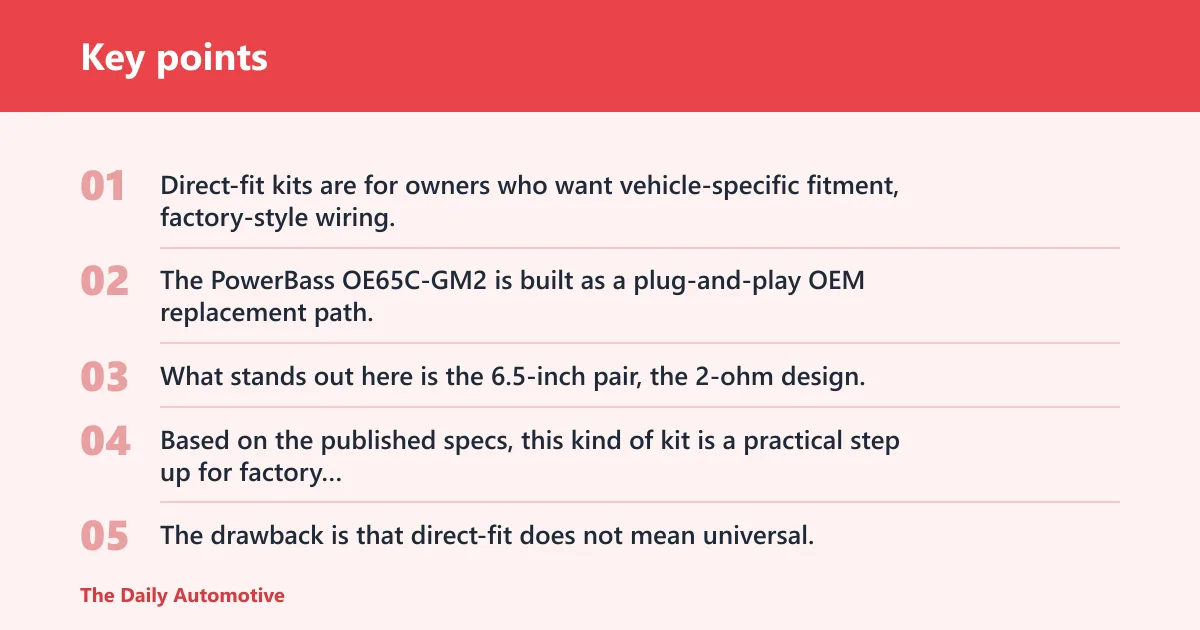
Direct-fit kits are for owners who want vehicle-specific fitment, factory-style wiring, and a low-risk install. The PowerBass OE65C-GM2 is built as a plug-and-play OEM replacement path, and that is the main appeal: less time adapting the door and less chance of needing extra brackets or wire splicing.
What stands out here is the 6.5-inch pair, the 2-ohm design, and the included adapters and silk dome tweeters. Based on the published specs, this kind of kit is a practical step up for factory systems that need a cleaner swap rather than a custom build.
The drawback is that direct-fit does not mean universal. Even a well-matched kit still depends on the right vehicle opening, the right depth, and a factory amplifier or radio that is comfortable with the speaker load. If the factory system expects a 4-ohm speaker, a 2-ohm replacement can change the way the radio or amp behaves.
Why vehicle-specific fitment matters
Vehicle-specific fitment is what cuts out guesswork. When a kit is made for a named platform, it is far more likely to include the wiring pieces and adapters needed to bolt into the factory opening instead of forcing you to cut panels or splice wires.
The same idea applies to factory audio restoration. If you are keeping the car close to stock, direct-fit parts are usually the cleanest path because they are built around the original speaker locations and mounting points.
What included harnesses and adapters solve
Included wiring plugs, adapter rings, and mounting hardware do two jobs. They simplify wiring and they help the new speaker sit correctly in the factory opening. That matters when the original speaker shape, depth, or connector is not standard.
Direct-fit kits are also the easiest way to avoid hidden labor costs. Without those parts, a “simple” speaker swap can turn into a hardware run to the store for spacers, wiring pieces, or screws.
Where this type can fail: depth and impedance
The two common failure points are shallow-depth conflicts and load mismatch. A speaker can fit the label size and still hit the window mechanism behind the door panel.
Impedance matters too. A 4-ohm factory system is common, but the wrong load can reduce volume, strain an amplifier, or make the head unit work harder than it should. RMS power handling matters for the same reason: if the speaker’s continuous rating is far above what the radio can supply, loudness may disappoint until an amplifier is added.
Coaxial speakers: best for easy full-range upgrades
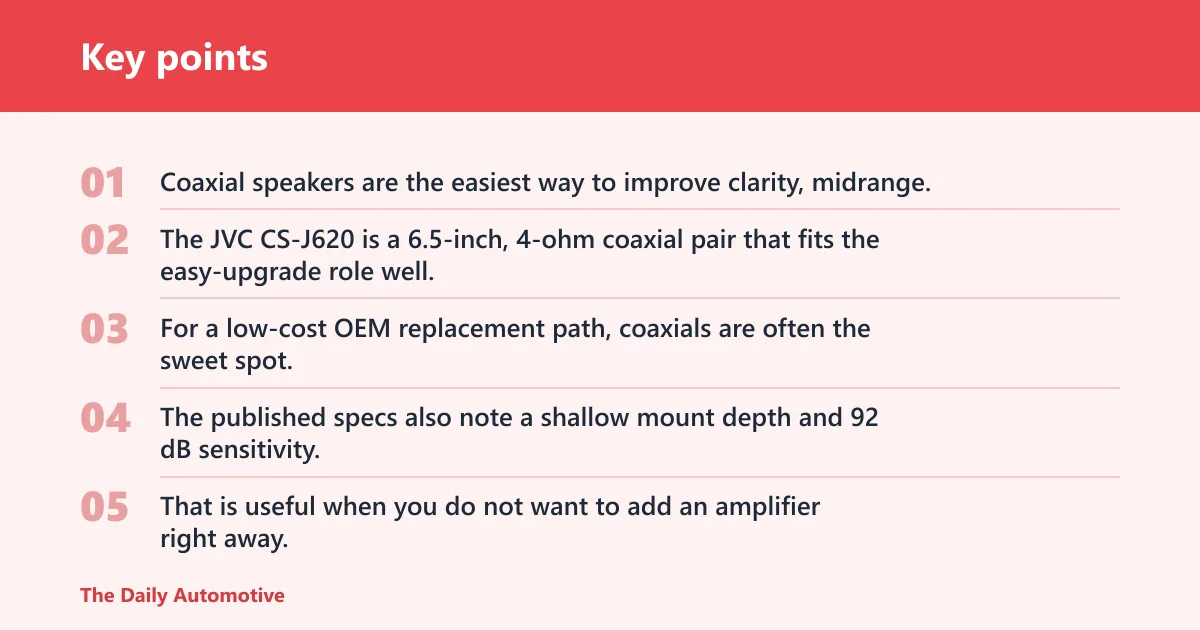
Coaxial speakers are the easiest way to improve clarity, midrange, and treble without adding separate tweeters or an external crossover. The JVC CS-J620 is a 6.5-inch, 4-ohm coaxial pair that fits the easy-upgrade role well, especially for a stock radio and a shallow installation space.
For a low-cost OEM replacement path, coaxials are often the sweet spot. The published specs also note a shallow mount depth and 92 dB sensitivity, which points to easier output from modest factory power. That is useful when you do not want to add an amplifier right away.
The drawback is that coaxials will not stage sound as precisely as a component set. They can sound cleaner than worn factory speakers, but they are still a simpler design, so imaging and top-end placement are usually not as precise as a separate tweeter setup.
2-way and 3-way coaxial differences
A 2-way coaxial speaker uses a woofer and a tweeter in one frame. A 3-way coaxial adds another driver to split the work further, which can help with detail and dispersion when the design is tuned well.
For most daily drivers, the simpler 2-way design is enough. It is usually easier to install, and it still gives the factory radio a clearer target than a tired OEM speaker.
Clarity and midrange gains
Coaxials tend to improve the most obvious weak spots in factory audio: muddy mids, dull highs, and compressed vocal range. That is why they are a strong match for owners who want better sound without a full system rebuild.
If the stock speakers are worn, even a basic coaxial swap can make the system sound more open. Just do not expect speaker-only upgrades to create deep bass that the vehicle did not have before.
When coaxials beat component speakers
Coaxials beat component speakers when simplicity matters more than pinpoint staging. If you want a straightforward install, fewer crossover parts, and less time spent routing tweeter wires, coaxials are the safer choice.
They also make sense when the head unit is staying stock. A modest, efficient coaxial often gives better real-world results than a more ambitious component set that never gets enough clean power.
Component speakers: best for imaging and detail
Component speakers are the better choice when you care more about imaging, detail, and separation than about the fastest install. The PowerBass OE65C-GM2 is a good example of the category path: separate tweeters, included adapters, and a more deliberate upgrade approach than a basic coaxial swap.
The advantage is sound staging. With the tweeter placed separately from the woofer, you can get clearer top-end placement and better front-stage focus. The drawback is installation effort, because separate tweeters and an external crossover add more parts and more wiring decisions.
A component set can also reveal power limits faster than a coaxial. If the head unit is weak, the extra detail may not sound better at all. It may just sound thin until you pair it with an amplifier that matches the RMS rating and impedance correctly.
Separate tweeters and external crossover
The separate tweeter is what gives component speakers their imaging advantage. The external crossover sends the right frequencies to the woofer and tweeter so each driver handles the range it is meant to play.
That crossover adds flexibility, but it also adds install work. You need a place to mount it, plus time to route the wiring cleanly so the system is reliable long term.
Install effort versus sound staging
Component speakers ask more from the installer because the tweeters need placement and the crossover needs space. In exchange, you get a more refined front stage and better left-right separation than many coaxial kits can provide.
Suppose your front doors are tight and your dash has no easy tweeter location. In that case, the install can become more involved than the sound gain is worth unless you are willing to add time and hardware.
When a component set needs an amplifier
A component set often benefits from an amplifier when the factory head unit cannot deliver enough clean power. RMS power handling matters here, because clipping shows up first as harshness, not just as low volume.
If you want a component kit to sound full and controlled, match the amplifier to the speaker’s continuous wattage and impedance. That avoids distortion and gives the set room to perform.
Subwoofer bundles: best for bass-first builds
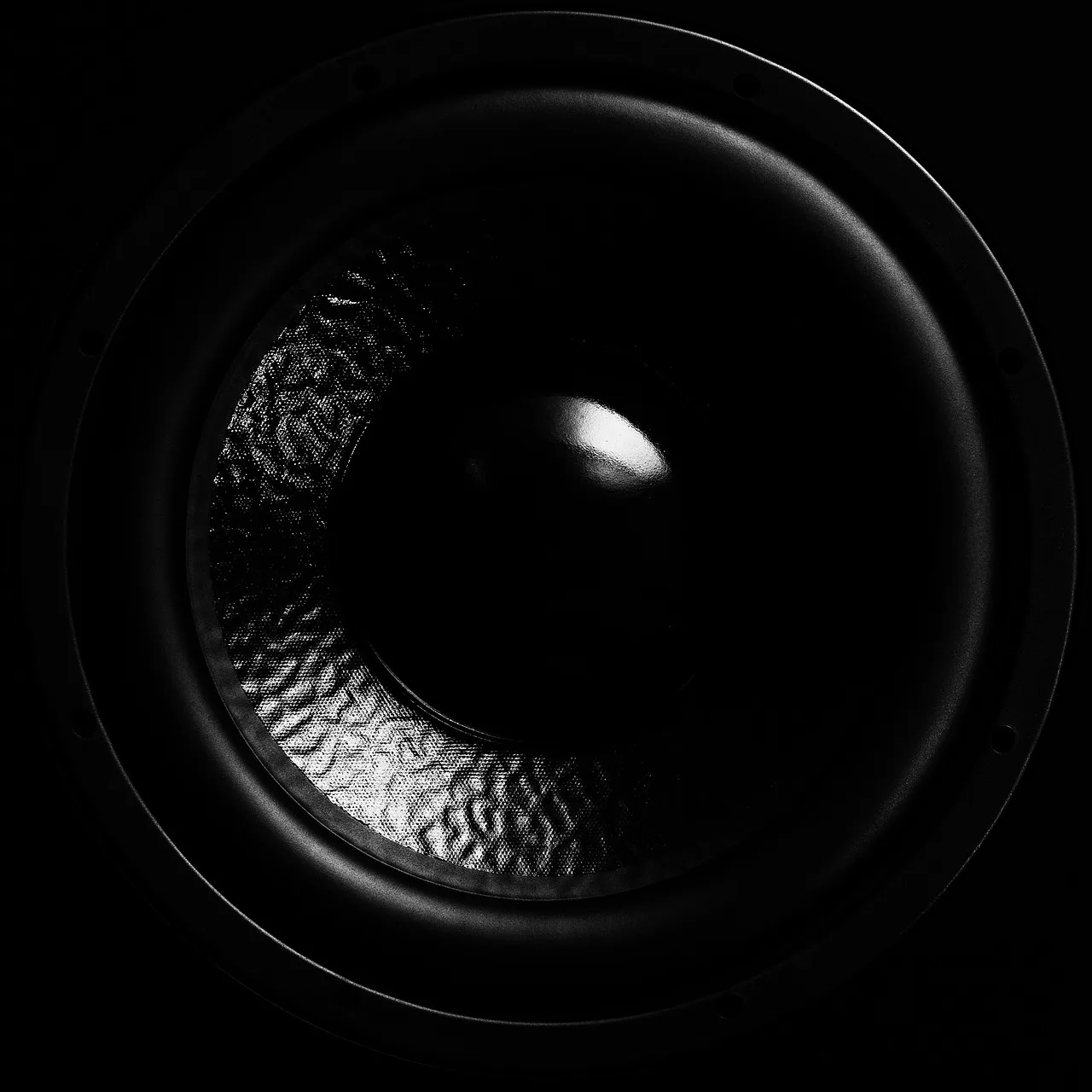
Subwoofer bundles are for buyers who want real low-end output, not just better door-speaker clarity. The MTX Terminator bundle combines dual 12-inch subwoofers, a mono amp, and wiring, so it belongs in the bass-first category rather than the speaker-only category.
Based on the published details, this bundle is the strongest bass-focused path here. It pairs a loaded enclosure with a 1200W mono amp and includes wiring, which simplifies part of the build even though the overall install is still more complex than a speaker swap.
The drawback is obvious: space and system load. A dual 12-inch enclosure takes up cargo room, and bass bundles can create more vibration, more wiring work, and more tuning needs than a simple speaker kit.
Sealed vs ported enclosure
Sealed enclosures usually give tighter, more controlled bass. Ported enclosures usually play louder and lower for a given power level, but they can take more room and need more careful tuning.
When a bundle does not clearly state the enclosure style, you should verify it before buying. The box design affects both output and how much cargo room disappears.
MDF construction and durability
Enclosure material matters because it affects rigidity and resonance. MDF is a common choice because it is dense, durable, and easier to build into a rigid box that supports bass performance.
The MTX enclosure is built from 5/8-inch MDF, which is a useful sign that the box is meant for structure rather than flimsy packaging. That does not make it small, though, and it does not reduce the trunk-space trade-off.
Amplifier pairing and cargo-space impact
Subwoofer bundles depend on amplifier pairing more than the average speaker swap. The amp must match the sub load and power target, or the system can clip early and sound strained.
For daily driving, the real question is whether the bass gain is worth the cargo loss. If you carry strollers, tools, luggage, or groceries often, a large sub box can become annoying fast.
What size speaker kit fits your car?
The right size depends on the vehicle year, make, and model, plus the mounting depth behind the panel. Common fit sizes include 6.5-inch, 6×9-inch, 6×8-inch, and 3.5-inch speakers, but the opening alone does not tell the whole story.
You also need to check whether the car uses adapter rings, factory brackets, or a deeper-than-average basket. A speaker that matches the opening but not the depth can still fail at install time.
6.5-inch, 6×9-inch, 6×8-inch, and 3.5-inch fitment
6.5-inch speakers are common in doors and rear decks. 6×9-inch speakers are often used where more cone area is possible, while 6×8-inch speakers show up in many Ford applications. 3.5-inch speakers are usually dash or rear-fill sizes.
Size alone is not enough. You still need to confirm the shape, mounting tabs, and depth against your specific trim level and audio package.
Mounting depth and adapter-ring checks
Mounting depth is the detail that catches many buyers off guard. A shallow speaker can fit where a deeper basket will not, and a spacer may be needed to clear the glass or door hardware.
Adapter rings and mounting hardware matter because they stabilize the speaker and keep the cone aligned. Without them, fit can be loose, noisy, or impossible to finish cleanly.
How to verify your year, make, and model
- Check the exact vehicle year, trim, and audio package.
- Measure the factory opening and note the mounting depth.
- Confirm speaker impedance and whether the system uses an external amplifier.
- Match the kit’s wiring plugs, adapter rings, and hardware to the car.
- Verify whether the install keeps the stock radio or adds an amp.
Say your 2018 truck needs a 6×8 door speaker, but the chosen 6.5-inch kit includes a shallow basket and no adapter ring. The opening may look close enough, but the wrong depth or bracket shape can still stop the install cold.
Which one should you buy?
Choose direct-fit if you want the simplest factory-style swap, especially if the factory radio is staying in place and you care most about fit and installation speed. Choose coaxial if you want better clarity from a stock radio and do not want a more involved front-stage build.
Choose component speakers if you want better imaging, separate tweeters, and are willing to spend more time on placement and wiring. Choose a subwoofer bundle if bass matters more than cargo space and you are ready for a larger install and amp pairing.
If your goal is restoration, the PowerBass route is the right shape. If your goal is a cheap clarity upgrade, the JVC style of coaxial is the better fit. If your goal is real low end, the MTX bundle is the one that changes the system most.
Do not buy an amplifier bundle just because it looks more complete. If the car only needs clearer mids and highs, a direct-fit or coaxial kit is usually the better value and the lower-risk install.
Frequently asked questions
What is the best speaker kit for my car?
The best speaker kit is the one that fits your exact vehicle opening, matches the factory or added amplifier load, and aligns with your sound goal. For most drivers, that means a direct-fit replacement for easiest install, a coaxial upgrade for better daily sound, or a bass bundle if low-end output is the priority.
Do I need a speaker kit or just new speakers?
You need a speaker kit when the install requires vehicle-specific wiring pieces, adapter rings, or brackets. If your car uses an unusual connector or mounting pattern, the kit saves time and reduces mistakes. If the replacement speakers are standard and the hardware is already compatible, separate speakers may be enough.
Which speaker kit fits a Ford F-150?
For the exact vehicle matches listed here, the KICKER DS Series kit fits Ford F-150 models from 2015 to 2025, and the SONICELECTRONIX DS6804 fits Ford F-150 models from 1999 to 2014. Always verify trim and audio package before ordering, since factory audio layouts can vary.
Are component speakers better than coaxial speakers for cars?
Component speakers are better when you want more precise imaging, better tweeter placement, and a more refined front stage. Coaxials are better when you want easier installation and a simpler upgrade from factory speakers. The better choice depends on how much install effort you want to accept.
What size car speakers do I need?
The size depends on the vehicle’s year, make, model, and speaker location. Common sizes are 6.5-inch, 6×9-inch, 6×8-inch, and 3.5-inch, but mounting depth and adapter fit matter just as much. Measure first, then confirm the opening and bracket style.
Can I install a speaker kit without an amplifier?
Yes, many speaker kits can run from a factory head unit, especially efficient coaxials and direct-fit replacements. The trade-off is output. If the speaker’s RMS rating is much higher than what the radio can supply, volume and clarity may be limited until an amplifier is added.
Products related to this article
Sponsored / affiliate links. As an Amazon Associate I earn from qualifying purchases. I may earn additional commission from eligible campaigns.