Michelin Defender Tire Review for Daily Driving
Michelin Defender tires suit high-mileage commuting, low cabin noise, and steady wet grip. Pick them for everyday driving, but skip them if you need serious winter traction or quicker steering response. The wrong touring tire costs you in uneven wear, extra road noise, longer stopping distances, or money spent on weather performance you never use. This guide sorts the Defender line by climate, mileage, and vehicle fitment, then compares it with key alternatives for daily use.
Verdict on the Michelin Defender
The Michelin Defender is worth a look for commuting first, comfort second, and sporty response last. It fits drivers who want a premium touring tire with long warranty coverage and quiet manners, then spend most of their time on paved roads in dry, wet, and lightly mixed weather.
Where the Defender wins
Its main strengths are long treadlife positioning, calm highway behavior, and a wet-road bias that should suit routine rain driving. Michelin positions the Defender 2 as a Standard Touring All-Season tire with an 80,000-mile treadwear warranty on applicable sizes, and that puts it squarely in the mileage-first commuter lane.
It also makes sense if you want one tire to handle school runs, freeway miles, and ordinary city use without the firmer ride that often comes with sportier touring tires. The low rolling resistance pitch can also matter for drivers who watch fuel use closely.
Where it falls short
The Defender is not the right answer for deep snow, drivers who want crisp turn-in, or owners who routinely carry heavy loads and need a more truck-focused setup. Light snow use is one thing. True winter readiness is another.
It can also be a poor value if you buy extra winter capability you will barely use, or if your climate keeps the tread wet for long stretches and you really want stronger wet grip than a mileage-first touring tire usually offers.
Pros and cons
Pros
- Built around long tread life for daily commuting.
- Quiet highway manners and comfort-focused touring tuning.
- Available in the Defender family for passenger cars and truck/SUV fitments.
- Wet-road design priorities include hydroplaning resistance and water evacuation grooves.
- Some sizes carry an 80,000-mile treadwear warranty.
Cons
- Not severe winter rated, so it is not a winter-tire substitute.
- Not the choice for sharp steering feel or sporty road response.
- Warranty coverage applies only to applicable sizes.
- Premium pricing can make the value case weak for low-mileage drivers.
- Load range and fitment need careful checking, especially on larger vehicles.
Who it’s for
The Defender family fits drivers who want a touring tire for ordinary pavement and expect a lot of highway or commuting miles. It is a strong match for people who value comfort, long wear, and easy daily driving more than cornering feel.
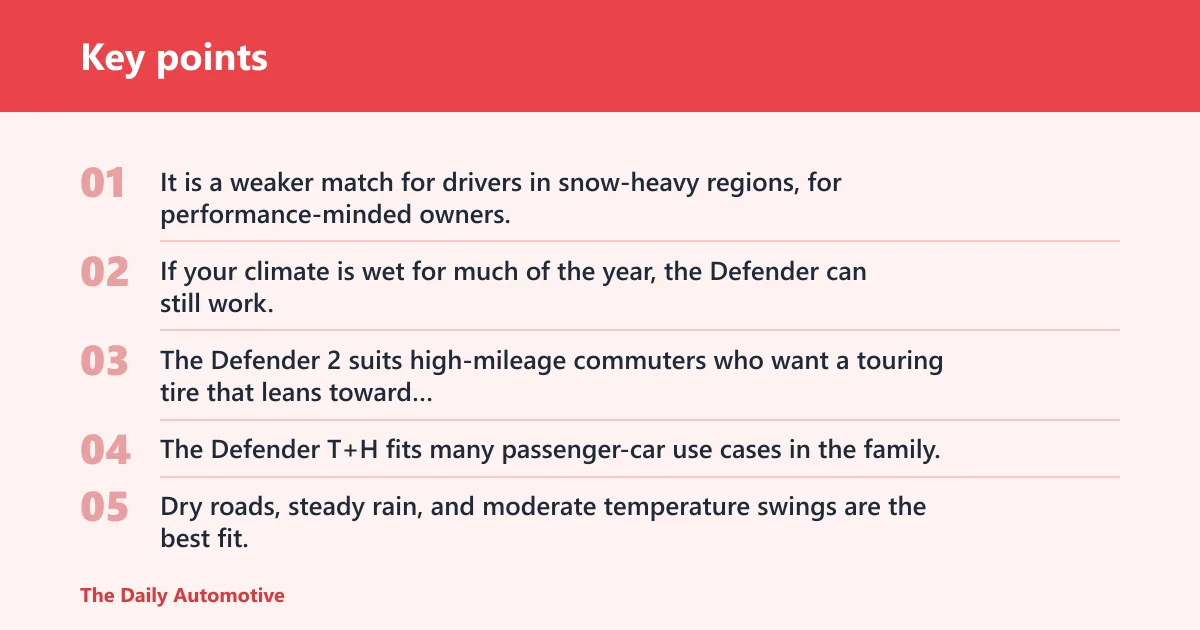
It is a weaker match for drivers in snow-heavy regions, for performance-minded owners, and for people whose vehicle or cargo needs point to a more load-focused tire. If your climate is wet for much of the year, the Defender can still work, but only if your wet-grip demands stay in the everyday range.
Best match by driver type
The Defender 2 suits high-mileage commuters who want a touring tire that leans toward treadlife and road comfort. The Defender T+H fits many passenger-car use cases in the family, while the Defender LTX M/S fits truck and SUV buyers who need a more utility-oriented option.
Best match by climate
Dry roads, steady rain, and moderate temperature swings are the best fit. Regular rain is acceptable. Light snow is acceptable. Deep winter, slush-heavy roads, and repeated freeze-thaw storms are where a dedicated winter tire becomes the smarter choice.
Best match by vehicle type
Passenger cars often point toward Defender 2 or Defender T+H fitments. Trucks and SUVs should look at Defender LTX M/S or the specific Defender 2 size only if the load index, load range, and speed rating match the vehicle manual.
Michelin Defender specs and warranty
The Defender 2 sits in the Standard Touring All-Season category. Consumer-facing listings show H and V speed ratings, an 80,000-mile treadwear warranty, and a tested size of 215/55R17. Consumer Reports also lists available sizes ranging from 205/55R16 to 255/50R20. (Consumerreports)
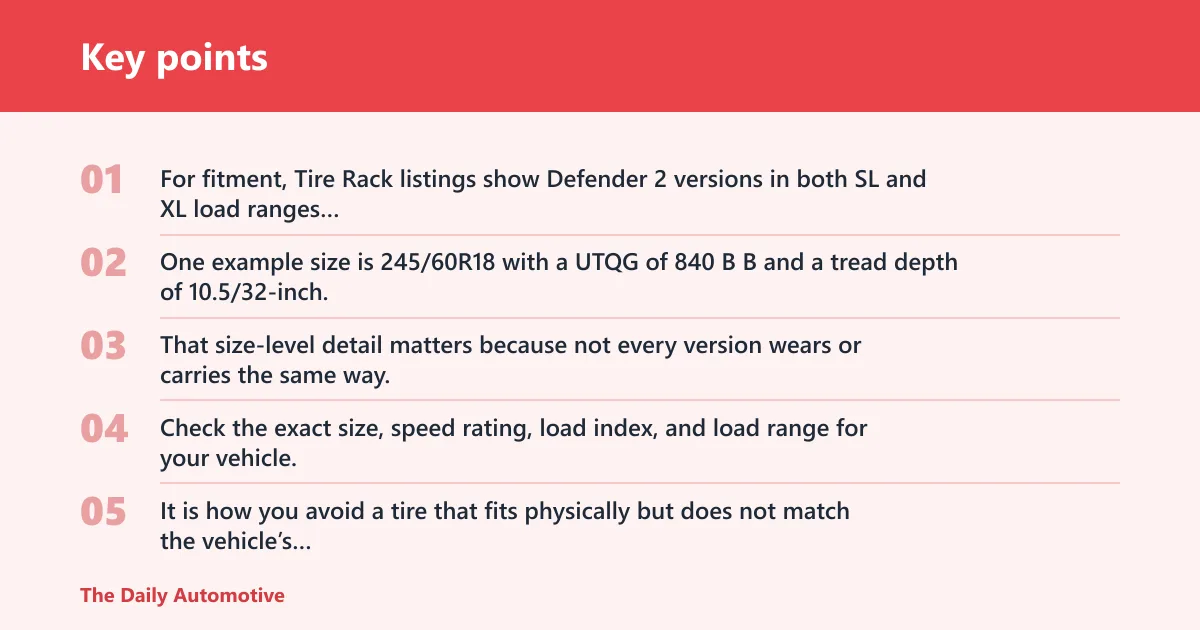
For fitment, Tire Rack listings show Defender 2 versions in both SL and XL load ranges in some sizes. One example size is 245/60R18 with a UTQG of 840 B B and a tread depth of 10.5/32-inch. That size-level detail matters because not every version wears or carries the same way.
Defender 2 sizing and ratings
Check the exact size, speed rating, load index, and load range for your vehicle. That is not busywork. It is how you avoid a tire that fits physically but does not match the vehicle’s required carrying capacity or speed rating.
Michelin Defender family coverage also includes the Defender T+H and Defender LTX M/S. That family split matters because it separates passenger-car use from truck and SUV fitments, which often need different construction and load support.
What the 80,000-mile warranty covers
The 80,000-mile treadwear warranty applies to applicable sizes only, and it covers 6 years. It is a warranty claim structure, not a promise that every driver will see 80,000 miles of service.
That difference matters. A tire can wear faster under aggressive alignment settings, underinflation, frequent hard braking, heavy loads, or severe heat. Warranty language does not erase those real-world variables.
Why warranty miles do not equal actual lifespan
The warranty gives a useful benchmark, not a guarantee. Michelin also reports a 94,400-mile estimated tread life in a specific controlled test application, but that number still reflects a controlled setup, not every car, climate, or driving style.
Suppose a driver in a 255/50R20 SUV size keeps the tires slightly underinflated and rotates them late. The tread will not behave like the same model on a lighter sedan with proper rotation and alignment. Same tire. Different result.
Is the Michelin Defender good in rain?
Yes, for a daily-driver touring tire, the Defender is built to handle rain with predictable wet manners, good water evacuation, and hydroplaning resistance. It is aimed at stable commuting in wet pavement conditions, not at sport-tire levels of wet grip.
Wet braking and handling
Wet braking and wet handling should be calm and predictable rather than sharp. That is useful for freeway commuting, traffic gaps, and routine stop-and-go driving. The goal is confidence, not aggressive cornering response.
Hydroplaning resistance
Water evacuation grooves are part of the wet design story, and that matters when standing water builds up in ruts or lane seams. Better evacuation helps the tire stay in contact with the road surface longer, which is the core of hydroplaning resistance.
What wet-weather drivers should watch
Drivers who spend much of the year in heavy rain should still compare the Defender with other touring all-seasons that put more focus on wet grip. A mileage-first tire can be good in rain without being the best choice for a region that sees frequent downpours and pooled water.
How does the Michelin Defender handle snow?
The Defender can handle light snow, but it is not severe winter rated and should not be treated as a replacement for winter tires. That is the dividing line that matters: light-snow commuting is one thing; true winter confidence on packed snow and ice is another.
Light snow versus severe winter use
For a few light snowfalls, cautious driving, and cleared roads, the Defender can be serviceable. For regular mountain use, untreated streets, or long winters, it is the wrong tool. All-season does not mean winter-ready.
Why it is not a winter tire
Winter tires use tread compounds and tread patterns designed for cold weather traction. The Defender’s comfort and mileage priorities point elsewhere. It is built for broad daily use, not for the steep tradeoffs that come with serious winter grip.
When to choose a winter alternative
Choose a winter tire if your area sees repeated snow, freezing slush, or long periods below freezing. Say your commute starts before plows run and the driveway stays icy. The Defender may get you moving, but a winter tire will do that job with more authority and less guesswork.
Defender buyer checklist table
This table is the practical shortcut. Match your climate, mileage, and vehicle type before you compare price tags.
| Driver profile | Climate | Annual mileage | Vehicle type | Best Defender fit or alternative | Buy / skip verdict |
|---|---|---|---|---|---|
| Daily commuter who wants quiet highway miles | Dry to lightly wet, with occasional rain | Moderate to high | Passenger car | Defender 2 or Defender T+H, depending on the required size and rating | Buy |
| High-mileage commuter in a rainy region | Frequent wet roads, little snow | High | Passenger car or crossover | Defender 2 if the exact size and load range match; check wet-grip alternatives if standing water is common | Buy, with caution |
| SUV or pickup owner carrying passengers or cargo often | Mixed weather, some rain, occasional light snow | Moderate to high | SUV or pickup | Defender LTX M/S, or a Defender 2 size only if the load index and XL or SL range match the vehicle manual | Buy if fitment matches |
| Driver who needs real winter traction | Regular snow, freezing slush, or icy mornings | Any | Any | A dedicated winter tire, not the Defender family | Skip |
Is the Michelin Defender worth the price?
It can be worth the higher price if you will keep the vehicle long enough to benefit from the warranty, the quiet ride, and the mileage-focused design. It is less compelling if you rack up few miles each year or if your climate demands a different tire priority.
Comfort and noise versus cost
The comfort payoff is real only if you actually value that kind of daily commute. A quiet touring tire is useful when highway droning and coarse pavement are part of the routine. If you barely drive, the extra upfront cost may never pay back.
Rolling resistance and fuel use
Michelin’s low rolling resistance positioning suggests a fuel-economy benefit, though the size of that benefit depends on vehicle, pressure, alignment, and driving style. Lower rolling resistance usually favors long commute owners more than weekend drivers.
When the higher price makes sense
Price makes the most sense when you expect to keep the tire for years, drive enough miles to value treadwear, and stay in weather that the Defender handles well. If you need winter grip, heavy-duty hauling, or sharper steering, the premium price is harder to justify.
Frequently asked questions
Is the Michelin Defender a good tire for daily driving?
Yes. It is built for daily commuting, long tread life, and quiet highway behavior, which makes it a strong fit for drivers who spend most of their time on paved roads. It is less suitable if your daily route demands sharp steering or serious winter traction.
How long do Michelin Defender tires last?
Real-world life can be shorter or longer depending on pressure, rotations, alignment, load, and climate.
Is Michelin Defender quieter than other all-season tires?
It is designed for quiet highway manners and comfort-focused commuting, so noise control is one of its main selling points. That said, tire noise depends on pavement, vehicle insulation, size, and wear state, so the final result still depends on the full setup.
What tire size and load rating should I buy for my car?
Buy the exact size, speed rating, load index, and load range your vehicle manual calls for. Defender 2 listings show SL and XL in some sizes, and the right choice can change ride quality and carrying capacity. Do not guess; match the vehicle label and the manufacturer’s listing.
- Check the door placard or owner’s manual for the required tire size.
- Confirm the speed rating and load index match the vehicle specification.
- Verify whether your vehicle needs SL or XL load range.
- Choose the Defender family variant that fits your vehicle type and climate.
- Rotate tires on schedule and keep inflation at the manual’s recommendation.
Products related to this article
Sponsored / affiliate links. As an Amazon Associate I earn from qualifying purchases. I may earn additional commission from eligible campaigns.