Cars and Lifestyle: How to Match a Vehicle to Daily Life
Choose the car that matches your daily mileage, passenger count, cargo needs, parking space, and budget first. Miss one of those, and you pay for it every week in time, money, or comfort. A poor fit turns commuting, errands, and trips into a string of compromises. This guide shows how to weigh routine, family life, ownership costs, and identity so your vehicle fits your real life.
How does a car reflect your lifestyle?



A car reflects your lifestyle through routine, priorities, and the signals you want to send. The Daily Automotive article says cars and lifestyle intersect because personal preferences shape vehicle choice, and that family features, design aesthetics, and status all factor into car choice. What someone drives often communicates more than income alone.
That does not mean image should lead the decision. A car can signal hobbies, environmental values, or taste, but it still has to work on Monday morning. If the vehicle cannot handle parking, cargo, or a child seat, the identity message gets expensive fast.
Identity and practical use pull in different directions
Luxury cars often work as design-led objects with strong status signaling, while sports cars signal performance focus and enthusiast identity. SUVs tend to fit family-friendly utility better. Vintage cars communicate craftsmanship and collectible taste, but daily usability usually drops because of parts, upkeep, and age-related limitations.
Suppose a buyer wants a low, two-door coupe for style but also needs to fit a stroller, a folding bike, and weekly grocery runs in a tight garage. The vehicle may look perfect in a showroom and fail in the driveway. That is where lifestyle logic matters more than branding.
When image and utility point in different directions
The right answer is not always the most expressive car. Sometimes it is the sedan that slips into a narrow spot, the SUV that swallows luggage, or the hybrid that trims fuel use on a long commute. A car becomes part of daily life whether or not the badge is.
📊 Law Enforcement Exploring is for ages 14-21. Source: Nyexploring.
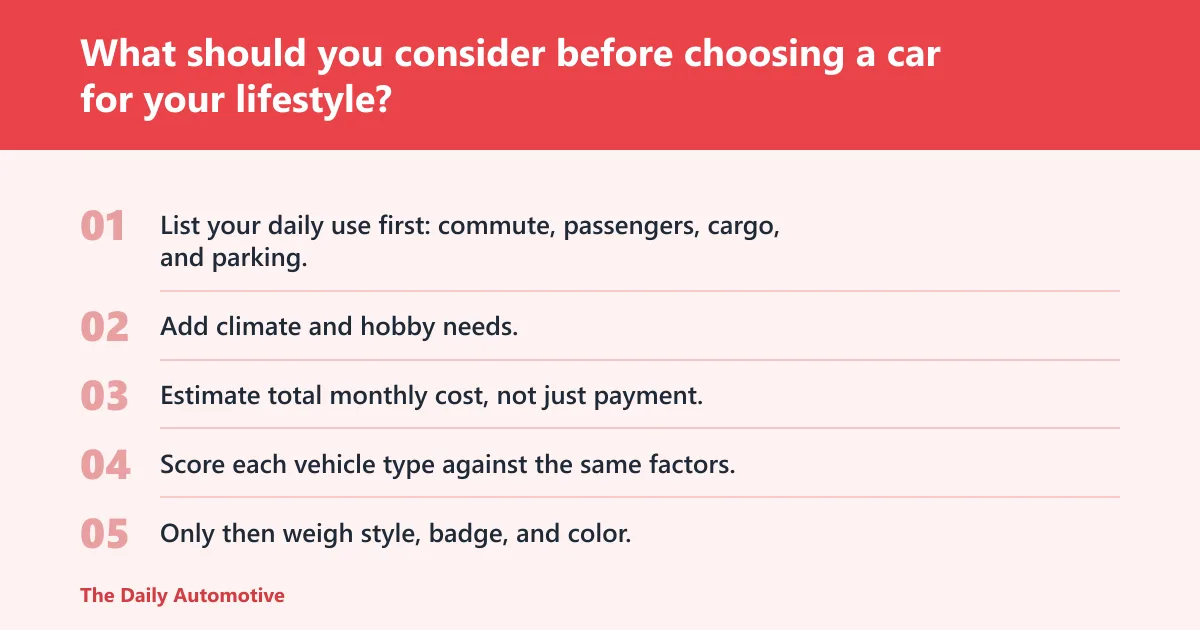
What should you consider before choosing a car for your lifestyle?
Start with commute length, passenger count, cargo volume, parking reality, climate, hobbies, and ownership cost. Those factors tell you far more about fit than trim-level marketing does. A vehicle that matches your schedule, streets, and storage will usually feel better than one bought for image alone.
Commute length and road conditions
Long highway commutes tend to reward comfort, fuel economy, and quiet cabins. Short city trips place more weight on parking, visibility, and easy entry and exit. Snow, steep drives, rough pavement, and heat also change the shortlist because tires, ground clearance, and climate control matter every day.
Passenger count, cargo, and parking reality
Count real passengers, not ideal ones. If three people ride most days and four or five ride only once a month, a midsize sedan may still fit the routine better than a large SUV. Cargo needs should be measured against actual objects: sports bags, dog crates, trade tools, strollers, or luggage.
Parking reality is the quiet deal-breaker. A vehicle that fits your garage, neighborhood street parking, or urban ramp saves time and reduces door dings. A bigger vehicle can also raise insurance costs and make tight turns harder in daily use.
Climate, hobbies, and ownership cost
Climate can shift the choice toward all-wheel drive, better heat management, or more efficient cabin cooling. Weekend hobbies matter too. Kayaks, track days, climbing gear, and antique shopping all need different cargo shapes and load floors.
Ownership cost can include fuel or electricity, insurance, tires, maintenance, depreciation, and parking fees. A vehicle that looks affordable at purchase may become costly if it needs premium fuel, special tires, or frequent repairs.
Lifestyle-to-vehicle decision matrix
| Lifestyle factor | What to ask | Sedan fit | SUV fit | EV fit | Sports car fit | Vintage car fit |
|---|---|---|---|---|---|---|
| Commute length | Mostly short city trips or long highway miles? | Strong for mixed commuting | Good, but often less efficient | Strong if charging is easy | Fair for pleasure drives, weak for daily grind | Weak for regular commuting |
| Passenger count | How many ride most days? | Good for 2-4 | Strong for families | Varies by size | Poor for more than 2 | Usually poor |
| Cargo needs | Do you carry strollers, tools, luggage, or gear? | Moderate | Strong | Moderate to strong | Weak | Weak to moderate |
| Parking reality | Garage, street, or tight urban lot? | Strong | Fair to weak in tight spaces | Depends on size, often good in city use | Strong for compact models | Varies, often limited by age and size |
| Climate | Snow, heat, hills, or mild weather? | Good with the right drivetrain | Strong in many climates | Good if range loss is planned for | Good only in favorable conditions | Weak in harsh weather |
| Weekend hobbies | Bikes, camping, racing, events, or shows? | Moderate | Strong | Moderate | Strong for enthusiast events | Strong for shows, weak for hauling |
| Ownership cost | Fuel, charging, insurance, tires, repairs? | Often balanced | Often higher than sedan | Can be lower on energy, higher up front | Often high | Often high and less predictable |
How to read the scorecard
Use the table as a filter, not a verdict. A sedan often wins on balanced commuting and parking. An SUV scores well when passenger and cargo needs matter more. An EV can fit a sustainability goal if charging access is practical. Sports cars make sense when enthusiast identity outweighs utility. Vintage cars fit collectors, not most daily routines.
Where the matrix breaks down is emotional preference. A buyer may accept tighter cargo or higher insurance for a car they truly value. That is reasonable only if the tradeoff is visible and intentional, not accidental.
- List your daily use first: commute, passengers, cargo, and parking.
- Add climate and hobby needs.
- Estimate total monthly cost, not just payment.
- Score each vehicle type against the same factors.
- Only then weigh style, badge, and color.

Which cars fit family, commuter, and urban lifestyles best?
SUVs often fit family routines because they can make child seats, cargo, and odd-shaped gear easier to manage. A sedan still makes more sense when parking is tight, fuel use matters, and passenger needs are modest. Urban drivers should consider compact dimensions before size or status.
Why SUVs often fit family routines
SUVs usually give you higher seating position, easier loading, and flexible cargo space. That makes school runs, weekend sports, and airport trips easier to organize. The tradeoff is usually more fuel use, more tire cost, and more trouble in small garages or crowded city blocks.
When a sedan still makes more sense
Sedans remain strong for commuters who want a comfortable ride, lower drag, and simpler parking. They can also be easier on insurance and tires than larger vehicles. For households with one or two regular passengers and limited cargo, a sedan often fits better than a taller body style.
City driving, parking pressure, and compact alternatives
Urban buyers should pay attention to turning radius, length, and rear visibility. Compact crossovers or smaller sedans often make day-to-day life easier than a full-size SUV. A car that fits the city will usually feel calmer every time you park.
How do luxury cars connect with fashion and design?
Luxury cars connect with fashion and design through materials, proportion, lighting, and cabin technology. They often sell a point of view as much as a drivetrain. The lifestyle pitch leans on design-led branding, status signaling, and fit with personal style, not price alone.
Design-led branding and cabin materials
Leather, metal trim, stitched surfaces, and carefully arranged controls all communicate taste. These details matter because the cabin becomes part of daily dressing, travel, and social arrival. For non-luxury buyers, the lesson is simple: choose interiors that feel coherent, durable, and easy to live with.
Technology as part of the lifestyle pitch
Modern cars use screens, driver aids, phone integration, and voice controls to signal modern life. The point is not gadget count. It is whether the technology reduces friction in your routine. A confusing interface can ruin an otherwise attractive car.
When luxury signals taste rather than practicality
Luxury can signal taste, design interest, or a specific professional image. It should not be confused with usefulness. A buyer paying for a branded cabin still needs to ask whether the back seat, cargo bay, and parking footprint fit the day-to-day schedule.
Are electric and hybrid cars part of a sustainable lifestyle?

Hybrid and electric cars can fit a sustainable lifestyle because they are common eco-friendly driving examples and can reduce fuel use. The fit depends on charging access, route length, and local electricity cost. Lower emissions do not erase all ownership tradeoffs, especially if charging is inconvenient.
Lower emissions and fuel efficiency
Hybrids help when you want better fuel efficiency without depending entirely on charging. EVs can eliminate tailpipe emissions while driving because they do not burn fuel on the road. That said, the lifestyle fit depends on how the vehicle is powered and how often it is used.
Charging access and range planning
Home charging is the easiest setup. Apartment dwellers and street parkers need a real plan for public charging or workplace charging. Range also changes with weather, speed, and load, so long trips require a margin of comfort rather than a best-case figure.
Maintenance and ownership tradeoffs versus gasoline models
EVs usually have fewer moving parts than gasoline models, which can reduce certain maintenance needs. But tires, brakes, software, charging equipment, and battery-related depreciation still matter. Hybrids can split the difference for drivers who want efficiency without rearranging every trip around charging.
Picture a commuter who drives roughly 20 to 25 miles each way, parks in a driveway, and can charge overnight. An EV may fit well. Now picture the same commuter in an apartment with no guaranteed charging and frequent winter road trips. The fit changes fast.
How do car brands use storytelling, design, and culture?
Brands use storytelling to connect a vehicle with identity, community, and taste. Porsche’s design culture, Lexus racing identity, and enthusiast media all show how makers build lifestyle meaning around the car. The strongest stories still have to be anchored in actual use.
Porsche design culture as a lifestyle cue
Porsche’s Type 7 story was published on September 7, 2022, and Porsche’s Type 7 book is described as a 400-page celebration. That signals more than product news. It shows how a brand can build design culture around architecture, objects, travel, and the visual language of mobility.
Lexus and performance identity
Lexus uses motorsport and performance cues to broaden its image beyond quiet comfort. That matters because buyers often read a brand as a set of values. Performance identity can support a lifestyle story for drivers who want refinement with a more dynamic character.
Community media and enthusiast culture
Community media and events matter because they turn ownership into participation. Clubs, track days, design magazines, and owner gatherings all help a car live beyond the spec sheet. That is how enthusiasts bond with a brand without ignoring the real-world costs.
How do car culture and architecture overlap?
Car culture and architecture overlap through shared attention to proportion, material, light, and space. The term carchitecture captures that link. Showrooms, event spaces, and garages often borrow the same design language as galleries, homes, and public buildings.
Shared design language in buildings and cars
Both disciplines shape how people move through space and how surfaces feel at eye level. A low sports car and a long modern facade can share similar lines. A well-planned garage or showroom can make the vehicle feel like part of the built environment instead of a separate object.
Showroom and event spaces
Dealerships, brand houses, and auto-event venues often use lighting, display height, and circulation to create an emotional setting. That is not decoration for its own sake. It tells buyers how the brand wants the car to fit into daily life, weekend culture, and personal identity.
Frequently asked questions
What should I consider when choosing a car for my lifestyle?
Start with commute length, passenger count, cargo needs, parking reality, climate, hobbies, and total ownership cost. Those are the variables that shape daily satisfaction. A car that misses on storage or parking can become a burden even if it seems right on paper.
Which cars are best for family lifestyle needs?
SUVs often work best for families because they ease loading, seating, and cargo flexibility. A sedan can still be the better answer if parking is tight and passenger needs are moderate. The best choice is the one that fits your routine without excess size.
Are electric cars part of a sustainable lifestyle?
Yes, if charging access, trip patterns, and ownership costs fit the household. The Daily Automotive article lists hybrid and electric cars as eco-friendly driving examples. An EV can support a lower-emission lifestyle, but only when charging and range planning are realistic.
Products related to this article
Sponsored / affiliate links. As an Amazon Associate I earn from qualifying purchases. I may earn additional commission from eligible campaigns.