3 Best Car Amplifiers: Top Picks by Use Case
The 3 best car amplifiers in 2026 are JL Audio VXi, AudioControl D-Series, and Sony Mobile ES. JL Audio VXi is the premium all-around pick, AudioControl D-Series is the built-in DSP pick, and Sony Mobile ES is the sound-quality pick. Choose poorly and you waste money, pull more power than needed, or add noise and clipping to a system that should stay clean. This guide ranks each choice by use case so you can match channels, power, inputs, and size to your car before buying.
Why RMS power matters more than peak watts


RMS power is the continuous output that tells you whether an amp can actually feed your speakers and subwoofer without clipping. Peak watt stickers are marketing numbers, not the figure you should size around. Match continuous power to the load you plan to run, then verify the final impedance before you buy.
How to match RMS to speakers and subs
Start with the speaker’s or subwoofer’s RMS rating, then pick an amplifier that can deliver a similar continuous figure at the final impedance. If a sub is rated for 300 watts RMS and the amp does 300 watts at the same load, you are in the right zone. Too little power clips sooner. Too much invites careless gain settings.
A common first-timer mistake is buying for peak watts and ignoring the real load. Suppose a sub is wired to 2 ohms, but the amplifier’s full output is listed at 1 ohm. You may end up with less power than expected, then turn the gain up until the bass distorts. That is where heat and clipping start.
Why impedance changes the real output you get
Impedance changes how much current the amp must supply, so the same model can make very different power at different loads. A mono amp that looks oversized on paper may be a weak fit if the sub wiring lands at the wrong impedance. Check the final wiring plan before you check the box.
Common power-matching mistakes that cause clipping
Three mistakes show up often: picking a sub amp with no headroom at the final load, wiring speakers below the amp’s stable range, and using gain as a volume knob. Those errors create harsh sound, hot chassis temperatures, and battery strain. The fix is simple: size the amp to the load, then set gain with a meter.
How many channels do you need for your car amplifier?
Channel count should follow the system, not the other way around. A mono amp suits a single subwoofer system, a 4-channel amp fits front-stage speakers, a 5-channel amp covers speakers plus sub, and a 6-channel amp makes sense when you want one chassis to handle a fuller system or OEM-style integration.
Mono, 4-channel, 5-channel, and 6-channel use cases
- Mono: best for one subwoofer or a dedicated bass build.
- 4-channel: best for front components and rear fill, or front speakers plus passive crossovers.
- 5-channel: best for a full-range system and one sub in one chassis.
- 6-channel: best when you want more output channels, rear fill, or factory-style integration with flexibility.
When a DSP amp replaces separate gear
A DSP amp makes sense when you want tuning control without stacking separate signal processors and amps. JL Audio VXi and AudioControl D-Series both fit that role. They cut box count, simplify signal routing, and help correct factory EQ or timing issues. That matters more than raw wattage in many daily-driver systems.
When a separate sub amp still makes sense
If the car already has strong front-stage amplification, a dedicated mono sub amp can be the better move. It keeps bass current demand off the main channels and lets you size the sub stage independently.
Best car amplifiers in 2026
The best car amplifier depends on the build, not the logo. For a premium all-around system, JL Audio VXi is the strongest fit because it combines Class-D NexD2 amplification with onboard DSP. For a built-in DSP pick, AudioControl D-Series is the cleaner route. For sound quality without onboard DSP, Sony Mobile ES is the better direct amplification play.
Best all-around pick: JL Audio VXi
JL Audio VXi is presented as a premium all-around pick because it combines Class-D NexD2 amplification with onboard DSP and TüN tuning. The line spans channel options from 1 to 8, and the 6-channel variant is rated at 75W×6 per the manufacturer specifications. That range suits serious upgrades where tuning and channel flexibility matter as much as power.
Choose VXi when you want one chassis to do several jobs: front speakers, rear fill, sub output, and precise tuning. It is the safest pick if the build may expand later. The tradeoff is that you are paying for capability you may not need in a simple sub-only setup.
Best built-in DSP pick: AudioControl D-Series
AudioControl D-Series is the best built-in DSP pick when you want a clean mixed system with speaker channels and sub support in one package. The family includes a 6-channel version rated at 125W×6 per the manufacturer specifications, plus 4-channel and 5-channel variants for smaller builds. It is a practical answer when factory noise and tuning correction are both on the list.
Pick D-Series if you want DSP without moving all the way into a premium multi-purpose platform. It suits active front stages, integration-heavy installs, and systems where you care more about controlled setup than raw output bragging rights. The main failure mode is overbuying channels for a simple build.
Best sound-quality pick: Sony Mobile ES amplifiers
Sony Mobile ES Amplifiers are the best high-resolution pick in this guide. The line includes a mono amplifier rated at 600W, a 4-channel model rated at 100W×4, and a 5-channel model rated at 100×4 + 450, per the manufacturer specifications. There is no onboard DSP, which keeps the focus on clean amplification rather than extra processing.
This is the right choice when the head unit already provides the tuning tools you need, or when you want to keep signal processing separate. It is a good fit for listeners who care about clean output and do not need the amplifier to solve factory integration problems on its own.
Compact and factory-fit options
The three picks above already cover the main buying decision. This section only reinforces that JL Audio VXi, AudioControl D-Series, and Sony Mobile ES can still be matched to tight installs or OEM-style systems depending on chassis space and integration needs.
Best slim-install pick: Kenwood Excelon X
Best OEM replacement pick: Kenwood Excelon P-XR600-6DSP
Budget mono-sub option: Hifonics ZRX
Which amplifier is right for your build?
The right amplifier depends on speaker count, factory integration, thermal room, and how much tuning support you actually need. Use JL Audio VXi for premium all-around builds, AudioControl D-Series for built-in DSP needs, and Sony Mobile ES for sound quality without onboard processing.
| Use case | Amp type | Minimum channels | DSP needed | Factory integration needed | Thermal risk | What to avoid |
|---|---|---|---|---|---|---|
| Premium all-around system with front stage, sub, and tuning | JL Audio VXi | 5 or 6 | Yes | Maybe | Medium if airflow is tight | Buying a mono amp plus separate processor when one chassis would do |
| Mixed speaker-and-sub build with onboard correction | AudioControl D-Series | 5 or 6 | Yes | Maybe | Medium | Choosing a 2-channel amp and trying to split duties later |
| Factory stereo upgrade or OEM-style integration | Kenwood Excelon P-XR600-6DSP | 6 | Yes | Yes | Low to medium | Using a plain amp without high-level inputs or signal-sensing turn-on |
| Tight under-seat install with limited depth | Kenwood Excelon X | 1, 4, or 5 | No | Sometimes | Medium to high if airflow is poor | Overbuying a large heatsink that cannot breathe |
| Budget subwoofer-only setup | Hifonics ZRX | 1 | No | Sometimes | Medium if gains are set badly | Chasing peak watts instead of the sub’s RMS and final impedance |
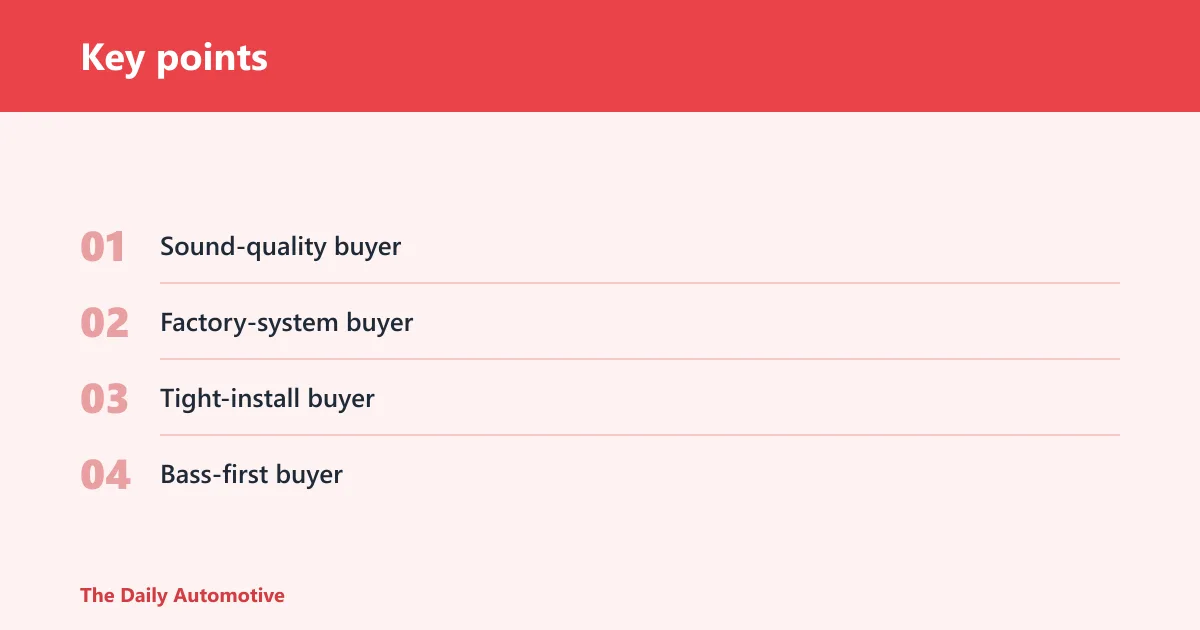
- Sound-quality buyer: choose Sony Mobile ES if you already have tuning control elsewhere, or JL Audio VXi if you want DSP in the amp.
- Factory-system buyer: choose Kenwood Excelon P-XR600-6DSP when you need OEM integration and a clean replacement path.
- Tight-install buyer: choose Kenwood Excelon X when depth and airflow are limited.
- Bass-first buyer: choose Hifonics ZRX when a mono sub amp is enough and budget matters.
Say your car has a factory head unit, under-seat clearance is limited, and you want one amp for both speakers and sub. That build points to a 6-channel DSP amp, not a separate stack of boxes. The wrong choice here is a large non-DSP amplifier that forces awkward wiring and leaves the factory EQ untouched.
Picture a hatchback with one 10-inch sub rated at 300 watts RMS and front components already powered elsewhere. A mono amp sized near 300 watts at the final impedance is the clean fit. Buying a 600-watt amp for that setup adds little value unless the impedance plan and thermal headroom justify it.
How much DSP do you really need?
DSP is worth paying for when the car’s acoustics, factory EQ, or speaker layout need correction. If the head unit already gives you usable crossover and timing tools, a non-DSP amp can be fine. If the signal path starts with a factory radio, onboard DSP is often the smarter buy.
Built-in DSP versus head-unit controls
Built-in DSP is useful when the amplifier has to do the tuning work itself. JL Audio VXi and AudioControl D-Series both fit that need. If the head unit already allows reasonable crossover control and the system is simple, Sony Mobile ES keeps the amplifier role narrower and the signal path cleaner.
When TüN or similar tuning matters
TüN matters when you want repeatable, channel-by-channel control over crossover points, delays, and EQ in the amp itself. That is most useful in active front stages, factory-retrofit systems, and mixed speaker-plus-sub builds. It matters less in a one-sub, one-amp setup with little correction needed.
Why a DD-1 or meter-based gain setup helps
A DD-1 or another meter-based gain tool helps set amplifier input levels repeatably instead of guessing. That reduces clipping, which is one of the most common causes of harsh sound and overheated gear. Use it after wiring is confirmed and before you start listening at full volume.
What to check before you buy
Check the wiring inputs, turn-on method, fuse needs, and physical dimensions before you order. High-level inputs and signal-sensing turn-on are important for factory integration. Wire gauge must match current draw. Chassis size and airflow determine whether the amp survives daily use without heat soak.
High-level inputs and signal-sensing turn-on
High-level inputs let the amplifier accept speaker-level output from an OEM radio. Signal-sensing turn-on tells the amp when to wake up without a separate remote lead in many factory-style installs. If a car still uses the factory head unit, those features are often the difference between an easy install and a noisy one.
Fuse ratings, wiring gauge, and battery load
Fuse rating gives you a rough sense of current demand, but the real issue is whether the car’s charging system can support the load. More channels and more output mean more current. Size the wiring for the amp, not for the old system that used less power.
SNR, THD, and real chassis dimensions
Signal-to-noise ratio and total harmonic distortion matter most in sound-quality builds and factory upgrades. Real chassis dimensions matter in every build. Measure the mounting location, including connector space and airflow gap, before you buy an amp that barely fits on paper and cooks in the car.
Frequently asked questions
What is the best car amplifier for sound quality?
Sony Mobile ES Amplifiers are the best sound-quality pick in this guide when you want clean amplification without onboard DSP. If you also want tuning inside the amp, JL Audio VXi is the stronger all-in-one option. The better choice depends on whether your system already has processing elsewhere.
How many channels do I need for my car amplifier?
Use 1 channel for a subwoofer-only build, 2 channels or a bridged 4-channel setup for a front-stage setup, 5 channels for speakers plus one sub, and 6 channels when you want extra flexibility or OEM-style integration. If you are unsure, count the speaker channels you need first, then add a sub channel or a mono sub amp if the bass section is separate.
What size amp do I need for my speakers and subwoofer?
Match the amplifier’s continuous RMS output to the speakers’ and subwoofer’s RMS ratings at the final impedance. A 300-watt RMS sub needs an amp that can deliver about that much at the wiring load you plan to run. Do not size the system around peak watt claims.
What is the best car amplifier for a factory stereo?
Kenwood Excelon P-XR600-6DSP is the best factory/OEM upgrade pick here because it is built for OEM replacement use with onboard DSP. For a factory radio, high-level inputs and signal-sensing turn-on matter just as much as raw power. Those features reduce integration problems and keep the install cleaner.
What is the best compact car amplifier for tight installs?
Kenwood Excelon X is the best compact and slim choice for tight installs. Its mono 300W model and low-profile multi-channel versions suit under-seat or cramped cargo mounting better than larger chassis amps. In small spaces, airflow and depth matter more than chasing a larger heatsink.
Do I need DSP in a car amplifier?
You need DSP when the system needs correction, timing, or factory signal cleanup. JL Audio VXi and AudioControl D-Series make sense for that reason. If the system is simple and the head unit already handles basic tuning, a non-DSP amp such as Sony Mobile ES can be the better value.
What is the best amplifier for a subwoofer in a car?
Hifonics ZRX is the best subwoofer amp pick in this guide for a budget mono setup, and its top mono option is rated at 800W. For a more compact alternative, Kenwood Excelon X includes a mono model rated at 300W. Pick based on your sub’s RMS and final impedance, not peak claims.
Products related to this article
Sponsored / affiliate links. As an Amazon Associate I earn from qualifying purchases. I may earn additional commission from eligible campaigns.