Finding the Best Auto Repair in Murfreesboro, TN
To find the best auto repair in Murfreesboro, TN, compare every shop on five checks: diagnosis quality, estimate clarity, warranty strength, turnaround time, and proof of local reputation. Price alone can cost you twice for the same repair, stretch the wait, or leave coverage disputes later. This guide shows how to judge Murfreesboro repair shops on those five points before you book service.
Rank by process and repair type, not promises
Start by ranking shops on process, not promises. A strong candidate can explain how it diagnoses faults, what goes on the estimate, how its warranty works, how long the repair should take, and what recent customers say about that exact job.
Start with five non-negotiables
- Diagnosis quality: The shop should explain how it finds the cause, not only the code or symptom.
- Estimate clarity: You should get an itemized written estimate before work starts.
- Warranty strength: Coverage should state time, mileage, and whether parts and labor are included.
- Turnaround time: Ask when the car can be finished and what could delay it.
- Local reputation: Read recent reviews for the exact repair you need.
Use pass/fail thresholds before price
Any shop that cannot give a written estimate, refuses to explain diagnosis steps, or will not state warranty terms should fail immediately. A low quote does not matter if it hides scope gaps, omits labor, or leaves out parts that should be replaced together.
Sort by repair type, not by ads
A shop that works well for oil changes may not fit electrical faults or engine diagnostics. Compare brakes with brake reviews, AC with AC reviews, and check-engine complaints with diagnostic reviews. The best shop for your repair type is the one with the strongest track record on that job.
Auto repair scorecard

Use this scorecard to compare Murfreesboro repair shops. The scorecard totals about 100 points, and shops should only pass if they clear the red flags. Keep the scoring strict. A shop that fails diagnosis or estimate rules should not be rescued by a strong review count.
| Criterion | Weight | What earns a strong score | Pass/fail threshold |
|---|---|---|---|
| Diagnostic process | 30 | Explains scan-tool use, electrical testing, and root-cause steps; names technician training or specialization | Fail if the shop guesses, skips testing, or cannot explain the cause |
| Estimate clarity | 25 | Itemized labor and parts, authorization before work, scope limits, and possible add-ons | Fail if the quote is vague, verbal only, or changes without approval |
| Warranty strength | 15 | Clear time and mileage coverage, with parts and labor spelled out | Fail if the shop cannot state coverage and claim steps in writing |
| Turnaround time | 15 | Gives a realistic finish window, parts plan, and update schedule | Fail if timing is vague or communication stalls after drop-off |
| Local reputation | 15 | Recent, service-specific reviews with repeated positive patterns and few repeat complaints | Fail if reviews are old, thin, or dominated by the same complaint |
Red flags that fail a shop
- No written estimate before work begins.
- No clear answer on who authorizes extra work.
- Warranty language that avoids mileage, time, or covered labor.
- Repeated complaints about misdiagnosis or returning for the same repair.
- Slow replies when you ask about status, parts, or pickup timing.
Sample scoring guidance for common repairs
For brakes, weight estimate clarity and warranty heavily because pad, rotor, and labor scopes can vary. For AC repairs, diagnostic quality matters more because pressure checks, leak detection, and electrical testing often decide whether the fault is minor or recurring. For engine lights, root-cause work should outrank a cheap scan-and-clear approach.
Say your car has a check-engine light and rough idle. A shop that only reads a code and quotes parts gets a low diagnostic score. A better shop explains whether it will verify fuel, ignition, air, or sensor data before replacing anything, then writes that plan into the estimate.
Can the shop diagnose the problem?
Good diagnosis is the first defense against paying for the wrong repair. Look for ASE-certified or otherwise qualified technicians, ongoing training, and proof that the shop can handle the system involved, whether that is engine management, brakes, charging systems, or electrical faults.
ASE signals and ongoing training
Certification alone is not enough, but it is a useful signal. Ask whether the technician working on your car is trained for the system at issue and whether the shop keeps up with newer vehicle electronics, scan-tool procedures, and manufacturer updates.
Scan tools, electrical testing, and root-cause work
A proper diagnostic process should not stop at the fault code. For check-engine lights and electrical complaints, the shop should mention scan-tool data, circuit testing, and a method for confirming the real cause before authorizing parts. That matters because many symptoms point to one code while the failure lives elsewhere.
Questions to ask before authorizing diagnosis
- What tests will you run before replacing parts?
- Will you explain the root cause, not only the code?
- Who performs the diagnostic work on my vehicle system?
- Will I be contacted before any extra diagnosis time is billed?
Will the estimate hold up?
A trustworthy estimate names the labor, parts, and scope of repair before work begins. It should also state what must be approved later if hidden damage appears. If a shop will not put those terms in writing, it is hard to compare value or control cost.
What a written estimate should include
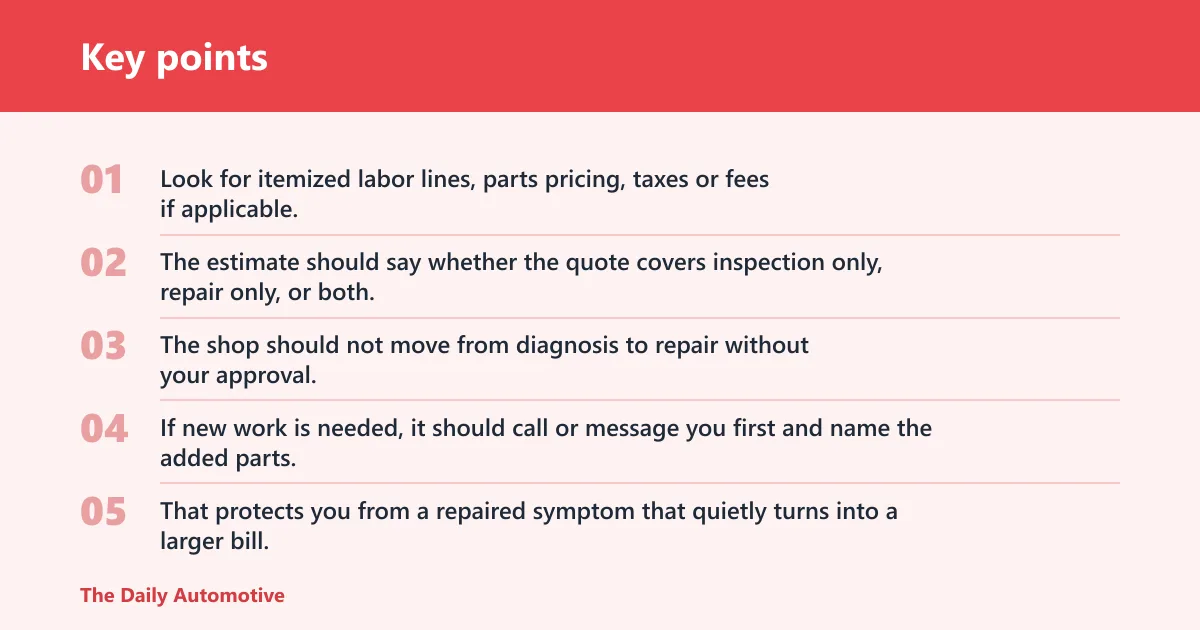
Look for itemized labor lines, parts pricing, taxes or fees if applicable, and a plain description of the repair. The estimate should say whether the quote covers inspection only, repair only, or both. It should also identify what is excluded.
Authorization rules and scope control
The shop should not move from diagnosis to repair without your approval. If new work is needed, it should call or message you first and name the added parts, added labor, and revised total. That protects you from a repaired symptom that quietly turns into a larger bill.
How to spot vague or padded quotes
Be careful with quotes that bundle too much into one line, hide labor hours, or mention “recommended services” without explaining why they matter now. A high total may still be fair if the repair type is complex, but the shop should be able to justify every major line item.
Suppose a brake quote is lower than two others, but it excludes rotor machining, brake fluid service, and shop fees. That quote may not be cheaper at all once the work is complete. Compare scope, not only the first number you see.
Do local repair shops offer warranties on their work?
Many shops do, but the terms matter more than the headline. A useful warranty states how long coverage lasts, how many miles it covers, and whether both parts and labor are included. It should also explain what you must do to make a claim.
Time and mileage coverage
Look for both a time limit and a mileage limit. If either one is missing, ask for the exact figure in writing. A clear term helps you compare repairs that may fail early against those that are expected to last under normal driving.
Parts and labor coverage
Some warranties cover parts only. Others cover parts and labor. Those are not equal. If a repaired part fails again, labor coverage can matter as much as the replacement itself, especially on jobs that take several hours to revisit.
Claim steps and exclusions to check
Ask where warranty work must be performed, who inspects the failed part, and whether outside damage, wear items, or maintenance neglect are excluded. If the claim process sounds vague, coverage may be harder to use when you need it.
Can they finish on time?
Turnaround depends on the repair, parts availability, and how the shop schedules work. Same-day service can fit minor maintenance or simple tire problems, but diagnostics, electrical issues, and some engine repairs usually need more time. The key is whether the shop gives realistic timing and updates you when that changes.
Same-day versus multi-day repairs
Same-day promises are reasonable for routine maintenance, flat tires, and some small fixes if parts are on hand. Multi-day jobs are more common when the shop must order parts, confirm a diagnosis, or work through several systems. Ask which parts must arrive before the repair can finish.
Parts availability and scheduling
A shop with strong parts access often controls delay better. The best answer is not “soon”; it is a window tied to diagnosis, parts arrival, and bay availability. That detail helps you decide whether to book now, wait, or choose another shop with a better fit for the repair type.
Update speed and communication habits
Fast updates matter when a repair changes from simple to complex. If a shop waits until closing to mention a problem, that is a warning sign. You want clear status messages about diagnosis results, parts orders, and pickup timing before the delay becomes your problem.
How do I compare reviews for auto repair shops?
Look past star averages. Review volume, recency, and service-specific detail tell you much more about a shop’s pattern of work. A shop with many current reviews that mention the same type of repair is easier to judge than one with a high score and little context.
Volume, recency, and service detail
Recent reviews matter because staffing, parts access, and management can change. Service-specific comments are more useful than general praise because they show how the shop handled brakes, AC, diagnostics, or maintenance. A large review count is helpful only if the comments are current and relevant.
Patterns that matter more than star average
Read for repeated praise or repeated complaints. If several customers mention accurate diagnosis, clear updates, and repairs that held, that is useful. If several mention the same comeback problem, surprise charges, or missed deadlines, treat that as a serious warning even when the average rating looks strong.
What repeated complaints can signal
Recalling the same vehicle for the same issue may point to misdiagnosis, poor parts selection, or rushed work. Complaints about upselling can mean the shop adds services without clear support. Complaints about vague communication can mean the final bill or pickup time may drift after you leave the car.
What convenience details matter?
Convenience matters, but it should not outrank quality. Hours, location, drop-off options, and tow access help if the shop is close to home or work and can fit your schedule. If a shop is inconvenient and weak on diagnosis or estimates, convenience should not save it.
Hours, location, and drop-off options
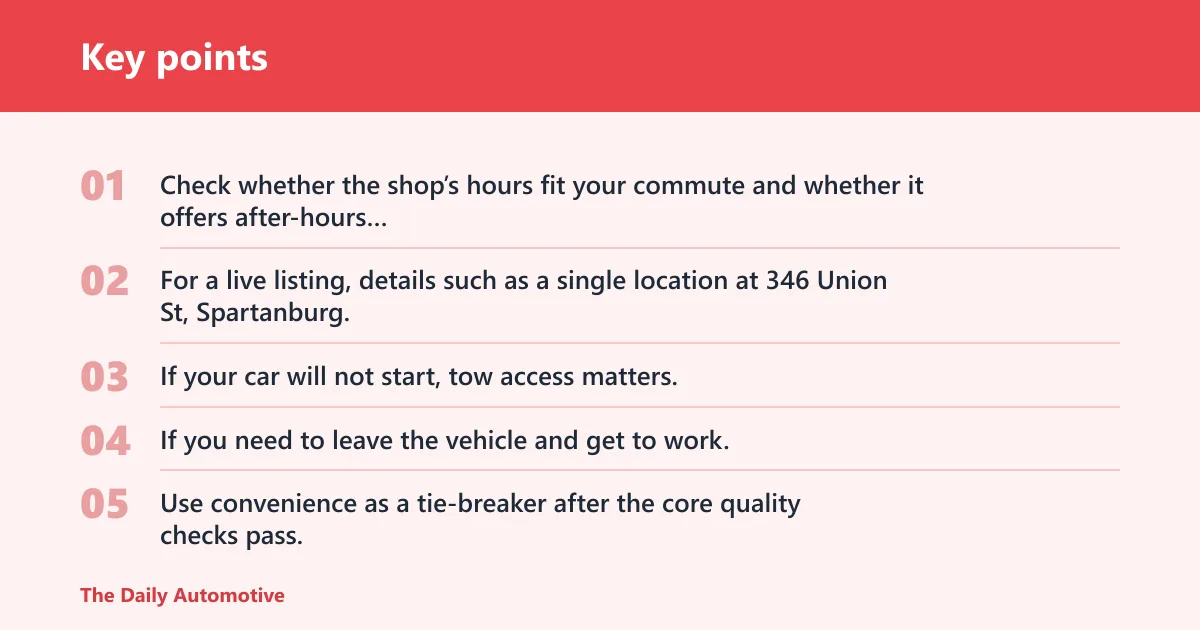
Check whether the shop’s hours fit your commute and whether it offers after-hours drop-off or early pickup. For a live listing, details such as a single location at 346 Union St, Spartanburg, SC 29306, a phone number of (864) 585-0025, Monday through Thursday from 7:30 AM to 5:30 PM, Friday from 7:30 AM to 5:00 PM, 517 reviews, a 3-year, 36,000-mile warranty, upfront estimates before any work begins, and service for domestic and import models show the sort of specifics a serious shop should make easy to find.
Tow access and commute fit
If your car will not start, tow access matters. If you need to leave the vehicle and get to work, a nearby shop with early hours can save time even if it is not the cheapest option. Use convenience as a tie-breaker after the core quality checks pass.
Routine maintenance still needs scrutiny
Even for oil changes, brake inspections, tire service, or fluid checks, the shop should still explain what it found and what it recommends next. A routine visit is often where an honest shop earns trust, and where a careless one starts building repeat problems.
What should I look for in a trustworthy mechanic near me?
Look for clear diagnosis, a written estimate, a warranty that states coverage terms, timely communication, and reviews that describe specific repair results. Qualifications matter too. ASE signals, system-specific training, and ongoing education help you judge whether the shop can handle modern vehicles, not just basic maintenance.
How much should auto repair cost in Murfreesboro?
The fair price depends on the repair type, the labor time, and the parts required. A useful way to anchor cost is to compare scope across two or three written estimates, then ask what is included, what is excluded, and whether the shop confirmed the cause before quoting parts.
What questions should I ask before booking car repair?
Ask who will diagnose the problem, what tests will be used, whether the estimate is itemized, how the warranty works, and how long the repair should take. Also ask how you will be updated, what could change the price, and whether the shop has experience with your repair type.
Frequently asked questions
How do I find the best auto repair in Murfreesboro, TN?
Compare shops on diagnosis quality, estimate clarity, warranty strength, turnaround time, and recent review patterns. A strong option can explain the cause of the problem, write the repair in detail, and state how coverage works if the same issue returns.
How can I tell if a shop is honest about estimates?
Ask for an itemized written estimate before any work starts. It should list labor, parts, and the repair scope, plus any approval needed for added work. Be wary of verbal quotes, vague “recommended services,” or totals that change without a clear reason.
What services should a full-service auto repair shop provide?
A full-service shop should handle diagnosis, routine maintenance, brake inspections, tire service, fluid checks, and repair work for the systems it advertises. The useful question is not how many services it lists, but whether it can explain each one clearly and back it with proper testing.
Products related to this article
Sponsored / affiliate links. As an Amazon Associate I earn from qualifying purchases. I may earn additional commission from eligible campaigns.