My First RC Car AdventureI stil
Radio controlled cars work by turning the transmitter’s radio command into receiver instructions, then using the ESC, servos, battery power, and drivetrain parts to change motor speed and steering angle. If any link in that chain is weak, you get lag, dead steering, short runtime, or a car that stops responding. This guide explains the full control loop and where the signal, power, and mechanical systems can fail.
What does radio controlled mean?


A radio-controlled car is a battery- or fuel-powered model that takes commands from a handheld transmitter and turns them into motion through electronics and mechanical parts. Most RC cars use a transmitter-receiver radio system, and the transmitter and receiver must be matched to work correctly.
The transmitter sends radio waves through an antenna. The receiver inside the car picks up those signals and turns them into usable output for the ESC and steering servo. Binding links the transmitter and receiver so they recognize each other and ignore stray commands from other systems.
What the transmitter sends
The transmitter is the handheld controller. Its joysticks or triggers usually handle steering and throttle or brake. On many hobby models, the same unit also offers trim, dual-rate, and other setup controls that change how sharply the car responds.
What the receiver does
The receiver sits inside the car. It decodes the incoming radio signal and sends control output to the ESC and the steering servo. If the receiver loses power, loses binding, or picks up airwave noise, the car may stop, twitch, or ignore steering.
How binding links the two
Binding is the pairing step that locks a transmitter to a receiver. Without it, the receiver has no trusted command source. A common failure point is replacing one part without matching it to the other, which is why the transmitter and receiver must be selected as a pair or bound correctly.
How does an RC car move?
An RC car moves when the receiver turns your stick input into control signals for the ESC and steering servo, then the battery or fuel system powers the drivetrain. The drivetrain sends that power to the wheels, and the suspension helps keep tire contact and stability on rough ground.
From control signal to wheel movement
In an electric RC car, the battery feeds the ESC. The ESC controls the car’s speed and direction by changing power delivery to the motor. The motor then spins the drivetrain, which turns the wheels. Steering works through a servo that rotates the front wheels or changes the steering linkages.
What the drivetrain and suspension do
The drivetrain transfers motor power to the wheels through gears, shafts, differentials, and axles. Suspension is not only for comfort. It helps the tires stay planted, which improves traction and stability on rough terrain, loose dirt, and curb cuts.
Say your 1/10-scale truck turns on but does not move. If the steering works and the wheels stay still, the problem is usually in the power path, not the radio link. A dead battery, unplugged ESC, or failed motor connection is a more likely first check than the transmitter.
RC car parts list
Most RC cars use the same core parts: transmitter, receiver, ESC, motor, battery, servo, chassis, drivetrain, and suspension. The exact layout changes by model type, but the signal-to-motion chain stays the same. If one link fails, the car usually shows a clear symptom that points to that part.
| Part | What it does | Common failure sign |
|---|---|---|
| Transmitter | Sends steering and throttle commands | No response or random response |
| Receiver | Decodes the radio signal inside the car | Car stops, jitters, or ignores input |
| ESC | Regulates power to the motor | No drive, weak drive, or no reverse |
| Motor | Turns electrical energy into wheel movement | Slow acceleration or no rotation |
| Servo | Moves the steering, or brake and gas on some fuel models | Weak or stuck steering |
| Battery | Powers electric RC systems | Short runtime or voltage sag |
| Chassis | Holds the system together | Loose mounts or damaged alignment |
| Drivetrain | Transfers power to the wheels | Slipping, binding, or broken motion |
| Suspension | Helps traction and stability | Poor grip or unstable handling |
Electric RC cars
Electric RC cars use rechargeable batteries to power the ESC, and the ESC controls the car’s speed and direction. They are usually quieter than fuel models, simpler to start, and easier for beginners to understand because the main job is electrical control, not engine tuning.
How the battery powers the system
Common battery types include NiMH and LiPo, and hobby pages often list capacities in about the 3000-3300 mAh range. Capacity affects runtime, while voltage and current delivery affect how hard the car can pull. A battery with low charge can make the car feel sluggish before it stops completely.
Brushed versus brushless motors
Electric RC motors are usually brushed or brushless. Brushed motors are simpler and often cheaper. Brushless motors are more efficient and usually faster, but they depend on a compatible ESC. If the motor or ESC does not match, acceleration can feel weak or the car may not run at all.
Suppose a beginner’s buggy is running a 3000 mAh battery and starts strong, then loses punch after a few minutes. That drop often points to battery sag, a tired pack, or gearing that asks too much from the motor, rather than a bad transmitter.
Nitro and gas RC cars
Nitro RC cars use nitromethane-based fuel and need a glow plug igniter before starting. Their engines include a carburetor, piston, crankshaft, and glow plug. Gas-powered RC cars use gasoline and oil, and they can use two-stroke or four-stroke engines with spark plug ignition.
Nitro RC cars
Nitro engines are mechanical, not battery-driven in the same way as electric cars. The carburetor meters air and fuel, the glow plug helps ignite the mix, and internal parts like the piston and crankshaft turn combustion into motion. Because of that, tune, fuel mix, and starting procedure matter a lot.
Gas-powered RC cars
Gas-powered RC cars use gasoline and oil, and they also rely on a carburetor to mix fuel and air. They may use two-stroke or four-stroke layouts. A spark plug ignition system starts the combustion event, which makes them different from nitro setups even though both are fuel-based.
How fuel models differ from electric cars
Electric cars are simpler to prepare for a run and usually quieter. Nitro cars are louder and need engine start-up support. Gas models tend to be larger and use fuel system parts that resemble small-engine hardware. In all three, the transmitter still sends the command, but the power path is different.
What frequency do RC cars use?
RC cars commonly use 2.4GHz or 900MHz frequencies, while older systems may use AM or FM bands. Frequency matters because it affects range, interference resistance, and whether two systems can operate near each other without conflict. Many RC cars also use selectable bands for alternate frequencies.
2.4GHz
2.4GHz is commonly used in modern RC systems. It is widely used because it supports dependable control and reduces the old channel-sharing problem. For beginners and families, that usually means fewer setup headaches and less chance of another nearby transmitter taking over the car.
900MHz
900MHz systems are also used in some RC equipment. They can suit specific setups, especially where a different radio profile is preferred. The key point is simple: the transmitter and receiver must support the same band, or the car will not respond correctly.
AM and FM
Older RC systems can use AM or FM. In practical terms, these systems are more likely to run into channel clashes than modern 2.4GHz gear. The most practical FM devices operate at 40 MHz, which is one reason older cars often needed careful channel management.
RC troubleshooting matrix
This table covers the fastest first checks for the most common failures. Start with power, then binding, then connections, then the mechanical parts. That order catches the problems that stop a car from responding at all and the ones that only weaken one function.
| Symptom | Likely component at fault | What to check first | Fastest fix |
|---|---|---|---|
| No response | Transmitter, receiver, or battery | Transmitter power, car battery, receiver light, binding status | Replace or recharge batteries, then rebind the radio system |
| Weak steering | Servo, steering linkages, or receiver signal | Servo horn position, binding, jammed steering parts | Center the linkage and replace a stripped or weak servo |
| Slow acceleration | Battery, ESC, motor, or drivetrain | Battery charge, loose motor wires, binding gears, overheated ESC | Charge or replace the battery, then clear drivetrain drag |
| Signal dropouts | Radio link or interference | Range, antenna condition, nearby transmitters, binding | Move away from interference and rebind the receiver |
- Check power first. A dead transmitter battery or a low car battery can mimic a radio failure.
- Confirm binding. If the transmitter and receiver are not matched, the car will not follow commands.
- Look for loose plugs or damaged wires at the receiver, ESC, motor, or servo.
- Test steering and throttle separately so you can isolate the bad branch of the system.
- Inspect the drivetrain for binding, stripped gears, or a jammed wheel.
How do remote controlled cars work?
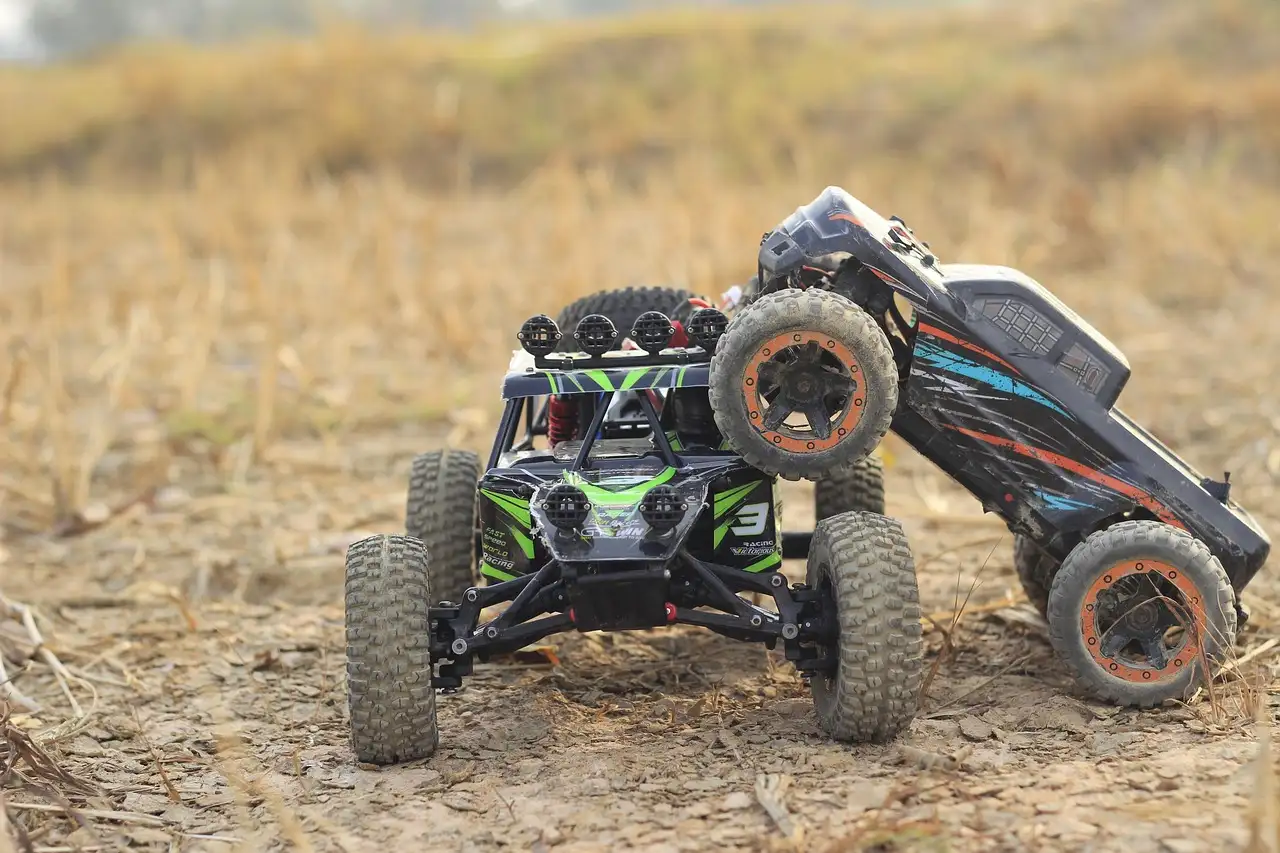
Remote controlled cars work by converting your hand input into a radio command, then into electrical or mechanical action inside the car. The cleanest way to think about it is signal, decoding, power delivery, and motion. If one stage fails, the next stage never gets the right instruction.
How do wireless remote control cars work?
Wireless remote control cars use the same basic control loop without a physical tether. The transmitter sends a radio signal, the receiver decodes it, and the car acts on that command through the ESC and servo. Wireless control is only useful when the radio link stays matched and powered.
How do remote control cars work for kids?
For kids, the simplest RC cars usually use a toy-grade radio system with fewer setup steps and lower speed. Hobby-grade cars give more control, stronger parts, and more repair options, but they also ask for more attention to battery care, binding, and maintenance. Choose based on age, not hype.
A common first-timer mistake is mixing a hobby transmitter with a toy-grade car or assuming any remote will work with any model. That usually leads to a dead car or only partial control, because the receiver expects a matching system and the frequency band matters.
Frequently asked questions
What parts make an RC car move?
The parts that make an RC car move are the transmitter, receiver, ESC, motor or engine, battery or fuel system, and drivetrain. Steering movement depends on the servo. Suspension helps the car stay planted so the wheels can use the available grip.
What is the difference between electric, nitro, and gas RC cars?
Electric RC cars use rechargeable batteries and an ESC to drive an electric motor. Nitro cars use nitromethane-based fuel, a glow plug, and an engine with a carburetor, piston, and crankshaft. Gas models burn gasoline and oil and use spark plug ignition, with two-stroke or four-stroke layouts.
How does the transmitter communicate with the receiver?
The transmitter generates radio waves through an antenna, and the receiver listens for the matched signal. Once bound, the receiver converts that radio input into usable control signals for the car’s steering and speed systems. If the pair is not matched, communication fails.
Do RC cars use batteries or fuel?
They can use either. Electric RC cars use batteries, usually rechargeable packs. Nitro cars use nitromethane-based fuel, and gas RC cars use gasoline and oil. The power source changes the setup, startup routine, noise, and maintenance needs.
Products related to this article
Sponsored / affiliate links. As an Amazon Associate I earn from qualifying purchases. I may earn additional commission from eligible campaigns.