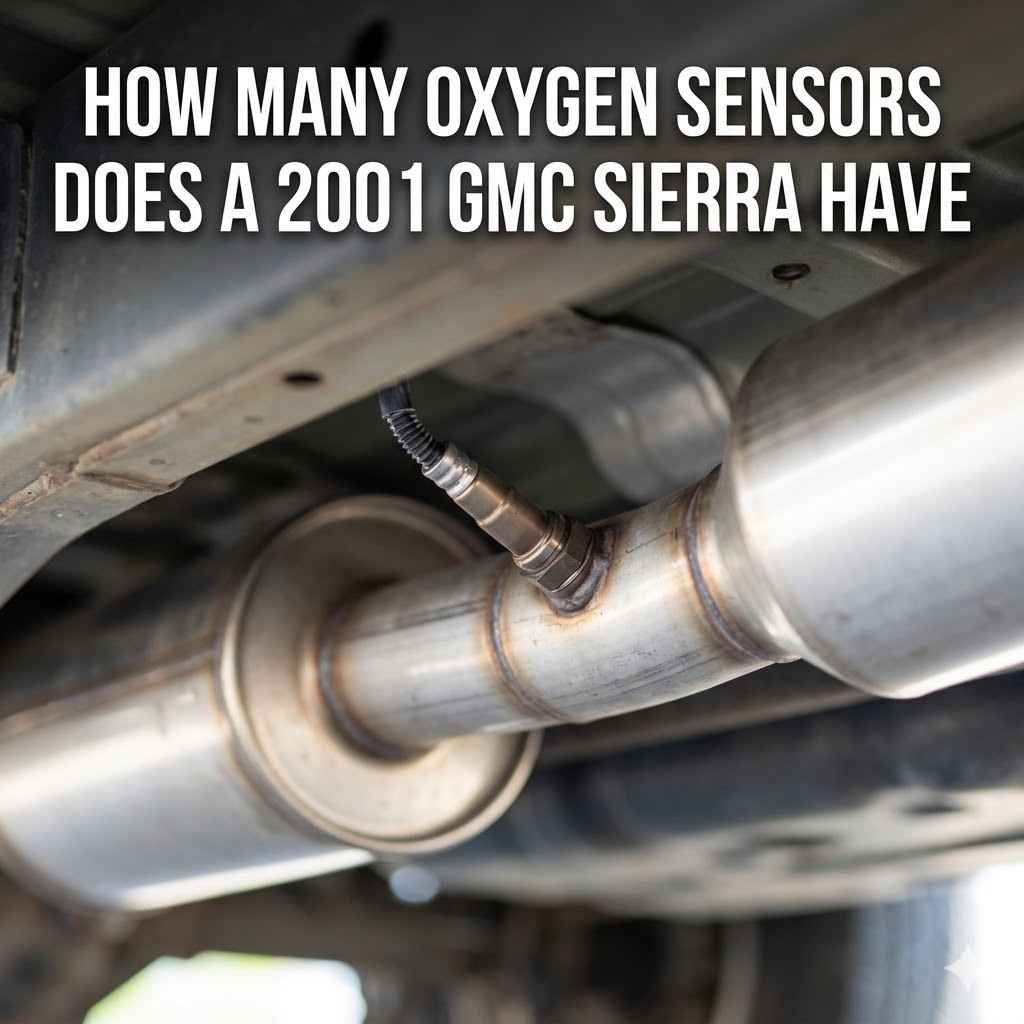
How Many Oxygen Sensors Does a 2001 GMC Sierra Have
Figuring out how many oxygen sensors your 2001 GMC Sierra has can sometimes be a bit tricky, especially if you’re new to working on cars. You might wonder about this when you see a check engine light or plan some maintenance. Don’t worry, it’s a common question!
This guide will make it super simple. We’ll break down exactly where they are and how many you can expect. Get ready to get all the answers you need without any confusion.
Understanding Oxygen Sensors In Your 2001 GMC Sierra
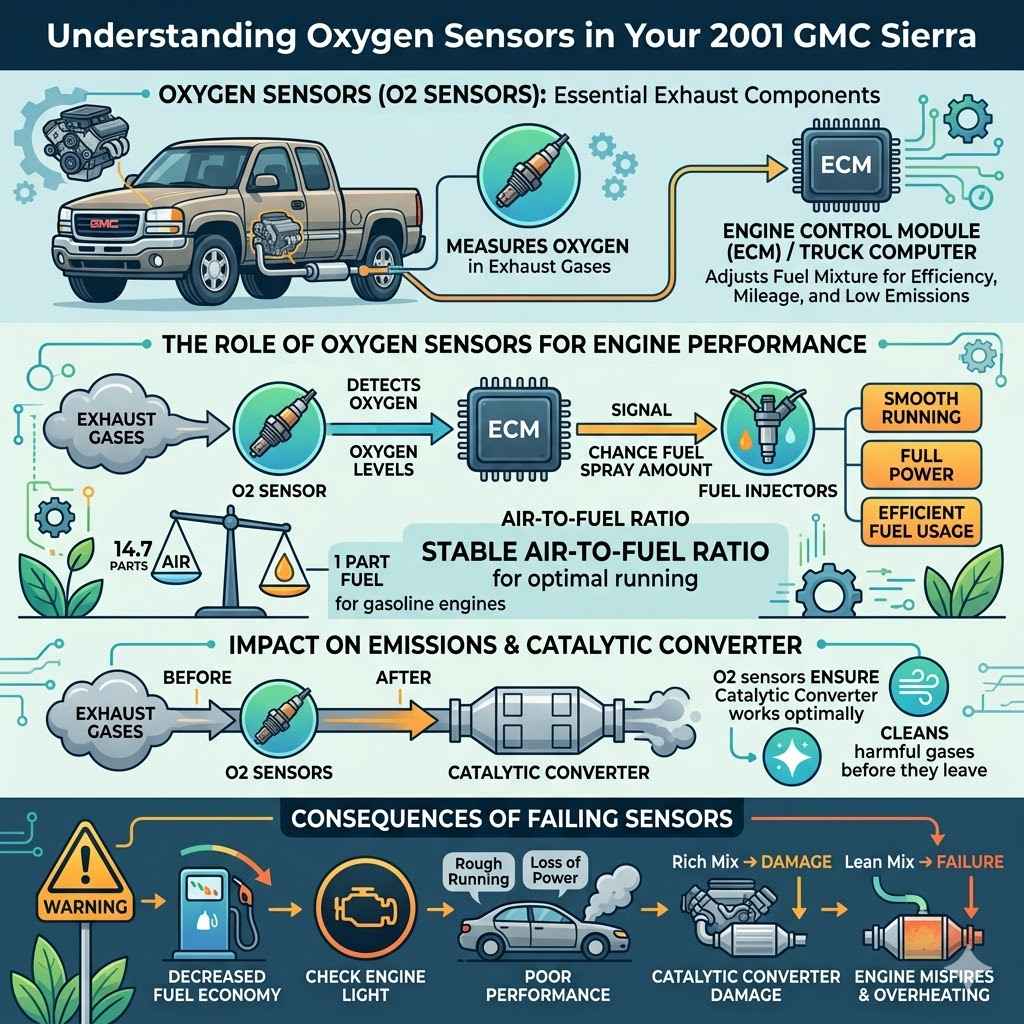
Oxygen sensors, often called O2 sensors, are small but mighty parts of your GMC Sierra’s exhaust system. Their main job is to measure how much oxygen is in the exhaust gases. This information is then sent to your truck’s computer, which is also known as the Engine Control Module or ECM.
The ECM uses this data to adjust the fuel mixture. This helps your engine run more efficiently, get better gas mileage, and keep those harmful emissions down. For anyone looking to do their own repairs or just understand their vehicle better, knowing the number and location of these sensors is a key first step.
The Role of Oxygen Sensors for Engine Performance
Oxygen sensors are vital for your engine’s health and how well it runs. They are like the eyes of your engine, constantly watching the exhaust. When the O2 sensor detects too much or too little oxygen, it signals the ECM.
The ECM then tells the fuel injectors to change how much fuel they spray. This keeps the air-to-fuel ratio just right. A good air-to-fuel ratio is about 14.7 parts air to 1 part fuel for gasoline engines.
If this ratio is off, your engine might run rough, lose power, or use more gas than it should.
Having properly working oxygen sensors also directly impacts your truck’s emissions. Modern vehicles are designed to meet strict environmental standards. O2 sensors help achieve this by ensuring the catalytic converter works at its best.
The catalytic converter is another part of the exhaust system that cleans up harmful gases before they leave your truck. Without accurate readings from the O2 sensors, the catalytic converter can’t do its job effectively. This can lead to increased pollution and potentially failed emissions tests.
Consider a scenario where an O2 sensor is failing. You might notice a slight decrease in your gas mileage at first. Then, your check engine light could come on.
If left unaddressed, a faulty sensor can cause your engine to run too rich (too much fuel) or too lean (too little fuel). Running too rich can damage the catalytic converter over time, a costly repair. Running too lean can cause engine misfires and overheating.
This highlights why knowing the number of sensors and their condition is so important for maintaining your 2001 GMC Sierra.
How Many Oxygen Sensors Are in a 2001 GMC Sierra
For a 2001 GMC Sierra, the number of oxygen sensors depends on a couple of things, mainly the engine size and if it’s a two-wheel drive or four-wheel drive model. Most 2001 GMC Sierras come equipped with a total of four oxygen sensors. These sensors are strategically placed in the exhaust system to monitor different parts of the combustion process.
Having four sensors allows for more precise control over fuel delivery and emissions, helping your truck meet standards and run efficiently.
These four sensors are typically divided into two sets: upstream and downstream. The upstream sensors are located before the catalytic converter, while the downstream sensors are found after it. Each bank of the engine has its own pair of sensors.
This setup gives the ECM detailed information about how well the engine is burning fuel and how effectively the catalytic converter is cleaning the exhaust. Knowing this configuration is helpful if you’re troubleshooting a check engine light code related to O2 sensors.
Let’s break down the common configurations. A 2001 GMC Sierra with the 4.8L or 5.3L V8 engine generally has four oxygen sensors. If your truck has a different engine option, the number might vary, but four is the most common setup for this model year.
Understanding this common number is the first step when you begin any maintenance or diagnostic work on your exhaust system. It helps you know what to expect under the truck.
Upstream Oxygen Sensors The Engine’s Primary Feedback
The upstream oxygen sensors are critically important because they provide the primary feedback to the engine’s computer regarding the air-fuel mixture. These sensors are positioned in the exhaust manifold or pipe just before the catalytic converter. They are also known as pre-catalytic converter sensors.
There are typically two upstream sensors, one for each bank of cylinders on a V8 engine. Bank 1 covers cylinders 1, 3, 5, and 7, while Bank 2 covers cylinders 2, 4, 6, and 8.
These upstream sensors measure the amount of unburned oxygen in the exhaust gas. Based on this measurement, they send a voltage signal to the Engine Control Module (ECM). If there’s too much oxygen, it means the mixture is lean (too much air, not enough fuel).
The ECM then commands the fuel injectors to spray more fuel. If there’s too little oxygen, it indicates a rich mixture (too much fuel, not enough air). The ECM then reduces the amount of fuel injected.
This constant adjustment is what keeps the engine running optimally. The upstream sensors are crucial for fuel economy and engine power. When they start to fail, you’ll often notice a significant drop in miles per gallon, rough idling, hesitation during acceleration, and potentially engine misfires.
A faulty upstream O2 sensor is one of the most common causes for a check engine light to illuminate. Replacing them promptly can prevent further engine damage and restore lost performance.
A common issue is when an upstream O2 sensor gets contaminated with oil or coolant. This contamination can cause it to send inaccurate readings, making the engine computer think the air-fuel mixture is something it’s not. For example, if the sensor mistakenly reports a lean condition, the computer will add more fuel, leading to a rich mixture and poor fuel economy.
This is why regular maintenance and addressing any engine leaks are important for sensor longevity.
Downstream Oxygen Sensors Monitoring Catalytic Converter Efficiency
The downstream oxygen sensors, also called post-catalytic converter sensors, play a different but equally important role. Their primary function is to monitor the efficiency of the catalytic converter. These sensors are located in the exhaust pipe after the catalytic converter.
Similar to the upstream sensors, a 2001 GMC Sierra typically has two downstream sensors, one for each exhaust bank.
Unlike upstream sensors that fluctuate rapidly with changes in the air-fuel mixture, downstream sensors should show a relatively stable and steady voltage reading if the catalytic converter is working correctly. The catalytic converter cleans up pollutants like carbon monoxide, hydrocarbons, and nitrogen oxides by converting them into less harmful substances. The downstream O2 sensor’s job is to confirm that this conversion process is happening effectively.
If the catalytic converter is functioning properly, the exhaust gas composition after the converter will be different from the gas before it. The downstream sensor detects this difference. If the downstream sensor’s readings begin to mimic those of the upstream sensor, it’s a strong indicator that the catalytic converter is not operating efficiently.
This often triggers a check engine light code specifically related to catalytic converter efficiency.
Replacing downstream O2 sensors is sometimes done as a diagnostic step when a catalytic converter issue is suspected. However, it’s important to remember that the downstream sensor’s main job is to report on the converter’s status, not to directly control the air-fuel mixture. A failing downstream sensor itself might not cause immediate drivability issues like rough idling or poor MPG, but it will certainly alert you to a problem with your emissions system.
It’s essential to address these codes promptly to avoid further damage and environmental impact.
Locating the Oxygen Sensors On Your 2001 GMC Sierra
Knowing where to find the oxygen sensors on your 2001 GMC Sierra is key to performing any maintenance or diagnostic work. With four sensors, they are distributed along the exhaust system. You’ll typically find two upstream sensors and two downstream sensors.
They look like small threaded bolts with wires coming out of them. The wires are usually covered in protective sheathing to withstand the heat of the exhaust system.
The upstream sensors are usually found on or very close to the exhaust manifolds. On a V8 engine, you have two exhaust manifolds, one for each bank of cylinders. Each manifold will have an oxygen sensor screwed into it or into the exhaust pipe immediately after it.
These are the sensors that most directly influence your engine’s fuel trim adjustments.
The downstream sensors are located further back in the exhaust system, after the catalytic converter. You’ll find one in the exhaust pipe after the converter for each bank. They serve as a check on the converter’s performance.
Accessing these sensors can sometimes be challenging due to their location, which is often underneath the vehicle.
When you’re under your 2001 GMC Sierra, look for the exhaust pipes coming from the engine. The upstream sensors will be closer to the engine block, often bolted into the exhaust pipes just after the manifolds. The downstream sensors will be further back, typically after the large metal canister of the catalytic converter.
They are usually identifiable by their wire harnesses, which will lead back towards the engine compartment or the chassis.
Identifying Upstream Sensor Locations
The upstream oxygen sensors are your engine’s first line of defense in controlling the air-fuel ratio. For your 2001 GMC Sierra with a V8 engine, you’ll have two exhaust manifolds, one on each side of the engine. Each manifold connects to an exhaust pipe.
The upstream O2 sensor for that side of the engine is typically screwed into this exhaust pipe very close to the manifold.
On the driver’s side of the engine (Bank 1), you’ll find one upstream sensor. On the passenger’s side (Bank 2), you’ll find the second upstream sensor. They are usually identifiable by their wire harness, which might be a grey or black connector.
They often have three or four wires coming out of them. These are the sensors that are most critical for daily engine operation and fuel efficiency.
Sometimes, a repair manual or diagnostic code will specify “Bank 1 Sensor 1” or “Bank 2 Sensor 1”. “Sensor 1” typically refers to the upstream sensor. “Bank 1” is usually the cylinder bank that contains cylinder #1.
On most V8 engines, cylinder #1 is on the passenger side of the engine. However, it’s always good to confirm this with a repair manual specific to your 2001 GMC Sierra, as configurations can sometimes vary.
When you are under the vehicle, you’ll see the exhaust pipes coming down from each side of the engine. Look for a threaded sensor screwed into the pipe, usually within a foot or two of where the exhaust pipe leaves the engine. That’s your upstream sensor.
They are generally easier to access than some other engine components due to their placement.
Pinpointing Downstream Sensor Positions
The downstream oxygen sensors on your 2001 GMC Sierra are positioned after the catalytic converter. The catalytic converter is a large, often oval-shaped component in the exhaust system designed to reduce emissions. After this converter, the exhaust pipe continues, and that’s where you’ll find the downstream sensors.
Similar to the upstream sensors, you will have one downstream sensor for each bank of the V8 engine. So, you’ll have a Bank 1 Sensor 2 and a Bank 2 Sensor 2. These are located in the exhaust pipe downstream of their respective catalytic converters.
If your Sierra has two catalytic converters, you’ll have two downstream sensors.
These sensors are essential for monitoring the effectiveness of the catalytic converter. They don’t directly control the air-fuel mixture like the upstream sensors do. Their readings are used by the ECM to verify that the converter is functioning as intended.
A common check engine light code related to the catalytic converter will often involve the downstream O2 sensor’s readings.
Accessing downstream sensors can sometimes be more difficult than upstream sensors, as they are located further back and lower on the exhaust system. You might need to use specialized tools or jack stands to get a clear view and good access. Always ensure the exhaust system is cool before attempting to work on it to avoid burns.
Replacing Oxygen Sensors A Step-By-Step Guide
Replacing oxygen sensors on your 2001 GMC Sierra can be a manageable DIY task if you’re comfortable working under your truck. It’s a common repair that can save you money on labor costs. The process involves a few key steps, from safely lifting the vehicle to correctly installing the new sensors.
Having the right tools and parts makes the job much smoother and safer.
Before you start, ensure you have the correct replacement oxygen sensors for your specific 2001 GMC Sierra model and engine. It’s also a good idea to have a repair manual handy for your truck, as it can provide detailed diagrams and torque specifications. Safety is paramount when working under a vehicle, so always use jack stands and ensure the parking brake is firmly engaged.
Once the new sensors are installed and connected, you’ll likely need to clear the check engine light using an OBD-II scanner. After clearing the code, drive your truck to allow the system to re-learn and verify the new sensor’s operation. This process generally takes some driving cycles under various conditions.
If you’re unsure about any step or uncomfortable working with exhaust components, it’s always best to consult a professional mechanic. However, for those looking to tackle this themselves, following these steps carefully can lead to a successful repair and a well-running truck.
Safety First Lifting and Securing Your Truck
Safety is the most critical part of any automotive repair, especially when working underneath your 2001 GMC Sierra. Before you even think about reaching for a wrench, you need to ensure your truck is properly and securely lifted. Your first step should be to park your truck on a level, solid surface.
Avoid soft ground or slopes.
Engage the parking brake firmly. If you have a manual transmission, put it in gear. For automatic transmissions, put it in park.
You should also place wheel chocks behind the rear wheels to prevent the vehicle from rolling forward. This adds an extra layer of security.
Use a high-quality hydraulic jack to lift the front of the truck. Lift it high enough so you can comfortably work underneath. Once it’s at the desired height, you must place sturdy jack stands under the frame rails or designated support points.
Never rely solely on the jack to hold the vehicle up. Gently lower the truck onto the jack stands. Give the truck a little shake to ensure it’s stable before you proceed.
Always double-check that the jack stands are positioned correctly and are rated to support the weight of your truck. The weight of a 2001 GMC Sierra can be significant, so using appropriate safety equipment is non-negotiable. If you have any doubts about the stability of your setup, do not work under the vehicle.
Removing Old Oxygen Sensors
Once your 2001 GMC Sierra is safely supported, you can begin the process of removing the old oxygen sensors. You will likely need a specialized oxygen sensor socket for this task. These sockets have a slot for the wire harness, allowing you to fit the socket onto the sensor while leaving the wires accessible.
A breaker bar might be needed if the sensors are seized due to rust or heat.
Spray a penetrating oil, such as PB Blaster or WD-40 Specialist Penetrant, onto the base of the oxygen sensor where it threads into the exhaust pipe. Let it soak for at least 15-30 minutes, or even longer if the sensors are very old or rusted. This will help to break down any corrosion and make removal easier.
Place the oxygen sensor socket onto the sensor and attach your ratchet or breaker bar. Turn the socket counter-clockwise to unscrew the sensor. If it’s very tight, apply steady pressure.
Be careful not to strip the sensor or the threads in the exhaust pipe. If it feels like it’s going to break, try applying more penetrating oil and waiting longer.
As you unscrew the sensor, be prepared for some soot or exhaust residue to fall out. Once removed, inspect the old sensor. The tip might be covered in black soot, which indicates a rich fuel mixture, or it might appear oily or discolored, suggesting other engine issues.
Place the old sensor aside; you’ll need to dispose of it properly.
Installing New Oxygen Sensors
After removing the old oxygen sensors, clean the threads in the exhaust pipe where the new sensor will be installed. You can use a wire brush or a thread chaser tool to ensure the threads are clean and free of debris. This is crucial for a good seal and to prevent cross-threading.
Before screwing in the new sensor, apply a small amount of anti-seize lubricant to the threads of the new sensor. This will make future removal much easier. Be careful not to get any anti-seize on the sensor tip itself, as this can affect its readings.
Some new sensors come with anti-seize pre-applied.
Carefully thread the new oxygen sensor into the exhaust pipe by hand. You want to feel the threads engage smoothly. Once it’s finger-tight, use your oxygen sensor socket and ratchet to tighten it.
Refer to your repair manual for the specific torque specification for your 2001 GMC Sierra. Overtightening can damage the sensor or the exhaust pipe threads, while undertightening can lead to exhaust leaks.
Connect the wiring harness of the new sensor to the corresponding connector on your truck. Ensure the connection is secure and that the wire is routed away from any hot exhaust components or moving parts. Inspect the connection to make sure it’s properly seated and locked.
Common Issues and Diagnostic Codes
Oxygen sensors are wear-and-tear items, and they can fail over time. When an O2 sensor malfunctions on your 2001 GMC Sierra, it can lead to a variety of performance problems and trigger diagnostic trouble codes (DTCs) that illuminate your check engine light. Understanding these common issues and their associated codes can help you diagnose and fix problems more effectively.
The most common symptom of a failing oxygen sensor is a lit check engine light. However, other drivability issues can also arise. These include decreased fuel economy, rough idling, hesitation during acceleration, and in severe cases, engine misfires.
If you notice any of these symptoms, it’s wise to get your truck scanned for diagnostic codes.
Modern vehicles use an OBD-II (On-Board Diagnostics II) system to monitor emissions and engine performance. When a problem is detected, the system stores a DTC. These codes are alphanumeric identifiers that point to a specific issue.
For oxygen sensors, these codes often start with “P0130” through “P0167”.
Knowing these codes can give you a head start in identifying which sensor is at fault and where it’s located. For instance, codes related to “Sensor 1” usually point to upstream sensors, while codes for “Sensor 2” indicate downstream sensors. Codes specifying “Bank 1” or “Bank 2” help you identify which side of the V8 engine is experiencing the issue.
Understanding P0130-P0167 Diagnostic Trouble Codes
The diagnostic trouble codes (DTCs) related to oxygen sensors on your 2001 GMC Sierra typically fall within the P0130 to P0167 range. These codes are generated by the Engine Control Module (ECM) when it detects a problem with the performance of one or more O2 sensors or the circuit connected to them.
Here’s a breakdown of what some of these codes might mean:
- P0130 Oxygen Sensor Circuit Malfunction (Bank 1 Sensor 1): This code indicates a problem with the circuit or performance of the upstream oxygen sensor on Bank 1.
- P0131 O2 Sensor Circuit Low Voltage (Bank 1 Sensor 1): The voltage signal from the Bank 1 upstream sensor is too low.
- P0132 O2 Sensor Circuit High Voltage (Bank 1 Sensor 1): The voltage signal from the Bank 1 upstream sensor is too high.
- P0133 O2 Sensor Circuit Slow Response (Bank 1 Sensor 1): The Bank 1 upstream sensor is not responding quickly enough to changes in the air-fuel mixture.
- P0134 O2 Sensor Circuit No Activity Detected (Bank 1 Sensor 1): The ECM is not detecting any activity from the Bank 1 upstream sensor, suggesting it may be completely dead or disconnected.
- P0135 O2 Sensor Heater Circuit Malfunction (Bank 1 Sensor 1): The heating element within the Bank 1 upstream sensor is not working. The heater is important for bringing the sensor up to operating temperature quickly.
Similar codes exist for Bank 2 Sensor 1, and for Bank 1 Sensor 2 and Bank 2 Sensor 2 (downstream sensors). For instance, P0150 would be a general circuit malfunction for Bank 2 Sensor 1. Codes for downstream sensors (Sensor 2) often relate to catalytic converter efficiency, like P0137 (Bank 1 Sensor 2 Circuit Low Voltage) or P0161 (Bank 2 Sensor 2 Heater Circuit Malfunction).
When you get a code read, it’s essential to note the exact code and which sensor bank and number it refers to. This information is critical for pinpointing the problematic sensor and ensuring you purchase the correct replacement. A code reader or scan tool will be necessary to retrieve these codes from your truck’s ECM.
Symptoms of Failing Oxygen Sensors
A failing oxygen sensor doesn’t always mean your engine will sputter and die immediately. Often, the symptoms are subtle at first, but they can become more noticeable as the sensor’s performance degrades. Recognizing these signs can help you address the issue before it causes more significant problems or leads to expensive repairs.
The most universal symptom is a lit check engine light. This is your truck’s way of telling you something is wrong. However, don’t solely rely on the light.
Pay attention to how your truck is running. A significant and sudden drop in fuel economy is a major red flag. If you’re filling up your tank more often than usual, and you haven’t changed your driving habits, a faulty O2 sensor could be the culprit, especially an upstream one.
Other signs include:
- Rough Idle: The engine might shake or run unevenly when the truck is stopped.
- Hesitation or Stumbling During Acceleration: When you press the gas pedal, the engine might hesitate or feel like it’s stumbling before it picks up speed.
- Engine Misfires: You might feel the engine miss a beat, especially under load. This can sometimes be accompanied by a strong smell of unburned fuel.
- Failed Emissions Test: Because oxygen sensors are crucial for emissions control, a failing sensor will almost certainly cause your truck to fail an emissions inspection.
- Poor Engine Performance: Overall, the truck might feel less responsive, lack power, or not accelerate as smoothly as it used to.
If you notice any combination of these symptoms, especially alongside a check engine light, it’s highly recommended to have your truck’s diagnostic codes read. Early detection and replacement of faulty oxygen sensors can save you from poor performance, increased fuel costs, and potential damage to other components like the catalytic converter.
Benefits of Maintaining Your Oxygen Sensors
Regularly maintaining and ensuring your oxygen sensors are in good working order offers several significant benefits for your 2001 GMC Sierra. It’s not just about avoiding a check engine light; it’s about keeping your truck running at its best, saving you money, and protecting the environment.
The most immediate benefit is improved fuel efficiency. Oxygen sensors play a direct role in regulating the air-fuel mixture. When they are functioning correctly, the ECM can optimize the fuel injection for maximum efficiency.
This means fewer trips to the gas station and more money in your pocket. Studies have shown that replacing faulty O2 sensors can improve fuel economy by as much as 15-20%.
Another major benefit is reduced emissions. Oxygen sensors help ensure that your engine is running cleanly, which allows the catalytic converter to do its job effectively. This leads to lower emissions of harmful pollutants like carbon monoxide and hydrocarbons.
This not only benefits the environment but also ensures your truck will pass mandatory emissions tests.
Furthermore, well-maintained oxygen sensors contribute to better overall engine performance. An engine that receives the correct amount of fuel and air will run smoother, have more power, and be more responsive. This leads to a more enjoyable driving experience and can prevent premature wear on other engine components.
Consider this: The U.S. Environmental Protection Agency (EPA) estimates that a malfunctioning oxygen sensor can increase emissions by as much as 50%. Over time, these emissions contribute to air pollution.
Ensuring your O2 sensors are working properly is a small step that has a large positive impact on your vehicle’s environmental footprint. Investing in their maintenance is an investment in your truck’s longevity, your wallet, and the planet.
Maximizing Fuel Efficiency
Fuel efficiency is a major concern for many truck owners, and oxygen sensors are key players in achieving it. The engine’s computer constantly strives for an ideal air-to-fuel ratio, typically around 14.7 parts air to 1 part fuel. This precise ratio allows for complete combustion, which maximizes the energy extracted from each drop of gasoline.
Upstream oxygen sensors are the primary tools the ECM uses to monitor and adjust this ratio in real-time. If an upstream sensor is faulty, it might send inaccurate signals. For example, if it wrongly reports a lean condition (too much air), the ECM will inject more fuel to compensate.
This results in a “rich” mixture, wasting fuel and decreasing your miles per gallon.
Conversely, if the sensor reports a rich condition (too much fuel), the ECM will lean out the mixture. While this might seem good for saving fuel, a lean mixture can cause other problems like engine detonation or overheating, and it’s not the intended efficient operation.
A study by the National Institute for Automotive Service Excellence (ASE) highlighted that a malfunctioning oxygen sensor is one of the most common reasons for a vehicle to fail an emissions test and suffer from poor fuel economy. Replacing a bad O2 sensor can often restore lost miles per gallon, effectively paying for itself over time through fuel savings. For a truck like the 2001 GMC Sierra, this can mean significant savings over the course of a year.
Reducing Harmful Emissions
The role of oxygen sensors in reducing harmful emissions cannot be overstated. In conjunction with the catalytic converter, these sensors are vital for meeting environmental regulations and ensuring clean air. A properly functioning engine, monitored by accurate O2 sensor data, burns fuel more completely.
When the air-fuel mixture is precisely controlled, the exhaust gases entering the catalytic converter are at the optimal composition for conversion. The catalytic converter uses precious metals like platinum, palladium, and rhodium to chemically transform toxic pollutants into less harmful substances. Carbon monoxide (CO) is converted to carbon dioxide (CO2), unburned hydrocarbons (HC) are converted to CO2 and water (H2O), and nitrogen oxides (NOx) are reduced to nitrogen gas (N2).
If an oxygen sensor is failing and providing incorrect data, the air-fuel mixture will be off. This can lead to incomplete combustion, producing more unburned hydrocarbons and carbon monoxide. It can also lead to the catalytic converter operating outside its optimal temperature or chemical environment, reducing its efficiency.
This means more pollutants are released into the atmosphere.
The Clean Air Act in the United States mandates strict emission standards for vehicles. For older trucks like your 2001 GMC Sierra, having functioning emission control systems, including properly working oxygen sensors, is essential for compliance. Failing to maintain these components not only harms the environment but can also result in fines or the inability to register your vehicle in certain areas.
According to the EPA, vehicles are a significant source of air pollution, and well-maintained emission control systems are critical in mitigating this impact.

Frequently Asked Questions
Question: How many oxygen sensors does a 2001 GMC Sierra typically have
Answer: A 2001 GMC Sierra typically has four oxygen sensors, with two upstream sensors located before the catalytic converter and two downstream sensors located after it.
Question: What is the difference between upstream and downstream oxygen sensors
Answer: Upstream oxygen sensors (Sensor 1) measure the oxygen in the exhaust to help the engine computer adjust the fuel mixture for optimal performance. Downstream oxygen sensors (Sensor 2) monitor the performance of the catalytic converter.
Question: Can I drive my 2001 GMC Sierra with a bad oxygen sensor
Answer: You can usually drive with a bad oxygen sensor, but it is not recommended for extended periods. It can lead to poor fuel economy, increased emissions, and potential damage to other engine components like the catalytic converter.
Question: Where is Bank 1 located on a V8 engine
Answer: Bank 1 typically refers to the cylinder bank that contains cylinder number 1. On most V8 engines, this is the passenger side of the engine, but it’s always best to consult a repair manual for your specific vehicle to be sure.
Question: How often should oxygen sensors be replaced
Answer: Oxygen sensors are generally recommended for replacement every 60,000 to 100,000 miles, or sooner if symptoms of failure appear or diagnostic trouble codes are present.
Summary
Your 2001 GMC Sierra most likely has four oxygen sensors. Two are upstream, helping control fuel, and two are downstream, checking the catalytic converter. Keeping these sensors working well improves gas mileage, cuts pollution, and keeps your engine running smoothly.
Regular checks and timely replacement are key.