How Much Does a Car Service Cost in South Africa?
In South Africa, a routine car service typically costs about R1,200–R2,500 for a small hatchback, R1,800–R3,800 for a sedan or crossover, and R3,500+ for premium or larger SUVs, with dealer quotes usually higher than independent workshops. Skip it, or buy the wrong service, and you can face breakdowns, faster wear, and repair bills that far exceed the service invoice. This guide breaks down service types, what is included, and why quotes differ by brand, mileage, and parts.
Car service cost table

| Service type | Vehicle segment | Workshop type | Typical inclusions | Common exclusions | Likely price range |
|---|---|---|---|---|---|
| Minor service | Entry-level hatchback | Independent workshop | Engine oil, oil filter, basic inspection, top-up of fluids, reset service light | Brake pads, spark plugs, air filter if not listed, diagnostics, wheel alignment | R1,200–R2,000 |
| Minor service | Sedan or crossover | Independent workshop | Oil, oil filter, safety check, fluid inspection, labour | Cabin filter, brake fluid flush, battery testing fee, extra consumables | R1,800–R3,000 |
| Minor service | Premium car or large SUV | Dealership service center | OEM oil and filter, inspection, diagnostic scan, service reset | Tyres, brakes, plugs, transmission fluid, wear items outside the service list | R3,500–R7,500+ |
| Major service | Entry-level hatchback | Independent workshop | Oil, oil filter, air filter, spark plugs where due, brake fluid check, deeper inspection | Timing belt, brakes, battery, coolant flush, diagnostics unless asked for | R2,500–R4,500 |
| Major service | Sedan or crossover | Independent workshop | Oil and filters, plugs or diesel filter if due, more labour time, fuller inspection | Suspension repairs, brake overhaul, transmission service, tyres | R3,500–R6,500 |
| Major service | Premium car or large SUV | Dealership service center | OEM parts, model-specific fluids, scan tool checks, scheduled maintenance items | Wear-and-tear repairs, accident damage, tyres, alignment, anything outside the schedule | R6,000–R15,000+ |
Minor service pricing by vehicle segment
A minor service in South Africa usually sits at the lower-cost end of the bill. For many cars, it is due every 10,000–15,000 km or about 12 months, although some modern models stretch further. It normally covers engine oil, the oil filter, fluid checks, and a basic inspection.
Entry-level hatchbacks cost less because they use less oil, simpler parts, and less labour time. Sedans and crossovers cost more. Premium cars and larger SUVs cost more again because their oil capacity, parts list, and diagnostic time are usually greater.
Major service pricing by vehicle segment
A major service costs more because it covers a wider maintenance scope than a minor service. It often lands around 30,000 km to 60,000 km, or every 24 months, depending on the manufacturer schedule. The bill rises when the service includes air filters, spark plugs, brake fluid, diesel filters, and more labour.
On higher-spec vehicles, a major service can jump sharply if the schedule calls for model-specific fluids or access-heavy parts. That is why two cars with the same mileage can produce very different quotes.
Dealer versus independent workshop ranges
Dealer quotes are usually higher because the workshop uses OEM parts, brand-specific diagnostic systems, and higher labour rates. Independent workshops are often cheaper because their overheads are lower and they can source quality aftermarket or OEM-equivalent parts.
The cheapest quote is not always the best one. A low number can mean oil, filters, or labour are excluded, or that the workshop plans to add them later. Compare the same service level, same parts list, and same oil spec before deciding.
Typical inclusions, exclusions, and add-ons
A proper service quote should list consumables and labour clearly. The usual consumables are engine oil, oil filter, air filter when due, spark plugs when due, and brake fluid when the schedule calls for it. That is where a large share of the price goes.
Common exclusions are wear parts and repairs outside the routine service, such as brake pads, discs, batteries, suspension parts, tyres, alignment, and fault-finding for warning lights. A quote that looks unusually cheap may simply omit those items.
What does a car service include?
A routine car service usually includes an oil change, a new oil filter, fluid checks, and a multipoint inspection of visible wear and safety items. If the service is minor, that is often the core of it. If it is major, the workshop adds more filters, plugs, and deeper checks.
Oil, filter, and fluid checks
Engine oil grade matters because the correct viscosity and specification affect wear protection and price. The oil filter is replaced every service in most schedules. Air filters, cabin filters, and brake fluid may be due on longer intervals or only on a major service.
Brake fluid is often overlooked. It absorbs moisture over time, so many manufacturers specify replacement every two years, even if the car has low mileage.
Inspection items and wear parts
Service inspections usually cover brakes, belts, hoses, tyres, steering, suspension, lights, and leaks. A workshop may also check battery condition and scan for fault codes if the package includes diagnostics. That inspection is useful only if the results are written down clearly.
Say your 1.4-litre hatchback is booked for a minor service at 48,000 km. The quote may include oil, an oil filter, and an inspection, but the final bill rises if the technician finds worn front pads or a blocked cabin filter.
What quotes often leave out
Some quotes leave out parts that matter to the total cost. The most common omissions are labour for extra work, diagnostic time, spark plugs, brake fluid, air filters, and any repair discovered after the car is opened up. Always ask whether the quote is parts-and-labour inclusive.
Minor service versus major service
The difference is scope. A minor service handles routine maintenance and basic safety checks. A major service goes further and replaces more scheduled items, so it costs more and takes longer. That is why service interval and price usually move together.
Typical intervals in kilometres or months
Most manufacturers list minor services around 10,000–15,000 km or 12 months, and major services at longer mileage points or every 24 months, depending on the model. Follow the service book for your car, not a generic rule, because turbo engines, diesels, and premium models often have tighter schedules.
Common work in a minor service
A minor service usually includes oil, the oil filter, a general inspection, and top-ups of screenwash or other listed fluids. It is the lower-cost end of servicing and is meant to keep the car within its routine maintenance cycle.
Common work in a major service
A major service is broader. It may include the engine oil, oil filter, air filter, cabin filter, spark plugs, brake fluid, fuel filter on some engines, and a longer inspection. More parts and more labour push the price higher.
How scope changes the price
The service bill rises when the workshop has to replace more consumables or spend longer on access-heavy jobs. Engine size, cylinder count, and packaging all matter. A small naturally aspirated hatchback is easier than a turbocharged SUV with tight engine bay access and expensive fluids.
Dealer or independent workshop?
A dealership service center is usually the better fit for warranty-covered vehicles and model-specific work. An independent workshop is often the cheaper option for older cars, out-of-warranty vehicles, and routine maintenance where the shop can source approved parts at a lower labour rate.
Labour rates and diagnostic systems
Dealers generally charge more per hour because they use OEM systems, brand training, and factory diagnostic software. Independent workshops tend to charge less and can often complete routine services faster. For a simple oil-and-filter service, that gap can be meaningful.
OEM parts versus aftermarket parts
Dealers normally fit OEM parts and approved fluids. Independent workshops may use OEM, OEM-equivalent, or aftermarket parts, depending on what you ask for and what your vehicle needs. Good aftermarket parts can be acceptable, but the quality of the supplier matters.
Suppose a mid-size SUV needs a major service just after the warranty ends. An independent workshop may cut the bill materially by using quality aftermarket filters and oils, while still following the manufacturer’s service spec.
When each option makes sense
Choose the dealer when the car is still under warranty, the schedule is strict, or the vehicle needs a brand-specific scan. Choose a reputable independent workshop when the car is older, the service is routine, and the shop can prove it follows the correct service schedule with parts that meet spec.
How do service plans and warranties affect cost?
Service plans can lower your out-of-pocket cost because they are prepaid maintenance coverage. Warranties can make servicing non-negotiable because missing the required intervals can put coverage at risk. The real cost is not only the invoice; it is also what happens if you service the car incorrectly.
What prepaid coverage usually includes
A service plan usually covers scheduled maintenance items such as labour, engine oil, oil filters, and the service items listed by the manufacturer. Some plans also include selected filters or fluids. It depends on the contract, not the badge on the car.
Common exclusions and expiry rules
Service plans often exclude wear-and-tear parts such as brakes, tyres, batteries, wiper blades, clutches, and accident damage. They may also expire by time or mileage, whichever comes first. Some plans are transferable, but only if the contract says so.
Approved servicing and warranty risk
Warranty rules usually require servicing at the manufacturer interval and at an approved workshop standard. Missing the deadline, using unapproved parts, or skipping a service can create a dispute if a later failure is claimed under warranty. Keep stamped records and itemised invoices.
What pushes a quote higher?
The biggest price jumps come from diagnostics, wear parts, and vehicle complexity. Add-ons can turn a modest service quote into a much larger bill. That is normal when a warning light is involved or the scheduled maintenance includes more than oil and filters.
Diagnostics and warning lights
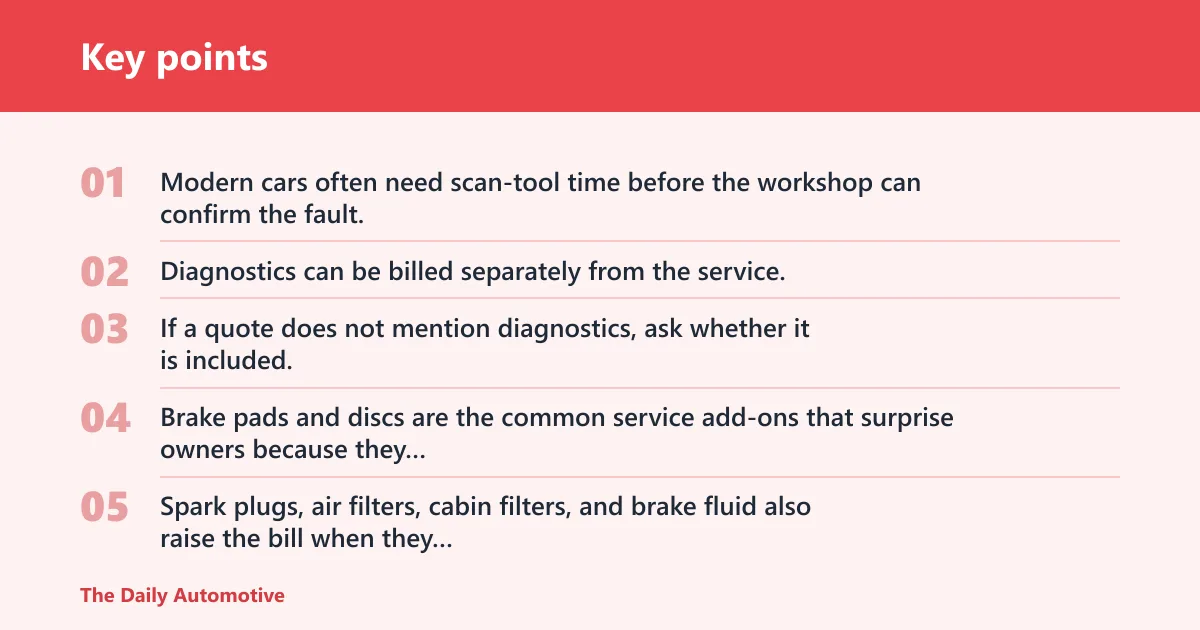
Modern cars often need scan-tool time before the workshop can confirm the fault. Diagnostics can be billed separately from the service, especially when a warning light is already on. If a quote does not mention diagnostics, ask whether it is included.
Brakes, plugs, filters, and fluids
Brake pads and discs are the common service add-ons that surprise owners because they are not part of every routine service. Spark plugs, air filters, cabin filters, and brake fluid also raise the bill when they are due. These are normal maintenance items, not hidden extras.
| Add-on charge | What it usually covers | Likely effect on the bill |
|---|---|---|
| Diagnostics | Fault-code scan, fault tracing, basic electrical checks | Often adds R300–R1,000+ |
| Brake work | Pads, discs, sensors, labour | Often adds R800–R4,000+ |
| Spark plugs | Plugs and replacement labour on petrol engines | Often adds R400–R2,500+ |
| Filters | Air filter, cabin filter, fuel filter where due | Often adds R200–R1,500+ |
| Fluids | Brake fluid, coolant, gearbox or differential fluids if scheduled | Often adds R250–R2,000+ |
Vehicle age, engine size, and parts availability
Older cars can be cheaper to service, but they can also need extra work if parts are worn or hard to source. Large engines take more oil and sometimes more expensive filters. Imported parts and limited stock can also push both price and turnaround higher.
How can you keep servicing affordable?
You can reduce service cost without taking warranty risks by comparing the same parts list, matching the service schedule exactly, and checking exclusions before you book. The cheapest headline number is not always the best deal if it omits consumables or labour that the car still needs.
Compare like-for-like quotes
Ask each workshop to quote on the same service level, same oil spec, and same parts list. If one quote includes a cabin filter, brake fluid, and diagnostics while another does not, the lower price is not a fair comparison.
Match the service schedule exactly
Do not pay for extra work that the schedule does not call for unless the car actually needs it. At the same time, do not skip required items because the quote seems low. A full service history is cheaper than a repair bill after neglect.
Ask what is excluded before booking
Ask whether the quote includes labour, consumables, taxes, and diagnostics. Ask whether the oil is the correct grade and whether OEM or equivalent parts will be used. A clear answer now is cheaper than an argument at collection time.
- Check the service book for the exact interval and parts list.
- Get at least two itemised quotes on the same spec.
- Confirm whether the quote includes labour, oil, and filters.
- Ask about diagnostics, brakes, plugs, and fluids before approving extras.
- Keep the invoice and service record for warranty proof.
Frequently asked questions
How much does a car service cost in South Africa?
Most routine services fall into a few bands: about R1,200–R2,500 for a small hatchback, R1,800–R3,800 for a sedan or crossover, and R3,500+ for premium or larger SUVs. Dealer pricing usually sits above independent workshop pricing because of labour rates and OEM parts.
How much is a car service on average?
There is no single useful average because segment and service type matter too much. A practical midpoint for many mainstream cars is around R2,000–R3,500, but a minor service and a major service are not the same bill, and a premium car can sit well above that.
How much does a major car service cost in South Africa?
A major service often starts around R2,500–R4,500 for an entry-level hatchback at an independent workshop, then moves higher for larger vehicles. Premium cars and big SUVs can run from R6,000 to well over R15,000 when OEM parts, model-specific fluids, and extra labour are involved.
What does a car service include in South Africa?
A normal service usually includes engine oil, an oil filter, fluid checks, and a safety inspection. On a major service, the workshop may also replace air filters, spark plugs, cabin filters, and brake fluid if the manufacturer schedule says those items are due.
What is the difference between a minor and major car service?
A minor service is routine maintenance with a lower cost and narrower scope. A major service covers more scheduled items, more consumables, and more labour. In South Africa, that usually means oil and a filter for a minor service, then a wider list that may include plugs, air filters, and brake fluid for a major service.
How often should you service a car in South Africa?
Most cars need a minor service every 10,000–15,000 km or 12 months, with major services at longer intervals set by the manufacturer. Turbo engines, diesels, and premium models often have tighter rules, so the service book should be the final word.
Why do dealer service prices differ from independent workshops?
Dealers usually charge more because they use OEM parts, factory diagnostics, and higher labour rates. Independent workshops are often cheaper and can still be a sensible choice for out-of-warranty cars, provided they use the correct service spec and quality parts.
Products related to this article
Sponsored / affiliate links. As an Amazon Associate I earn from qualifying purchases. I may earn additional commission from eligible campaigns.