What Does an Automotive Service Advisor Do? Role Guide
An automotive service advisor translates customer concerns into repair orders, coordinates with technicians, updates the customer, and closes the visit from check-in to pickup. Done badly, that handoff leads to missed repairs, comebacks, longer waits, and lost trust. This guide explains the day-to-day workflow, how the title differs from service writer, service consultant, and service manager, and what strong performance looks like in a dealership service lane.
From Plain Complaints to Repair Orders
An automotive service advisor is the dealership’s front counter link between the customer and the shop. The job turns a customer’s symptom, concern, or maintenance request into a repair order, then keeps the visit moving between the counter, the technician, parts, and the customer until the vehicle is delivered.
How the advisor translates the complaint
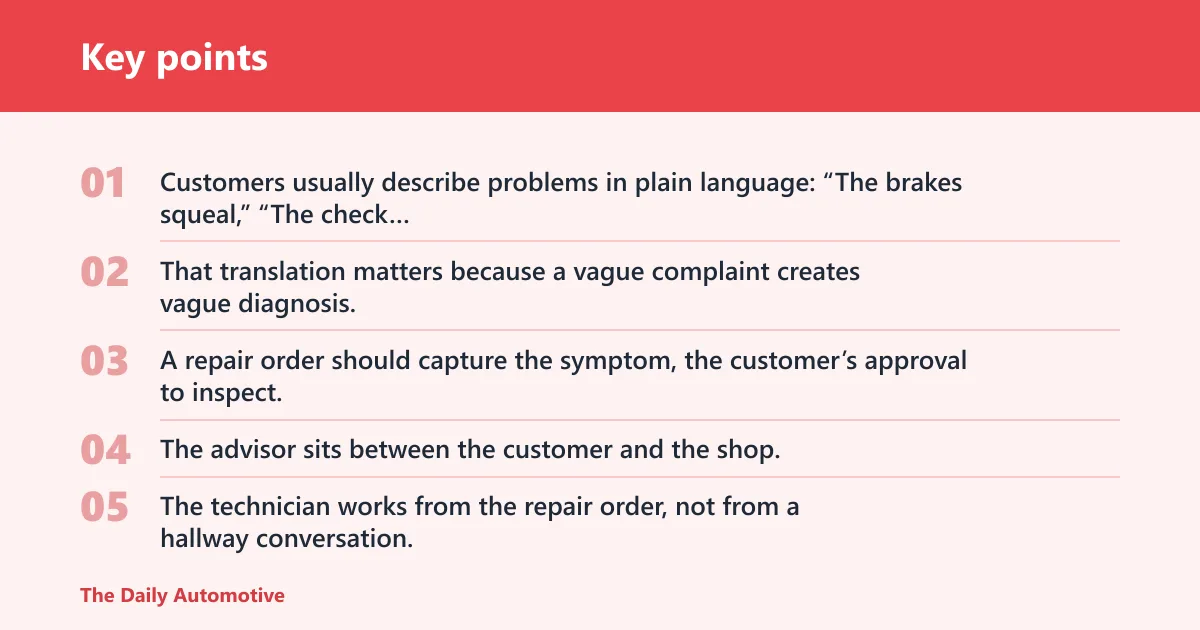
Customers usually describe problems in plain language: “The brakes squeal,” “The check engine light is on,” or “It pulls to the right.” The advisor has to turn that into technician-friendly notes with mileage, warning lights, driving conditions, recent repairs, and any history that may matter.
That translation matters because a vague complaint creates vague diagnosis. A repair order should capture the symptom, the customer’s approval to inspect, and any prior context that helps the technician start in the right place.
Where the advisor sits in the service lane
The advisor sits between the customer and the shop, but the work is more specific than that. The technician works from the repair order, not from a hallway conversation. The customer gets answers, options, and timing from the advisor, not from the lift bay.
That separation is the role. It is also the risk point. If the advisor misses a detail, the technician may chase the wrong fault. If the advisor misstates the diagnosis, the customer may reject needed work.
📊 A typical Ulta Beauty Advisor median annual salary is $38,325. Source: What Does an Ulta Beauty Advisor Do?.
How does a service advisor handle a visit from start to finish?
A service advisor typically handles the dealership visit in a sequence: check-in, repair order creation, diagnosis, estimate presentation, approval, repair updates, and delivery. The job is part scheduling, part documentation, part customer communication, and part decision support when the vehicle needs more than one fix.
Check-in and repair order creation
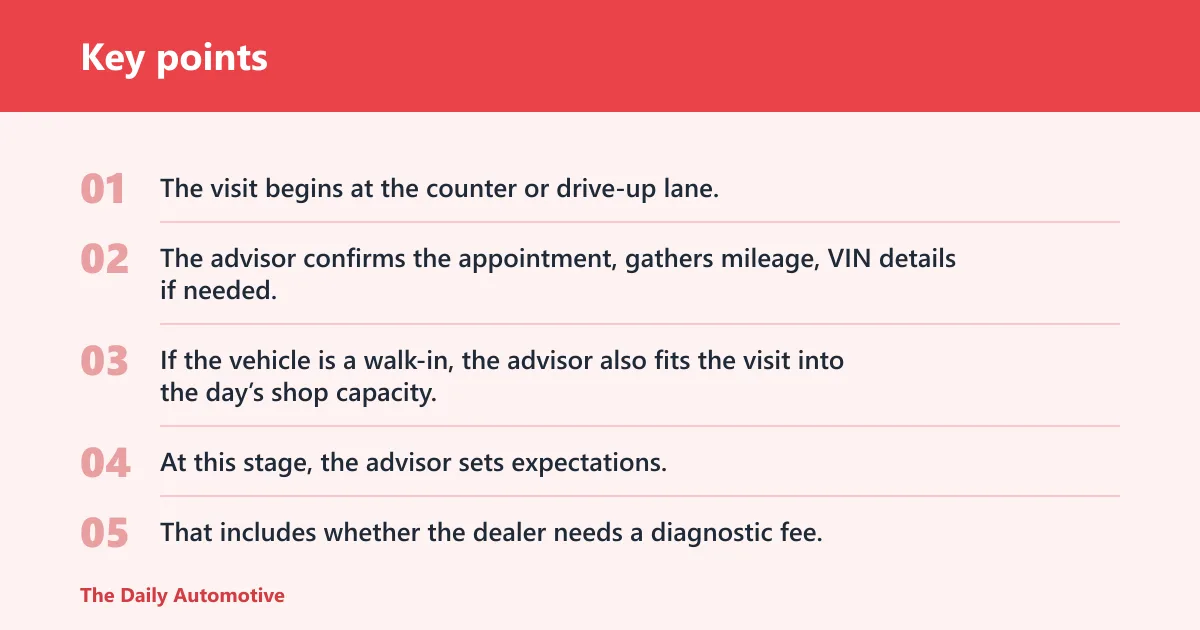
The visit begins at the counter or drive-up lane. The advisor confirms the appointment, gathers mileage, VIN details if needed, and records the customer concern in the repair order. If the vehicle is a walk-in, the advisor also fits the visit into the day’s shop capacity.
At this stage, the advisor sets expectations. That includes whether the dealer needs a diagnostic fee, whether inspection time is separate from repair time, and how the customer will be updated.
Diagnosis, estimate presentation, and approval
After the technician inspects the vehicle, the advisor presents the labor estimate, parts pricing, and any diagnostic findings. The customer may approve all work, approve only part of it, or decline repairs and ask for a later plan.
The approval workflow is the decision point. No repair should move forward without clear authorization unless there is a documented exception or a pre-approval process.
Repair updates, delivery, and pickup explanation
During repairs, the advisor gives status updates when the job changes, parts are delayed, or additional findings appear. Good communication here is specific: what was found, what it means, what it costs, and whether it is urgent or can wait.
At pickup, the advisor explains what was repaired, what was inspected, and what still needs attention. The visit closes with maintenance recommendations, invoice review, and a final check that the customer understands the work performed.
Service advisor workflow table
| Stage | Owner | What the advisor says | Paperwork or software | Common mistake |
|---|---|---|---|---|
| Appointment check-in | Advisor | “Tell me what the vehicle is doing and when it happens.” | DMS appointment screen, customer record | Skipping mileage, VIN, or symptom detail |
| Repair order creation | Advisor | “I’m writing up your concern and authorizing inspection.” | Repair order, customer complaint notes, authorization record | Writing a vague complaint with no context |
| Initial triage | Advisor and technician | “The vehicle will need diagnosis before we can quote repair work.” | RO notes, technician story, inspection checklist | Promising a fix before inspection |
| Estimate presentation | Advisor | “Here is the labor estimate, parts total, and any diagnostic fee.” | DMS estimate screen, parts quote, labor guide | Blending approved and unapproved items together |
| Approval | Customer with advisor support | “Would you like all of it done, or only the items you want now?” | RO authorization, text or call log | No written approval before work starts |
| In-repair updates | Advisor | “The technician found an added issue, and here are your options.” | DMS notes, communication log | Waiting too long to mention delays or new findings |
| Delivery | Advisor | “Here is what was completed, what to monitor, and when to return.” | Final RO, invoice, recommended maintenance notes | Handing over the keys without explaining the work |
That sequence matters because every handoff affects speed and accuracy. The advisor is not only relaying messages. The advisor is protecting the repair order from guesswork, missed approvals, and incomplete documentation.

What paperwork and software does the role use?
The main tools are the repair order and the dealer management system, often shortened to DMS. The repair order documents the customer complaint, vehicle history notes, authorization for diagnostic and repair work, and the completed work line by line.
Repair order and authorization record
A good repair order answers basic questions before the technician touches the vehicle: what is wrong, when did it start, has it happened before, and what did the customer approve today. It also records declined work, which helps if the same concern returns later.
That record protects both the customer and the dealership. It shows what was requested, what was inspected, what was recommended, and what was declined.
Dealer management system use
In the DMS, the advisor may schedule visits, track customer records, write estimates, update repair status, and help move the final invoice through delivery. It keeps the visit from living in separate sticky notes, texts, and memory.
In a busy store, the DMS is also the communication hub. Messages, notes, approvals, and timing changes belong there, because that is where managers and coworkers can track the job.
Labor estimate, parts pricing, and invoice workflow
Labor estimates convert the technician’s diagnosis into time and money. Parts pricing, diagnostic fee handling, and any related shop charges must be clear before the customer approves work.
When the repair is complete, the invoice should match the authorized work. If the advisor adds a recommendation, it needs to be separated from completed repairs so the customer can see the difference.
What is the difference between a service advisor, service writer, consultant, and manager?
Service advisor and service writer are often used interchangeably in search intent, especially in dealership job ads. Service consultant appears in similar postings and usually points to the same front-of-house role, though the title can vary by store.
Advisor, writer, and consultant
These titles usually describe the same core job: customer intake, repair order creation, estimate presentation, status updates, and delivery. A dealership may prefer one title over another, but the workflow is usually the same.
What matters is the function, not the label. If the role handles the lane, the RO, the estimate, and the pickup, it is doing service advisor work.
What the service manager owns
The service manager is the supervisor and escalation point. That person oversees advisors, shop flow, department performance, and customer issues that the advisor cannot resolve alone.
Managers judge the whole lane. Advisors own the interaction at the counter and throughout the visit.
What do good maintenance recommendations look like?
Good maintenance recommendations are specific, timely, and tied to the vehicle’s condition. They are not random add-ons. They should reflect factory-scheduled services, wear-item monitoring, and condition-based findings from inspection.
Factory schedules and wear items
A recommendation can point to time or mileage service due dates, but it should also account for brake wear, tire condition, fluid condition, batteries, belts, and filters. If the inspection shows a near-term need, the advisor should say so plainly.
That approach helps the customer plan. It also keeps the advisor from sounding like the lane is pushing work for its own sake.
Present options without pressure
Suppose a customer declines a cabin filter and brake fluid service on the same visit. The advisor should separate the items, explain the consequence of waiting, and give the customer a clear next step instead of a hard sell.
Good language sounds like options, not pressure: “This is due now,” “This can wait for a later visit,” and “Here is what we would watch if you defer it.”
A useful retail comparison
Customer-facing work in another retail setting may include greeting guests, answering questions, scheduling appointments, processing transactions, and recommending products. Ulta Beauty Advisors do those tasks, and the role is associated with a median annual salary of $38,325, a top 10% annual salary listed as $58,000, and a typical requirement of a high school diploma or post-secondary certificate. Training often includes on-the-job learning and specialized programs. In the dealership lane, the pressure is different because the advisor is also managing diagnosis, approvals, repair timing, and invoice accuracy.
How do dealerships measure service advisor performance?
Dealerships judge service advisors by more than friendliness. Common metrics may include CSI or satisfaction scores, repair orders per day, communication speed, and upsell percentage or approval rate. Those numbers show how well the advisor moves work through the lane without losing the customer.
CSI and satisfaction scores
CSI reflects how the customer rates the visit. Clear explanations, accurate promises, and a clean handoff at pickup all affect that score.
A low score can come from something simple: the customer waited without an update, did not understand the estimate, or felt surprised at pickup.
Repair orders per day and communication speed
Repair orders per day shows throughput. Communication speed measures how quickly the advisor returns calls, answers texts, or updates the customer when the job changes.
Fast communication does not mean rushed communication. It means the customer hears from the dealership before frustration builds.
Upsell percentage and approval rate
Upsell percentage tracks how often recommended work is accepted. That number should be read carefully, because a high rate is not useful if the recommendations are sloppy or unrelated to the vehicle’s actual condition.
A healthy approval rate usually comes from trust, clear explanations, and recommendations tied to factory schedules or real inspection findings.
What does an automotive service advisor make?
Pay varies by store, region, brand, and pay plan. A service advisor’s earning potential often includes base pay, commissions, bonuses, or flat-rate style incentives tied to labor sales, customer satisfaction, and department volume.
What affects pay
Stores with heavier traffic, stronger CSI targets, and larger ticket averages often pay differently than smaller operations. Advisors who can handle more repair orders, communicate well, and keep approvals moving may earn more under a performance-based plan.
Because pay structures vary so much, the better question is how the store measures the role and what the incentive plan rewards.
What are automotive service advisor duties and responsibilities?
Automotive service advisor duties can include customer intake, repair order writing, estimate presentation, approval management, technician communication, status updates, delivery explanation, and follow-up. The role also tracks declined work and maintenance recommendations so the next visit starts with better history.
Day-to-day responsibilities
- Check in the customer and capture the complaint accurately.
- Write a clear repair order and obtain inspection authorization.
- Review diagnosis and present the labor estimate.
- Get approval for work, diagnostic fees, and added findings.
- Send updates while the vehicle is in the shop.
- Explain the repair and maintenance plan at pickup.
A common first-timer mistake is assuming the role is only about handing over keys and printing invoices, when it actually involves translating repair needs between customers and technicians. Dealership service requires more than being courteous. It requires precise documentation, timing discipline, and comfort with customers who need choices, not scripts.
Frequently asked questions
What does a service advisor do at a car dealership?
A service advisor checks in the customer, writes the repair order, coordinates diagnosis, presents estimates, gets approval, and explains the completed work at pickup. The job keeps the dealership’s customer, technician, and parts department aligned from the first complaint to the final handoff.
What does a vehicle service advisor do?
A vehicle service advisor handles the service lane workflow for each visit. That includes documenting symptoms, tracking authorization, communicating repair progress, and closing the visit with a clear explanation of what was repaired and what still needs attention later.
What does an automotive service consultant do?
An automotive service consultant usually performs the same front-of-house duties as a service advisor. The title often appears in similar job ads and search results, but the core work is still customer intake, repair order management, estimate presentation, and delivery communication.
What does an automotive service writer do?
An automotive service writer is commonly used as a synonym for service advisor. In dealership use, the role documents customer concerns, translates them into technician notes, tracks approvals, and keeps the customer informed until the vehicle is picked up.
What does an automotive service manager do?
An automotive service manager supervises advisors and shop workflow. The manager handles escalations, department performance, and process issues, while the advisor works the individual repair order and communicates directly with the customer.
What does a car service advisor do day to day?
Day to day, a car service advisor moves between check-in, estimates, approvals, updates, and delivery. The job is paced by phone calls, texts, technician findings, parts availability, and the customer’s decision on whether to approve recommended work.
Products related to this article
Sponsored / affiliate links. As an Amazon Associate I earn from qualifying purchases. I may earn additional commission from eligible campaigns.
 V5.3 AG V5.3 CF Software Service Advisor EDL V3 Electronic Data Link Heavy Duty Diagnostic Scanner Kit for John Deere, Agricultural Tractor & Construction Equipment Tool
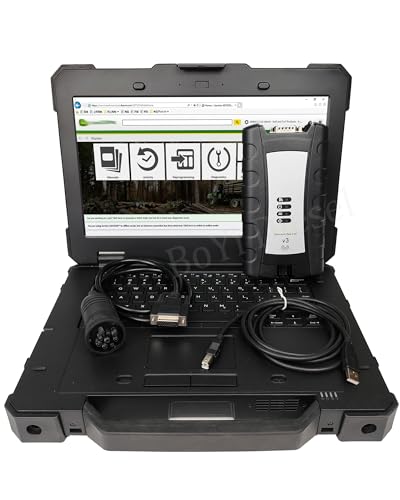 EDL V3 V2 for John De-e Service Advisor Electronic Data Link Diagnostic Tool with V5.3.210 AG-CF Software Plus cf53 Service Scanner Tool